


Introduction
In today’s complex business landscape, the ability to clearly define, analyze, and optimize organizational processes is a critical competitive advantage. However, bridging the gap between business stakeholders and IT professionals has historically been a challenge due to differing terminologies and perspectives. Enter the Business Process Model and Notation (BPMN) 2.0—a globally recognized standard that provides a universal visual language for specifying business processes.
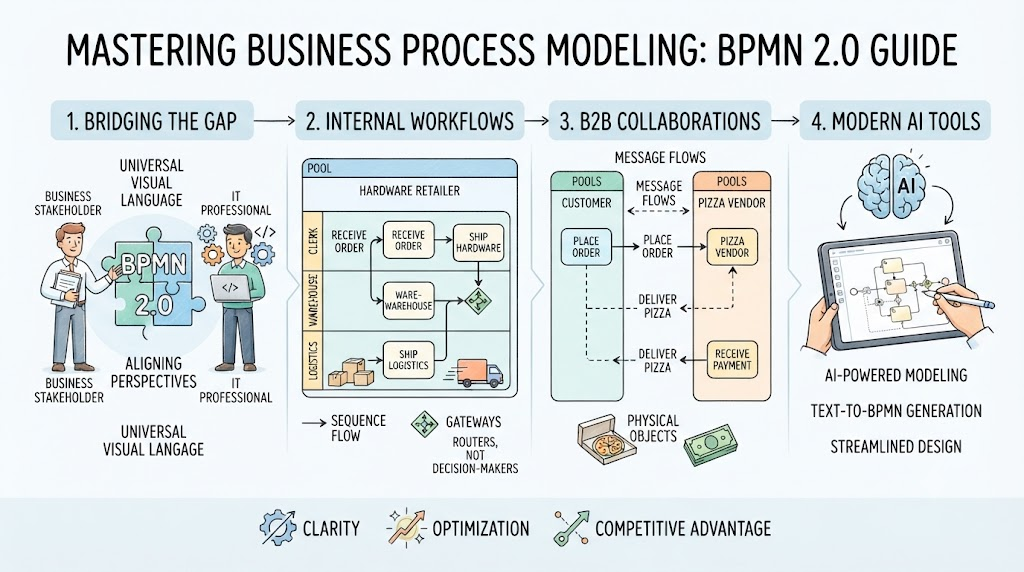
Whether you are mapping a simple internal workflow or orchestrating a complex, multi-organization supply chain, BPMN 2.0 offers the precise building blocks needed to turn abstract narratives into actionable diagrams. This comprehensive guide will walk you through the core concepts of BPMN 2.0, utilizing practical examples like hardware shipment processes and pizza delivery collaborations to illustrate how to effectively model internal workflows, manage cross-company communications, and leverage modern AI tools to streamline your modeling efforts.
1. Internal Workflows: The Shipment Process
When modeling processes that occur strictly within a single organization, the goal is to map out how different roles interact to achieve a specific outcome. The shipment process of a hardware retailer serves as a perfect illustration of this.
Pools, Lanes, and Process Engines
In this scenario, all participants—such as the Clerk, the Warehouse Worker, and the Logistics Manager—are contained within a single pool. Inside this pool, we use lanes to represent the specific roles or departments responsible for different tasks.
Using lanes within a single pool effectively “blanks out” the explicit communication between individuals. The model assumes that because they belong to the same organizational entity, they are seamlessly communicating. This approach is highly ideal for processes driven by a process engine (like a workflow automation system) that automatically assigns tasks to the appropriate people based on predefined business rules.
Gateways as Routers: A Critical Concept
One of the most common misconceptions in BPMN is that a gateway makes a decision. In reality, a gateway is not responsible for a decision; it is merely a router.
For example, in a “mode of delivery” choice, the actual decision of whether a shipment is “special” or “postal” is made during the preceding task (e.g., a task explicitly named “Decide if normal post or special shipment”). The gateway that follows simply acts as a router, directing the process flow down the correct path based on the result of that completed work.
Parallel vs. Inclusive Gateways
To manage the flow of tasks, BPMN utilizes different types of gateways:
-
Parallel Gateways: Used to show that multiple tasks can happen simultaneously without any conditions. In the shipment process, a parallel gateway indicates that packaging the goods and deciding the delivery mode can occur at the exact same time.
-
Inclusive Gateways: Used when multiple paths are possible, and one or more may be taken based on conditions. In our example, an inclusive gateway shows that while one path (filling out a post label) is always taken, another path (taking out extra insurance) is only executed if the shipment requires it.
2. Explicit Communication: The Pizza Collaboration
While lanes handle internal organizational workflows, pools are the standard for modeling Business-to-Business (B2B) collaborations. The “Pizza Collaboration” example demonstrates how to model interactions between entirely separate entities.
Modeling B2B with Multiple Pools
In this scenario, the customer and the pizza vendor are treated as separate participants, each with their own dedicated pool. This clear separation visually distinguishes the internal processes of the vendor from the actions of the customer.
Message Flows vs. Sequence Flows
Communication within a single pool is modeled using sequence flows (solid arrows). However, communication between different pools must be modeled using message flows (dashed arrows). Message flows explicitly show the interaction between the customer (sending the order) and the vendor (receiving the order), highlighting the exact hand-off points between organizations.
Physical vs. Informational Objects
A unique and powerful feature of BPMN is its ability to use message objects to represent physical items. In the pizza example, the pizza itself and the money used for payment are modeled as message flows. This is possible because the arrival of a physical object acts as an informational trigger—the customer knows the pizza has arrived simply because they can physically see it, thereby triggering the next step in their process (eating or paying).
Event-Based Decisions
The customer’s process relies heavily on an event-based gateway to handle unpredictable real-world outcomes. After placing the order, the customer enters a waiting state. The event-based gateway listens for two distinct events:
-
The arrival of the pizza (triggering the payment and eating process).
-
The passage of 60 minutes without delivery (triggering a follow-up call to the vendor).
3. Strategic Modeling: Choosing Between Pools and Lanes
A frequent dilemma for process modelers is deciding whether to use one pool with multiple lanes, or multiple pools for a collaboration. The golden rule is that the decision depends entirely on the purpose of the model.
-
When to use Lanes: Use lanes when you want to model the internal hand-offs between departments, roles, or systems within a single legal entity or process engine. It focuses on how the work gets done internally.
-
When to use Pools: Use pools when you need to highlight the contractual, legal, or communicative boundaries between separate organizations.
Modelers can easily adjust their perspective: you can use multiple pools to zoom out and show a high-level organizational flow, or you can “zoom in” by expanding a single pool to show the intricate interactions between internal departments. Mastering this flexibility allows you to create diagrams that are technically accurate for IT implementation while remaining easily understandable for business stakeholders.
4. The Future of Process Modeling: AI-Powered BPMN Tools
As business processes grow in complexity, the demand for efficient modeling tools has led to the integration of Artificial Intelligence into BPMN software. Modern platforms, such as Visual Paradigm, are revolutionizing how professionals create process models through AI-powered features:
-
Text-to-BPMN Generation: Utilizing advanced Natural Language Processing (NLP), AI tools can now convert plain text narratives and business requirements directly into fully structured BPMN diagrams, drastically reducing the time spent on manual drawing.
-
Bridging Business and IT: AI-powered generators help bridge the gap between abstract business logic and technical execution by instantly visualizing complex workflows, ensuring that both stakeholders and developers are aligned.
-
Professional Architecture: While AI accelerates the drafting process, visual BPMN tools remain essential for professional software architecture, allowing modelers to refine, validate, and optimize the AI-generated diagrams for enterprise-grade execution.
5. BPMN Exanples
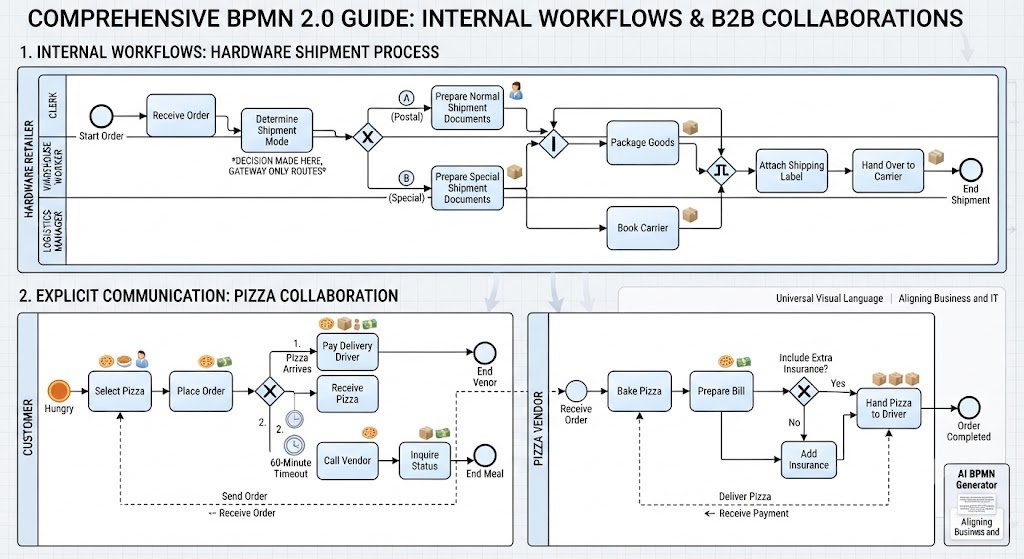
To further illustrate the core concepts of BPMN 2.0, we can analyze the two primary scenarios presented in the diagram: the Internal Hardware Shipment Workflow and the Pizza Delivery B2B Collaboration.
1. Internal Workflows: The Hardware Shipment Process
This example demonstrates how an organization maps internal hand-offs between roles or departments within a single legal entity.
-
Pools and Lanes: The entire process is contained within one “Hardware Retailer” pool, with specific lanes representing the Clerk, Warehouse Worker, and Logistics Manager. This design assumes seamless internal communication.
-
Gateways as Routers: The gateway following the “Determine Shipment Mode” task is a router, not a decision-maker; the actual decision is finalized during the task itself.
-
Gateway Varieties:
-
Parallel Gateway: Shows tasks like packaging goods and determining delivery mode occurring simultaneously.
-
Inclusive Gateway: Facilitates paths that may occur in combination, such as always filling out a label while only adding insurance when required.
-
2. Explicit Communication: The Pizza Collaboration
This scenario highlights the necessity of modeling interactions between separate, independent legal entities, such as a customer and a vendor.
-
Message vs. Sequence Flows: While internal processes use solid sequence flows, this B2B model uses dashed message flows to represent the explicit hand-offs and communication between the customer and vendor pools.
-
Physical Objects as Triggers: The arrival of physical items, such as the pizza or payment, acts as an informational trigger in the process, signaling to the participant that it is time to move to the next stage, such as paying or eating.
-
Event-Based Gateways: The customer’s process utilizes an event-based gateway to handle real-world uncertainty. It effectively “listens” for two distinct outcomes: the arrival of the pizza or a 60-minute timeout, triggering different subsequent actions.
Key Concepts Summary
The fundamental distinction between these two models lies in their scope and boundary management:
-
Lanes are utilized for modeling internal departmental hand-offs within a single entity or process engine.
-
Pools are employed to establish clear legal, contractual, or communicative boundaries between distinct organizations.
-
Strategic Flexibility: Modelers can transition from a “zoomed-out” view using multiple pools for high-level collaboration to a “zoomed-in” view expanding a single pool to detail complex internal interactions.
As process complexity increases, integrating AI tools—such as text-to-BPMN generators—can further streamline this workflow, allowing users to move rapidly from narrative business requirements to structured, professional-grade architecture.
Conclusion
The Business Process Model and Notation (BPMN) 2.0 is far more than just a drawing standard; it is a vital communication bridge that aligns business strategy with technical execution. By understanding the nuanced differences between internal workflows (utilizing lanes and sequence flows) and external collaborations (utilizing pools and message flows), modelers can accurately capture the reality of their organizational processes.
Furthermore, grasping the true nature of gateways—viewing them as routers rather than decision-makers—and knowing when to deploy parallel, inclusive, or event-based gateways ensures that your diagrams are logically sound. As the discipline evolves, the integration of AI-powered tools promises to make the creation of these complex diagrams faster and more accessible than ever before. Whether you are mapping a simple hardware shipment or a complex B2B pizza delivery, mastering these core BPMN 2.0 concepts empowers you to design processes that are efficient, transparent, and primed for optimization.
References
- From Narrative to Diagram: How Visual Paradigm’s AI BPMN Generator Transforms Process Modeling Workflows: Explores how AI converts text narratives into BPMN diagrams.
- Mastering Business Process Modeling (BPMN 2.0) with Visual Paradigm’s AI-Powered Tools: A guide to mastering BPMN 2.0 using AI tools.
- Visual Paradigm BPMN Review: Bridging the Gap Between Business Logic and Technical Execution: An in-depth review of Visual Paradigm’s BPMN capabilities.
- AI BPMN Business Process Diagram Generator Update: Release notes for the AI BPMN generator update.
- Understanding the BPMN Notation: A Key to Effective Business Process Modeling: A foundational guide to understanding BPMN notation.
- Visual Paradigm BPMN Tutorial: A video tutorial demonstrating BPMN features.
- Beyond Code and AI: Why Visual Paradigm Remains Essential for Professional Software Architecture: Discusses the enduring value of Visual Paradigm in software architecture.
- BPMN Activity Types Explained: A detailed explanation of different BPMN activity types.
- How AI-Powered NLP is Revolutionizing Text-to-BPMN Generation for Enterprise Process Modeling: Details the NLP technology behind text-to-BPMN generation.
- Visual Paradigm Features: An overview of the core features of Visual Paradigm.
- BPMN Diagram and Tools: A dedicated look at BPMN diagramming tools and features.
- Visual Paradigm Official Website: The official homepage for Visual Paradigm.
- Click Start AI – Technical Support: Technical support documentation for getting started with AI features.
- Testing Visual Paradigm’s AI-Powered BPMN Diagram Generator for Real-World Process Mapping: A practical test of the AI generator for real-world mapping.