


Introduction
In the modern digital enterprise, the speed and accuracy with which organizations can document their operational processes directly impacts their ability to innovate, scale, and respond to market changes. Business Process Model and Notation (BPMN) has emerged as the universal language for visualizing workflows, yet the traditional process of creating these diagrams remains a significant barrier to agility. Business analysts and process architects often spend countless hours manually translating stakeholder conversations and procedure documents into visual models—a tedious, error-prone task that delays critical decision-making.
The emergence of artificial intelligence in business process modeling represents a transformative breakthrough. Visual Paradigm’s AI BPMN Diagram Generator eliminates the manual drafting bottleneck by converting plain English process descriptions into fully compliant, interactive BPMN 2.0 diagrams complete with swimlanes, gateways, and sequence flows. This comprehensive guide explores how organizations can harness this technology to accelerate their process documentation initiatives, ensuring that valuable analyst time is devoted to strategic optimization rather than mechanical diagram construction. Whether you’re documenting employee onboarding workflows, customer support procedures, or complex financial approval chains, this guide provides the framework for leveraging AI to create professional-grade process models in minutes rather than hours.
The Challenge: Manual BPMN Drafting Bottlenecks
Process modeling teams frequently encounter a common bottleneck: the initial translation of stakeholder interviews, workshop notes, or textual procedure documents into visual BPMN diagrams. This manual drafting phase is time-consuming, prone to inconsistencies, and can divert valuable analyst bandwidth away from higher-value activities like process analysis, gap identification, and improvement planning. Furthermore, ensuring diagrams adhere to BPMN 2.0 standards while maintaining clarity across complex, multi-role workflows requires significant expertise and attention to detail.
The Solution: AI-Powered Text-to-Diagram Translation
Visual Paradigm addresses this challenge by embedding advanced artificial intelligence directly into its desktop modeling environment. The AI BPMN Diagram Generator allows users to bypass manual drag-and-drop drafting entirely. By feeding structured textual workflows into its natural language processing engine, the software instantly identifies roles, structures swimlanes, sequences tasks, and applies appropriate BPMN gateway logic. The output is not a static image but a fully interactive, editable Business Process Diagram that integrates seamlessly with Visual Paradigm’s comprehensive modeling suite.
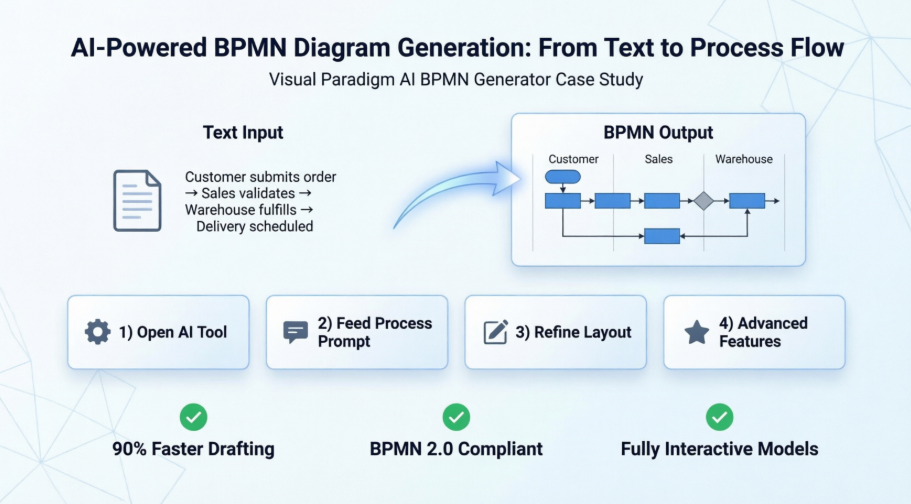
Implementation Framework: A Four-Step Workflow
Step 1: Accessing the AI Tool
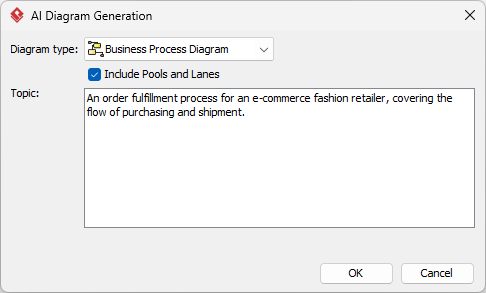
The AI capabilities are built directly into the Visual Paradigm Desktop environment (Professional Edition or higher). Users launch the application, navigate to Tools > AI Diagram Generation, select Business Process Diagram as the diagram type, and crucially, enable the “Include Pools and Lanes” option. This instruction ensures the AI engine automatically constructs clear swimlanes for every department or system role mentioned in the narrative, establishing a clean, role-based foundation for the process model.
Step 2: Crafting an Effective Process Prompt
The quality of the AI-generated layout depends heavily on the clarity and structure of the text input. Instead of broad topic keywords, users should write their process as a clear, chronologically ordered procedural story.
-
Less Effective Prompt: “Order fulfillment process for an e-commerce shop.” (This relies too much on AI guesswork).
-
Highly Effective Prompt: “The Customer places an online purchase order. The Sales Department reviews the inventory availability. If the item is out of stock, Sales cancels the order and notifies the customer. If the item is in stock, the Warehouse packs the item, and the Shipping Department delivers it.”
This structured narrative provides the NLP engine with explicit actors, actions, conditions, and outcomes, enabling precise diagram generation. Users paste this well-formed story directly into the AI tool’s Description field and initiate the generation process.
Step 3: Reviewing and Refining the Generated Output
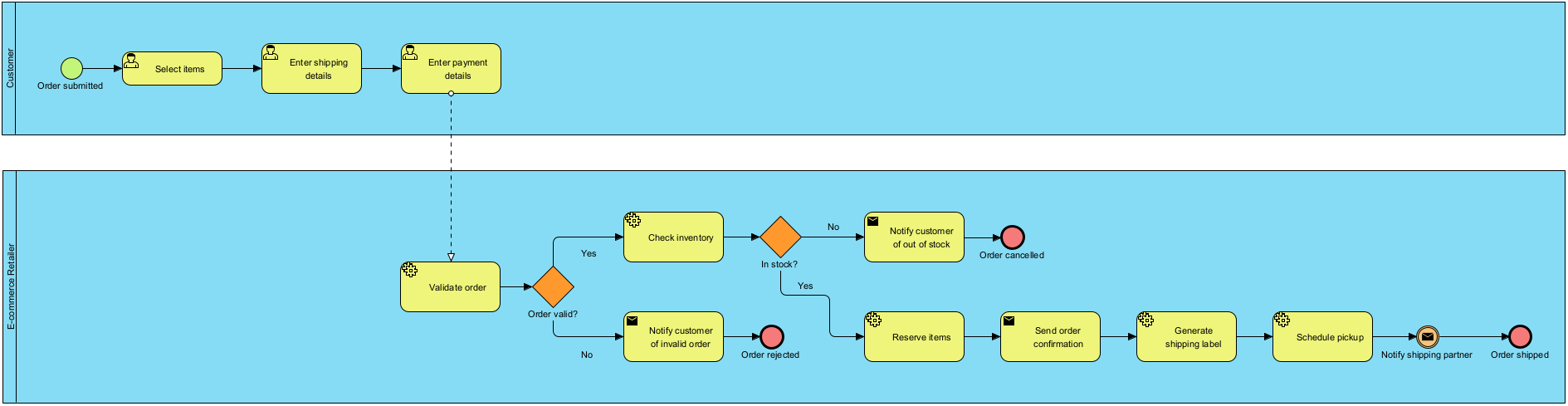
Within seconds, the engine processes the text and renders a standard BPMN graphic. Because the output integrates seamlessly with the core editor, the model is completely interactive from the moment of creation.
Key refinement activities include:
-
Verifying Swimlanes: Confirming that roles (e.g., Customer, Warehouse, Shipping) are cleanly separated into distinct horizontal pools or lanes.
-
Validating Gateway Logic: Ensuring decision points (like an “In Stock?” check) generated a proper diamond-shaped Exclusive Gateway (XOR) with correctly labeled conditional sequence flows (e.g., “Yes” and “No” paths).
-
Optimizing Layout: Using Visual Paradigm’s design canvas tools to reposition any overlapping sequence arrows or labels for maximum readability.
Step 4: Leveraging Advanced Modeling Capabilities
Once the initial AI-generated draft is populated, teams can utilize Visual Paradigm’s advanced toolsets to enhance process documentation and analysis:
-
Working Procedure Editor: To maintain a clean high-level diagram, users can right-click any activity box and open the Working Procedure Editor. This allows for detailed, step-by-step procedural guidelines to be attached to individual tasks without cluttering the master flow.
-
As-Is vs. To-Be Analysis: Teams can duplicate the AI-generated baseline (As-Is) process to build a target optimization (To-Be) model. Visual Paradigm maintains traceability links between both versions in the background, enabling straightforward comparison and optimization reporting.
Demonstrated Applications: AI-Generated BPMN Examples
The versatility of the AI BPMN generator is evident across diverse business domains. Below are examples of processes rapidly modeled using textual prompts:
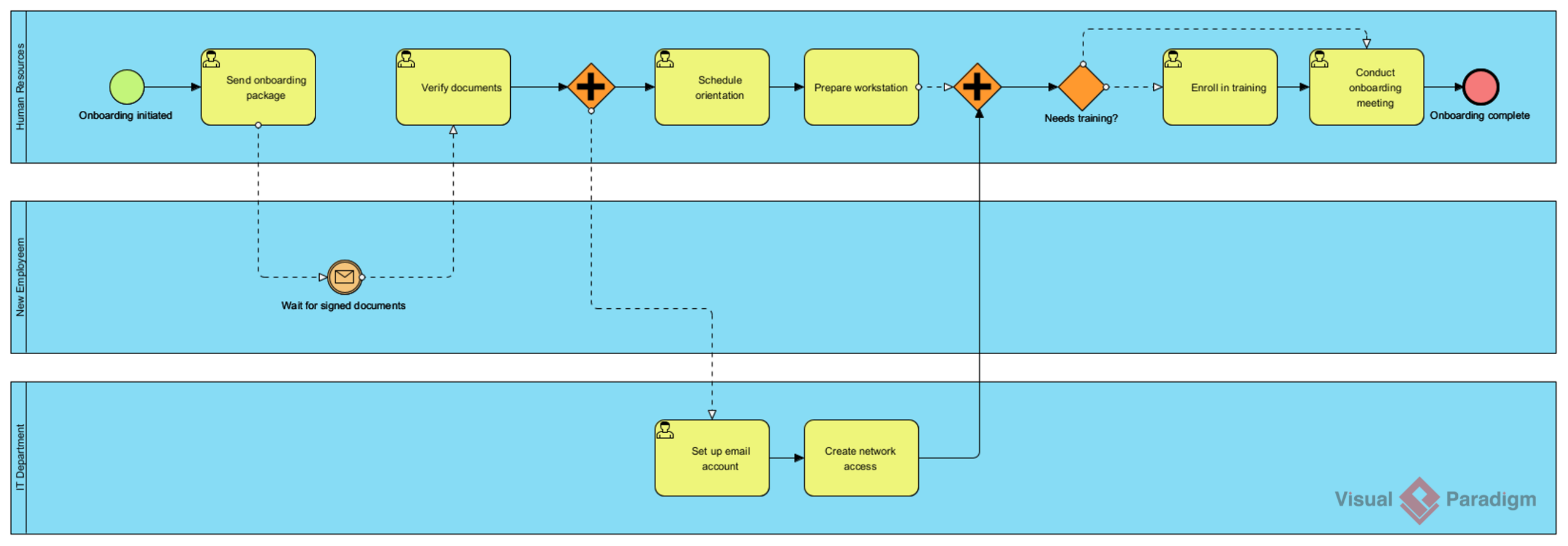
Employee Onboarding Process
Prompt: An employee onboarding process in a mid-sized company.
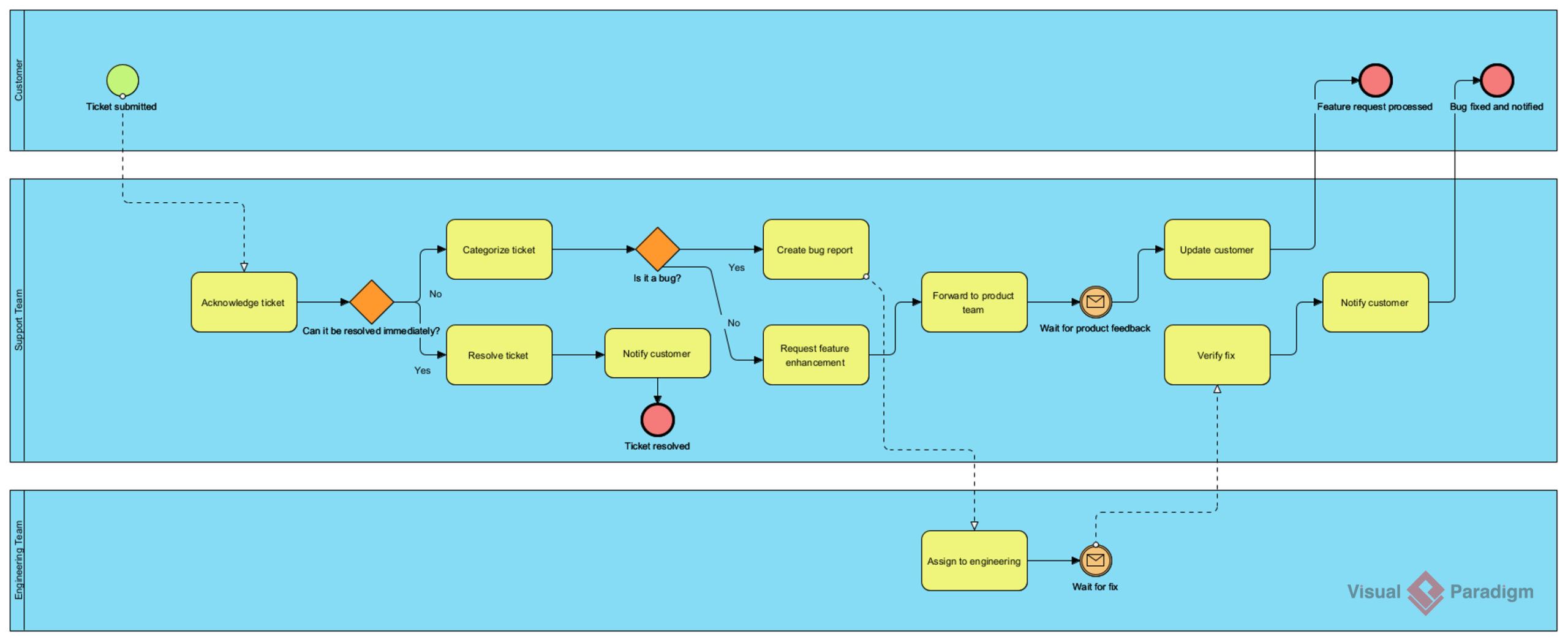
Customer Support Ticket Resolution
Prompt: A customer support ticket resolution process for a SaaS company.
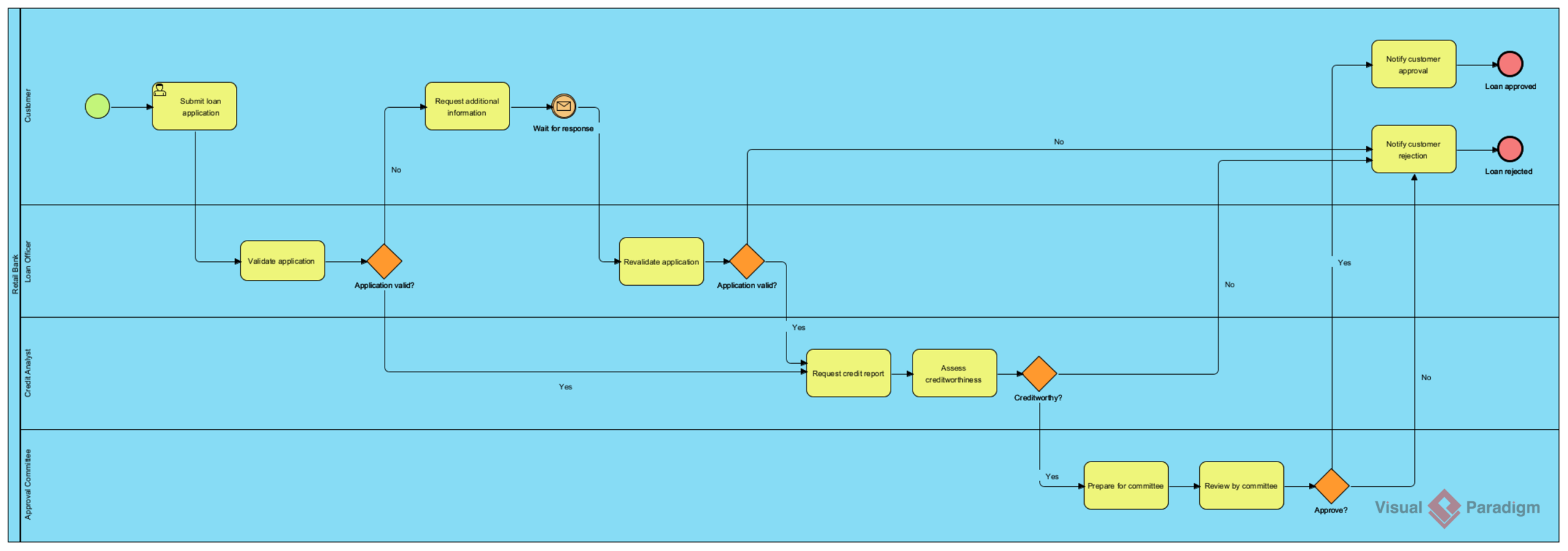
Loan Application and Approval Workflow
Prompt: A loan application and approval process in a retail bank.
Best Practices for Optimal Results
Writing Effective Process Narratives
To maximize the quality of AI-generated diagrams, follow these narrative construction guidelines:
-
Identify Clear Actors: Explicitly name each role, department, or system involved (e.g., “Customer,” “Finance Department,” “Payment Gateway”)
-
Use Sequential Language: Structure your narrative chronologically using transition words like “then,” “next,” “after,” and “finally”
-
Specify Decision Points: Clearly articulate conditions using “if-then” logic (e.g., “If approved, proceed to shipping; if rejected, notify customer”)
-
Define Outcomes: State the end result of each path clearly to help the AI determine appropriate end events
Common Pitfalls to Avoid
-
Vague Role Definitions: Avoid generic terms like “someone” or “the team”—be specific about which role performs each action
-
Ambiguous Conditions: Ensure decision criteria are explicit and binary where possible
-
Overly Complex Sentences: Break down multi-step actions into individual sentences for clearer AI interpretation
-
Missing Start/End Points: Always specify how the process begins and what constitutes completion
Post-Generation Optimization
After the AI generates your initial diagram:
-
Validate BPMN Compliance: Use Visual Paradigm’s built-in validation tools to ensure standards adherence
-
Refine Gateway Labels: Add descriptive text to decision branches for stakeholder clarity
-
Adjust Swimlane Organization: Consolidate or split lanes based on actual organizational structure
-
Add Annotations: Include business rules, SLAs, or performance metrics as text annotations
-
Link to Documentation: Attach supporting documents, policies, or SOPs to relevant activities
Measurable Outcomes and Strategic Value
Organizations implementing this AI-powered approach report significant improvements in process modeling efficiency:
-
Reduced Time-to-First-Draft: Initial diagram creation shifts from hours to minutes, accelerating workshop follow-ups and stakeholder reviews.
-
Enhanced Consistency: AI application of BPMN 2.0 standards reduces manual errors and ensures diagrammatic uniformity across teams.
-
Increased Analyst Capacity: Business analysts spend less time on mechanical drafting and more time on value-added activities like process analysis, optimization, and stakeholder facilitation.
-
Improved Collaboration: Rapid generation of visual models from textual descriptions facilitates clearer communication between business stakeholders and technical teams during requirements gathering.
-
Faster Digital Transformation: Accelerated process documentation enables quicker identification of automation opportunities and system integration points.
Integration with Enterprise Process Management
The AI BPMN Generator doesn’t operate in isolation—it serves as a catalyst for broader enterprise process management initiatives:
Agile Process Discovery
During agile sprint planning or design thinking workshops, facilitators can capture process narratives in real-time and generate immediate visual feedback, enabling rapid iteration and consensus building.
Compliance and Audit Readiness
Regulated industries benefit from the consistent application of BPMN standards, ensuring that process documentation meets audit requirements while reducing the compliance burden on process owners.
Knowledge Transfer and Training
New business analysts can contribute immediately by documenting processes in natural language, with the AI handling the technical complexities of BPMN notation, accelerating onboarding and knowledge capture.
Continuous Improvement Cycles
The speed of diagram generation supports more frequent process reviews, enabling organizations to adopt true continuous improvement methodologies rather than episodic optimization efforts.
Conclusion
Visual Paradigm’s AI BPMN Diagram Generator represents more than a technological convenience—it embodies a fundamental shift in how organizations approach process documentation and analysis. By removing the mechanical barriers to BPMN diagram creation, this tool empowers business analysts, process architects, and operational leaders to focus on what truly matters: understanding how work flows through their organizations, identifying opportunities for improvement, and driving strategic transformation.
The ability to convert plain English narratives into professional, standards-compliant swimlane diagrams in minutes rather than hours democratizes process modeling, making it accessible to subject matter experts who may not have deep BPMN expertise. This accessibility doesn’t compromise quality; rather, it ensures that those who understand the work best are the ones documenting it, with AI handling the technical translation into visual notation.
As organizations navigate increasingly complex operational landscapes, the competitive advantage will belong to those who can rapidly capture, analyze, and optimize their processes. The AI BPMN Generator provides the acceleration needed to keep pace with change, while Visual Paradigm’s comprehensive modeling environment ensures that these rapid drafts can evolve into sophisticated, enterprise-grade process architectures.
The future of business process management is not about choosing between human expertise and artificial intelligence—it’s about leveraging AI to amplify human insight. By embracing this synergistic approach, organizations can build more agile, transparent, and efficient operations, turning process documentation from a bureaucratic necessity into a strategic asset that drives continuous innovation and value creation.
References
-
How AI-Powered NLP is Revolutionizing Text-to-BPMN Generation: Technical foundations and enterprise applications of NLP for automated BPMN diagram creation
-
AI Business Process Improvement Tool Release: Official release notes detailing AI-enhanced capabilities for business process analysis and optimization
-
AI BPMN Diagram Generator: Quick BPD Tool Update: Comprehensive update covering features, usage steps, and benefits of the AI-powered Business Process Diagram generator
-
BPMN Diagram and Tools Feature Overview: Detailed documentation of BPMN 2.0 modeling capabilities, including advanced editing, validation, and collaboration features
-
AI Diagram Generation Feature Page: Official product page outlining scope, supported diagram types, and integration points of AI diagram generation technology
-
What is BPMN? Guide to Business Process Model and Notation: Foundational resource explaining BPMN 2.0 standards, elements, and best practices for effective process modeling
-
From Text to Process Flow: Hands-On Review of Visual Paradigm’s AI BPMN Generator: Third-party user review providing practical insights, testing methodology, and real-world evaluation
-
Visual Paradigm AI x BPMN Demonstration: Video walkthrough showcasing the AI BPMN diagram generation workflow, from text input to interactive model output