


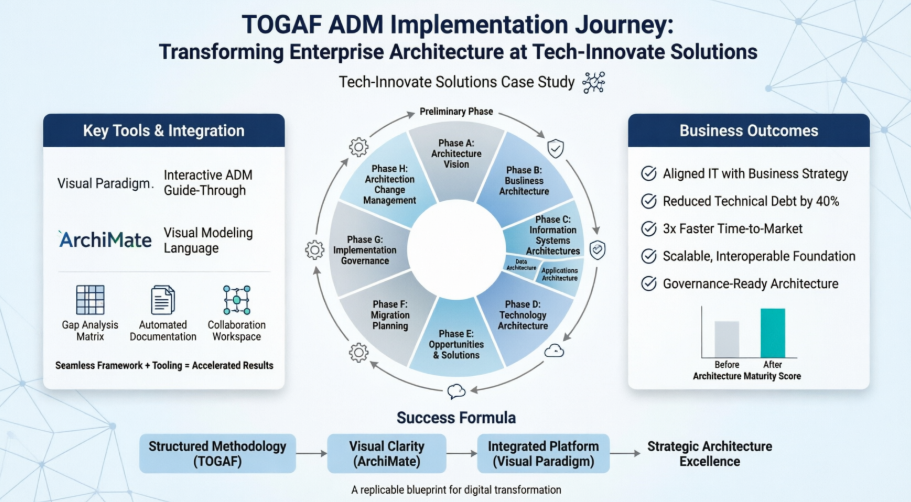
In today’s rapidly evolving digital landscape, organizations face mounting pressure to align their technology investments with strategic business objectives. Enterprise Architecture (EA) has emerged as a critical discipline for achieving this alignment, yet many organizations struggle with fragmented systems, inconsistent processes, and unclear roadmaps for transformation. The Open Group Architecture Framework (TOGAF) and its Architecture Development Method (ADM) provide a proven, structured approach to developing and managing enterprise architecture. However, the theoretical framework alone is insufficient—successful implementation requires the right tools, methodologies, and practical guidance.
This case study examines how Tech-Innovate Solutions, a mid-sized technology company experiencing rapid growth and IT complexity, successfully implemented TOGAF ADM to streamline its operations and improve strategic alignment. By leveraging Visual Paradigm’s integrated TOGAF ADM platform and ArchiMate modeling language, the organization transformed its fragmented IT landscape into a cohesive, scalable architecture that directly supports business goals. Through this comprehensive exploration, readers will gain practical insights into phase-by-phase ADM execution, tool selection criteria, visualization strategies, and governance approaches that can be adapted to organizations of varying sizes and maturity levels.
Company Background
Tech-Innovate Solutions is a mid-sized technology company specializing in software development and IT consulting services. Over the past five years, the company has experienced exponential growth through strategic acquisitions and organic expansion, serving clients across finance, healthcare, and retail sectors. This rapid scaling, while beneficial for revenue, created significant challenges: disparate legacy systems, redundant applications, inconsistent data practices, and misaligned technology investments. Business leaders found it increasingly difficult to launch new products quickly, ensure regulatory compliance, or optimize operational costs.
Recognizing that sustainable growth required a unified architectural foundation, Tech-Innovate Solutions’ executive leadership commissioned an enterprise architecture initiative. After evaluating multiple frameworks, the organization selected TOGAF ADM for its comprehensive, iterative approach and global recognition. To maximize adoption and efficiency, the EA team prioritized tooling that could operationalize the framework while minimizing administrative overhead—ultimately selecting Visual Paradigm integrated with ArchiMate as their enterprise architecture platform.
Key Concepts of TOGAF ADM
TOGAF ADM is a cyclical, iterative process consisting of interconnected phases, each with defined objectives, inputs, activities, and deliverables. This structured methodology ensures that architecture development remains aligned with business strategy while accommodating change and learning. The core phases include:
- Preliminary Phase: Establishing the architecture framework, principles, and governance structures
- Architecture Vision (Phase A): Defining scope, stakeholders, and high-level target architecture
- Business Architecture (Phase B): Modeling business strategy, processes, organization, and capabilities
- Information Systems Architectures (Phase C): Developing Data and Applications Architecture blueprints
- Technology Architecture (Phase D): Specifying infrastructure, platforms, and technical standards
- Opportunities and Solutions (Phase E): Identifying implementation options and solution building blocks
- Migration Planning (Phase F): Creating detailed transition roadmaps with timelines and resources
- Implementation Governance (Phase G): Ensuring architecture compliance during execution
- Architecture Change Management (Phase H): Managing ongoing evolution and adaptation
This cyclical nature allows organizations to revisit earlier phases as new requirements emerge, ensuring the architecture remains relevant and responsive to business needs.
Applying TOGAF ADM at Tech-Innovate Solutions
Preliminary Phase
Objective: Establish the architecture framework and foundational principles.
Activities:
- Defined the architecture vision scope focused on core business capabilities
- Identified key stakeholders across executive leadership, IT operations, and business units
- Established architecture principles emphasizing scalability, interoperability, security, and user-centricity
- Selected Visual Paradigm with ArchiMate as the EA team’s primary modeling and governance platform
Outcome: A ratified Architecture Framework document, stakeholder register, and approved set of architecture principles that guided all subsequent ADM phases.
Architecture Vision (Phase A)
Objective: Develop a high-level, stakeholder-aligned vision of the target architecture.
Activities:
- Conducted collaborative workshops to capture business drivers, constraints, and success criteria
- Created a high-level Architecture Vision document outlining strategic goals, scope boundaries, and key stakeholder concerns
- Developed initial risk assessments and mitigation strategies
Outcome: A signed-off Statement of Architecture Work that secured executive sponsorship and defined the project’s mandate, timeline, and resource commitments.
Business Architecture (Phase B)
Objective: Define the business strategy, governance, organization, and key business processes.
Activities:
- Mapped current-state business processes using BPMN to identify redundancies and bottlenecks
- Developed target business architecture models showing optimized workflows, organizational roles, and capability maps
- Aligned business capabilities with strategic objectives to prioritize transformation initiatives
Outcome: A comprehensive Business Architecture document featuring process maps, capability matrices, and organizational models that became the foundation for downstream architecture work.
Information Systems Architectures (Phase C)
Data Architecture
Objective: Define the structure of the organization’s logical and physical data assets.
Activities:
- Analyzed existing data sources, flows, and quality issues to identify silos and inconsistencies
- Developed a target data architecture emphasizing master data management, governance policies, and API-first integration
- Created logical and physical data models using ArchiMate to visualize relationships and dependencies
Outcome: A Data Architecture document including entity-relationship diagrams, data flow models, and governance frameworks ensuring data integrity, security, and accessibility.
Applications Architecture
Objective: Provide a blueprint for the individual application systems to be deployed.
Activities:
- Inventoried the existing application portfolio to assess functionality, technical debt, and integration points
- Developed a target applications architecture promoting modular services, cloud-native patterns, and standardized interfaces
- Defined application interaction models and integration strategies to support business processes
Outcome: An Applications Architecture document featuring application portfolios, service catalogs, and integration blueprints that guided modernization efforts.
Technology Architecture (Phase D)
Objective: Describe the hardware, software, and network infrastructure needed to support mission-critical applications.
Activities:
- Assessed current infrastructure capabilities, performance bottlenecks, and security postures
- Developed a target technology architecture emphasizing cloud scalability, resilience, and cost optimization
- Specified infrastructure components, platform standards, and operational procedures
Outcome: A Technology Architecture document including network diagrams, infrastructure specifications, and deployment models aligned with business and applications architectures.
Opportunities and Solutions (Phase E)
Objective: Identify and evaluate different implementation approaches.
Activities:
- Conducted comprehensive gap analysis between baseline and target architectures across all domains
- Evaluated solution options considering cost, risk, timeline, and strategic alignment
- Defined Architecture Building Blocks (ABBs) and Solution Building Blocks (SBBs) for reuse
Outcome: A Solutions Architecture document with prioritized initiative portfolios, business cases, and implementation roadmaps.
Migration Planning (Phase F)
Objective: Plan the transition from baseline to target architecture.
Activities:
- Developed a detailed, phased migration plan with clear milestones, dependencies, and resource allocations
- Identified risks, assumptions, and mitigation strategies for each transition phase
- Created work packages and project charters for execution teams
Outcome: A Migration Plan document featuring Gantt charts, resource plans, and risk registers that enabled controlled, measurable progress.
Implementation Governance (Phase G)
Objective: Ensure the architecture is implemented correctly.
Activities:
- Established architecture review boards and compliance checkpoints within project lifecycles
- Implemented automated conformance checks within Visual Paradigm to validate designs against principles
- Conducted regular architecture audits and feedback sessions with delivery teams
Outcome: A governance framework with clear roles, processes, and metrics ensuring architecture integrity throughout implementation.
Architecture Change Management (Phase H)
Objective: Manage changes to the architecture.
Activities:
- Established a formal change request process with impact assessment workflows
- Implemented version control and baseline management within the architecture repository
- Created communication protocols to keep stakeholders informed of architectural evolution
Outcome: A sustainable change management process ensuring the architecture remains adaptive, relevant, and valuable over time.
The Interactive TOGAF ADM Guide-Through Process
The core of Visual Paradigm’s TOGAF support is its interactive ADM wheel interface. It acts as a structural wizard that walks enterprise architecture teams through every phase of the development method:
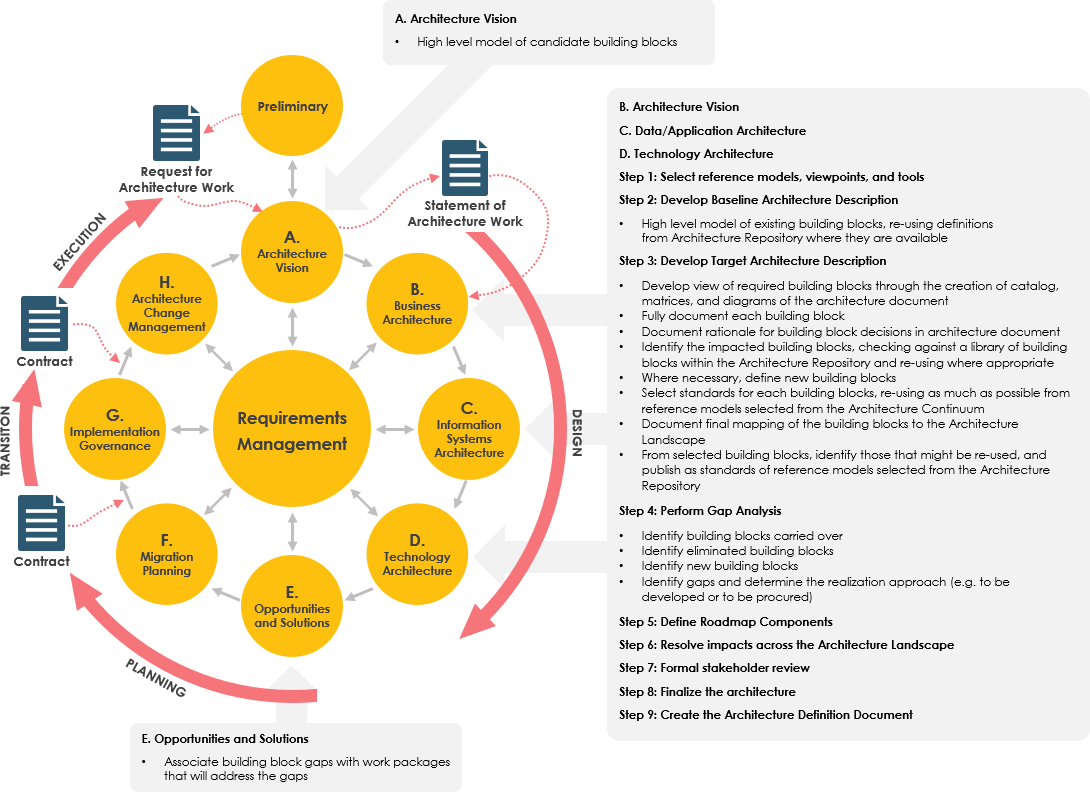
- Step-by-Step Task Checklist: Clicking on any phase of the ADM wheel expands a detailed, sequential checklist of activities required by the TOGAF standard.
- Pre-Mapped Diagrams: Each task automatically provides the exact modeling canvas required for that step (e.g., ArchiMate, BPMN, UML, or Organization Charts), ensuring architects don’t have to guess which diagram to use.
- Form-Based Data Entry: For steps requiring qualitative analysis (like risk assessments or principle definitions), the tool provides out-of-the-box form templates to cleanly collect structured text data.
Deep Integration with ArchiMate 3.1
While Visual Paradigm supports standard UML and BPMN, its TOGAF ADM framework relies heavily on native ArchiMate compliance, the Open Group’s dedicated enterprise architecture modeling language.
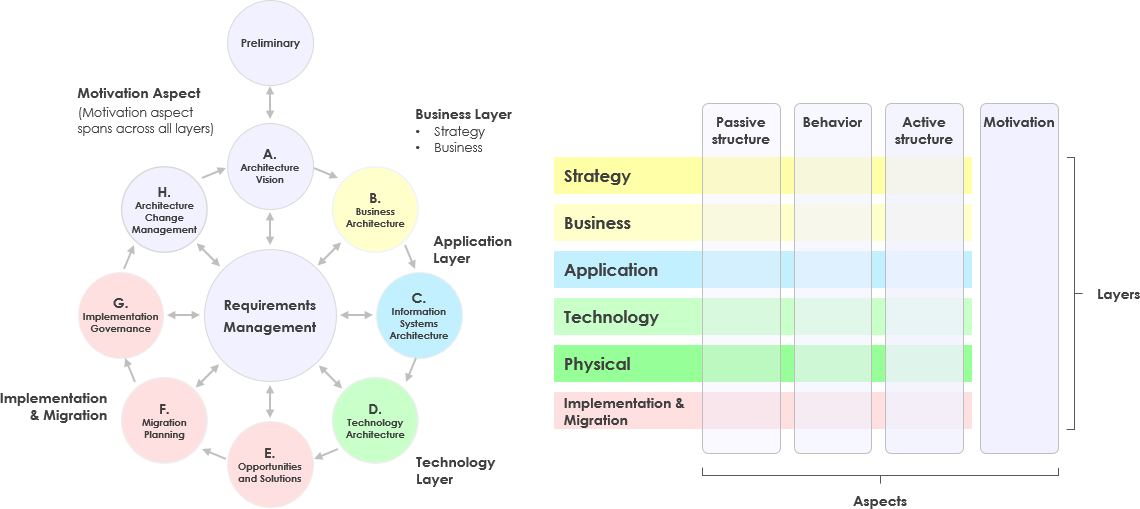
- Cross-Layer Alignment: It seamlessly maps elements across the core ArchiMate layers: Business (processes/roles), Application (software components/services), and Technology (hardware/networks).
- Strategy and Motivation Elements: Built-in support for capturing high-level drivers, goals, outcomes, principles, and requirements, ensuring physical systems map directly back to business strategy.
- Implementation and Migration Layers: Provides explicit ArchiMate shapes to visualize work packages, plateaus, and deliverables directly inside Phases E and F (Opportunities, Solutions, and Migration Planning).
Key Features for Enterprise Architects
Gap Analysis Matrix (Phases B, C, and D)
Visual Paradigm features an automated Gap Analysis Matrix tool. Architects place “As-Is” (Baseline) architecture elements on one axis and “To-Be” (Target) elements on the other. The software tracks which systems are being Eliminated, New, Enhanced, or Unchanged, completely eliminating manual cross-referencing.
Architecture Repository & Building Blocks
Every element drawn or documented in any phase of the ADM is stored as a reusable enterprise asset in the central repository. Architects can define Architecture Building Blocks (ABBs) in early phases and instantiate them as Solution Building Blocks (SBBs) during implementation planning.
Capability-Based Planning & Heatmapping
Visualize organizational capabilities using nested matrix charts. Architects can apply color-coded Heatmapping to instantly highlight strategic gaps, high-risk systems, or underfunded business capabilities.
Automated Document Generation (Deliverables Tool)
One of the most tedious aspects of a TOGAF audit is writing formal documentation. Visual Paradigm solves this with an automated Just-in-Time (JIT) Document Generation pipeline.
- Auto-Compiling Deliverables: As you complete the forms and diagrams inside the ADM workflow, the tool automatically injects that data into officially formatted TOGAF templates.
- Standard Out-of-the-Box Layouts: Instantly generates complex structural documents, including the Architecture Principles, Statement of Architecture Work, Architecture Definition Document (ADD), and the Requirements Impact Assessment.
- Custom Layout Reporting: If the standard TOGAF templates do not fit your company’s guidelines, you can use a drag-and-drop report developer to design custom enterprise blueprints.
Multi-User Collaboration & Governance
Enterprise architecture requires cross-department alignment. Visual Paradigm handles this through its secure cloud repository (VP Server / Teamwork Server).
- Element-Level Version Control: Multiple architects can work on the same TOGAF project simultaneously. The system manages conflicts down to individual model elements, not just flat files.
- Architecture Governance Workflows: Set up formal approval gates between ADM phases. For example, Phase A cannot be marked complete until the steering committee digitally reviews and signs off on the auto-generated Statement of Architecture Work.
Practical Application Examples
Using ArchiMate with TOGAF
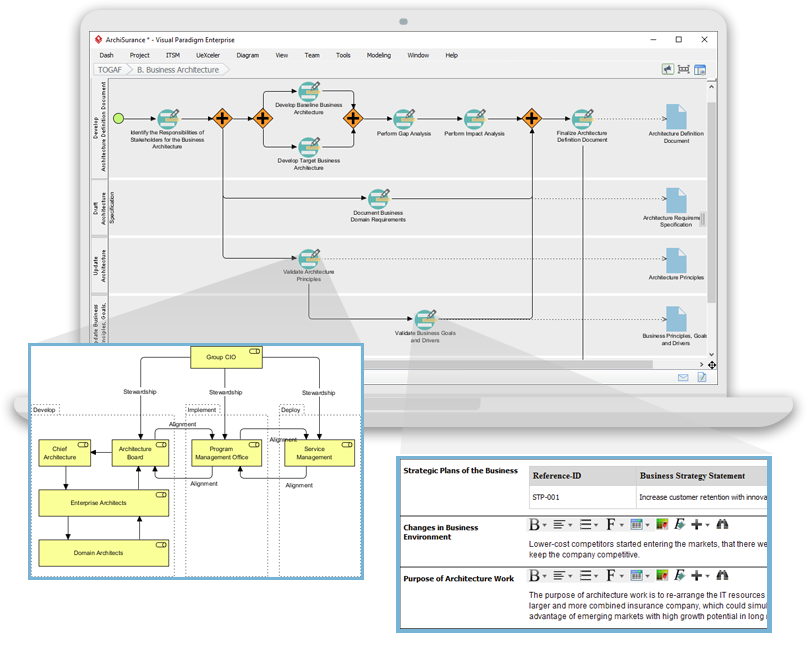
Tech-Innovate Solutions used ArchiMate, a visual language for modeling enterprise architecture, to create diagrams and models that support the TOGAF ADM phases. ArchiMate helped in visualizing the relationships between different architecture domains and facilitated communication with stakeholders.
Enterprise Architecture Design for SMEs
The company referred to case studies of small and medium-sized enterprises (SMEs) that used TOGAF ADM to design their enterprise architecture. These case studies provided practical insights into the challenges and best practices of implementing TOGAF in smaller organizations.
Real-life Case Studies
Tech-Innovate Solutions reviewed real-life case studies of companies that successfully implemented TOGAF ADM. These case studies highlighted the adaptability and comprehensiveness of TOGAF, as well as the importance of system “building blocks” in managing interdependencies between target architectures.
Why Visual Paradigm and ArchiMate Made the Difference
Tech-Innovate Solutions’ selection of Visual Paradigm integrated with ArchiMate was driven by several critical factors that directly contributed to project success:
- Seamless Integration: The unified platform eliminated tool-switching overhead and ensured consistency between methodology execution and visual modeling.
- Comprehensive Toolset: From initial discovery through governance, the suite provided purpose-built capabilities for every ADM phase without requiring third-party extensions.
- Enhanced Visualization: ArchiMate’s standardized notation enabled clear communication of complex architectural concepts to both technical and non-technical stakeholders.
- Efficiency and Productivity: The process navigator reduced onboarding time and minimized methodology deviations, keeping the team focused on value-adding activities.
- Collaboration and Communication: Real-time co-authoring and centralized repositories broke down silos between architecture, development, and business teams.
- Adaptability and Flexibility: The platform accommodated Tech-Innovate Solutions’ unique context while maintaining TOGAF compliance.
- Industry Standards Compliance: Leveraging Open Group-certified tools enhanced credibility with clients, partners, and auditors.
Conclusion
The implementation of TOGAF ADM at Tech-Innovate Solutions demonstrates that a structured, tool-supported approach to enterprise architecture can transform organizational complexity into strategic advantage. By methodically progressing through each ADM phase—from establishing foundational principles in the Preliminary Phase to managing ongoing evolution in Architecture Change Management—the company achieved tangible outcomes: reduced technical debt, accelerated time-to-market for new capabilities, improved cross-functional alignment, and a scalable foundation for future growth.
Critically, success was not driven by framework adoption alone. The integration of Visual Paradigm’s interactive ADM workflow with ArchiMate’s expressive modeling language operationalized TOGAF theory into practical, collaborative action. Automated documentation, intelligent gap analysis, and robust governance features reduced administrative burden while enhancing architectural rigor. This case underscores a vital lesson for practitioners: the most effective enterprise architecture initiatives combine methodological discipline with enabling technology that empowers teams rather than constrains them.
For organizations contemplating their own architecture journey, Tech-Innovate Solutions’ experience offers a replicable blueprint. Start with clear business objectives, secure executive sponsorship, select tools that amplify rather than complicate the methodology, and prioritize communication and collaboration throughout. Enterprise architecture is not a one-time project but an ongoing capability—one that, when executed thoughtfully, becomes a powerful engine for innovation, resilience, and sustained competitive advantage.
References
- Essential TOGAF ADM Knowledge: A foundational guide covering core TOGAF ADM concepts, phases, and deliverables for enterprise architecture practitioners.
- Elevate Your Enterprise Architecture Game with Visual Paradigm: Practical insights on leveraging Visual Paradigm’s integrated toolset to enhance EA planning, modeling, and governance.
- What’s New in the TOGAF Standard 10th Edition: Overview of updates and enhancements in TOGAF 10 and their implications for architecture teams.
- Comprehensive Guide to Adopting Visual Paradigm for Enterprise Architecture Modeling: Step-by-step guidance for implementing Visual Paradigm in EA initiatives with ArchiMate.
- 10 Tips for Effective Business Process Capturing with Visual Paradigm: Practical techniques for modeling business processes that align with architecture goals.
- Best TOGAF Software Solutions: Evaluation criteria and recommendations for selecting TOGAF-compliant tooling.
- Technology Viewpoint in Visual Paradigm: User guide section detailing technology architecture modeling capabilities.
- What Is a Gap Analysis: Your Guide to AI-Powered Strategic Planning: Modern approaches to gap analysis leveraging automation and visualization.
- Deliverable vs Artifact vs Building Block in TOGAF ADM: Clarification of key TOGAF terminology and their practical application.
- Getting Started with Visual Paradigm: Initial setup and configuration guide for new users.
- Visual Paradigm UML Knowledge Base: Collection of tutorials and best practices for UML modeling within EA contexts.
- 10 Tips for Effective Business Process Capturing: Repeated reference emphasizing business process modeling excellence.
- Mastering Enterprise Architecture with ArchiMate and TOGAF: The Visual Paradigm Advantage: Comprehensive resource on leveraging the integrated Visual Paradigm platform for end-to-end EA success.