


For years, PlantUML has been the gold standard for developers who want to create UML diagrams from plain text. Its ability to generate class diagrams, sequence diagrams, use case diagrams, activity diagrams, state diagrams, component diagrams, deployment diagrams, and timing diagrams from simple syntax has made it a cornerstone of the text-based UML tool ecosystem.
However, running a traditional PlantUML Server setup comes with its own set of challenges. From managing local Java runtimes to dealing with complex Graphviz installations, the maintenance overhead can often outweigh the benefits. Many teams have found that the expectation of configuring a Java environment or Node.js just to run PlantUML creates a significant barrier to adoption, particularly for new developers joining the team.
Enter VPasCode, the next-generation diagram as code platform from Visual Paradigm. As a core component of the Visual Paradigm AI Ecosystem, VPasCode offers a modern, cloud-native alternative that not only solves the pain points of PlantUML Server but also introduces powerful new capabilities. If you are searching for a better online text to diagram tool, this migration guide will show you exactly what you gain by making the switch.
The Friction of Traditional PlantUML Server
Traditionally, to leverage PlantUML’s power, teams needed to set up and maintain a local server. This often involved:
- Complex Local Setup: Installing Java, managing Graphviz binaries, and ensuring compatibility across team members’ machines created a high barrier to entry for new developers.
- Fragmented Toolchains: If your team also used Mermaid for rapid documentation or Graphviz for network topologies, you were forced to switch between multiple disconnected tools.
- Manual Syncing: Diagrams lived outside the codebase, leading to the dreaded “documentation drift” where the visual representation no longer matched the actual system.
These challenges prevented PlantUML Server from being a true “living” code-based diagramming software integrated into modern CI/CD pipelines.
What You Gain with VPasCode
VPasCode redefines the diagram as code experience by eliminating these barriers. Here is what you gain when you migrate.
1. Zero Setup, Instant Access
The most immediate benefit of VPasCode is the elimination of local dependencies. It is a 100% cloud-native, browser-based workspace. There are no Java runtimes, Node.js modules, or IDE extensions to install. You can just open a browser and start diagramming. This “zero-setup cloud rendering” dramatically lowers the onboarding time for new team members, allowing them to create diagrams from text in seconds.
2. True Multi-Engine Unity (One Platform, All Syntaxes)
VPasCode is the only platform that natively supports the three major text-to-diagram engines simultaneously: PlantUML, Mermaid, and Graphviz. Unlike PlantUML Server, which locks you into a single syntax, VPasCode unifies them under one roof.
This means your team can use the best tool for the job:
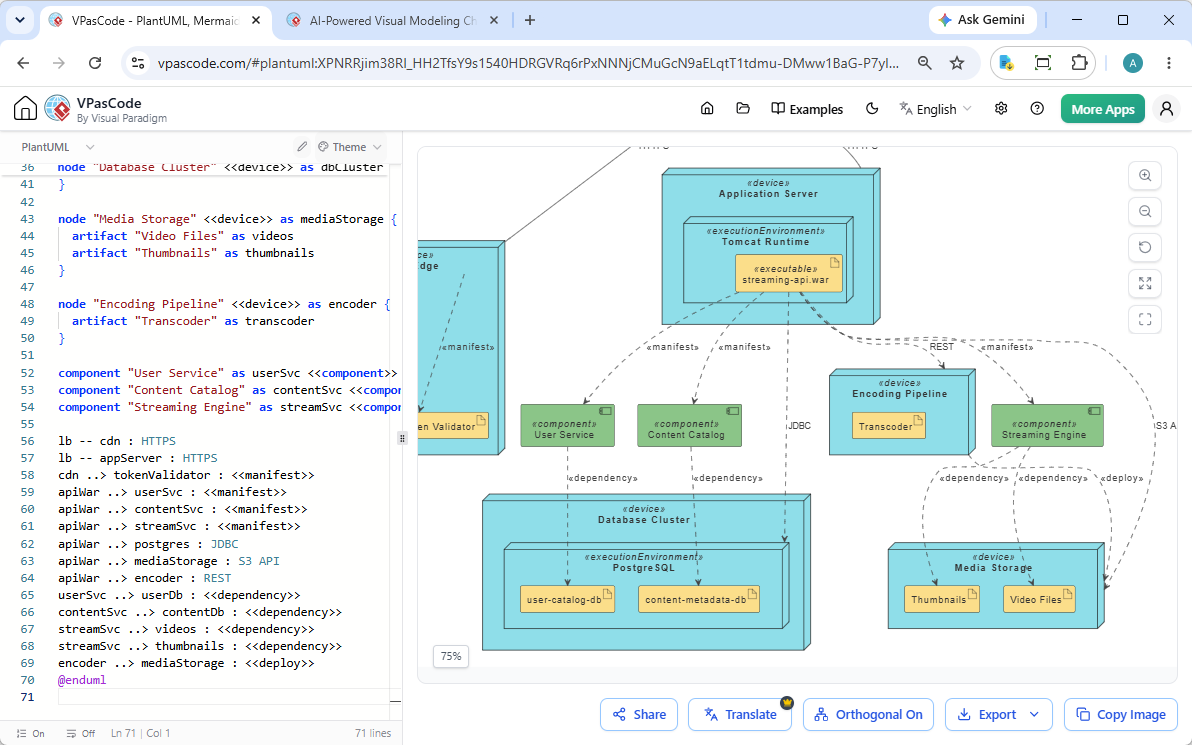
- PlantUML: For rigorous enterprise UML, C4 models, and detailed sequence or deployment diagrams.
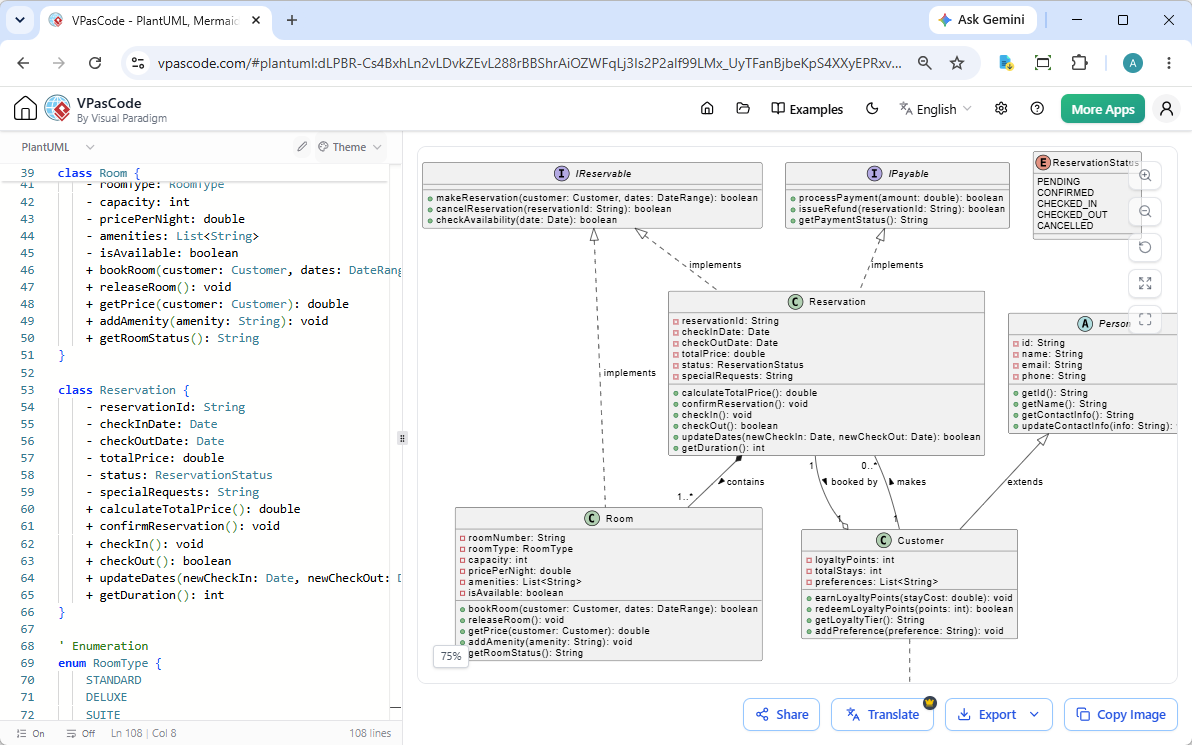
- Mermaid: For agile, markdown-friendly flowcharts, user journeys, and Git graphs.
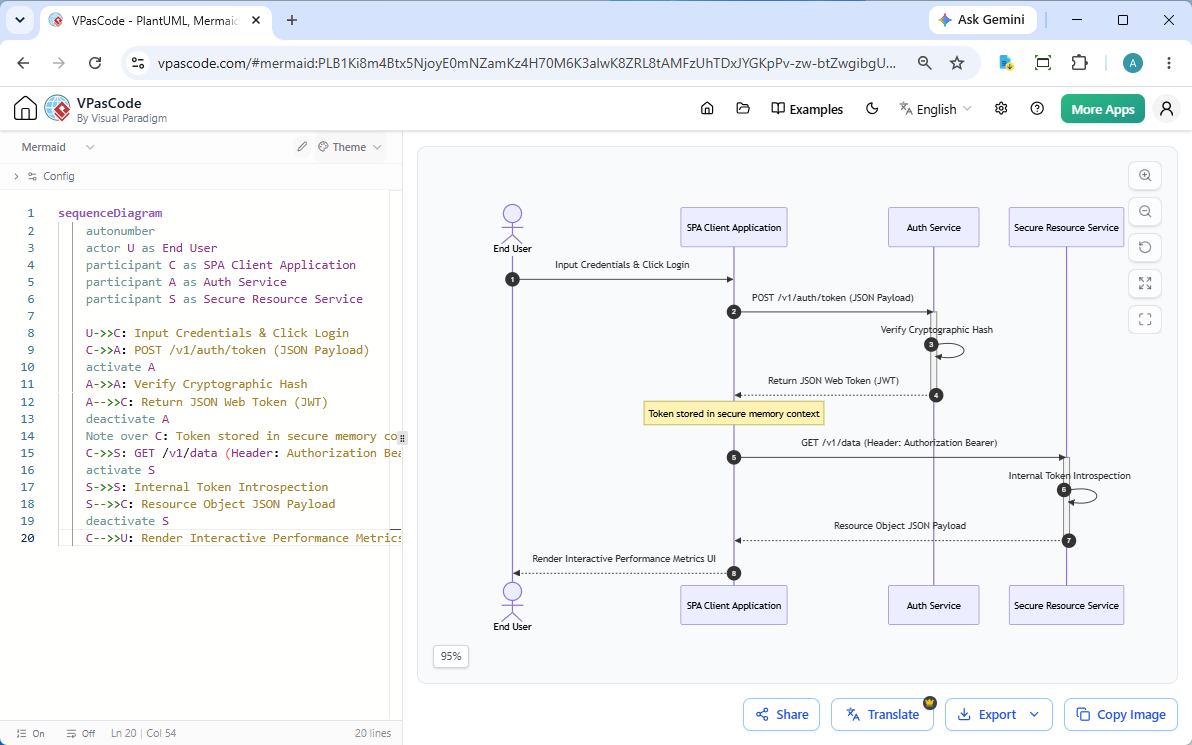
- Graphviz: For complex network topologies and dependency trees.
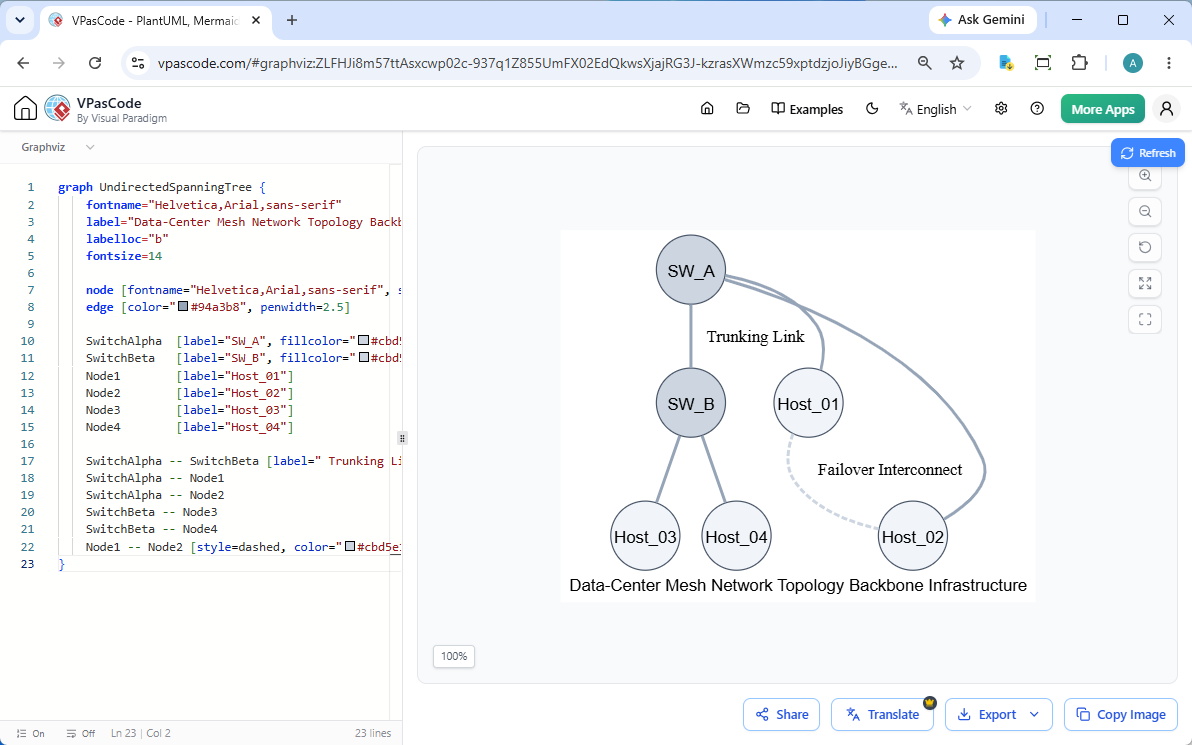
This unified approach eliminates the “engine-specific training” and fragmented workflows typical of traditional tools.
3. Living Documentation
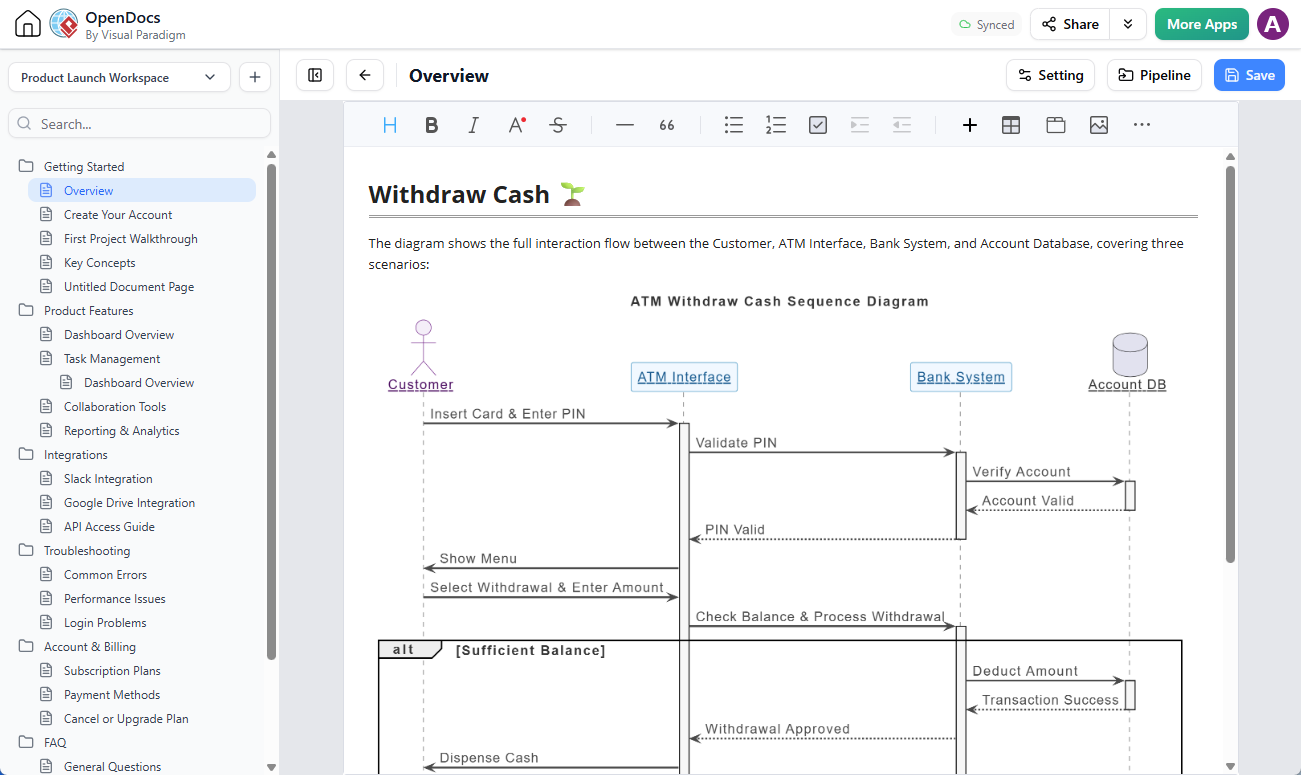
VPasCode embraces the philosophy that architecture should live as code. You can send your finalized diagrams directly to Visual Paradigm OpenDocs for further documentation and knowledge sharing, creating a seamless documentation pipeline.
4. AI-Native Architecture
This is where VPasCode truly differentiates itself from a traditional PlantUML server. Because structured text is the native language of LLMs, VPasCode unlocks powerful AI capabilities.
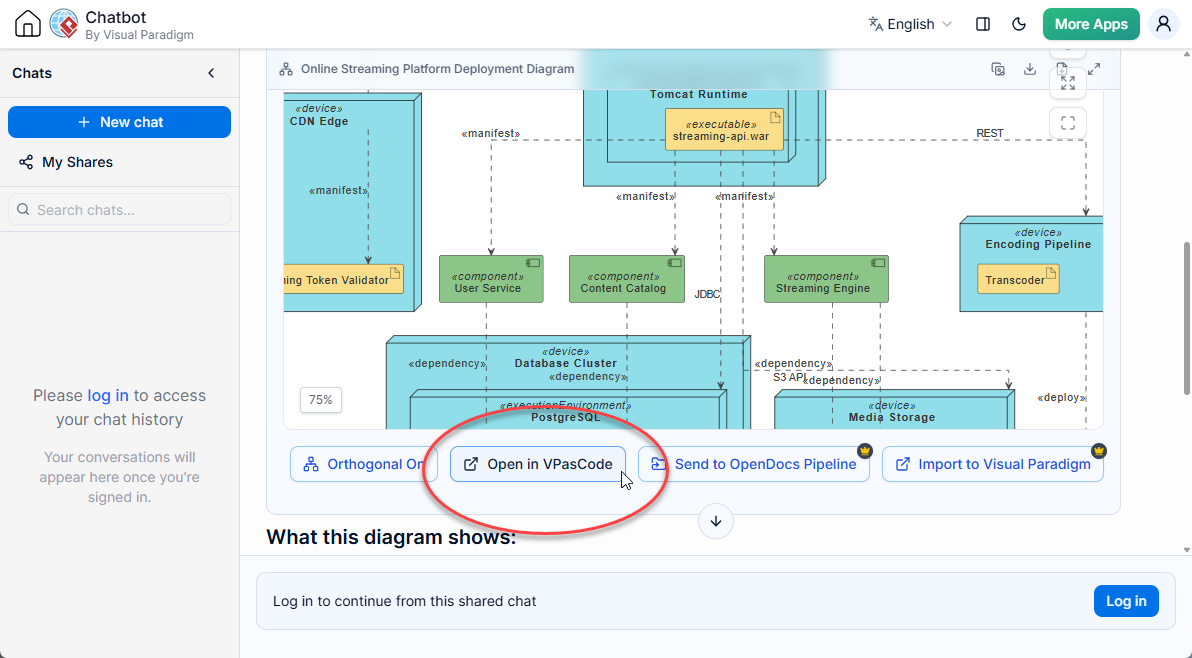
As a core element of the Visual Paradigm AI Ecosystem, VPasCode integrates directly with an AI-powered Chatbot. You can generate code from a natural language prompt and then click the “Open in VPasCode” button to touch up the generated code.
The platform also offers features like:
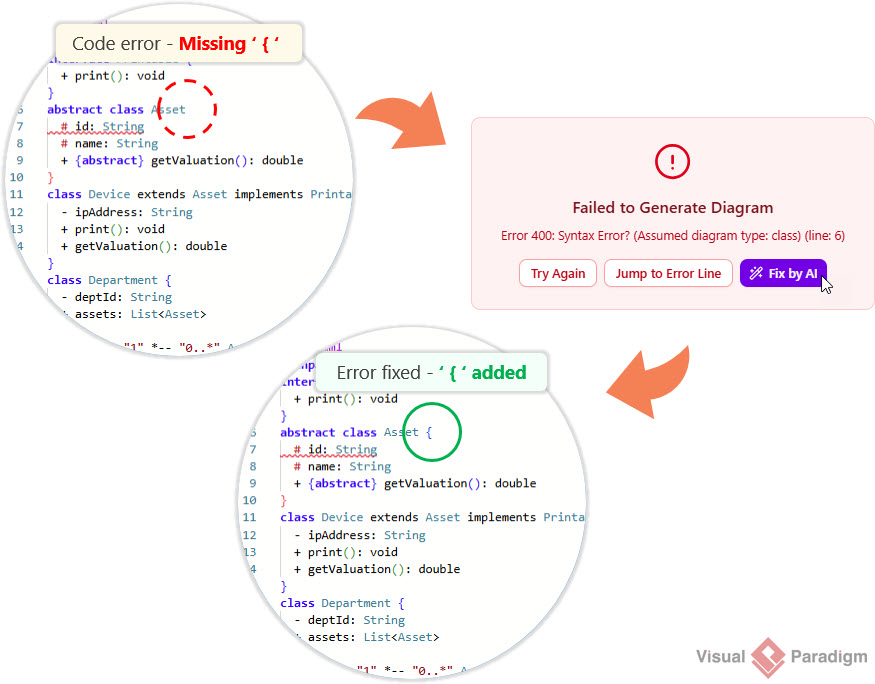
- AI Code Error Fixing: Automatically detect and correct syntax errors with a single click, eliminating the frustration of debugging complex scripts.
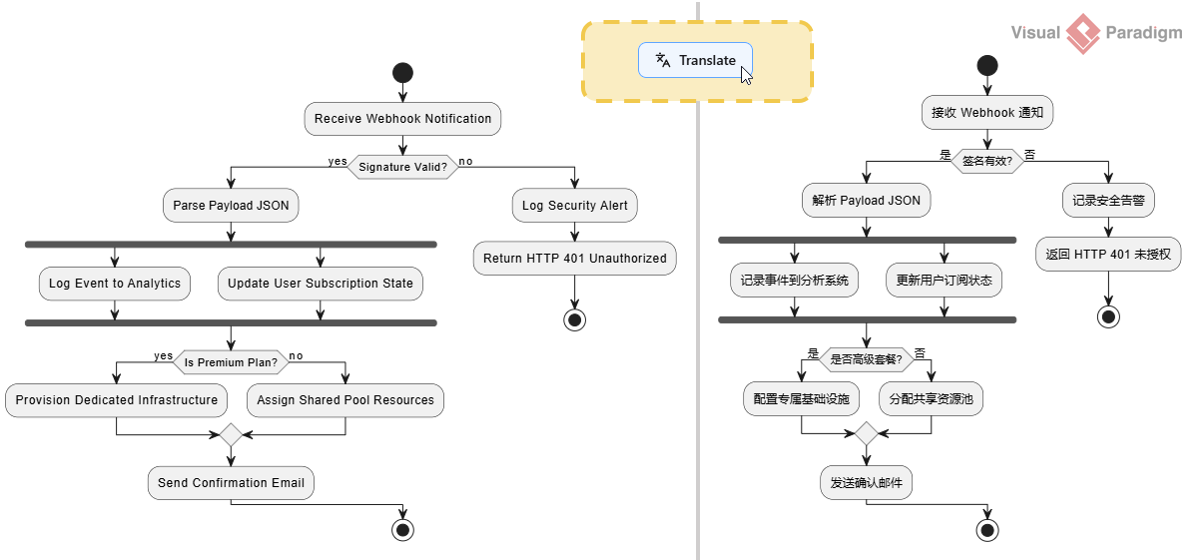
- AI Code Content Translation: Instantly translate diagram labels to support global teams (e.g., “Car” becomes “汽車”).
5. Free Integrated Editor with Enterprise-Grade Exports
VPasCode’s core editing feature is completely free, making it an accessible free diagram as code tool for individual developers and startups. Unlike PlantUML Server, which can require infrastructure costs, VPasCode is ready to use out of the box. It includes a dual-panel workspace with a syntax-highlighted code editor and a real-time previewer, providing instant visual feedback.
Once your diagram is ready, you can share it via a persistent URL, export as SVG or PNG, or copy it directly to your clipboard for use in wikis, Slack, or presentations.
VPasCode vs. PlantUML Server: A Comparison
| Feature | PlantUML Server | VPasCode (Visual Paradigm) |
|---|---|---|
| Setup | Requires local Java, Graphviz, and server configuration | Zero-Setup, Browser-Native |
| Engine Support | PlantUML only | Unified: PlantUML, Mermaid, and Graphviz |
| AI Integration | None | AI Chatbot for generation, error fixing, and translation |
| Documentation Pipeline | Manual uploads | OpenDocs Integration for seamless knowledge sharing |
| Cost | Infrastructure and maintenance overhead | Free Core Editor; AI features are paid |
Conclusion: Future-Proof Your Diagramming Workflow
Migrating from PlantUML Server to VPasCode is not just about changing tools; it is about adopting a more agile, collaborative, and AI-ready approach to technical documentation. By unifying multiple engines, embracing Git-native workflows, and integrating cutting-edge AI capabilities, VPasCode represents the next evolution of diagram as code software.
If your team is still wrestling with local setups and fragmented toolchains, it is time to explore the modern alternative. Experience the zero-setup, multi-engine power of VPasCode, the diagram as code tool that is redefining how engineers visualize their systems.
Ready to make the switch? Try the free diagram as code tool from Visual Paradigm today.