


Introduction
For years, software architects and developers have faced a persistent dilemma: how to keep technical documentation in sync with rapidly evolving codebases. Traditional drag-and-drop diagramming tools often result in static images that become outdated the moment a system changes, while maintaining them requires tedious manual repositioning of boxes and arrows. Enter VPasCode, a cloud-native Diagram-as-Code (DaC) platform by Visual Paradigm that promises to bridge the gap between text-driven development and high-fidelity system modeling.
As someone who has spent countless hours wrestling with alignment issues in Visio or Lucidchart, I was intrigued by the promise of defining complex architectures through simple text scripts. VPasCode isn’t just another editor; it’s a unified playground that supports PlantUML, Mermaid.js, and Graphviz, all infused with AI-powered automation. In this review, I’ll walk you through my experience using VPasCode, exploring its multi-engine architecture, AI capabilities, and how it transforms the way we create, maintain, and share visual documentation.
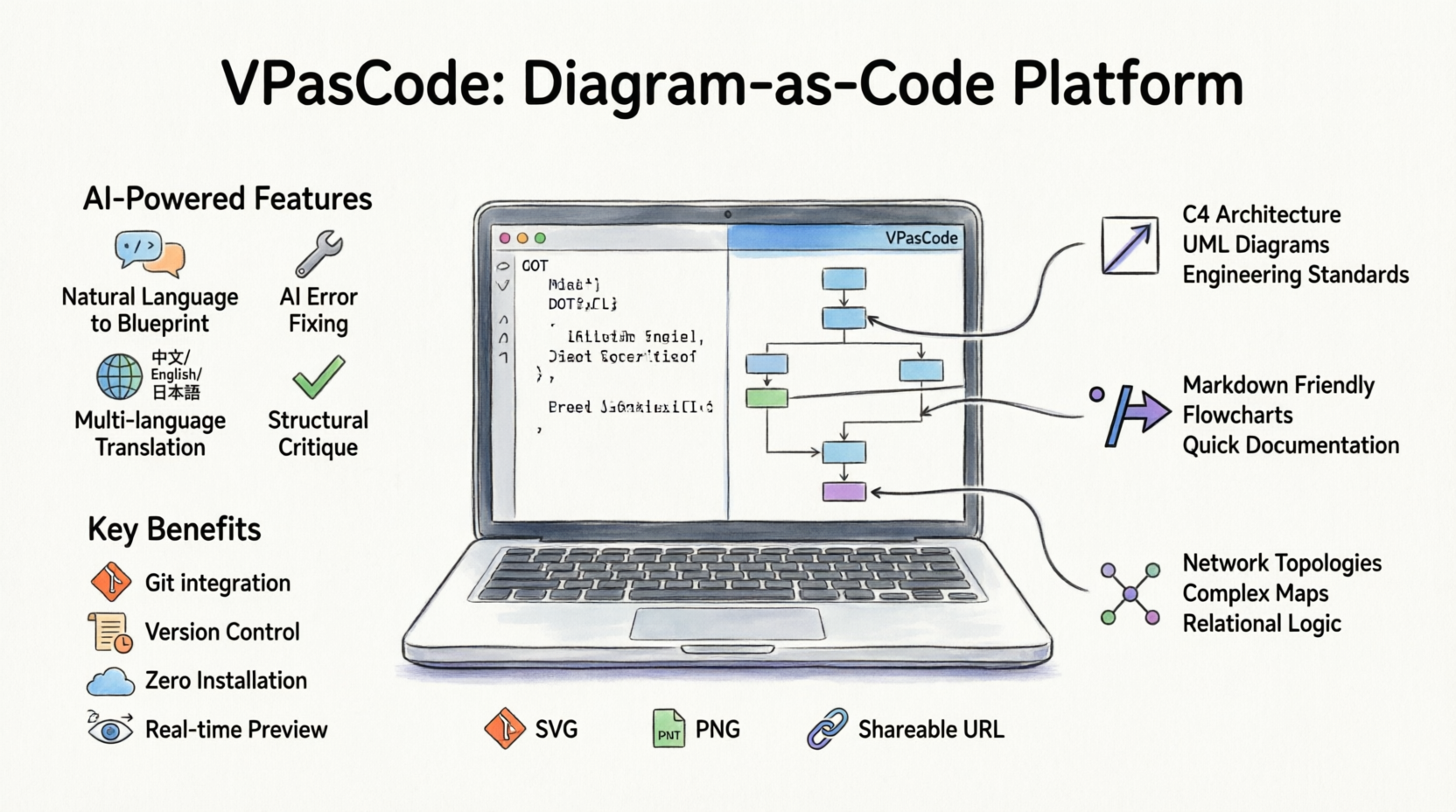
⚙️ Multi-Engine Architecture Support
One of the first things that struck me about VPasCode is its flexibility. Instead of forcing users into a single diagramming language, it provides a dual-panel editing canvas that automatically detects and interprets three industry-standard diagramming languages. This means you can switch between tools based on your specific needs without leaving the browser.
-
PlantUML: Ideal for strict engineering structures, C4 architecture models, and traditional UML diagrams like Class, Sequence, and Deployment diagrams.
-
Mermaid.js: Tailored for markdown-friendly integration, rapid project flow charts, and quick documentation mapping.
-
Graphviz (DOT): Optimized for intricate network topologies, complex relational maps, and customized node layouts.
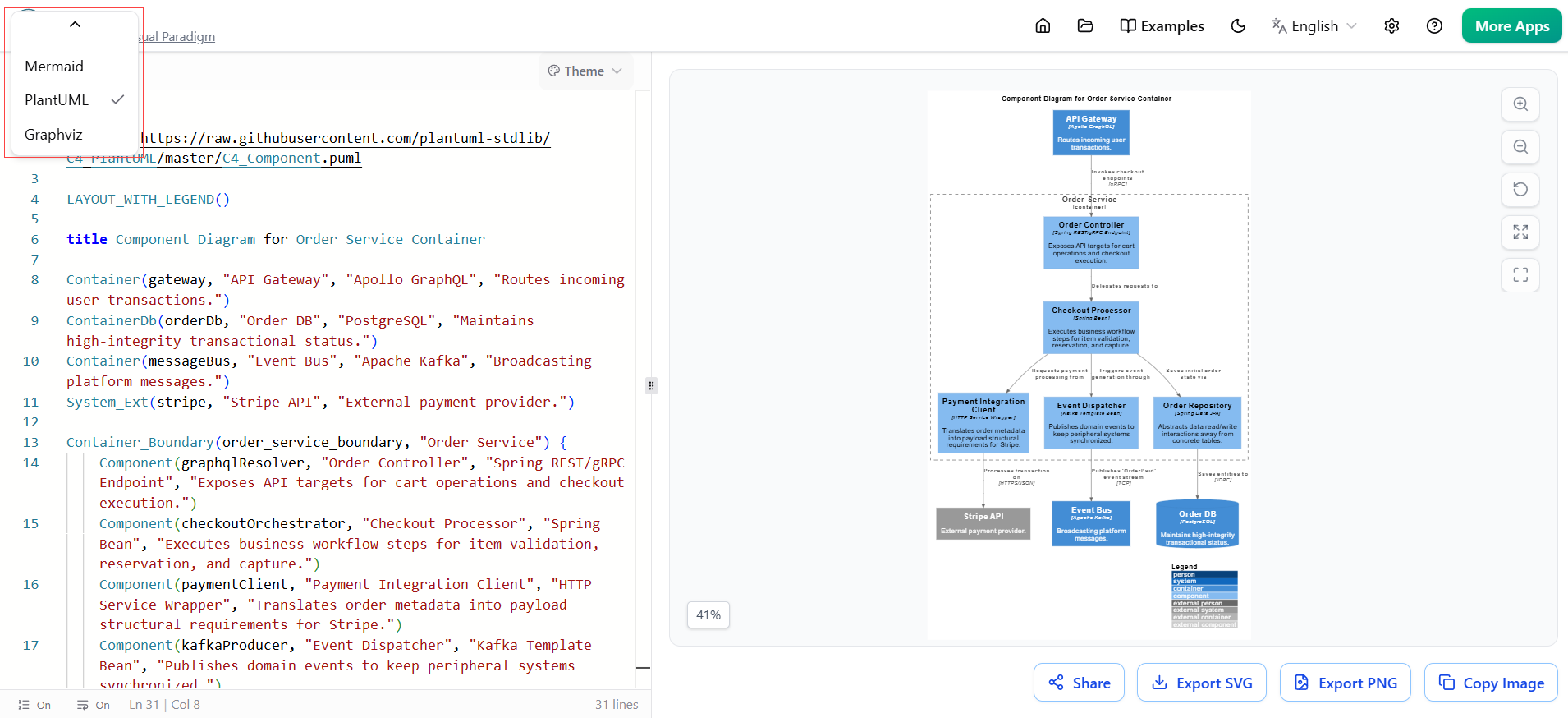
This multi-engine approach eliminates the need to switch between different standalone tools, allowing teams to standardize on a single platform regardless of their preferred markup language.
🤖 AI-Powered Superpowers
Where VPasCode truly shines is in its integration of advanced conversational and analytical AI. These features aren’t just gimmicks; they significantly streamline diagram design and maintenance.
-
Natural Language to Blueprint: I tested this by typing a simple prompt: “Create a hotel booking system with rooms and customers.” Within seconds, VPasCode generated syntactically valid diagram code. This feature is a game-changer for those who know what they want to model but struggle with syntax.
-
AI Code Error Fixing: We’ve all been there—missing a semicolon or misplacing a bracket. The one-click “Fix by AI” button scans, diagnoses, and repairs broken or invalid syntax instantly. It’s like having a pair programmer who never gets tired.
-
AI Diagram Translation: For global teams, the ability to localize textual content inside diagrams across multiple languages (such as Spanish, German, French, Chinese, and Arabic) while adjusting code on the fly is invaluable.
-
Automated Structural Critique: The platform offers automated reviews to identify system anti-patterns or broken logic directly within the text layout, helping ensure your diagrams are not just visually correct but logically sound.
📁 Workspace, Collaboration, & Pipelines
VPasCode operates completely in the web browser with zero local installation or setup. This zero-configuration workspace eliminates the hassle of configuring Java runtimes or managing local installations, making it accessible to anyone with a modern browser.
The real-time preview editor features a side-by-side workspace window that updates your visual layout instantaneously as you type or adjust code blocks. This immediate feedback loop is crucial for rapid iteration.
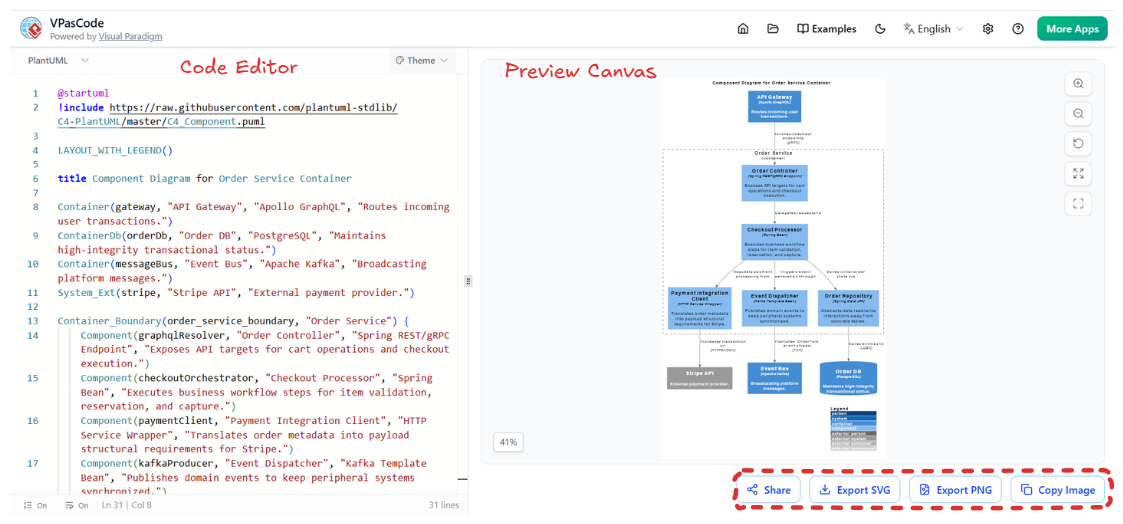
Because diagrams are created as plain-text scripts, teams can effortlessly track changes, diff lines, and manage version control directly inside standard Git repositories. This Git-native friendly alignment ensures that your diagrams are treated with the same rigor as your codebase.
Furthermore, VPasCode integrates seamlessly with Visual Paradigm’s OpenDocs Platform, allowing you to push diagrams directly into live knowledge bases without manual export/import cycles. When it’s time to share, you can download high-fidelity visual assets as scalable vector files (SVG) or high-resolution images (PNG), or generate unique, shareable preview URLs for team distribution.
💎 Edition Capabilities Matrix
VPasCode offers capabilities split across a free tier and professional tiering bundled within the broader Visual Paradigm ecosystem.
| Feature Tier | Included Capabilities |
|---|---|
| Free Tier | Code editor, Real-time rendering, URL sharing, SVG/PNG exporting. |
| Premium Tier (VP Online Combo / VP Desktop Professional) | All free tools + AI Code Error Fixing, AI Prompt-to-Diagram Generator, and AI Language Translation. |
For individual developers or small teams just starting out, the free tier provides robust functionality. However, the AI-powered features in the Premium Tier are worth considering for teams looking to maximize efficiency and reduce manual effort.
Seamless Diagram-as-Code Integration
Reading a complex architecture guide like the C4 Model often leaves developers wanting to see how the underlying code behaves dynamically. Visual Paradigm addresses this by transforming static articles into interactive sandboxes through integrated “Edit in VPasCode” hyperlinks.
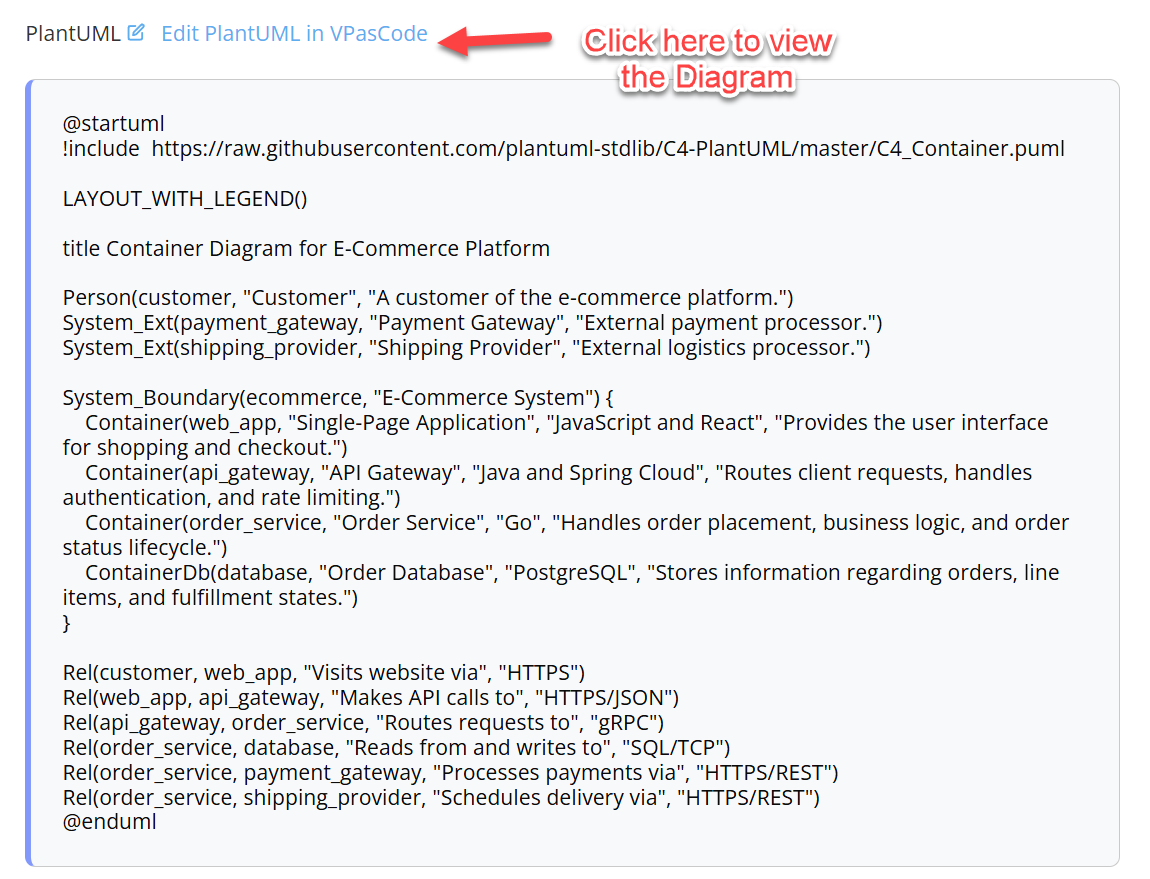
As seen in the case study, clicking the “Edit PlantUML in VPasCode” link directly above an architecture code block instantly migrates the snippet into the live rendering environment. This friction-free bridge between technical documentation and code execution provides several significant advantages:
-
Eliminates Copy-Paste Friction: You do not have to highlight extensive code strings, handle formatting bugs, or accidentally lose indentation layouts during manual transfers.
-
Instant Visual Context: In a single click, abstract C4 text models manifest into high-fidelity, interactive vector diagrams.
-
Immediate Experimentation: Developers can instantly use the article’s structure as a living template, modifying boundaries, adding new microservices, or shifting database variables on the fly.
-
Accelerated Technical Training: Eliminates setup friction, allowing new team members to learn complex syntax mechanics directly from production-ready templates.
User Interface & Workflow Design
The VPasCode interface is engineered for real-time iteration, featuring a responsive two-column layout that balances code authoring with immediate visual feedback.
🖥️ Left Panel: Code Editor
-
Syntax Engine Selector: Instantly toggle between PlantUML, Mermaid, and Graphviz compilers.
-
Theme Customization: Adjust code highlighting palettes to match your preferred IDE or reduce eye strain.
-
IDE-Grade Features: Line numbering, intelligent indentation tracking, collapsible code blocks, and real-time cursor position (
Ln / Col). -
Live Status Bar: Continuous syntax validation with real-time error counting to catch typos and structural issues before rendering.
🎨 Right Panel: Interactive Preview Canvas
-
Vector Render Output: Instant, high-fidelity diagram rendering with zero lag.
-
Adjustable Split View: Draggable divider to dynamically resize the code and preview panes.
-
Canvas Control Toolbar: Floating vertical menu for zoom, pan, fit-to-screen, and full-screen immersion.
-
Zoom Context Indicator: Subtle percentage tracker to maintain design proportionality during navigation.
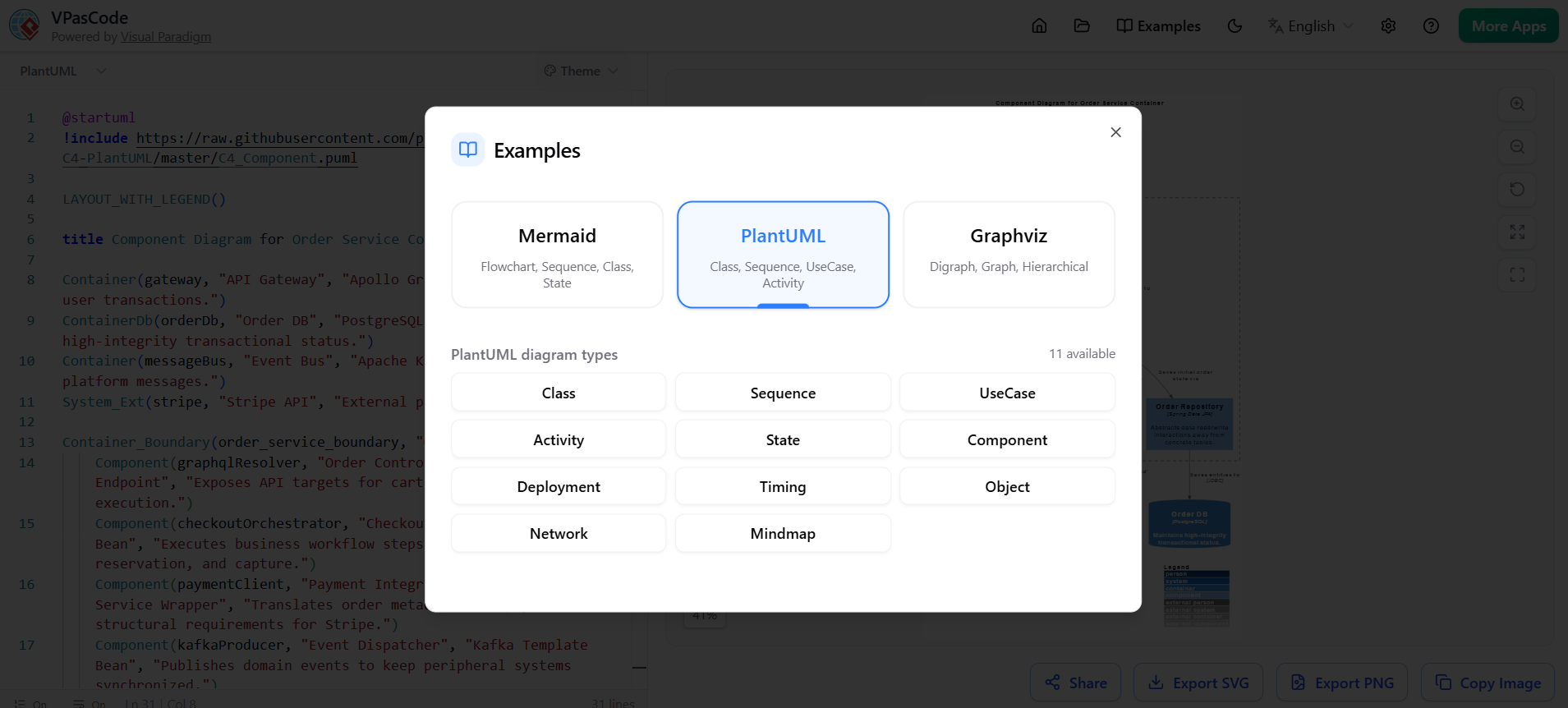
Beyond basic rendering, VPasCode includes intelligent features that streamline the authoring experience. The built-in syntax parser actively monitors input. If you paste code written for one engine while another is active, VPasCode prevents compilation errors and displays a contextual warning. A single-click “Wrong Diagram Type?” prompt automatically switches the active engine to match your pasted code. Additionally, the dynamic examples library offers ready-to-use structures across all three engines, eliminating the need to memorize syntax from scratch.
Conclusion
Visual Paradigm’s VPasCode redefines technical diagramming by merging developer-friendly code workflows with professional-grade visual output. By supporting PlantUML, Mermaid, and Graphviz under one roof, it eliminates tool fragmentation while enforcing consistency, version control, and rapid iteration. Whether you’re documenting microservices, mapping system dependencies, or creating onboarding architecture guides, VPasCode ensures your diagrams remain as maintainable, reviewable, and collaborative as your actual codebase.
For teams struggling with outdated diagrams and fragmented tools, VPasCode offers a compelling solution. Its AI-powered features reduce the learning curve and maintenance overhead, while its cloud-native nature ensures accessibility and ease of collaboration. If you’re ready to move beyond drag-and-drop and embrace the power of Diagram-as-Code, VPasCode is definitely worth a try.
References
- Visual Paradigm VPasCode Features: Overview of VPasCode’s core features, including multi-engine support and AI capabilities.
- Mastering VPasCode: The Ultimate Guide to AI-Powered Diagram-as-Code: A comprehensive guide to using VPasCode for AI-powered diagram creation.
- Case Study: Accelerating Software Architecture Documentation with VPasCode: Real-world example of how VPasCode accelerates documentation workflows.
- From Syntax Struggles to Seamless Diagrams: How AI-powered auto-error fixing transforms documentation workflows.
- Comprehensive Guide to VPasCode by Visual Paradigm: Detailed guide covering all aspects of VPasCode.
- From Prompt to Pattern: Mastering UML Class Diagrams with AI: Using AI to generate UML class diagrams from natural language prompts.
- Visual Paradigm Guide: General guide resources from Visual Paradigm.
- AI Generated PERT Chart Example: Example of AI-generated PERT chart for ERP implementation.
- Visual Paradigm Desktop AI Activity Diagram Generation: Release notes on AI activity diagram generation.
- Enhanced AI Deployment Diagram Generation: Release notes on enhanced AI deployment diagram generation.
- Visual Paradigm Online: Access to Visual Paradigm’s online tools.
- Revolutionizing Diagram Maintenance with AI Auto-Fix: How AI auto-fix eliminates syntax frustrations.
- Break Language Barriers with AI Diagram Translation: Release notes on AI diagram translation features.
- How Visual Paradigm AI Chatbot and VPasCode Function as an Integrated Ecosystem: Overview of the integrated ecosystem.
- Seamlessly Connect Diagramming to Documentation: Release notes on VPasCode integration with OpenDocs.
- Introducing Visual Paradigm 18.1: Release notes introducing Visual Paradigm 18.1 and its new features.
- Blog: Introducing Visual Paradigm 18.1: Blog post detailing the new era of unified ecosystems and AI-driven innovation.
Related posts:
 From Chaos to Clarity: How the Visual Paradigm Pipeline Revolutionized My Documentation Workflow
From Text to Visuals: A Hands-On Review of VPasCode and the Visual Paradigm AI Chatbot
A Hands-On Review of Visual Paradigm’s Automated Documentation Pipeline
From Chaos to Clarity: How the Visual Paradigm Pipeline Revolutionized My Documentation Workflow
From Text to Visuals: A Hands-On Review of VPasCode and the Visual Paradigm AI Chatbot
A Hands-On Review of Visual Paradigm’s Automated Documentation Pipeline
 From Frustration to Flow: Mastering UML Timing Diagrams with Visual Paradigm