


Running a business alone requires a different kind of strategic discipline than managing a large team. When you are the only decision-maker, every resource counts. Time, capital, and attention are finite. A misstep can be costly. This is where strategic frameworks become essential tools for clarity. One such framework, originally designed for corporate strategy, offers immense value when adapted for the solo entrepreneur.
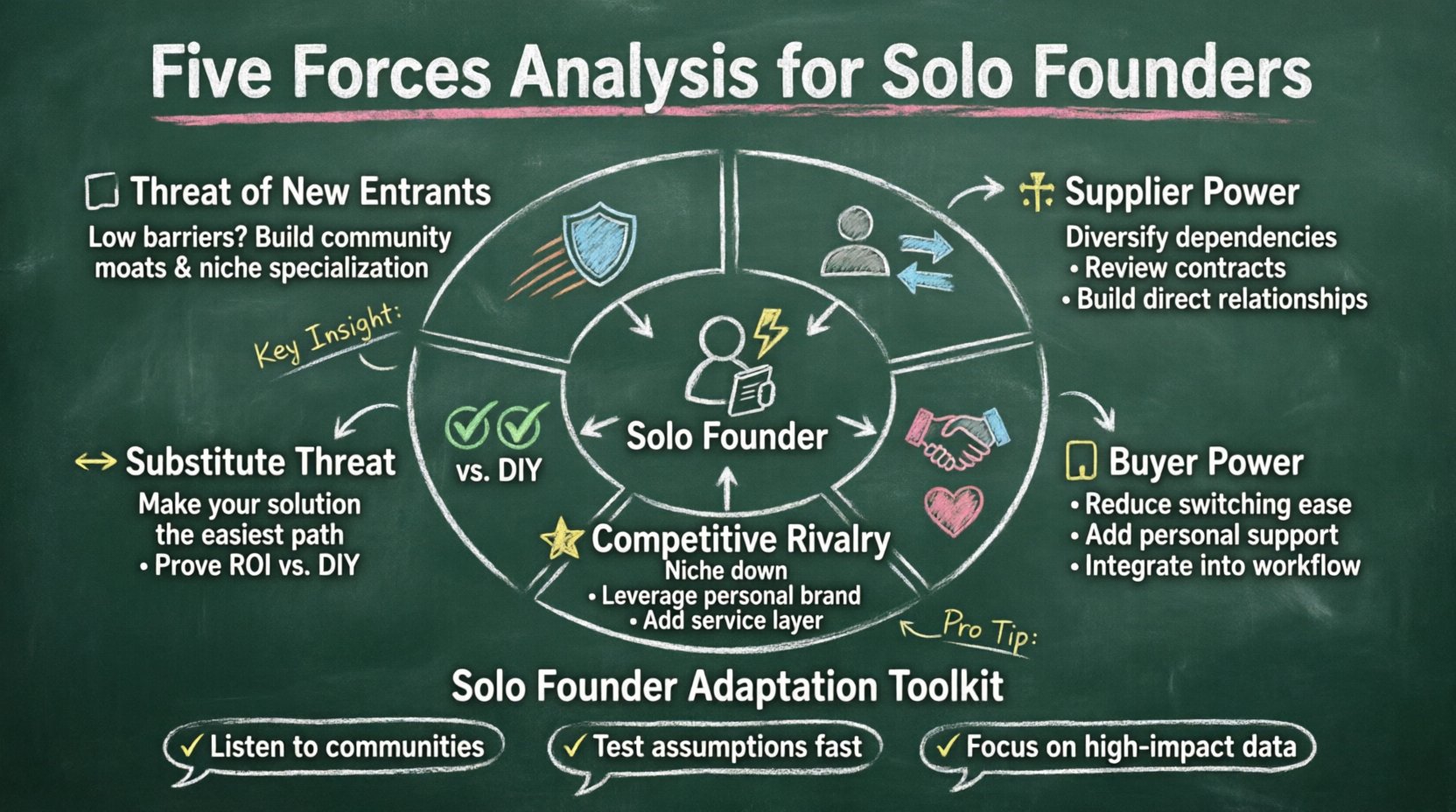
Porter’s Five Forces Analysis provides a structured way to evaluate the competitive environment of your industry. For a solo founder, understanding these forces helps you identify risks before they become crises. It guides product decisions, pricing models, and marketing focus. This guide breaks down how to apply this analysis without a department of analysts. We will focus on practical application, risk mitigation, and sustainable growth.
Why Solo Founders Need Strategic Frameworks 🎯
In a corporate setting, strategy is often a collaborative process. Departments vie for resources, and data is gathered from multiple sources. A solo founder operates differently. You are the strategist, the researcher, the product manager, and the sales team. Without a structured approach, it is easy to get lost in the daily grind.
Key reasons to adopt this analysis include:
- Risk Identification: Spotting market shifts before they impact revenue.
- Resource Allocation: Knowing where to invest time for maximum return.
- Competitive Positioning: Finding a niche where you can win without a massive budget.
- Focus: Filtering out distractions that do not align with your strategic goals.
When you lack a team, your strategic insight is your primary asset. A clear view of the landscape allows you to navigate with confidence.
Understanding Porter’s Five Forces 👥
Developed by Michael Porter in 1979, this framework analyzes the intensity of competition and profitability in an industry. It looks at five specific forces that shape the market. For a solo founder, the goal is not to memorize theory but to apply the logic to your specific business model.
The five forces are:
- Threat of New Entrants
- Bargaining Power of Suppliers
- Bargaining Power of Buyers
- Threat of Substitute Products or Services
- Rivalry Among Existing Competitors
Each force represents a different type of pressure on your business. By assessing each one, you build a complete picture of your operational environment.
1. Threat of New Entrants 🚪
This force measures how easy it is for new competitors to enter your market. In the digital age, barriers to entry are often low. Anyone with a laptop and an internet connection can launch a product.
Assessing Your Barriers to Entry
Ask yourself what stops someone from copying your business tomorrow. If the answer is “nothing,” your market is highly vulnerable. Barriers can be technical, regulatory, or brand-based.
- Capital Requirements: Do you need significant investment to start? If not, entry is easy.
- Technology: Is your tech stack proprietary, or is it open source?
- Brand Loyalty: Do customers stick with you because of trust, or because of habit?
- Access to Distribution: Can new players reach your customers as easily as you can?
Strategic Implications for Solo Founders
When entry is low, speed and differentiation are key. You cannot compete on scale immediately. You must compete on agility and specificity.
- Build Community: Create a network that new entrants cannot replicate quickly.
- Specialization: Focus on a niche segment that is too small for larger players.
- Speed to Market: Iterate faster than anyone else.
For a solo founder, community is a significant moat. If your users feel a personal connection to you, they are less likely to switch to a new entrant just because it is cheaper.
2. Bargaining Power of Suppliers 💸
Suppliers are not just vendors. They are anyone or anything you depend on to deliver value. In a solo business, dependencies can be critical. If a key supplier raises prices or stops service, your business halts.
Identifying Your Suppliers
Look beyond traditional vendors. Your suppliers include:
- Hosting platforms or cloud infrastructure
- Payment processors
- Content creators or freelancers
- API providers
- Marketing channels
Evaluating Power Dynamics
Supplier power is high when:
- There are few alternatives available.
- Switching costs are high.
- The supplier offers a unique service.
- Your business volume is small relative to theirs.
Mitigating Risk
As a solo founder, you have limited leverage. You must actively manage these relationships to reduce risk.
- Diversification: Never rely on a single platform for a critical function. Have backups ready.
- Contract Terms: Review terms of service regularly to understand liability and pricing changes.
- Direct Relationships: Where possible, build direct relationships with key partners rather than relying on intermediaries.
Dependency is a vulnerability. Reducing it increases your stability and negotiating power over time.
3. Bargaining Power of Buyers 🛒
Buyers are your customers. Their power lies in their ability to drive prices down or demand higher quality. In a crowded market, buyer power is often high.
Factors Increasing Buyer Power
- Low Switching Costs: If it is easy for a customer to leave, they will.
- Price Sensitivity: Is your product a commodity, or is it unique?
- Volume: Do you rely on a few large clients, or many small ones?
- Information Access: Can customers easily compare your price and features?
Strategies to Retain Buyers
To reduce buyer power, you must increase the value you provide beyond the core product.
- Customer Support: Offer exceptional service that competitors cannot match.
- Customization: Tailor solutions to specific customer needs.
- Integration: Make your product part of their workflow so it is hard to remove.
- Educational Content: Help them succeed with your product.
For a solo founder, personal connection is a powerful lever. Customers often prefer buying from a person they trust over a faceless corporation. Use this to your advantage.
4. Threat of Substitute Products or Services 🔄
Substitutes are not direct competitors. They are alternative ways to solve the same problem. A user might not buy your software, but they could hire a freelancer. They might not buy your course, but they could read a free guide.
Types of Substitutes
- Do Nothing: The customer decides to solve the problem themselves without buying anything.
- DIY Solutions: Open source tools or manual processes.
- Alternative Industries: A different approach to the same pain point.
Defending Against Substitution
You cannot eliminate the threat of substitution, but you can raise the cost of switching away from your solution.
- Convenience: Make your solution the easiest path to the result.
- Results: Ensure your outcome is superior to the alternative.
- Cost: Demonstrate that the alternative is actually more expensive in time or effort.
Understanding substitutes helps you position your product correctly. If the alternative is “doing nothing,” you must prove that inaction is more painful than the cost of your solution.
5. Rivalry Among Existing Competitors ⚔️
This is the most obvious force. It refers to the intensity of competition among current players in your industry. High rivalry leads to price wars and marketing saturation.
Indicators of High Rivalry
- Number of Competitors: Many players increase competition.
- Industry Growth: Slow growth forces companies to fight for market share.
- Fixed Costs: High fixed costs encourage price cutting to fill capacity.
- Differentiation: If products are similar, price becomes the main factor.
Strategies for Solo Founders
Entering a market with high rivalry is difficult. You need a clear differentiation strategy.
- Niche Down: Serve a specific segment that giants ignore.
- Personal Brand: Leverage your unique voice and story.
- Service Layer: Offer services that automated competitors cannot provide.
- Innovation: Focus on features that matter to your specific audience.
Competition is inevitable. The goal is to make your position so specific that direct competition becomes irrelevant.
Adapting the Framework for One Person 🛠️
Traditional analysis often involves large teams and expensive data. A solo founder must adapt this process. The goal is efficiency. You need insights, not a 100-page report.
Data Gathering Without a Team
You cannot hire a research firm. You must use available public information.
- Public Reviews: Read reviews of competitors to understand pain points.
- Forums and Communities: Listen to conversations where your customers hang out.
- Competitor Websites: Analyze their pricing, features, and messaging.
- Direct Outreach: Talk to potential customers to validate assumptions.
Time Management for Analysis
Strategy work competes with execution. Schedule time for deep thinking.
- Weekly Reviews: Dedicate a few hours to market observation.
- Quarterly Deep Dives: Reassess the five forces every few months.
- Focus on High Impact: Ignore data that does not affect your decisions.
Comparison: Traditional vs. Solo Adaptation 📊
| Force | Traditional Corporate Approach | Solo Founder Adaptation |
|---|---|---|
| Market Research | Third-party reports, focus groups | Direct customer interviews, community listening |
| Competitor Analysis | Detailed feature mapping, pricing tracking | Manual review of landing pages and pricing |
| Supplier Vetting | Legal contracts, RFPs | Trial periods, contract reviews |
| Strategic Planning | Annual strategy meetings | Monthly check-ins, agile pivots |
| Resource Allocation | Budget approval processes | Personal capital management, time blocking |
Common Pitfalls to Avoid ⚠️
Even with a solid framework, execution can go wrong. Solo founders often fall into specific traps.
- Analysis Paralysis: Spending too much time planning and not enough time building. Strategy should inform action, not replace it.
- Confirmation Bias: Only looking for data that supports your idea. Seek out contradictory evidence.
- Ignoring Weak Signals: Small changes in the market can indicate large shifts. Pay attention to early indicators.
- Overgeneralization: Assuming industry trends apply to your specific niche. Validate assumptions for your context.
Actionable Checklist for Solo Founders ✅
Use this checklist to start your analysis today.
- Identify Competitors: List top 5 direct and indirect competitors.
- Analyze Pricing: Map out their pricing models and discount structures.
- Check Reviews: Read negative reviews to find gaps in the market.
- Review Suppliers: List all vendors and identify single points of failure.
- Survey Customers: Ask why they chose you over others.
- Document Findings: Keep a living document of your analysis.
- Set Triggers: Define what market changes will force a strategic pivot.
Building Resilience into Your Model 🛡️
The ultimate goal of this analysis is resilience. A solo business must withstand shocks. By understanding the five forces, you can build buffers into your model.
For example, if buyer power is high, you can build a recurring revenue model to stabilize cash flow. If supplier power is high, you can build relationships that offer priority support. If rivalry is high, you can focus on customer retention to reduce acquisition costs.
Resilience comes from flexibility. The market will change. Your strategy must be able to adapt without collapsing.
Moving Forward with Clarity 🧭
Strategy is not a one-time event. It is a continuous practice. For a solo founder, clarity is currency. The Five Forces Analysis provides a lens to see the market clearly.
Start small. Pick one force and analyze it this week. Then move to the next. Over time, you will build a deep understanding of your business environment. This understanding will guide your product decisions, marketing efforts, and operational choices.
Remember that you are the business. Your health and focus are the most critical resources. Use this framework to protect them. By understanding the forces at play, you can navigate the complexities of entrepreneurship with confidence and precision.
Begin your analysis today. Identify your risks. Build your defenses. Grow your business with intention.