


Understanding the structural dynamics of an industry is fundamental to strategic planning. Among the various frameworks available, Porter’s Five Forces remains a cornerstone for analyzing competitive intensity. Within this model, the threat of new entrants stands as a critical determinant of long-term profitability. This force is heavily influenced by barriers to entry, which act as the economic or regulatory hurdles preventing competitors from easily joining the market.
Many organizations approach market analysis with the assumption that barriers are static. In reality, they are fluid, often eroding over time due to technological shifts or regulatory changes. This guide provides a rigorous examination of barriers to entry, dissecting their components, strategic implications, and limitations within the context of industry analysis.
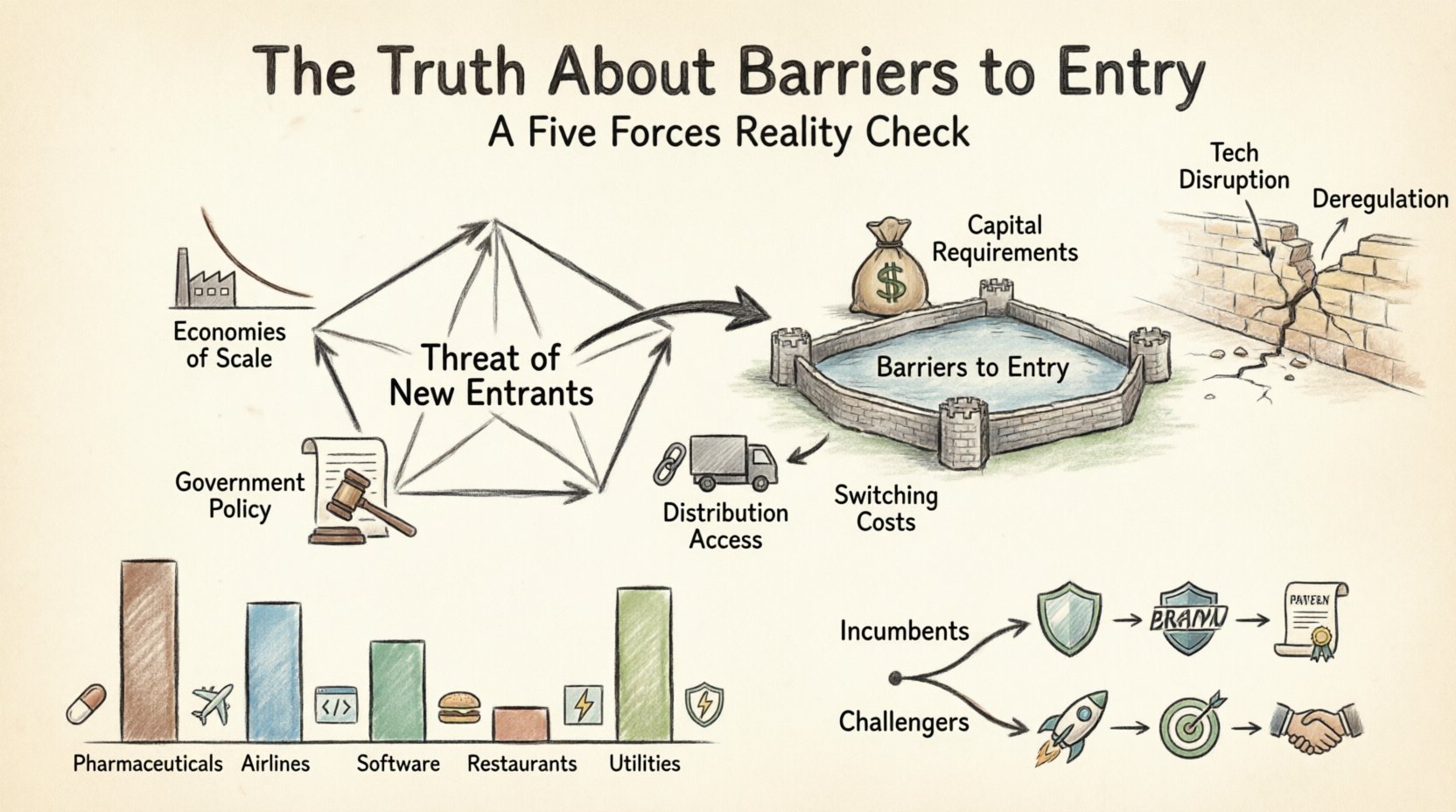
Defining the Moat: What Are Barriers to Entry? 🧱
Barriers to entry are the obstacles that make it difficult for a new competitor to enter a specific industry. They protect existing firms from competition by raising the cost or risk of market entry. When barriers are high, incumbents enjoy greater pricing power and sustained margins. When barriers are low, the market tends toward commoditization and price wars.
These barriers are not merely financial. They encompass structural, legal, and psychological factors that shape the competitive landscape.
- Structural Barriers: Built into the technology or economics of the industry (e.g., economies of scale).
- Strategic Barriers: Actions taken by incumbents to deter entry (e.g., aggressive pricing or patenting).
- Legal Barriers: Government regulations, patents, or licensing requirements.
The Five Forces Context: Where Entry Fits 🔍
Porter’s framework consists of five forces that determine the competitive intensity and attractiveness of a market. The threat of new entrants is one of these five. It is directly correlated to the height of the barriers.
When barriers are low, the threat is high. New players can enter, increase supply, and drive down prices. When barriers are high, the threat is low. Incumbents can maintain profitability without constant fear of displacement.
Interplay with Other Forces
Barriers to entry do not exist in isolation. They interact with the other four forces:
- Rivalry Among Existing Competitors: High barriers often reduce the number of competitors, lowering direct rivalry.
- Bargaining Power of Suppliers: New entrants may struggle if suppliers are locked into long-term contracts with incumbents.
- Bargaining Power of Buyers: High switching costs (a type of barrier) reduce buyer power.
- Threat of Substitutes: High barriers to entry can make it harder for substitutes to gain market share if they face similar hurdles.
Core Types of Barriers to Entry 📉
To conduct a meaningful analysis, one must categorize the specific types of barriers present in the target industry. The following sections detail the primary categories.
1. Economies of Scale 📊
Economies of scale occur when the cost per unit of production decreases as the volume of production increases. Large incumbents benefit from lower average costs, allowing them to price products more aggressively than new entrants who operate at smaller volumes.
Key Considerations:
- Does the industry require massive production runs to be cost-effective?
- Are there volume-based discounts available only to large buyers?
- Can a new entrant achieve scale quickly, or will they operate at a loss initially?
2. Capital Requirements 💰
Some industries demand significant upfront investment. This includes the cost of manufacturing facilities, research and development, and marketing campaigns. High capital requirements deter risk-averse investors and limit the number of potential entrants.
Examples:
- Aerospace: Requires billions in R&D and certification.
- Telecommunications: Needs extensive infrastructure deployment.
- Automotive: Requires massive factories and supply chain setup.
3. Switching Costs 🔗
Switching costs are the one-time expenses that a customer incurs when changing from one supplier to another. These costs can be financial, procedural, or relational. High switching costs create a sticky customer base that is resistant to new entrants.
Dimensions of Switching Costs:
- Procedural: Time and effort required to retrain staff or migrate data.
- Relational: Loss of trust or relationship value built over years.
- Financial: Penalties for breaking contracts or loss of accumulated loyalty points.
4. Access to Distribution Channels 🚚
Even with a superior product, a new entrant cannot succeed without access to the market. If distribution channels are controlled by incumbents, entry becomes nearly impossible.
Common Barriers:
- Exclusive contracts with retailers.
- Control over key logistics networks.
- High advertising costs required to gain shelf space.
5. Government Policy and Regulation ⚖️
Legal restrictions can create formidable barriers. Licenses, patents, quotas, and environmental regulations can legally prohibit or severely limit new competition.
Types of Regulatory Barriers:
- Patents: Grant exclusive rights to produce a specific product for a set period.
- Licensing: Mandatory permits to operate (common in utilities and healthcare).
- Trade Barriers: Tariffs or import quotas that protect domestic industries.
Cost Advantages Independent of Scale ⚙️
Incumbents often possess cost advantages that do not stem from their size. These can provide a defensive moat against new competitors regardless of their production volume.
- Proprietary Technology: Patented processes that lower production costs.
- Favorable Locations: Control over scarce natural resources or prime real estate.
- Learning Curve Effects: Experience-based efficiency gains that take years to replicate.
- Access to Raw Materials: Long-term contracts securing cheaper inputs.
Barriers in Practice: A Comparative Analysis 📋
Understanding the theoretical framework is one thing; applying it to specific industries reveals the nuance. The table below contrasts how barriers function across different sectors.
| Industry | Primary Barrier | Barrier Height | Strategic Implication |
|---|---|---|---|
| Pharmaceuticals | Regulatory Approval & Patents | Very High | High R&D investment required; long payback periods. |
| Commercial Airlines | Capital Costs & Slot Availability | High | Thin margins; reliance on volume and efficiency. |
| Consumer Software | Network Effects & User Acquisition | Moderate/High | First-mover advantage is critical; viral growth required. |
| Restaurants | Location & Brand Recognition | Low/Moderate | High turnover; easy to enter but hard to scale. |
| Utilities | Government Licenses & Infrastructure | Very High | Natural monopolies; regulated pricing. |
The Erosion of Barriers: A Dynamic Reality ⏳
A common pitfall in strategic analysis is assuming barriers are permanent. History shows that technology and market shifts frequently dismantle established moats. Incumbents must vigilantly monitor these changes.
Technological Disruption
New technologies often lower the capital requirements for entry. For example, cloud computing has drastically reduced the infrastructure costs for software startups. Digital distribution has bypassed traditional retail gatekeepers.
Regulatory Deregulation
Government policies can shift, opening closed markets. The deregulation of airlines and telecommunications in various countries led to an influx of new competitors, intensifying rivalry and lowering prices.
Changing Consumer Behavior
If customers become less brand-loyal, switching costs decrease. This empowers new entrants to compete on price or innovation rather than trying to overcome established relationships.
Strategic Responses for Incumbents 🛡️
For established firms, the goal is to maintain the integrity of these barriers. Strategies often focus on reinforcing existing moats or creating new ones.
- Continuous Innovation: Stay ahead of the curve so that the latest technology is not a barrier for entrants, but a necessity for survival.
- Brand Building: Cultivate strong emotional connections that increase switching costs.
- Vertical Integration: Control the supply chain to deny resources to potential competitors.
- Patent Portfolios: Acquire and defend intellectual property aggressively.
- Customer Loyalty Programs: Implement systems that reward retention and penalize churn.
Strategic Responses for Challengers 🚀
For new entrants, the objective is to bypass or neutralize barriers. This often requires a different approach than incumbents.
- Niche Focus: Target a specific segment that incumbents ignore.
- Innovative Business Models: Use technology to change the cost structure (e.g., subscription vs. one-time purchase).
- Disintermediation: Sell directly to customers to bypass distribution barriers.
- Partnerships: Collaborate with established players to gain access to their channels.
- Regulatory Arbitrage: Operate in jurisdictions with fewer restrictions.
Limitations of the Five Forces Model ⚠️
While powerful, Porter’s framework is not without its critics. Understanding its limitations ensures a more balanced analysis.
- Static Nature: The model analyzes the industry at a single point in time. It does not account for rapid evolution.
- Focus on Competition: It emphasizes rivalry over collaboration or ecosystem building.
- Supply Chain Complexity: Modern global supply chains make simple industry boundaries less clear.
- Platform Dynamics: Network effects in digital markets do not always fit traditional barrier definitions.
Measuring the Intensity of Barriers 📏
To assess barriers effectively, analysts should look at quantitative and qualitative metrics. This helps in ranking industries by their attractiveness for investment.
Quantitative Metrics
- Return on Invested Capital (ROIC): High sustained ROIC often indicates high barriers.
- Market Concentration: High concentration (few dominant players) often correlates with high barriers.
- Barriers to Exit: If exiting is costly, entry becomes riskier.
Qualitative Assessment
- Speed of Entry: How quickly can a competitor replicate the business model?
- Capital Efficiency: How much money is needed to generate revenue?
- Talent Scarcity: Is specialized human capital required that is hard to find?
Case Study: The Evolution of Barriers in Manufacturing 🏭
Consider the automotive industry. Historically, barriers were incredibly high due to the need for massive factories, complex supply chains, and strict safety regulations. New entrants were rare.
Today, the landscape is shifting. Electric vehicle manufacturers have entered the market with different capital structures. They do not need legacy engine plants. However, they face new barriers regarding battery supply chains and charging infrastructure. This illustrates that barriers transform rather than disappear.
Key Takeaways:
- Barriers are not binary (high or low); they exist on a spectrum.
- Different forces affect different segments of an industry.
- Strategic planning must account for the erosion of current barriers.
Integrating Barriers into Strategic Planning 🗺️
When conducting a Five Forces analysis, the assessment of barriers to entry should drive the strategic decisions. It informs whether to enter a market, defend a position, or exit an industry.
Decision Matrix:
| Barrier Height | Market Attractiveness | Recommended Strategy |
|---|---|---|
| High | High Profit Potential | Defend moat; invest in differentiation. |
| Low | High Profit Potential | Risk high; ensure cost leadership. |
| High | Low Profit Potential | Avoid entry; look for adjacent markets. |
| Low | Low Profit Potential | Exit or consolidate. |
Conclusion: A Living Framework 🌐
Barriers to entry are the bedrock of industry structure. They define who plays the game and who watches from the sidelines. However, they are not immovable objects. Technology, regulation, and consumer preference constantly reshape the terrain.
A robust analysis requires more than a checklist. It demands a dynamic understanding of how these forces interact, evolve, and impact profitability over time. By rigorously evaluating barriers to entry within the Five Forces framework, organizations can make informed decisions that align with long-term value creation.
Strategic success depends on recognizing when a barrier is a shield and when it is a shackle. For incumbents, the challenge is maintenance. For challengers, the challenge is innovation. Both parties must remain vigilant to the shifting sands of the competitive landscape.
Ultimately, the goal is not just to identify barriers, but to understand their durability. This insight allows for better resource allocation, risk management, and sustainable growth strategies.