


The business landscape is shifting. As we approach 2025, the dynamics of competition are evolving faster than ever before. Porter’s Five Forces framework remains a cornerstone for strategic planning, yet the specific forces are mutating. Among them, the Threat of New Entrants has become particularly volatile. Industries that once seemed impenetrable are now facing disruption from agile competitors leveraging technology, new regulatory models, and shifting consumer behaviors.
This guide provides a deep dive into the future of the Five Forces Analysis. We focus specifically on preparing your organization for the influx of new market players. By understanding the barriers that are rising and those that are falling, you can position your strategy for resilience. We will explore capital requirements, technological access, regulatory hurdles, and the psychological barriers of brand loyalty.
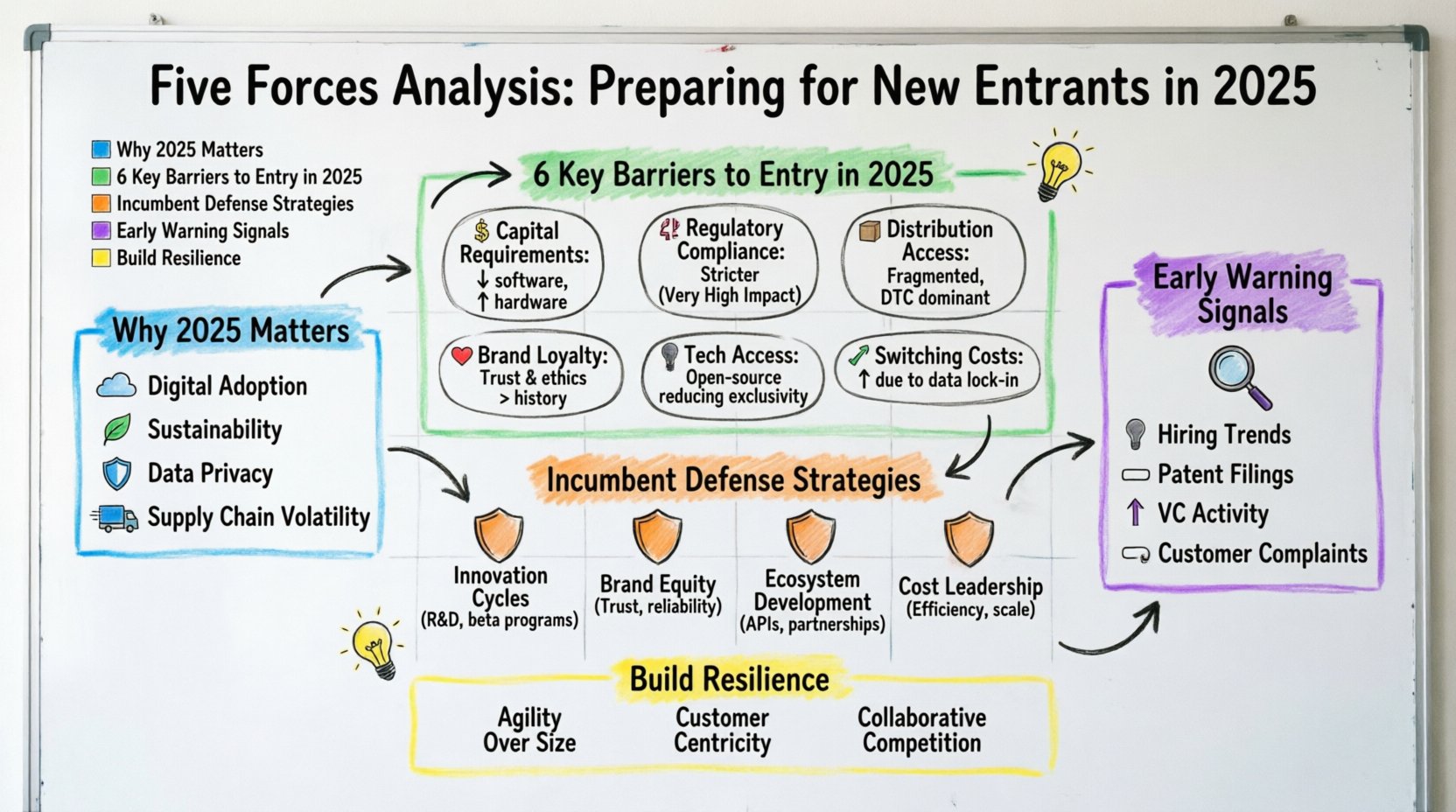
🧩 Understanding the Threat of New Entrants
The Threat of New Entrants refers to the ease with which competitors can enter your market. When barriers are low, new companies can launch quickly, capture market share, and drive prices down. When barriers are high, incumbents enjoy stability and higher profit margins.
In 2025, this force is not static. It is influenced by macroeconomic factors, digital infrastructure, and global supply chains. A comprehensive analysis requires looking beyond simple financial metrics. We must consider how quickly a new player can replicate your value proposition.
Why 2025 is a Critical Juncture
Several converging trends make the next two years significant for competitive analysis:
- Accelerated Digital Adoption: Cloud computing and SaaS models have lowered initial costs for many sectors.
- Sustainability Pressures: New entrants often build green credentials into their DNA, challenging older, polluting incumbents.
- Data Privacy Regulations: Laws like GDPR and CCPA create new compliance costs that can either block or enable entry.
- Supply Chain Volatility: Reshoring trends are altering where and how products are manufactured.
Ignoring these shifts leaves an organization vulnerable. A thorough Five Forces Analysis must account for these variables to remain accurate.
🛡️ Key Barriers to Entry in 2025
To defend against new competition, you must understand the walls protecting your market. In 2025, these walls are made of more than just money. They are constructed from technology, relationships, and compliance.
Below is a structured overview of the primary barriers you will face and observe.
| Barrier Type | Definition | 2025 Outlook | Impact Level |
|---|---|---|---|
| Capital Requirements | Initial investment needed to start operations. | Decreasing in software; Increasing in hardware/energy. | High |
| Regulatory Compliance | Laws governing industry operations. | Stricter, especially in data and health sectors. | Very High |
| Access to Distribution | Ability to reach customers effectively. | Fragmented; direct-to-consumer channels dominate. | Medium |
| Switching Costs | Costs incurred by customers changing providers. | Increasing due to data lock-in and integration. | High |
| Technological Access | Proprietary tech or patents. | Open-source alternatives are reducing exclusivity. | Medium |
| Brand Loyalty | Customer attachment to existing names. | Shifting towards trust and ethics over history. | Medium |
Detailed Breakdown of Barriers
1. Capital Requirements 💰
Traditionally, heavy industries like automotive or manufacturing required massive capital to enter. In 2025, the barrier for software and digital services is significantly lower. However, the cost of customer acquisition has risen sharply. New entrants must spend more to gain visibility in a crowded digital marketplace.
Conversely, in energy and physical infrastructure, capital requirements are rising due to the need for sustainable technology and resilient supply chains.
2. Regulatory Compliance ⚖️
Governments are tightening rules around data usage, environmental impact, and labor practices. A new entrant must navigate this maze before selling a single unit. For incumbents, existing compliance frameworks are an asset. For new players, this is a significant time and cost sink.
Key areas to watch include:
- Data sovereignty laws.
- Carbon emission reporting.
- Consumer protection standards.
3. Access to Distribution 📦
Control over how a product reaches the consumer is a classic barrier. However, the rise of e-commerce marketplaces has democratized access. A new brand can now reach global audiences without building a physical retail network.
Incumbents must secure partnerships with these platforms or build their own direct-to-consumer channels to maintain advantage. Relying solely on third-party distributors is a risk.
4. Switching Costs 🔗
If a customer finds it easy to leave, they will. High switching costs protect incumbents. In 2025, this is driven by data integration. If a customer’s entire workflow is embedded in your system, they are less likely to move.
However, interoperability standards are improving. Customers expect to move their data freely. This reduces the friction of leaving, forcing companies to rely on superior service rather than technical lock-in.
🤖 Technological Disruption and Cost Structures
Technology is the great equalizer. It lowers the cost of production and distribution, often inviting new entrants. However, it also creates new moats for those who own the infrastructure.
The Role of Artificial Intelligence
AI tools are becoming commoditized. Startups can now access sophisticated analytics and automation that were once exclusive to large corporations. This levels the playing field in terms of efficiency.
- Customer Service: Chatbots reduce the need for large support teams.
- Personalization: Algorithms can tailor offers without human intervention.
- Operations: Predictive maintenance and inventory management are accessible via API.
Incumbents cannot rely on their size alone. They must innovate faster than the new entrants adopting these tools.
Cloud Infrastructure
The shift to cloud-based operations means you do not need to build servers. You pay for what you use. This allows new competitors to scale rapidly without heavy upfront investment.
The risk lies in vendor lock-in. If a new entrant builds entirely on a specific cloud ecosystem, they may face high costs later. Incumbents often have hybrid models that offer more flexibility.
⚖️ Regulatory and Compliance Hurdles
As the global economy becomes more interconnected, regulations are becoming a primary filter for market entry. This is particularly true in finance, healthcare, and energy.
Data Privacy and Security
Handling customer data is no longer optional. It is a core business function. New entrants must design their systems with privacy by default. This adds complexity to the development cycle.
Incumbents with established security reputations hold an advantage. Customers are wary of sharing data with unknown entities. A breach can destroy a new company before it gains traction.
Environmental Standards
Sustainability is no longer a marketing buzzword; it is a compliance requirement in many jurisdictions. New entrants may have an advantage here if they are built from the ground up to be green.
Older companies often face the challenge of retrofitting legacy systems. This creates a temporary vulnerability where a new, clean competitor can capture eco-conscious customers.
🛡️ Incumbent Defense Strategies
Knowing the threats is only half the battle. You must act to defend your position. The following strategies are effective for maintaining market share against new entrants.
1. Innovation Cycles
Do not wait for a competitor to disrupt you. Disrupt yourself. Maintain a dedicated R&D budget focused on emerging technologies. If you lead the curve, you define the barriers for others.
- Launch beta programs for new features.
- Partner with academic institutions.
- Acquire small startups to absorb their technology.
2. Strengthen Brand Equity
Trust takes years to build but minutes to lose. Invest in your brand story. Highlight reliability, security, and ethical practices.
Customers often prefer the known entity over the new unknown. Reinforce this preference by showcasing longevity and consistent performance.
3. Ecosystem Development
Build a network of partners, developers, and complementary products. If your customers are part of a larger ecosystem, they are less likely to leave.
- Create API programs for third-party integrations.
- Offer loyalty rewards that work across partner networks.
- Develop standards that others must follow to join your platform.
4. Cost Leadership
If you can offer the lowest price without sacrificing quality, you deter new entrants who cannot match your margins. Achieve this through operational efficiency and economies of scale.
However, be careful not to enter a price war that erodes value for everyone. Use cost advantages to fund innovation instead.
🔍 Signals to Watch for Disruptors
How do you know a new competitor is coming? You can spot the signs before they launch a full product. Monitoring these indicators is crucial for early warning.
1. Hiring Trends
Check job boards for roles related to your industry. If you see a surge in hiring for specific technical skills or sales roles in a new region, a competitor may be preparing to enter.
- Look for senior leadership hires from your sector.
- Monitor recruitment for specialized roles.
- Track expansion into new geographic locations.
2. Patent Filings
Companies often file patents before releasing products. Analyze patent databases for keywords related to your core technology.
A sudden increase in filings by a non-competing company suggests they are pivoting into your space.
3. Venture Capital Activity
Follow investment firms. If they are funding startups in your sector, capital is flowing. This means new entrants have the resources to scale quickly.
Track the amount of funding and the valuation of these startups. High valuations indicate confidence and aggressive growth plans.
4. Customer Complaints
Listen to what customers say about your competitors. If they complain about poor support or high prices, a new entrant can position themselves as the solution.
Monitor social media and review sites. Unmet needs are opportunities for disruption.
🌱 Long-Term Industry Resilience
The ultimate goal is not just to survive the entry of new players, but to build an industry that is resilient. This requires a shift in mindset from defense to adaptation.
Agility Over Size
Large organizations often struggle to pivot. New entrants are agile. To compete, you must adopt smaller, cross-functional teams that can make decisions quickly.
Reduce bureaucracy. Empower employees to test new ideas without excessive approval layers.
Customer Centricity
The customer decides who wins. Focus relentlessly on their experience. If you solve their problems better than anyone else, the threat of new entrants diminishes.
- Gather feedback continuously.
- Personalize interactions.
- Remove friction from the buying journey.
Collaborative Competition
Not all competition is zero-sum. Consider partnerships with new entrants. They may have technology you lack; you may have distribution they need.
Strategic alliances can turn a threat into an opportunity for growth.
📊 Final Considerations for Strategic Planning
Preparing for the future requires a disciplined approach to analysis. Do not rely on assumptions. Gather data. Update your models regularly. The market of 2025 will not look like the market of 2020.
Key takeaways for your strategy include:
- Re-evaluate Barriers: What protected you last year may not protect you next year.
- Monitor Tech: Keep an eye on emerging tools that lower entry costs.
- Watch Regulations: Compliance is a barrier, but also a risk.
- Invest in Brand: Trust is your strongest defense against new money.
- Stay Agile: Speed of execution is a competitive advantage.
By integrating these insights into your Five Forces Analysis, you gain a clearer view of the competitive horizon. This allows you to allocate resources effectively and mitigate risks before they materialize. The threat of new entrants is inevitable, but the impact is manageable with the right preparation.
Related posts:
 Five Forces Analysis for Startups: The Definitive Overview You Need Before Launching
 How Tech Founders Use Five Forces Analysis to Spot Market Gaps in 2024
 Five Forces Analysis Checklist: A Step-by-Step Guide for First-Time Entrepreneurs
 The Real Cost of Ignoring the Five Forces: Common Mistakes That Kill Startups