


Founders often start their journey with a blank slate, but the market landscape is rarely empty. Understanding where your business fits within the competitive ecosystem is critical for survival. This is where the Five Forces Analysis comes into play. Developed by Michael Porter, this framework helps organizations evaluate the competitive intensity of their industry. However, many early-stage entrepreneurs find the traditional model overwhelming. It was designed for large corporations with vast resources, not for a lean startup trying to validate a product-market fit.
Does this mean you should ignore it? No. Does it mean you need to replicate the full corporate version? Also no. The goal here is to adapt the framework to the reality of an early-stage venture. We will strip away the academic complexity and focus on the actionable intelligence that matters for growth and sustainability.
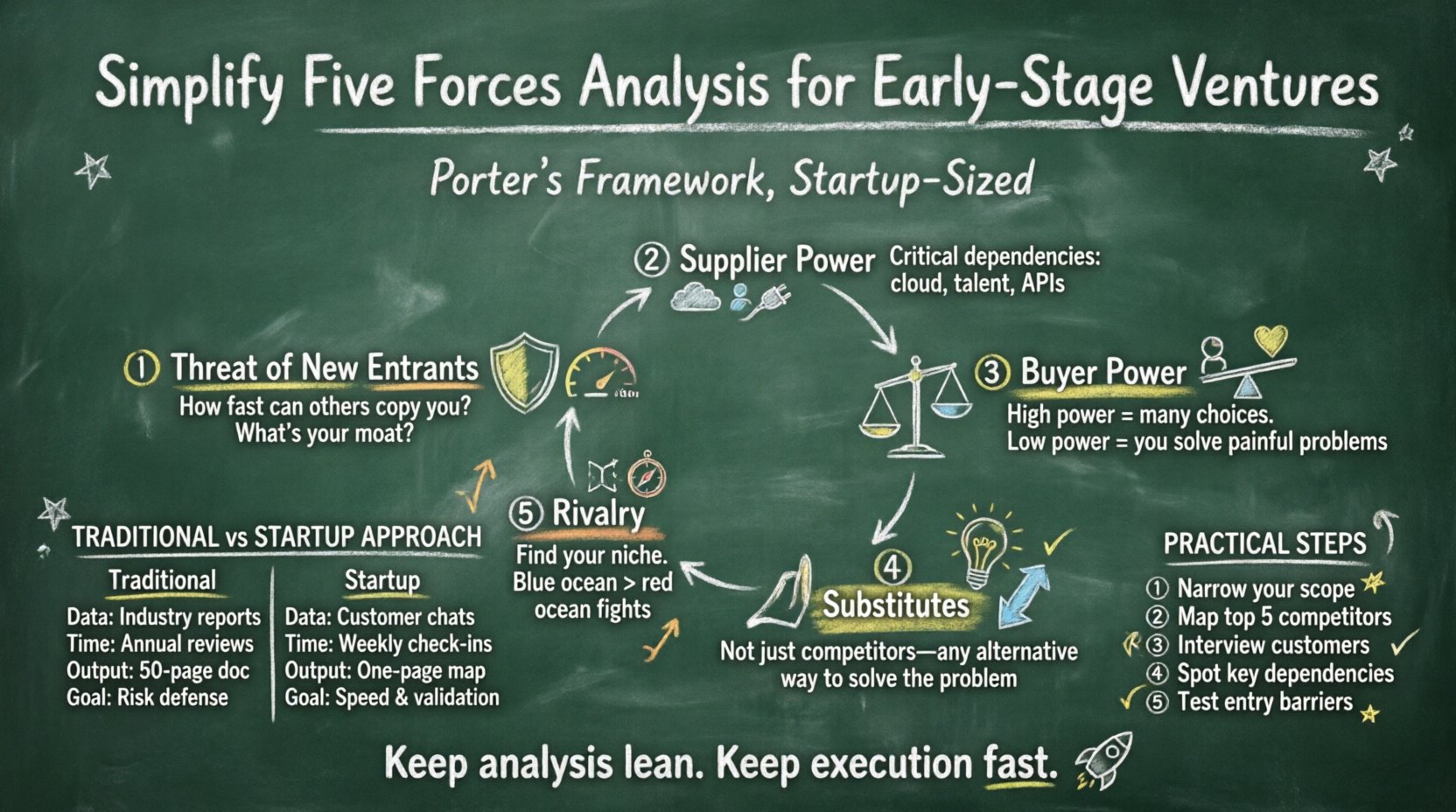
Why the Traditional Model Feels Overwhelming 🤯
When you first encounter Porter’s Five Forces, you might see a diagram with five distinct forces interacting in a cycle. In a textbook setting, each force requires deep quantitative data, extensive market research, and years of historical performance metrics. For a startup, time is the scarcest resource. Spending weeks gathering data on supplier bargaining power before launching your Minimum Viable Product (MVP) is often impractical.
The complexity arises from several factors:
- Data Intensity: Traditional analysis relies on financial reports and industry benchmarks that do not exist for new markets.
- Static Nature: The model assumes a snapshot in time, whereas startups operate in a rapidly shifting environment.
- Resource Requirements: It assumes the ability to hire strategists and consultants to interpret the data.
- Over-Engineering: It invites a “perfect is the enemy of good” mindset, delaying execution.
The challenge for founders is to extract the strategic value without getting bogged down in the mechanics. We need to shift from a compliance-based exercise to a strategic thinking tool.
Breaking Down the Five Forces for Startups 🛠️
To simplify this, we must reinterpret each force through the lens of a new venture. Instead of looking at industry-wide averages, look at your immediate ecosystem. Here is how each force translates for an early-stage company.
1. Threat of New Entrants 🚪
For established companies, this force looks at how easy it is for competitors to copy their business model. For a startup, this is a double-edged sword. You are the new entrant, but you are also facing the threat of others entering the same space.
Key Questions for Founders:
- How quickly can a well-funded competitor replicate our solution?
- Are there regulatory hurdles that protect us initially?
- Do we have proprietary technology or data that creates a barrier?
- Is network effect a factor in our specific niche?
Early-stage ventures often rely on speed and agility as their primary defense. If you can build a brand or community faster than the incumbents can react, you reduce the threat of new entrants. However, if your business model is easily copyable (e.g., a simple e-commerce store), you must focus on differentiation immediately.
2. Bargaining Power of Suppliers 📦
In a traditional sense, this measures how much control vendors have over your costs. In a startup context, this often refers to critical inputs like cloud infrastructure, talent, or raw materials.
Startup Specific Risks:
- Cloud Dependencies: Relying heavily on a single cloud provider can give them pricing power as you scale.
- Talent Scarcity: If your product depends on a specific skill set (e.g., AI engineering), the “suppliers” (the labor market) have significant leverage.
- Key Partnerships: Do you rely on a single API provider to function? If they change terms, your business is at risk.
Simplification Strategy: Do not map every vendor. Identify the top three critical dependencies. Diversify where possible, or negotiate long-term agreements early if you have traction.
3. Bargaining Power of Buyers 👥
This force assesses how much pressure customers can place on you to lower prices or increase quality. For startups, this is often the most immediate concern.
High Power Scenarios:
- Customers have many alternatives to choose from.
- The product is not differentiated enough to justify a premium.
- Switching costs for the customer are low.
- Customers are price-sensitive and well-informed.
Low Power Scenarios:
- Your solution solves a critical, painful problem.
- Integration into the customer’s workflow is deep.
- The market is fragmented, and you have a clear leader position.
- Brand loyalty is already forming.
For early-stage ventures, the goal is to move buyers from the “high power” side to the “low power” side through value creation, not just price cuts.
4. Threat of Substitute Products or Services 🔄
This is frequently the most misunderstood force. Substitutes are not just direct competitors; they are alternative ways to solve the same underlying problem.
Examples of Substitutes:
- For a Project Management Tool: The substitute might be a dedicated spreadsheet or a simple email thread.
- For a Food Delivery App: The substitute might be cooking at home or ordering directly from a restaurant’s website.
- For a Fitness App: The substitute might be a gym membership or a personal trainer.
Founders often look at direct competitors and ignore substitutes. This is a strategic error. If your product is a solution to a problem that can be solved easily without your tool, the threat is high. You must assess the job to be done. If the cost of using the substitute is low, you must demonstrate that your solution is significantly better.
5. Rivalry Among Existing Competitors ⚔️
This is the most visible force. It involves the intensity of competition in the current market. For startups, this can be the most dangerous force if the market is saturated.
Indicators of High Rivalry:
- Many competitors of similar size.
- Slow industry growth.
- High fixed costs leading to price wars.
- Lack of differentiation in the market.
Indicators of Low Rivalry:
- Market is emerging or fragmented.
- Barriers to entry are high (even for you).
- Competitors are focused on different segments.
- Innovation is rapid, keeping the market dynamic.
For an early-stage venture, the best strategy is often to find a niche where rivalry is low. This is known as a blue ocean strategy. Instead of fighting for market share in a crowded space, create a new space where competition is irrelevant.
Traditional vs. Simplified Framework Comparison 📊
To make this actionable, let’s compare how a large corporation approaches this analysis versus how a startup should approach it.
| Aspect | Traditional Corporate Approach | Startup Simplified Approach |
|---|---|---|
| Data Source | Industry reports, annual filings, paid data subscriptions. | Customer interviews, competitor websites, public job postings. |
| Timeframe | Quarterly or Annual review cycles. | Continuous, integrated into weekly strategy meetings. |
| Depth | Quantitative, statistical analysis. | Qualitative, scenario-based thinking. |
| Output | Comprehensive strategic document (50+ pages). | One-page strategic map or dashboard. |
| Goal | Long-term risk mitigation and market defense. | Speed to market and validation of assumptions. |
Notice the shift from quantitative to qualitative. Startups do not have the luxury of waiting for perfect data. They must make decisions with imperfect information. The simplified approach focuses on hypothesis testing.
Practical Steps to Apply This Framework 🏃♂️
How do you take this from theory to practice without spending months on it? Here is a step-by-step workflow.
Step 1: Define Your Scope
Do not try to analyze the entire global market. Define your specific segment. Are you targeting small businesses in the US? Are you targeting enterprise clients in Europe? Narrowing the scope makes the analysis manageable.
Step 2: Map Your Direct Competitors
List the top 5 to 10 companies solving the same problem. Look at their pricing, their feature sets, and their customer reviews. This gives you immediate data on the Rivalry Among Existing Competitors and the Threat of Substitutes.
Step 3: Talk to Your Customers
Ask them why they chose their current solution. Ask them what frustrates them about the alternatives. This provides direct insight into the Bargaining Power of Buyers.
Step 4: Identify Critical Dependencies
What do you need to run your business? If you need a specific API, a specific manufacturing partner, or a specific distribution channel, assess how easy it is to switch them. This addresses the Bargaining Power of Suppliers.
Step 5: Assess the Entry Barrier
Why didn’t someone else do this before? Is it because the market wasn’t ready? Or is it because the cost is too high? If the cost is low, the Threat of New Entrants is high. If the cost is high, you have a moat.
Common Pitfalls to Avoid ⚠️
Even with a simplified approach, founders can make mistakes that invalidate the analysis.
- Assuming Static Conditions: The market changes fast. A force that is weak today might be strong tomorrow. Revisit your analysis every quarter.
- Ignoring the Unconscious Competitor: Sometimes the biggest threat isn’t a company, but human behavior. For example, people’s unwillingness to change habits.
- Focusing on Price Only: Price is a function of value. If you lower prices without increasing value, you erode your position against rivals without fixing the underlying dynamic.
- Over-relying on Secondary Data: Industry reports are often outdated by the time they are published. Trust primary data (your customers) more than secondary data.
- Paralysis by Analysis: Do not let the analysis stop you from shipping. Use the insights to guide your next sprint, not to delay your launch.
When Not to Use the Five Forces Analysis 🛑
While powerful, this framework is not a magic wand. There are scenarios where it offers little value.
- First-Mover Innovation: If you are creating a completely new category, there are no competitors to analyze. The framework assumes an existing industry structure.
- Hyper-Growth Phases: During rapid scaling, the focus should be on execution and growth hacking, not deep strategic analysis.
- Platform Businesses: For two-sided marketplaces, the dynamics are more complex than the linear model of Porter’s forces suggests. Network effects dominate.
- Non-Profit or Social Ventures: The profit motive drives the traditional analysis. Social value creation requires a different set of metrics.
Integrating with Other Tools 🔗
The Five Forces Analysis works best when combined with other strategic tools. It should not stand alone.
- SWOT Analysis: Use the insights from the Five Forces to fill out the Threats and Opportunities sections of a SWOT matrix.
- Business Model Canvas: The Key Partners and Key Activities blocks can be informed by the supplier and rivalry forces.
- Value Proposition Design: Ensure your value proposition directly counters the forces that threaten your business model.
Real-World Application: A SaaS Example 💻
Let’s look at a hypothetical SaaS startup building an AI-powered customer support tool.
- Threat of New Entrants: High. The tech stack is accessible. However, they have a proprietary dataset that improves the AI over time. This creates a moat.
- Bargaining Power of Suppliers: Low. They use standard cloud infrastructure available to everyone. No single vendor holds leverage.
- Bargaining Power of Buyers: Medium. Customers have many alternatives. However, switching costs are high because data must be migrated.
- Threat of Substitutes: Medium. Customers could use a human team or a chatbot from a generalist platform.
- Rivalry Among Competitors: High. Many startups are entering this space. Differentiation must be based on specific industry verticals (e.g., support for healthcare only).
This analysis tells the founders that their strategy should focus on vertical specialization to reduce rivalry and switching costs to reduce buyer power. It also highlights the need to protect their data asset to mitigate new entrants.
Final Thoughts on Strategic Simplicity 🧠
The goal of any strategic framework is clarity, not complexity. The Five Forces Analysis is a robust tool for understanding industry structure, but it requires adaptation for the startup context. By simplifying the data requirements and focusing on the immediate ecosystem, founders can gain actionable insights without the overhead of corporate strategy.
Remember that strategy is not about predicting the future perfectly. It is about making the best decisions with the information available today. Use this framework to challenge your assumptions, validate your risks, and build a business model that is resilient against market forces. The market will test you regardless of your analysis, so equip yourself with the right questions before you face the answers.
Keep your analysis lean. Keep your execution fast. And always remember that the most successful ventures are often those that simplify the complex world into a clear, valuable proposition for their customers.