


Strategic planning often begins with a clear understanding of the competitive landscape. Among the various frameworks available, Porter’s Five Forces remains a cornerstone for evaluating industry attractiveness and profitability. While the model covers supplier power, threat of substitution, threat of new entrants, and rivalry, the component regarding buyer power frequently dictates pricing strategies and margin sustainability. Often, organizations face a significant hurdle: the absence of granular data. Despite this constraint, a rigorous qualitative assessment can yield actionable insights.
This guide explores how to dissect buyer power within the Five Forces framework when specific metrics are unavailable. We will examine the qualitative signals that indicate leverage, the structural factors influencing buyer behavior, and strategic responses to mitigate risk. By understanding the underlying mechanics of demand, decision-makers can navigate uncertainty with precision.
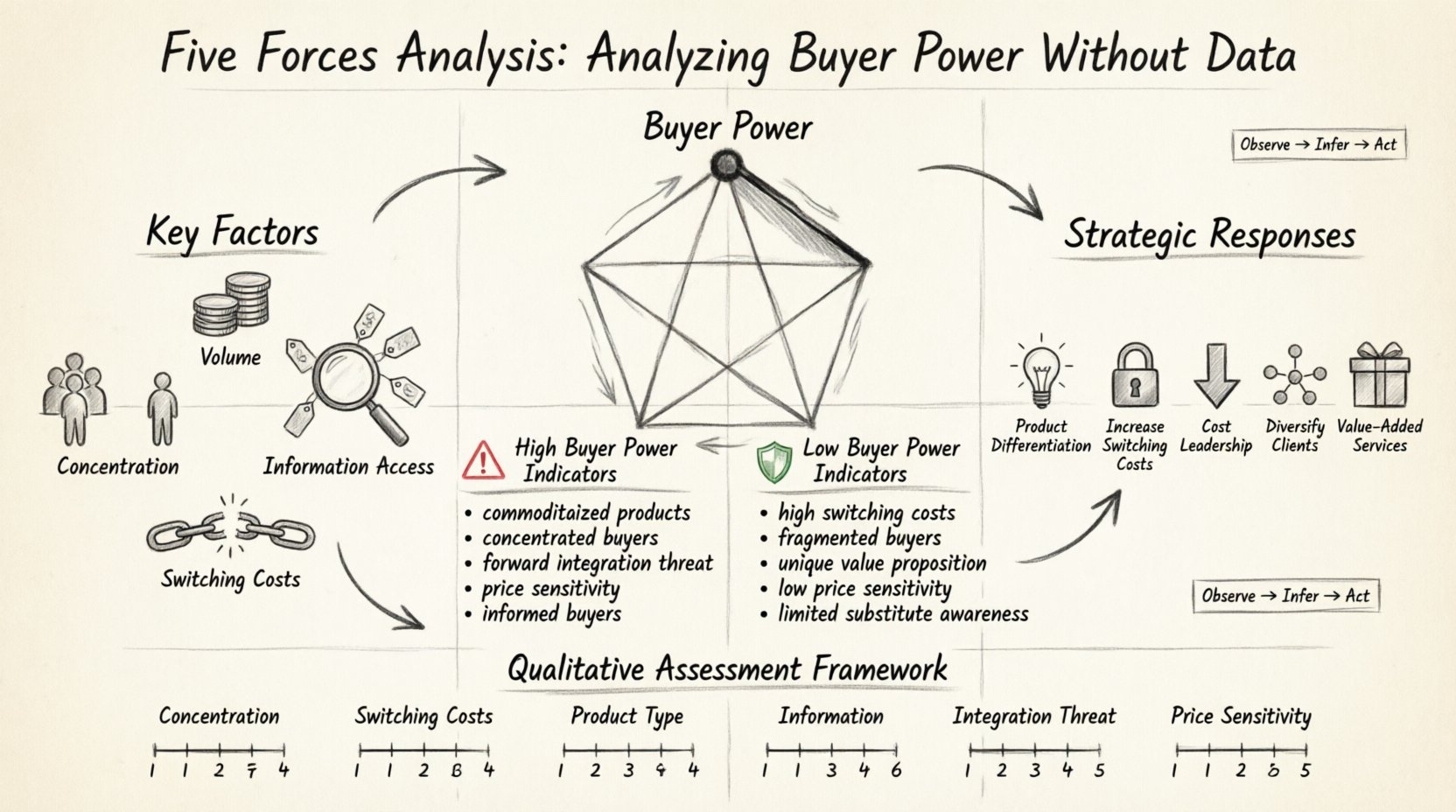
Understanding Buyer Power in Porter’s Framework 🏭
Buyer power refers to the ability of customers to drive prices down, demand higher quality, or request more services. In a perfectly competitive market, buyers have significant leverage. However, in many industries, this power is diluted by product differentiation or switching costs. When data is scarce, the focus shifts to structural characteristics of the market.
High buyer power exerts pressure on profitability. It forces companies to compete on price rather than value. Conversely, low buyer power allows for pricing stability and investment in innovation. The distinction is not always binary; it exists on a spectrum influenced by market dynamics.
Key characteristics that define buyer power include:
- Concentration: How many buyers exist relative to the number of sellers?
- Volume: Does a single buyer account for a significant portion of total revenue?
- Information Access: Do buyers know the costs and prices of competitors?
- Switching Costs: How difficult or expensive is it for a buyer to change providers?
Without access to financial statements or market share reports, these elements must be inferred through observation and industry knowledge. The goal is to construct a mental model of the relationship between the supplier and the customer.
Navigating Information Gaps 🕵️♂️
Data scarcity is common in early-stage ventures, niche markets, or emerging industries where historical records are nonexistent. Relying solely on quantitative metrics can lead to analysis paralysis. Instead, qualitative proxies serve as effective substitutes. These proxies are observable behaviors and structural realities that signal power dynamics.
When specific numbers are missing, consider the following approaches to gather intelligence:
- Direct Observation: Watch how buyers interact with competitors. Do they negotiate aggressively? Do they complain frequently about pricing?
- Interviews: Engage with sales teams. They often possess anecdotal evidence regarding buyer demands and leverage.
- Public Records: Review annual reports of public competitors. While your own data may be private, competitor disclosures often reveal buyer concentration risks.
- Industry Networks: Leverage professional connections to understand general market trends regarding pricing pressure.
These methods do not replace data, but they fill the void sufficiently to make informed strategic decisions. The absence of numbers does not mean the absence of patterns.
Qualitative Indicators of High Buyer Power 🚩
Identifying high buyer power requires looking for signs of dependence and leverage. When buyers hold the cards, they can dictate terms without fear of losing the supplier. The following indicators suggest a shift in power toward the customer side.
1. Low Product Differentiation
If the product or service is commoditized, buyers have no reason to stay loyal. They can switch providers without losing functionality. In such environments, price becomes the primary differentiator. Buyers will compare quotes relentlessly. This behavior indicates high power because the switching cost is effectively zero.
2. High Concentration of Buyers
Even if there are many buyers in the market, if a small group controls the majority of the volume, power concentrates in their hands. A single large client demanding a discount can impact the supplier’s bottom line significantly. This dynamic is common in B2B sectors where a few large distributors or manufacturers dominate the supply chain.
3. Threat of Forward Integration
Buyers may threaten to produce the product themselves if the price is too high. This is known as forward integration. If a buyer has the capital and technical capability to make the product, they hold a powerful negotiation chip. Even the perception of this threat can suppress prices.
4. Price Sensitivity
Buyers who are highly sensitive to price changes demonstrate power. If a small price increase leads to a significant drop in demand, the buyer is sensitive. This often happens when the product represents a large portion of the buyer’s total costs. In these cases, the buyer scrutinizes every expense line item.
5. Access to Substitute Information
When buyers are well-informed about alternative solutions, they can leverage that knowledge. If they know exactly what competitors charge, they can use that information to pressure suppliers. Information asymmetry is a key source of power; when it is removed, buyer power rises.
Qualitative Indicators of Low Buyer Power 🛡️
Conversely, low buyer power creates an environment where suppliers can maintain margins and invest in growth. Recognizing these indicators helps in validating a favorable market position.
1. High Switching Costs
Switching costs are the barriers that make it difficult or expensive for a buyer to change suppliers. These can be financial, technical, or procedural. For example, if a buyer must retrain staff, reconfigure hardware, or rewrite software to switch, they are locked in. This lock-in reduces their ability to negotiate aggressively.
2. Fragmented Buyer Base
When there are thousands of small buyers, no single entity can influence the market. Each buyer represents a tiny fraction of revenue. In this scenario, suppliers have the power to set prices because losing one customer has negligible impact. This is typical in consumer goods markets.
3. Unique Value Proposition
If a supplier offers something unique that cannot be found elsewhere, buyer power diminishes. This uniqueness could be proprietary technology, brand reputation, or specialized service. When buyers perceive the product as essential to their own success, they are less likely to demand price cuts.
4. Low Price Sensitivity
When the product is a small fraction of the buyer’s total cost, they are less likely to negotiate. For instance, a component costing $1 in a $10,000 machine will not be scrutinized heavily. The buyer focuses on the performance of the final product rather than the cost of the component.
5. Lack of Substitute Awareness
If buyers are unaware of alternatives, they cannot compare prices. This lack of information creates a dependency on the current supplier. While ethical considerations apply, this structural ignorance grants the supplier pricing flexibility.
Assessment Framework for Qualitative Analysis 📋
To structure this analysis without raw data, use a scoring framework based on observable traits. This table outlines the factors to evaluate and the signs that indicate power levels.
| Factor | Indicates High Buyer Power | Indicates Low Buyer Power |
|---|---|---|
| Concentration | One or few buyers control most volume | Many small buyers, none dominant |
| Switching Costs | Easy to change providers, no training needed | High technical or contractual barriers |
| Product Type | Commodity, standard, undifferentiated | Specialized, proprietary, complex |
| Information | Buyers know market prices and costs | Buyers rely on supplier for info |
| Integration Threat | Buyer can make product in-house | Buyer lacks capability or capital |
| Price Sensitivity | High, price is major cost driver | Low, performance is major driver |
When analyzing a specific industry, assign a qualitative weight to each factor. If most indicators point to high power, the strategic assumption should be that margins are under threat. If the indicators point to low power, the strategy can focus on volume growth and brand building.
Strategic Responses to Strong Buyers 🛠️
Identifying high buyer power is only the first step. The real value lies in formulating a response. When buyers are strong, the supplier must find ways to reduce that leverage or absorb the pressure without eroding profitability.
1. Product Differentiation
Strengthening the uniqueness of the offering reduces the buyer’s ability to switch. If the product solves a specific problem better than anyone else, price becomes secondary. Investment in R&D or service layers can create this differentiation.
2. Increasing Switching Costs
Intentionally build barriers that make leaving less attractive. This might involve offering long-term contracts with favorable terms, integrating systems deeply with the buyer, or providing training that is specific to the supplier’s tools. The goal is to make the relationship sticky.
3. Cost Leadership
If differentiation is impossible, efficiency becomes the defense. By lowering internal costs, a company can withstand price wars better than competitors. This requires rigorous operational discipline and a focus on lean processes.
4. Diversification of Client Base
Relying on a few large buyers is risky when they have power. Expanding into smaller segments or different geographic regions dilutes the influence of any single client. This spreads the risk and reduces the leverage of dominant buyers.
5. Value-Added Services
Shift the conversation from price to value. Offer consulting, analytics, or support that goes beyond the core product. When buyers purchase a solution rather than a commodity, they are less sensitive to the base price.
Monitoring Shifts Over Time 📅
Buyer power is not static. It evolves as the market changes. A supplier that has low buyer power today might face high power in five years if the market consolidates or technology shifts. Continuous monitoring is essential.
Look for these signals of change:
- Mergers and Acquisitions: If buyers merge, their concentration increases. This concentrates power.
- Technological Shifts: New technology might lower switching costs, empowering buyers to move freely.
- Economic Cycles: In recessions, buyers become more price-sensitive. In booms, they focus on availability and quality.
- Regulatory Changes: New laws might force buyers to look for cheaper options or change how they procure goods.
Without real-time data dashboards, these shifts must be tracked through market news, competitor movements, and customer feedback loops. Regularly revisiting the assessment framework ensures the strategy remains aligned with reality.
Integrating with Other Strategic Tools 🧩
The Five Forces analysis does not exist in isolation. It works best when combined with other strategic tools. Understanding buyer power informs SWOT analyses, positioning strategies, and financial planning.
For example, in a SWOT analysis, high buyer power appears as a Threat. Low buyer power appears as an Opportunity. This classification helps prioritize resources. If buyer power is a major threat, resources should be allocated to differentiation or cost reduction. If it is an opportunity, resources can be directed toward market expansion.
Additionally, this analysis impacts financial forecasting. High buyer power suggests lower revenue growth rates and tighter margins. Low buyer power suggests the potential for margin expansion. Financial models should reflect these qualitative assessments to avoid overestimating future cash flows.
Common Pitfalls in Qualitative Assessment ⚠️
Even with a structured approach, errors can occur when data is missing. Being aware of common pitfalls helps maintain the integrity of the analysis.
- Confirmation Bias: Assuming buyers are weak because you want them to be. Challenge this assumption by actively looking for signs of power.
- Overgeneralization: Assuming all buyers in an industry have the same power. Different segments may have different leverage levels.
- Ignoring Hidden Costs: Focusing only on price while ignoring the total cost of ownership for the buyer. High switching costs might hide in operational complexity.
- Neglecting Future Trends: Analyzing the current state without considering where the market is heading. A stable market today might consolidate tomorrow.
Strategic rigor requires acknowledging these limitations. The goal is not perfection, but a sufficiently accurate representation to guide action.
Conclusion on Strategic Autonomy 🏁
Conducting a Five Forces analysis without granular data is not only possible but often necessary. The absence of numbers does not preclude strategic clarity. By focusing on structural indicators, behavioral signals, and market dynamics, organizations can assess buyer power with confidence.
The strength of this approach lies in its adaptability. It relies on observation and logic rather than expensive data collection. This allows for faster decision-making in volatile environments. While data provides precision, qualitative analysis provides direction. In many cases, direction is the most valuable asset a strategy team can possess.
By systematically evaluating concentration, switching costs, and differentiation, leaders can anticipate pressure points and adjust their business models accordingly. The result is a resilient organization capable of navigating buyer dynamics regardless of data availability.