


Investors see hundreds of pitch decks. Most look the same. They promise growth, outline a market, and show a team. But the ones that stick? They show deep market understanding. They don’t just say “the market is big.” They explain why the market is big, who fights for it, and how you plan to win without getting crushed in the crossfire. This is where the Porter’s Five Forces Analysis comes into play. It is not just a business school exercise. It is a strategic necessity for serious fundraising.
Many founders skip this section. They assume it belongs in a business plan document tucked away in a drawer. This is a mistake. When an investor asks about your competitive landscape, they are really asking about risk. Five Forces quantifies that risk. It transforms vague assumptions into structured data. It shows you know the terrain before you send troops into battle.
In this guide, we will break down exactly why this analysis belongs in your deck, how to structure it for clarity, and the common pitfalls that make founders lose credibility. We will move beyond the definitions and into the application. Let us look at how to build a section that adds weight to your narrative.
What Investors Are Really Looking For 🧐
Before we dive into the forces, we need to understand the investor mindset. They are not looking for perfection. They are looking for honesty about the challenges. A deck that claims “we have no competition” is often a red flag. It suggests a lack of market research. A deck that analyzes the competitive pressure points shows maturity.
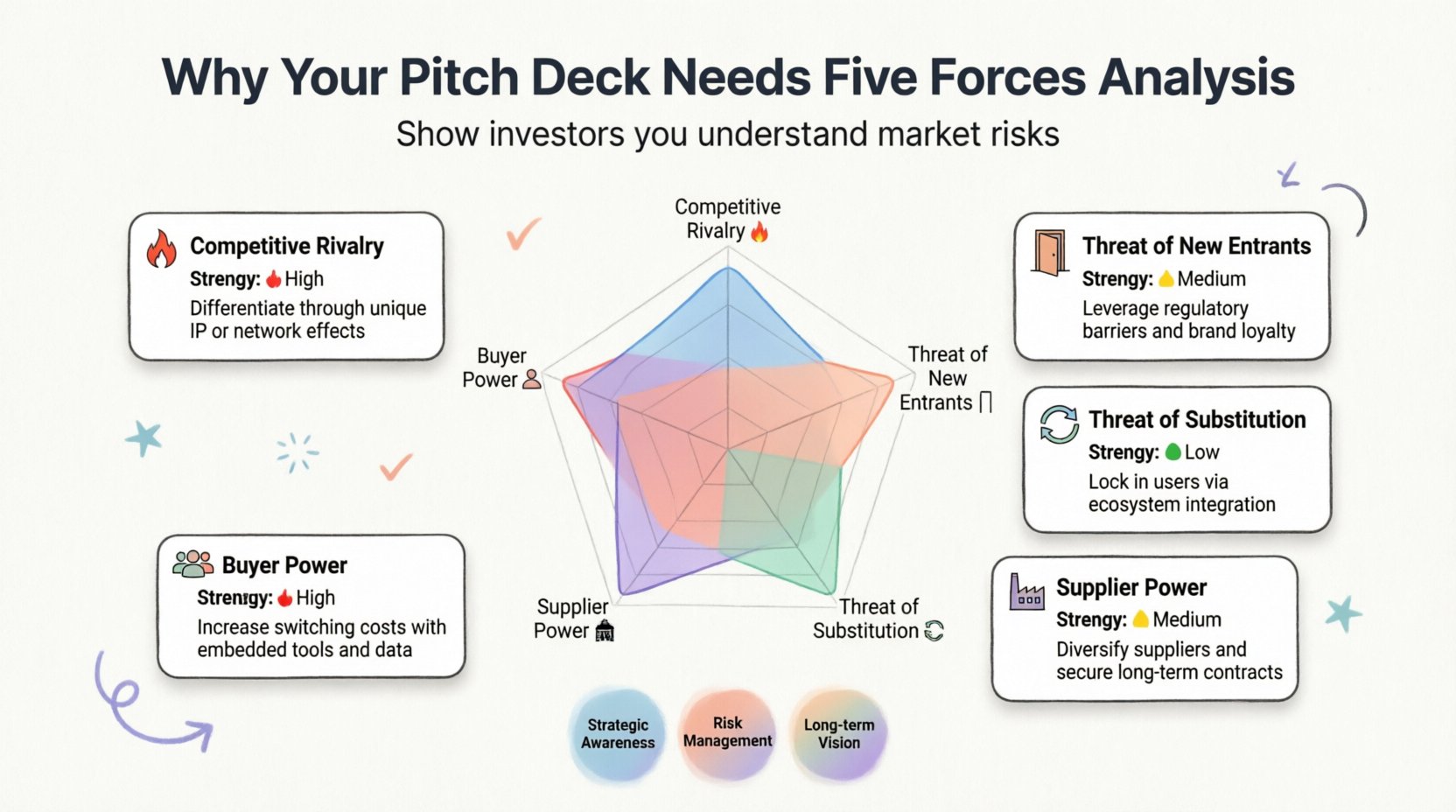
When you include a Five Forces section, you are signaling three things:
- Strategic Awareness: You understand the ecosystem, not just your product.
- Risk Management: You have identified where margins might get squeezed.
- Long-term Vision: You are thinking about sustainability, not just the next quarter.
Think of this section as your defense strategy. It answers the question: “If you succeed, who will try to stop you, and how strong are they?” It turns your pitch from a dream into a plan.
Breaking Down the Five Forces 🛡️
Michael Porter introduced this framework in 1979. It remains relevant because human dynamics in business have not changed. The forces are structural. They dictate profitability. Here is how you translate them into pitch deck content.
1. Competitive Rivalry 🔥
This is the most obvious one. How intense is the competition in your space? Is the market crowded? Are price wars common? In your deck, do not just list competitors. Analyze the intensity.
What to include:
- Market concentration (Is it fragmented or dominated by giants?)
- Growth rate (Fast growth allows more room; slow growth leads to fighting)
- Exit barriers (Is it hard for competitors to leave the market?)
If rivalry is high, explain your differentiation. If it is low, explain why that is the case. Honesty here builds trust.
2. Threat of New Entrants 🚪
Barriers to entry protect your margins. If anyone can copy your model tomorrow, your valuation suffers. This force asks: How hard is it for a new player to enter your market?
Key factors to highlight:
- Capital requirements (Do you need millions to start?)
- Regulatory hurdles (Are there licenses needed?)
- Access to distribution channels (Can new players reach customers easily?)
- Switching costs (Do customers get stuck with you?)
If you have high barriers, highlight them. If you do not, explain how you will build a moat over time. This shows you are thinking about defensibility.
3. Threat of Substitution 🔄
Substitution is often overlooked. It is not just about direct competitors. It is about alternatives. If you sell a project management tool, the substitute is not just another tool. It is email, spreadsheets, or doing nothing. Substitution caps your pricing power.
How to frame it:
- Identify non-obvious alternatives.
- Compare price-to-value ratios of substitutes.
- Explain why your solution is superior to the status quo.
This section helps investors understand the ceiling of your pricing. If the substitute is free (like a spreadsheet), your pricing model must reflect that value proposition clearly.
4. Bargaining Power of Suppliers 🏭
Who controls your costs? If you rely on a single supplier for a critical component, they hold the power. They can raise prices, and your margins disappear. In tech, this might mean cloud infrastructure or API access.
Points to address:
- Concentration of suppliers.
- Uniqueness of their inputs.
- Cost of switching suppliers.
- Threat of forward integration (Can the supplier become your competitor?)
Showing you have mitigated supplier risk proves operational maturity. Mentioning diversification strategies adds weight to your operational plan.
5. Bargaining Power of Buyers 👥
Who holds the power in the transaction? If buyers are large enterprises, they demand discounts. If buyers are individuals, they are less powerful. This force dictates your pricing strategy and sales cycle.
Consider these variables:
- Volume of purchases (Are they buying small or bulk?)
- Information availability (Do they know the market price?)
- Switching costs (Can they easily leave you?)
- Price sensitivity (Do they care more about price or quality?)
If buyer power is high, your deck should focus on stickiness, retention, and unique value that makes leaving painful for them.
Structuring the Slide for Maximum Impact 📐
How do you fit this into a deck without overwhelming the reader? You need a dedicated slide or a two-page spread. Do not bury this in a “Market Size” slide. It deserves its own space.
The Visual Approach 🎨
Investors scan. They do not read deeply during the first pass. Use visuals to convey the data.
- Spider Chart: Rate each force from 1 to 10. High threat = 10. Low threat = 1. This gives an instant visual of where the pressure is.
- Heat Map: Color code the forces. Red for high risk, Green for low risk.
- Iconography: Use simple icons for each force to aid recognition.
Here is an example of how to structure the data table for this section:
| Force | Intensity Level | Strategic Response |
|---|---|---|
| Competitive Rivalry | High 🔴 | Focus on niche segmentation |
| Supplier Power | Low 🟢 | Multiple vendor strategy |
| Buyer Power | Medium 🟡 | High switching costs |
| Threat of Entry | Medium 🟡 | Brand building |
| Substitution | Low 🟢 | Continuous innovation |
This table format is clean. It allows investors to see the risk profile and your counter-strategy side-by-side. It shows you are not just identifying problems, but solving them.
Common Mistakes to Avoid ⚠️
Even with good intentions, founders often mess up this section. These errors can undermine the credibility you built in previous slides.
1. Confusing 5 Forces with Competition
A common error is listing competitors on a “5 Forces” slide. This is wrong. The “Competitive Rivalry” force is about the industry structure, not a list of names. Use a separate slide for the competitive landscape matrix. Use 5 Forces for the industry dynamics. Mixing them creates confusion.
2. Overestimating or Underestimating Threats
Do not say “No competition exists.” Investors know this is false. Do not say “The market is dangerous.” Investors want to know you can navigate it. Be nuanced. High rivalry does not mean you will fail. It means you need a strong strategy.
3. Ignoring Trends
Five Forces are not static. Technology changes them. If you ignore how AI might change supplier power or buyer power, your analysis feels dated. Mention how external trends influence these forces. For example, regulatory changes might increase the threat of entry.
4. Lack of Data
Opinions are not evidence. If you claim supplier power is low, back it up. Mention the number of available suppliers or the availability of open-source alternatives. Data grounds your analysis in reality.
Integrating with Financial Projections 💰
How does this analysis connect to your numbers? It should. The Five Forces dictate your margins. If supplier power is high, your cost of goods sold (COGS) might be higher. If buyer power is high, your pricing power is lower. Your financial model must reflect these realities.
When presenting your financials, reference the forces. “We have modeled conservative pricing because buyer power is high.” “We expect margin expansion as we reduce reliance on single-source suppliers.” This creates a cohesive narrative between the market analysis and the money.
Investors will check for consistency. If you say rivalry is low, but your margins are thin, it does not add up. The Five Forces section acts as a sanity check for your financial assumptions.
When to Skip or Simplify 🕒
Is this always necessary? Not always. For early-stage seed rounds where the product is still being validated, a deep dive might be premature. However, even a simplified version helps. If you are in a highly regulated industry, the “Threat of Entry” force is critical to mention. If you are in a commodity market, “Competitive Rivalry” is the most important.
Adjust the depth based on the stage of the company. For Series A and beyond, this analysis is expected. For pre-seed, focus on the biggest risk. But never skip the logic. You must show you understand the forces, even if you do not have a slide for them.
Anticipating Investor Questions 🗣️
Having this section prepared changes the Q&A dynamic. Investors will not ask “What is your competition?” They will ask “How do you handle supplier consolidation?” or “What happens if a new entrant enters with better tech?”
Prepare answers for each force:
- Supplier: “We are diversifying our vendor list to mitigate risk.”
- Buyer: “Our contract terms lock in annual renewals.”
- Substitution: “We are building features that make switching inefficient.”
- Entry: “Our data network effects create a barrier.”
- Rivalry: “We are focusing on underserved segments.”
When you answer these questions directly, you show that the analysis is not just for the slide. It is how you run the business.
The Narrative Arc of the Deck 📖
Where does this slide fit in the flow? Usually, it comes after “Market Size” and before “Business Model.” It bridges the gap between “There is a big market” and “Here is how we make money in that market.” It provides the context for the strategy.
Without this section, the business model feels like magic. With it, the business model feels like a calculated response to market conditions. It turns the story from “We have a great idea” to “We have a viable business in a complex environment.”
Final Thoughts on Credibility 🏆
Writing a Five Forces section is about more than data. It is about confidence. It shows you are not afraid of the market. You have mapped it. You know the risks. You have a plan.
Investors fund teams that see clearly. This section is a proof point of that clarity. It demonstrates that you view the business as a system of forces, not just a product. It elevates the conversation from features to strategy.
Take the time to get this right. Do not copy generic templates. Analyze your specific market. Use real data. Be honest about the threats. When you do this, you do not just get a better pitch deck. You build a better business strategy.
Related posts:
 Five Forces Analysis for Startups: The Definitive Overview You Need Before Launching
 How Tech Founders Use Five Forces Analysis to Spot Market Gaps in 2024
 Five Forces Analysis Checklist: A Step-by-Step Guide for First-Time Entrepreneurs
 The Real Cost of Ignoring the Five Forces: Common Mistakes That Kill Startups