


The technology sector has always been defined by rapid evolution, but the integration of artificial intelligence and automation represents a structural shift unlike any seen before. For business strategists and industry analysts, understanding this shift requires a framework that accounts for changing power dynamics. Porter’s Five Forces remains a robust tool for evaluating competitive intensity, yet the variables within each force are undergoing significant transformation.
This guide examines how intelligent systems and automated workflows are reshaping the competitive landscape. We will look at the mechanics of market entry, supplier leverage, buyer expectations, substitute threats, and direct rivalry. The goal is to provide a clear, data-driven perspective on where the industry is heading without relying on speculative hype.
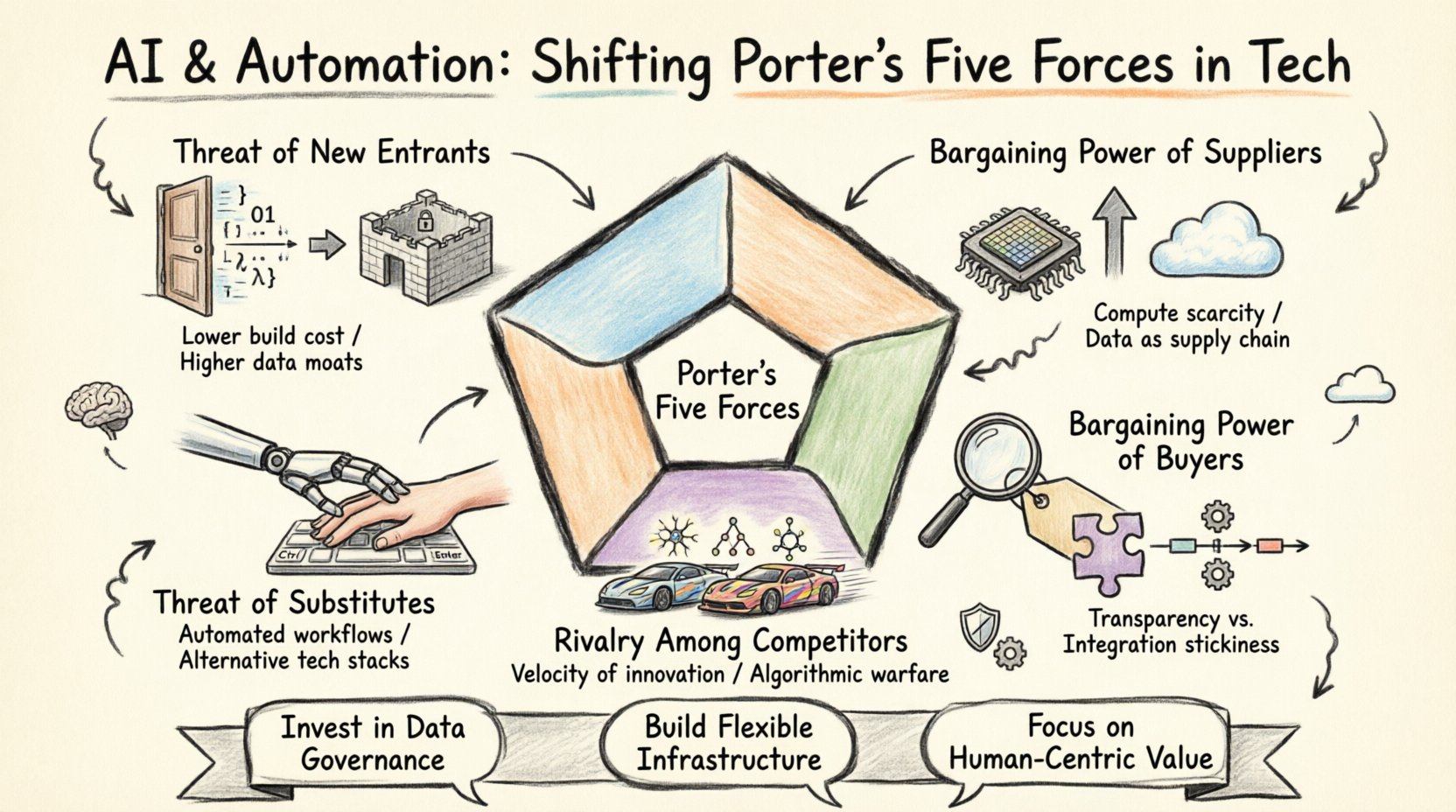
🧠 Understanding the Strategic Framework
Before analyzing specific changes, it is necessary to define the baseline. The Five Forces model assesses the attractiveness of a market based on five key factors:
- Threat of New Entrants: How easy is it for competitors to enter the market?
- Bargaining Power of Suppliers: How much control do vendors have over prices?
- Bargaining Power of Buyers: How much influence do customers have on pricing and quality?
- Threat of Substitute Products: Can alternative solutions meet the same need?
- Rivalry Among Existing Competitors: How intense is the competition between current players?
Traditionally, these forces were analyzed based on capital requirements, physical infrastructure, and brand loyalty. Today, data, compute power, and algorithmic efficiency have become the primary assets. The following sections detail how these specific assets alter the balance of power.
🚪 1. Threat of New Entrants: Lower Barriers, Higher Moats
The dynamics of market entry are becoming paradoxical. On one hand, the tools required to build software are cheaper and more accessible. On the other hand, the scale required to compete effectively is increasing. This duality creates a complex environment for startups and established firms alike.
Reduced Technical Friction
Generative tools and pre-built infrastructure have significantly reduced the cost of development. A small team can now build prototypes that previously required hundreds of engineers. This democratization means:
- Code generation speeds up initial product iterations.
- Cloud services eliminate the need for heavy upfront hardware investment.
- Automated testing reduces the time required to ensure reliability.
The Rise of Data Moats
While building software is easier, winning market share is harder. Competitors can copy features quickly, but they cannot easily replicate the data required to train superior models. This shifts the barrier from building capability to accessing data.
- Companies with historical datasets have a distinct advantage.
- Proprietary data collection becomes a critical defensive strategy.
- Network effects are amplified by AI-driven personalization.
Consequently, the threat of new entrants is low for markets requiring massive data integration, but high for markets where the value proposition is purely functional and easily replicated.
🏭 2. Bargaining Power of Suppliers: Compute and Data Dependence
Suppliers in the tech industry have historically included hardware manufacturers and cloud providers. Automation has expanded the definition of a supplier to include data providers and model developers. This concentration of critical resources alters negotiation power.
Compute Resource Scarcity
AI models require immense processing power. The supply of specialized chips is limited compared to demand. This gives hardware suppliers significant leverage.
- Cost volatility affects profit margins for AI-dependent companies.
- Reliance on specific hardware vendors creates switching costs.
- Energy constraints may limit expansion regardless of capital availability.
Data as a Supply Chain Asset
Training high-performance models requires vast amounts of high-quality data. The availability of clean, labeled data is becoming a bottleneck.
- Scarcity drives up the cost of data acquisition.
- Companies must invest in synthetic data generation to reduce reliance on external sources.
- Regulatory compliance adds complexity to data sourcing.
Strategic partnerships with suppliers are no longer just about cost; they are about securing access to critical resources during capacity constraints.
🛒 3. Bargaining Power of Buyers: Expectations and Switching Costs
Buyer power is increasing due to transparency and the ease of comparison. Automation allows customers to evaluate products faster and more accurately than ever before. However, high switching costs can still lock them in.
Transparency and Price Sensitivity
AI-driven analytics tools allow buyers to understand the true value of a product instantly. This reduces information asymmetry.
- Buyers can benchmark performance metrics against industry standards automatically.
- Price sensitivity increases when features are easily replicated by competitors.
- Expectations for uptime and support are standardized across the industry.
Customization and Integration
Conversely, buyers value solutions that fit their specific workflows perfectly. Automated integration tools lower the friction of adoption, but once embedded, they create stickiness.
- APIs and connectors make switching technically easier, but data migration remains a risk.
- Highly customized AI models create dependency on the original developer.
- Buyers demand continuous improvement, raising the bar for retention.
The balance shifts based on whether the product is commoditized or deeply integrated into the buyer’s operations.
🔄 4. Threat of Substitute Products: Efficiency vs. Human Touch
Substitutes are not just different products; they are different ways of solving a problem. Automation introduces the possibility of replacing human labor with software, which changes the nature of the substitute threat.
Automated Workflows
Tasks previously performed by humans can now be handled by intelligent agents. This creates a direct substitute for service-based offerings.
- Customer support bots replace human agents for tier-one inquiries.
- Automated coding assistants reduce the need for junior development staff.
- Process automation tools bypass the need for intermediate management layers.
Alternative Tech Stacks
Technological breakthroughs can render existing solutions obsolete overnight. A shift in underlying architecture can make current products irrelevant.
- Movement from on-premise to serverless architectures changes cost structures.
- New programming paradigms reduce the need for legacy maintenance.
- Open-source alternatives provide free versions of paid features.
Companies must monitor not only direct competitors but also emerging technologies that solve the same problem with a different approach.
🔥 5. Rivalry Among Existing Competitors: Speed and Algorithmic Warfare
Competition has accelerated. The time between innovation and imitation has shrunk. Companies are no longer fighting just on features, but on the speed of deployment and the quality of their underlying algorithms.
Velocity of Innovation
Automation shortens the development cycle. This forces competitors to maintain a constant pace of release to stay relevant.
- Feature parity is achieved quickly, reducing competitive advantage duration.
- Continuous deployment pipelines become a standard expectation.
- Marketing and sales cycles compress as awareness spreads faster.
Algorithmic Competition
Business logic is increasingly driven by code. Competitors are fighting over the same datasets and user attention through algorithmic optimization.
- Search ranking and recommendation engines dictate visibility.
- Automated bidding wars for digital advertising increase customer acquisition costs.
- Pricing algorithms adjust in real-time based on competitor actions.
Rivalry is now dynamic and continuous, requiring real-time monitoring systems rather than quarterly strategic reviews.
📊 Comparative Analysis: Traditional vs. AI-Shifted Forces
To visualize the shift, we can compare the traditional market dynamics with the current reality driven by automation.
| Force | Traditional Dynamic | AI & Automation Dynamic |
|---|---|---|
| New Entrants | High capital and physical infrastructure required. | Low build cost, high data requirement barrier. |
| Supplier Power | Hardware manufacturers and raw materials. | Compute providers and data curators. |
| Buyer Power | Brand loyalty and contract lock-ins. | Transparency and comparison tools. |
| Substitutes | Alternative manual processes or different tech. | Automated agents and synthetic solutions. |
| Rivalry | Marketing spend and feature differentiation. | Algorithmic efficiency and deployment speed. |
🛡️ Strategic Considerations for Leadership
Leadership teams must adjust their strategic planning to reflect these new dynamics. Relying on historical data alone is insufficient. The following actions provide a roadmap for adaptation.
Invest in Data Governance
Since data is the new moat, maintaining high quality and security is non-negotiable.
- Establish clear protocols for data collection and usage.
- Invest in cleaning and labeling pipelines internally.
- Ensure compliance with evolving privacy regulations.
Build Flexible Infrastructure
Dependency on single vendors creates risk. Diversifying the technology stack ensures resilience.
- Adopt multi-cloud strategies to avoid vendor lock-in.
- Design systems that can integrate with various AI models.
- Prioritize interoperability over proprietary features.
Focus on Human-Centric Value
As automation handles routine tasks, human interaction becomes a premium differentiator.
- Invest in customer experience teams that handle complex issues.
- Highlight ethical AI usage and transparency in communications.
- Develop products that augment human capability rather than just replace it.
⚠️ Emerging Risks and Regulatory Landscapes
While the opportunities are significant, the risks associated with widespread automation are substantial. Regulatory bodies are beginning to scrutinize the use of intelligent systems.
Compliance and Ethics
Legislation is catching up to technology. Companies must anticipate stricter rules regarding algorithmic bias and data privacy.
- Automated decision-making may require human oversight in regulated industries.
- Explainability of AI models is becoming a legal requirement in some sectors.
- Intellectual property rights regarding AI-generated content are still being defined.
Operational Resilience
Heavy reliance on automation introduces new points of failure. System outages or model drift can disrupt operations instantly.
- Implement robust monitoring for model performance degradation.
- Create manual fallback procedures for critical workflows.
- Conduct regular stress tests on automated systems.
🌐 The Path Forward
The integration of artificial intelligence into business strategy is not a temporary trend; it is a fundamental shift in how value is created and captured. The Five Forces model remains valid, but the variables within it have changed. Capital requirements have shifted to data requirements. Speed has replaced stability as a primary competitive advantage.
Organizations that fail to recognize these shifts risk losing relevance. Those that adapt by securing data assets, diversifying supply chains, and focusing on human-centric value will navigate the transition successfully. The landscape is evolving rapidly, and continuous monitoring of these forces is essential for long-term viability.
Strategic planning must now include scenario modeling that accounts for rapid technological change. Leaders need to ask not just what they are building, but how the underlying technology stack will evolve in the next five years. This foresight allows for proactive rather than reactive decision-making.
Ultimately, the goal is sustainable growth. Automation offers efficiency, but efficiency without strategy leads to commoditization. The winners in this new era will be those who combine technological capability with deep market insight and ethical governance.