


Understanding the competitive landscape is fundamental to business longevity. Michael Porter’s Five Forces framework remains a cornerstone of strategic management. This guide addresses the most critical questions regarding the analysis, helping you navigate industry dynamics with clarity and precision.
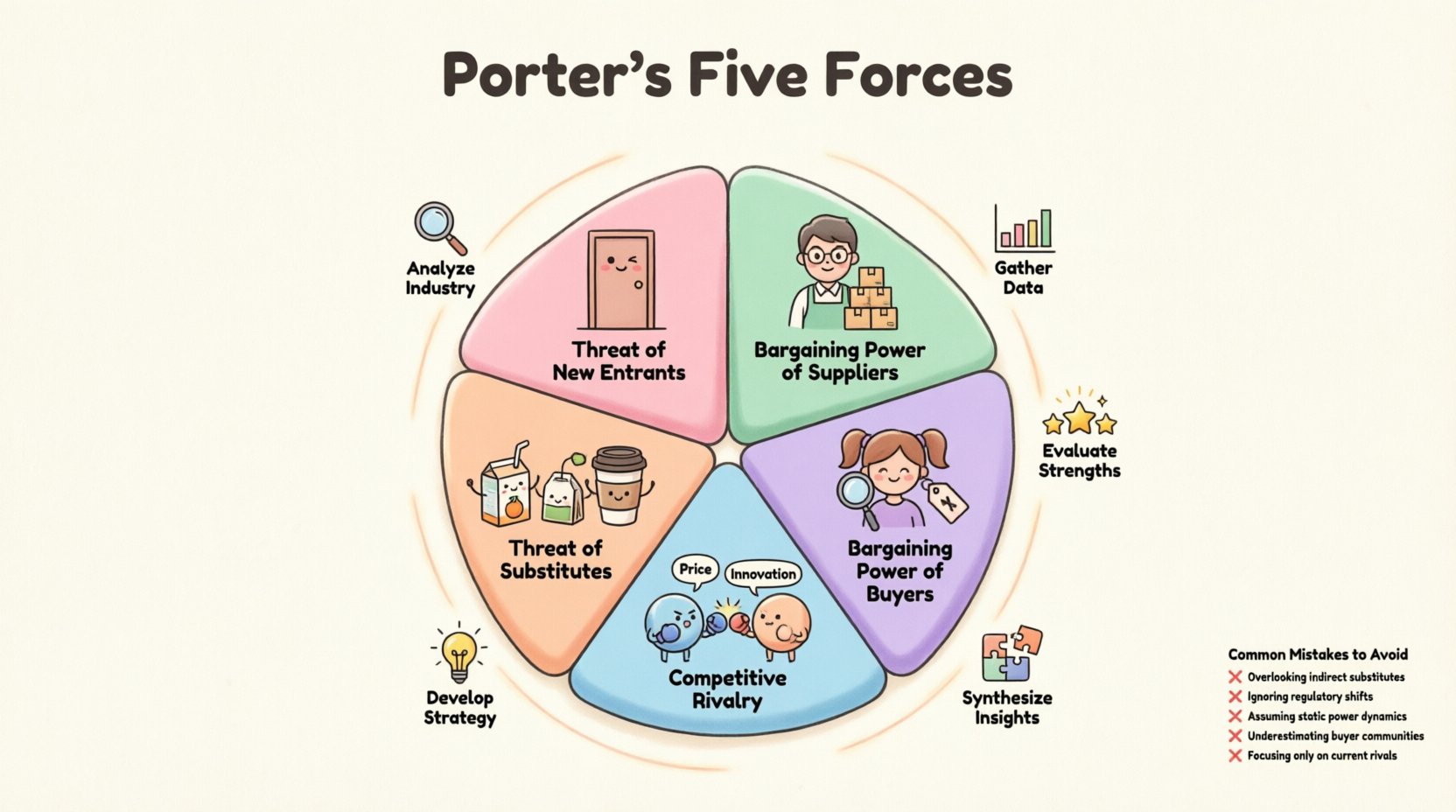
1️⃣ What is the Five Forces Analysis?
The Five Forces Analysis is a strategic model used to assess the competitive intensity and attractiveness of a market or industry. Developed by Harvard Business School professor Michael Porter in 1979, the framework identifies five key forces that shape every market.
- Threat of New Entrants: How easy is it for new competitors to enter the market?
- Bargaining Power of Suppliers: How much control do suppliers have over prices?
- Bargaining Power of Buyers: How much leverage do customers have to drive prices down?
- Threat of Substitute Products: Are there alternative solutions that customers might switch to?
- Rivalry Among Existing Competitors: How intense is the competition between current players?
By evaluating these forces, organizations can determine the profit potential of an industry and formulate strategies that mitigate risks or exploit opportunities.
2️⃣ Why is this framework essential for strategic planning?
Strategic planning requires more than internal assessment; it demands external awareness. Relying solely on internal capabilities ignores the environmental pressures that dictate industry profitability.
- Profitability Assessment: It reveals where profits are likely to be squeezed.
- Risk Identification: It highlights potential threats before they become critical issues.
- Resource Allocation: It guides where to invest capital for maximum return.
- Market Positioning: It helps define unique value propositions against competitors.
Without this analysis, strategies may be built on assumptions that do not align with market reality.
3️⃣ How do the five forces interact with each other?
The forces are not isolated; they interact dynamically. A change in one area often triggers shifts in others. For instance, high barriers to entry (low threat of new entrants) might allow existing competitors to raise prices, increasing the bargaining power of suppliers if they control essential resources.
The table below summarizes the core aspects of each force.
| Force | Key Question | High Intensity Indicator |
|---|---|---|
| Threat of New Entrants | Are barriers to entry high or low? | Low capital requirements, weak regulations |
| Bargaining Power of Suppliers | Do suppliers control critical inputs? | Few suppliers, high switching costs |
| Bargaining Power of Buyers | Can customers dictate terms? | High price sensitivity, low switching costs |
| Threat of Substitutes | Are there alternative solutions? | Low switching costs, high performance alternatives |
| Competitive Rivalry | How fierce is the competition? | Many competitors, slow industry growth |
4️⃣ What are the steps to conduct a Five Forces Analysis?
Executing a robust analysis requires a structured approach. Follow these steps to ensure comprehensive coverage.
Step 1: Define the Industry Scope
Clearly define what constitutes the industry. Is it the entire technology sector, or specifically cloud computing services? The scope dictates the data you gather.
Step 2: Gather Industry Data
Collect information from public reports, financial statements, and market research. Look for data on market concentration, growth rates, and entry barriers.
Step 3: Evaluate Each Force
Assess each of the five forces individually. Rate them as High, Medium, or Low intensity. Be specific about the reasons for your rating.
Step 4: Synthesize Findings
Combine the individual assessments to understand the overall industry attractiveness. Determine which forces pose the greatest threat to profitability.
Step 5: Develop Strategic Responses
Create action plans to address the identified threats. This might involve differentiation, cost leadership, or vertical integration.
5️⃣ What are common mistakes to avoid?
Even experienced strategists can misapply the framework. Avoid these pitfalls to maintain accuracy.
- Ignoring Industry Dynamics: Markets change. A static analysis becomes obsolete quickly.
- Confusing Industry with Company: The analysis focuses on the industry, not the specific company’s internal strengths.
- Overlooking Substitutes: Dismissing substitutes because they are not direct competitors. A coffee shop competes with tea, energy drinks, and water.
- Neglecting Global Factors: Supply chains and competitors often cross borders. Local analysis may miss global pressures.
- Assuming Static Conditions: Technology and regulations evolve. What was true five years ago may not hold today.
6️⃣ How often should the analysis be updated?
There is no fixed rule, but regular review cycles are necessary.
- Annual Review: Conduct a full analysis at least once a year during strategic planning.
- Event-Driven: Update immediately following major shifts, such as new regulations, disruptive technology, or economic crises.
- Quarterly Check: Monitor key indicators like raw material costs or competitor pricing changes.
Stagnation in analysis leads to strategic drift. Continuous monitoring ensures agility.
7️⃣ How does this differ from SWOT Analysis?
SWOT and Five Forces are complementary, not interchangeable. Understanding the distinction is crucial.
- SWOT: Focuses on internal Strengths and Weaknesses, and external Opportunities and Threats. It is broader and includes internal factors.
- Five Forces: Focuses exclusively on external industry structure and competitive pressures.
Best practice involves using Five Forces to define the external environment, then using SWOT to align internal capabilities with that environment.
8️⃣ Can you provide industry examples?
Applying the theory to real-world scenarios clarifies its utility.
Example A: Commercial Airlines
- Rivalry: High. Margins are thin, and capacity is often excess.
- Suppliers: High. Fuel prices and aircraft manufacturers (Boeing, Airbus) hold significant power.
- Buyers: High. Customers compare prices easily online.
- Substitutes: Medium. Trains or video conferencing for short distances.
- Entrants: Low. High capital costs and regulatory hurdles.
Example B: Streaming Services
- Rivalry: Very High. Multiple platforms competing for subscription time.
- Suppliers: Medium. Content creators have leverage as they can license to multiple platforms.
- Buyers: High. Low switching costs allow users to cancel easily.
- Substitutes: High. Gaming, social media, and traditional TV.
- Entrants: Medium. High production costs, but tech giants can enter easily.
9️⃣ What are the limitations of the framework?
While powerful, the model is not perfect. Acknowledging limitations prevents over-reliance.
- Static Nature: It captures a snapshot in time, not continuous evolution.
- Focus on Profitability: It prioritizes financial metrics over social or environmental impact.
- Industry Definition: Defining industry boundaries is often subjective in the digital age.
- Complementarity: It does not account for ecosystem partnerships or platform dynamics well.
🔟 How can I integrate this into long-term planning?
Integration ensures the analysis influences daily operations.
- Link to Budgeting: Allocate resources based on the forces identified as threats.
- Inform M&A Strategy: Use the analysis to identify acquisition targets that reduce supplier power or mitigate rivalry.
- Product Development: Design features that increase switching costs for buyers.
- Talent Acquisition: Hire experts who understand the specific competitive pressures of your sector.
Final Thoughts on Competitive Strategy
Strategic success relies on accurate diagnosis. The Five Forces Analysis provides a structured lens to view the competitive environment. By understanding the intensity of rivalry, supplier power, and market threats, organizations can build resilient strategies.
Continuous adaptation is key. Markets shift, technologies emerge, and consumer behaviors evolve. Keeping this analysis current ensures that your strategy remains relevant and effective over time. Use this tool to inform decisions, guide investments, and maintain a competitive edge in a dynamic landscape.