


Strategic planning often feels like navigating a map drawn for a different era. When you introduce artificial intelligence, platform economics, and rapid iteration cycles into the mix, traditional tools seem to lose their edge. One such tool is Porter’s Five Forces Analysis. Developed decades ago, it remains a staple in business schools and boardrooms. But does it hold up when applied to software startups, gig economies, and ecosystem plays? The answer is not a simple yes or no. It requires a nuanced understanding of how power dynamics shift in a digital-first world. 🌐
This guide explores the viability of the Five Forces framework in the context of disruptive technology. We will dissect each force, highlight where the model adapts well, and identify where it falls short. By the end, you will have a clear picture of how to integrate this tool into modern strategy without falling into the trap of using outdated assumptions. 💡
Understanding the Foundation 🏗️
Michael Porter introduced the Five Forces framework to determine the profitability of an industry. The core premise is that the structure of an industry dictates its profit potential. The five forces are:
- Threat of New Entrants: How easy is it for competitors to enter the market?
- Bargaining Power of Suppliers: How much control do vendors have over costs?
- Bargaining Power of Buyers: How much leverage do customers have to drive down prices?
- Threat of Substitute Products or Services: Are there alternative ways to solve the customer’s problem?
- Rivalry Among Existing Competitors: How intense is the competition between current players?
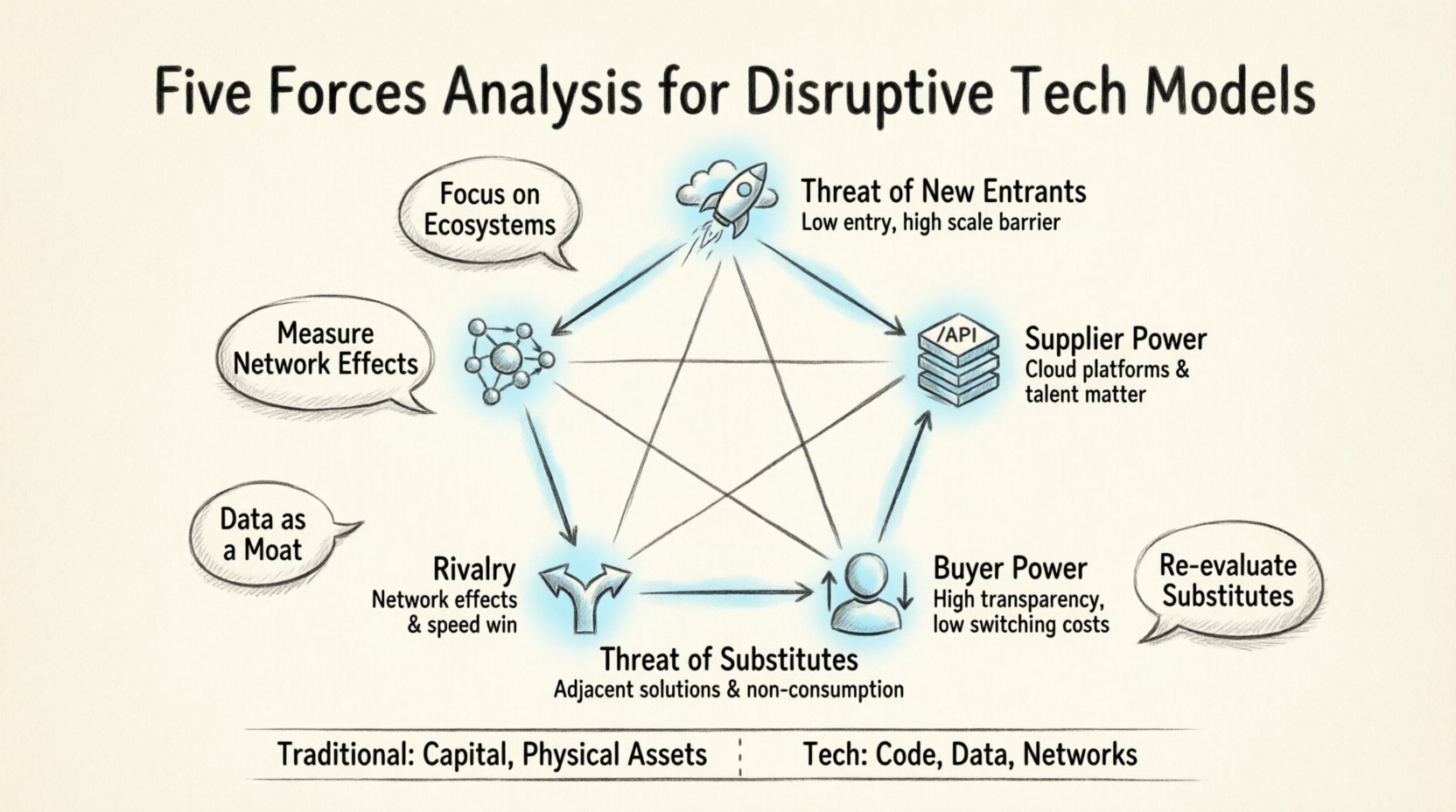
In traditional manufacturing or retail, these forces are tangible. You can count the number of suppliers. You can measure shipping costs. You can observe price wars in real-time. However, technology changes the variables. Network effects create moats that traditional models do not account for. Data acts as a resource that is not always scarce. These shifts require a re-evaluation of the framework. 📉
The Disruption Challenge ⚡
Disruptive technology often operates outside the boundaries of established industries. A ride-sharing app does not own cars. A cloud provider does not build servers. A streaming service does not produce content. This asset-light approach changes the power dynamics significantly.
Consider the threat of new entrants. In a physical industry, capital expenditure is a barrier. In tech, code can be written quickly, but distribution is the new barrier. A startup might have a better algorithm, but without a user base, it cannot leverage network effects. This distinction shifts the focus from production capacity to user acquisition.
Furthermore, the definition of a competitor changes. In the music industry, the rival was another record label. In the streaming era, the rival is Netflix, YouTube, and TikTok. These are substitutes that were not previously considered direct competitors. The framework still works, but the definitions of the players must expand.
Force-by-Force Breakdown in Tech 📊
Let us examine each force individually to see how it manifests in a technology-driven environment.
1. Threat of New Entrants 🚀
Traditional analysis looks at capital requirements and regulatory hurdles. In tech, the barrier to entry is often low. A developer can launch a Minimum Viable Product (MVP) with minimal funding. However, the barrier to scale is extremely high.
- Low Entry Costs: Cloud infrastructure allows teams to start small and grow on demand.
- High Switching Costs: Once a user builds a workflow around a specific tool, they rarely leave. This creates a barrier for new entrants trying to steal market share.
- Network Effects: The value of the service increases as more people use it. A new entrant with fewer users is inherently less valuable.
Therefore, while the threat of entry is high, the threat of successful entry is low unless a company can solve a distribution problem.
2. Bargaining Power of Suppliers 🛠️
In physical goods, suppliers control raw materials. In software, the “suppliers” are often platforms themselves. Think of the App Store, the Google Play Store, or the AWS cloud. These entities hold immense power.
- Platform Dependency: If your business relies on a third-party API or store, that platform can change fees or terms overnight.
- Talent as a Resource: In tech, skilled engineers are a critical supplier. The scarcity of top-tier talent increases their bargaining power significantly.
- Open Source: Conversely, open-source libraries reduce dependency on proprietary vendors, lowering supplier power.
Companies must diversify their tech stack to avoid being held hostage by a single provider.
3. Bargaining Power of Buyers 👥
Digital markets make it easy for customers to compare prices. A few clicks can show you the cheapest alternative. This transparency increases buyer power.
- Low Switching Costs: Moving from one SaaS tool to another is often a matter of data import/export. This makes customers fickle.
- Price Sensitivity: Freemium models allow users to try before they buy. This forces companies to compete on value rather than just features.
- Information Access: Reviews, forums, and social media give buyers a voice. Negative sentiment spreads quickly.
To counter this, companies focus on brand loyalty and ecosystem integration. If a product is deeply embedded in a user’s workflow, they become less price-sensitive.
4. Threat of Substitutes 🔄
This force is often the most dangerous in the tech sector. A substitute does not need to be a better version of your product; it just needs to solve the same problem.
- Non-Consumption: Sometimes the substitute is doing nothing. A project management tool competes with a team simply deciding to meet more often.
- Adjacent Categories: Video calls substituted for business travel. Email substituted for internal memos.
- Innovation Cycles: A feature in one app can become a standard in another, rendering a standalone product obsolete.
Strategic planning must look beyond direct competitors. It must look at what else the customer is doing to achieve their goal.
5. Rivalry Among Existing Competitors ⚔️
Price wars are common in tech because marginal costs are often near zero. Selling one more copy of software costs almost nothing.
- Feature Parity: Competitors often copy features rapidly. This makes differentiation harder and forces competition on service or support.
- Market Consolidation: Mergers and acquisitions are common as companies seek to eliminate rivals. This reduces the number of players but increases the power of the survivors.
- Global Reach: A local competitor can suddenly become a global one if they adapt their product for new regions.
Intense rivalry leads to lower margins. Companies must find niches or unique value propositions to escape the race to the bottom.
Traditional vs. Tech: A Comparison 📋
To visualize the differences, consider how the forces shift between a traditional manufacturing firm and a disruptive technology platform.
| Force | Traditional Industry | Disruptive Tech Model |
|---|---|---|
| Barriers to Entry | High (Capital, Regulation) | Low (Code), but Scale is Hard |
| Supplier Power | Raw Materials, Labor | Cloud Platforms, Talent, APIs |
| Buyer Power | Moderate (Switching Costs) | High (Instant Comparison) |
| Substitutes | Direct Competitors | Alternative Solutions, Non-Use |
| Rivalry | Price and Quality | Network Effects and Speed |
This table highlights that while the names of the forces remain the same, the mechanics behind them have evolved. A strategy that worked for a car manufacturer will fail for a ride-sharing platform without modification.
Adapting the Framework 🛠️
So, should you abandon the Five Forces Analysis? No. But you must adapt it. Here is how to apply it effectively in a modern context.
1. Focus on Ecosystems 🌿
Modern tech companies operate within ecosystems. Apple, Google, and Amazon create environments where multiple forces interact. Your analysis must include the platform owner as a potential competitor or partner. If you build on their infrastructure, they are a supplier. If they launch a competing feature, they are a rival.
2. Measure Network Effects 📈
Standard analysis does not quantify network effects. You need to add a metric for how much value a new user adds to the existing user base. If this number is high, the threat of new entrants decreases significantly. If it is low, the market is fragmented and volatile.
3. Re-evaluate Substitutes Continuously 🔄
In tech, substitutes change faster than in other industries. What was a substitute five years ago might be the standard today. Regular reviews of the substitute list are necessary. This includes looking at adjacent industries that might pivot into your space.
4. Consider Data as a Moat 🛡️
Data is a unique asset in tech. If your business accumulates unique data that improves the product (like training data for AI), this acts as a barrier to entry. Traditional analysis looks at physical assets; modern analysis must look at information assets.
When the Model Fails ⚠️
There are scenarios where the Five Forces Analysis provides little value. It is static in nature, while tech is dynamic. If a market is changing weekly, a quarterly analysis might be obsolete before it is published.
Additionally, the model assumes a zero-sum game regarding profit. In tech, value creation can be non-zero-sum. A platform can increase the value of the entire industry by solving a problem for users that did not exist before. In these cases, a Blue Ocean Strategy might be more appropriate than a Five Forces Analysis.
Practical Steps for Implementation 📝
If you decide to proceed with this framework, follow these steps to ensure accuracy.
- Define the Market Broadly: Do not limit your scope to direct competitors. Include adjacent solutions and potential future entrants.
- Identify the Moats: Determine what protects your position. Is it brand, data, network effects, or switching costs?
- Monitor Supplier Relationships: Pay close attention to API changes and platform fee adjustments. These can alter your cost structure overnight.
- Test Customer Retention: High churn rates indicate low switching costs and high buyer power. Address this through product improvements.
- Review Quarterly: Tech moves fast. A static annual review is insufficient. Update your analysis regularly to reflect market shifts.
Final Thoughts on Strategic Tools 🧭
Frameworks are not truth; they are lenses. The Five Forces Analysis provides a structured way to look at competition. When applied to disruptive technology, it requires a shift in perspective. It stops being about physical capacity and starts being about data, attention, and network effects.
There is no need to discard the model. It provides a vocabulary for discussing market structure. However, it must be supplemented with an understanding of digital dynamics. By combining the rigor of Porter’s work with the agility required for modern tech, you can build a strategy that withstands market volatility. 🚀
The goal is not to predict the future perfectly. The goal is to be prepared for the shifts that are already happening. Understanding where power lies in your specific ecosystem allows you to position your company for growth rather than reacting to change. This approach ensures longevity in a landscape that constantly rewrites its own rules.