


Understanding the competitive landscape is essential for any business aiming to sustain growth and profitability. Whether you are an entrepreneur launching a startup, a manager overseeing operations, or a student of business strategy, having a clear framework to evaluate market dynamics is crucial. This guide delves into Porter’s Five Forces Analysis, a proven method developed by Michael Porter in 1979. It helps organizations determine the intensity of competition and the profitability of an industry.
Many people find strategic frameworks intimidating. However, this model is designed to be practical. It breaks down complex market interactions into five distinct categories. By analyzing these categories, you can identify where power lies and where opportunities exist. This article provides a comprehensive breakdown without jargon, ensuring you can apply these concepts immediately.
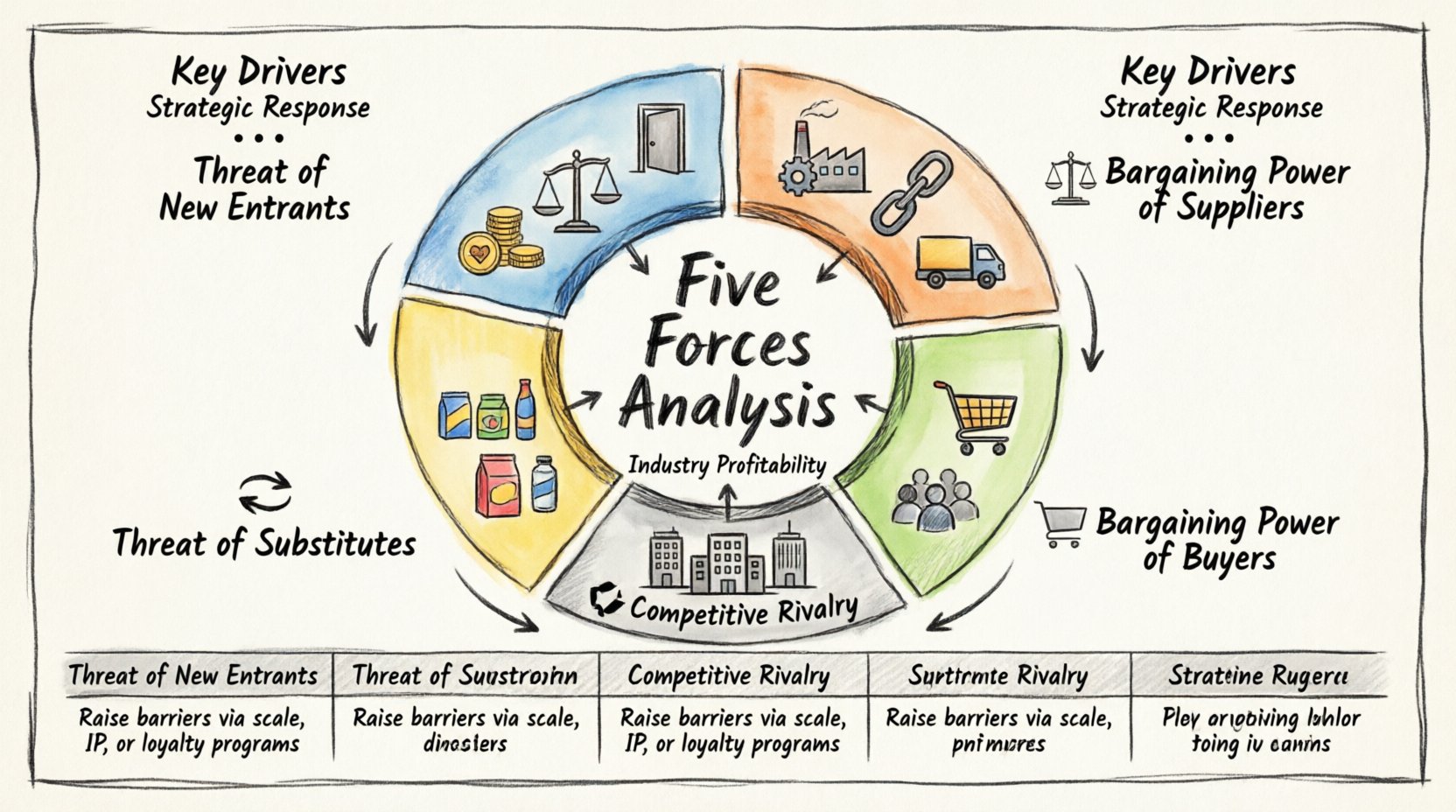
🧩 What is the Five Forces Framework?
The Five Forces framework is an industry analysis tool. It does not analyze a specific company’s internal strengths or weaknesses, but rather the external environment in which that company operates. It looks at the structural characteristics of an industry to understand how value is created and distributed.
When an industry is attractive, it offers the potential for above-average returns. When it is unattractive, profits are squeezed by the forces at play. The model suggests that profitability depends on the collective strength of five forces:
- Threat of New Entrants: How easy is it for competitors to enter the market?
- Bargaining Power of Suppliers: How much control do providers have over input costs?
- Bargaining Power of Buyers: How much pressure can customers place on prices?
- Threat of Substitute Products: Are there alternative solutions outside the industry?
- Rivalry Among Existing Competitors: How intense is the competition currently?
By assessing these areas, a business can anticipate where margins might be eroded and where they can build defenses. This is not about predicting the future with certainty, but about understanding the probabilities of competitive behavior.
🔍 The 5 Core Components Explained
To use this tool effectively, you need to understand the nuances of each force. Below is a detailed look at what drives each component and how to evaluate them.
1. Threat of New Entrants 🚪
This force examines the ease or difficulty for new competitors to enter your market. If entry is easy, new players can quickly capture market share and drive down prices. If entry is hard, existing companies enjoy more stability and pricing power.
Key Indicators to Evaluate:
- Capital Requirements: Does the industry require massive investment? (e.g., Manufacturing vs. Consulting)
- Regulatory Barriers: Are there licenses or government approvals needed?
- Brand Loyalty: Do customers stick to established names?
- Access to Distribution Channels: Can new players get their products to shelves or online?
- Proprietary Technology: Are there patents protecting the core product?
If the threat is high, you must focus on building barriers. This could mean investing in brand recognition or securing exclusive supplier contracts. If the threat is low, you can operate with a more relaxed posture, though vigilance is still required.
2. Bargaining Power of Suppliers ⚖️
Suppliers can dictate terms, raise prices, or reduce quality. When suppliers have high power, they capture more value from the industry, leaving less for the companies you are analyzing.
Factors Increasing Supplier Power:
- Few Suppliers: If there are only a few providers of a critical resource.
- Unique Products: If the supplier’s input is specialized or differentiated.
- Switching Costs: If changing suppliers is expensive or technically difficult.
- Threat of Forward Integration: If the supplier might decide to become your competitor.
To counter this, businesses often look for alternative sources or integrate backward (buy the supplier). However, in many industries, supplier power is a fixed reality that must be managed rather than eliminated.
3. Bargaining Power of Buyers 🛒
Customers are powerful when they can demand lower prices or higher quality. If buyers have high power, they squeeze industry profits. This is common in industries with many competitors and low switching costs.
Factors Increasing Buyer Power:
- Concentration of Buyers: A few large customers buying from many small sellers.
- Standardized Products: If the product is the same as competitors, buyers choose on price.
- Price Sensitivity: If the cost is a significant portion of the buyer’s total expense.
- Threat of Backward Integration: If the buyer might decide to make the product themselves.
Strategies to reduce buyer power include differentiation (making your product unique) and increasing switching costs (making it annoying to leave). Customer loyalty programs are a common tactic here.
4. Threat of Substitute Products 🔄
Substitutes are products from outside your industry that solve the same problem. For example, a video conferencing tool is a substitute for business travel. This force limits the price you can charge because if you raise prices too high, customers will switch to the substitute.
Key Considerations:
- Price-Performance Trade-off: Is the substitute cheaper or better?
- Switching Costs: How hard is it for a customer to switch to the alternative?
- Customer Tendency: Are customers open to trying new solutions?
Substitutes are often the biggest threat to long-term industry profitability. They set a ceiling on prices. Companies must ensure their value proposition is superior to the substitute, even if the substitute is cheaper.
5. Competitive Rivalry Among Existing Competitors ⚔️
This is the most visible force. It looks at how aggressively companies fight for market share. High rivalry leads to price wars, increased advertising, and new product introductions, all of which reduce profitability.
Factors Increasing Rivalry:
- Number of Competitors: More players usually mean more fighting.
- Industry Growth: Slow growth forces companies to fight for existing market share.
- Fixed Costs: High fixed costs encourage price cutting to fill capacity.
- Exit Barriers: If it is hard to leave the industry, companies fight to the end.
In highly competitive industries, the focus often shifts from profit maximization to survival and efficiency. Differentiation is the primary way to escape the trap of pure rivalry.
📊 Summary of Force Dynamics
To help visualize how these forces interact, refer to the table below. It outlines the primary drivers and the typical strategic response for each force.
| Force | Primary Driver | Strategic Response |
|---|---|---|
| New Entrants | Barriers to Entry | Build Brand, Secure Patents, Scale Operations |
| Supplier Power | Concentration & Uniqueness | Diversify Suppliers, Vertical Integration |
| Buyer Power | Volume & Sensitivity | Product Differentiation, Loyalty Programs |
| Substitutes | Price/Performance Ratio | Innovation, Value-Added Services |
| Rivalry | Growth Rate & Exit Barriers | Niche Focus, Cost Leadership, M&A |
📝 Step-by-Step Guide to Running an Analysis
Conducting a Five Forces analysis requires data and critical thinking. Follow this process to ensure accuracy and actionable insights.
Step 1: Define the Industry Scope
You cannot analyze everything at once. Be specific. Are you analyzing the “Smartphone Industry” or the “Mobile App Development Industry”? A broad scope leads to vague results. Narrow it down to the specific market segment you are interested in.
Step 2: Gather Data
Information is the fuel for this analysis. Collect data on:
- Market size and growth rates.
- Number of competitors and their market share.
- Supplier concentration and pricing trends.
- Customer demographics and switching behaviors.
- Technological changes affecting the sector.
Sources can include industry reports, government data, competitor financial statements, and direct interviews with industry insiders.
Step 3: Assess Each Force
For each of the five forces, rate the intensity. Use a simple scale:
- High: Significant pressure on profits.
- Medium: Moderate pressure, manageable.
- Low: Little pressure, opportunity for profit.
Do not just guess. Use the indicators listed in the previous section to justify your rating.
Step 4: Synthesize Findings
Look at the aggregate picture. If three forces are “High” and two are “Low,” the industry is generally unattractive. If most forces are “Low,” the industry offers good potential. Identify which forces are the most critical threats to your specific business model.
✈️ Practical Example: The Airline Industry
To make this concrete, let’s apply the framework to the commercial airline industry. This industry is known for low profit margins, and the Five Forces model explains why.
- Threat of New Entrants (Medium): High capital costs and regulatory hurdles make it hard to start. However, low-cost carriers have entered the market successfully by simplifying operations.
- Supplier Power (High): Aircraft manufacturers (like Boeing and Airbus) are a duopoly. Fuel suppliers also have significant influence. Airlines have little leverage here.
- Buyer Power (High): Passengers are price-sensitive. Online comparison sites make it easy to switch between airlines instantly. Corporate contracts give some power to large businesses, but general consumers have high leverage.
- Threat of Substitutes (Medium): Trains and video conferencing are substitutes for short-haul and business travel, respectively. This limits pricing power for airlines.
- Rivalry (High): Price wars are common. Capacity is often high relative to demand, leading to discounting. Exit barriers are high due to expensive assets.
Result: The industry is structurally unattractive. Airlines must focus intensely on cost control and ancillary revenue (baggage fees, upgrades) to survive. This analysis helps explain why airline profits are historically volatile.
⚠️ Limitations of the Model
While powerful, the framework is not perfect. It has limitations that you should acknowledge.
- Static Nature: The model is a snapshot in time. Industries change rapidly. A force that is weak today might be strong tomorrow.
- Focus on Industry, Not Firm: It explains industry profitability but not why one specific company outperforms another within the same industry.
- Ignores Complementors: It does not explicitly account for products that enhance the value of your own (e.g., apps that make smartphones more useful).
- Complex Interactions: Forces influence each other. For example, high buyer power might force companies to innovate, which increases rivalry.
For these reasons, this tool should be used alongside other strategic frameworks, such as SWOT or PESTEL analysis.
🧠 Integrating with Other Strategic Tools
Strategic planning rarely relies on a single model. Combining Five Forces with other tools provides a more holistic view.
1. SWOT Analysis
Use Five Forces to inform the Opportunities and Threats sections of a SWOT analysis. The external data you gathered for the forces fits directly into these categories. Use internal capabilities to address the strengths and weaknesses.
2. PESTEL Analysis
PESTEL (Political, Economic, Social, Technological, Environmental, Legal) looks at the macro environment. These factors often drive the Five Forces. For instance, a new Environmental regulation might increase Supplier Power or Threat of New Entrants.
3. Value Chain Analysis
Once you know the external pressures, use Value Chain Analysis to see where you can create efficiency. If Supplier Power is high, look at your procurement processes to reduce dependency.
💡 Common Mistakes to Avoid
When applying this framework, errors can lead to flawed strategies. Keep these pitfalls in mind.
- Defining the Market Too Broadly: Analyzing “The Retail Industry” is useless. Analyze “Online Grocery Delivery” instead.
- Ignoring Global Factors: Even local businesses face global competition. Supply chains are often international.
- Focusing Only on Price: Competition is not just about price. It is about brand, service, and innovation.
- Skipping the Data: Relying on intuition rather than market data leads to bias.
- Neglecting the Digital Shift: In the modern economy, digital substitutes are often the biggest threat. Do not overlook tech-driven alternatives.
🚀 Moving Forward with Strategy
Once the analysis is complete, the work is not done. You must translate insights into action. If the threat of new entrants is high, invest in customer retention. If buyer power is high, invest in product differentiation.
Strategy is about making choices. The Five Forces model helps you choose where to play and how to win. It clarifies where the money is made and where it is lost. By understanding these structural forces, you can navigate the market with confidence.
Remember that markets are dynamic. Revisit this analysis regularly. Quarterly or annual reviews ensure your strategy remains aligned with the current reality. The business environment changes, and your understanding of it must evolve with it.
Whether you are protecting an existing business or planning a new venture, this framework provides a solid foundation. It shifts the conversation from guesswork to structured analysis. Use it to identify risks before they become crises and to spot opportunities before competitors do.