


Every promising business idea sits within a specific industry ecosystem. Before committing time and resources to development, understanding the competitive landscape is crucial. Porter’s Five Forces Analysis offers a structured framework to evaluate the profitability and viability of a potential venture. This guide provides a clear pathway to applying this classic strategic tool to your new concept.
By assessing the forces at play, you can identify risks early and adjust your strategy accordingly. This process does not guarantee success, but it significantly reduces uncertainty. Whether you are launching a physical product or a digital service, understanding the industry dynamics is a foundational step.
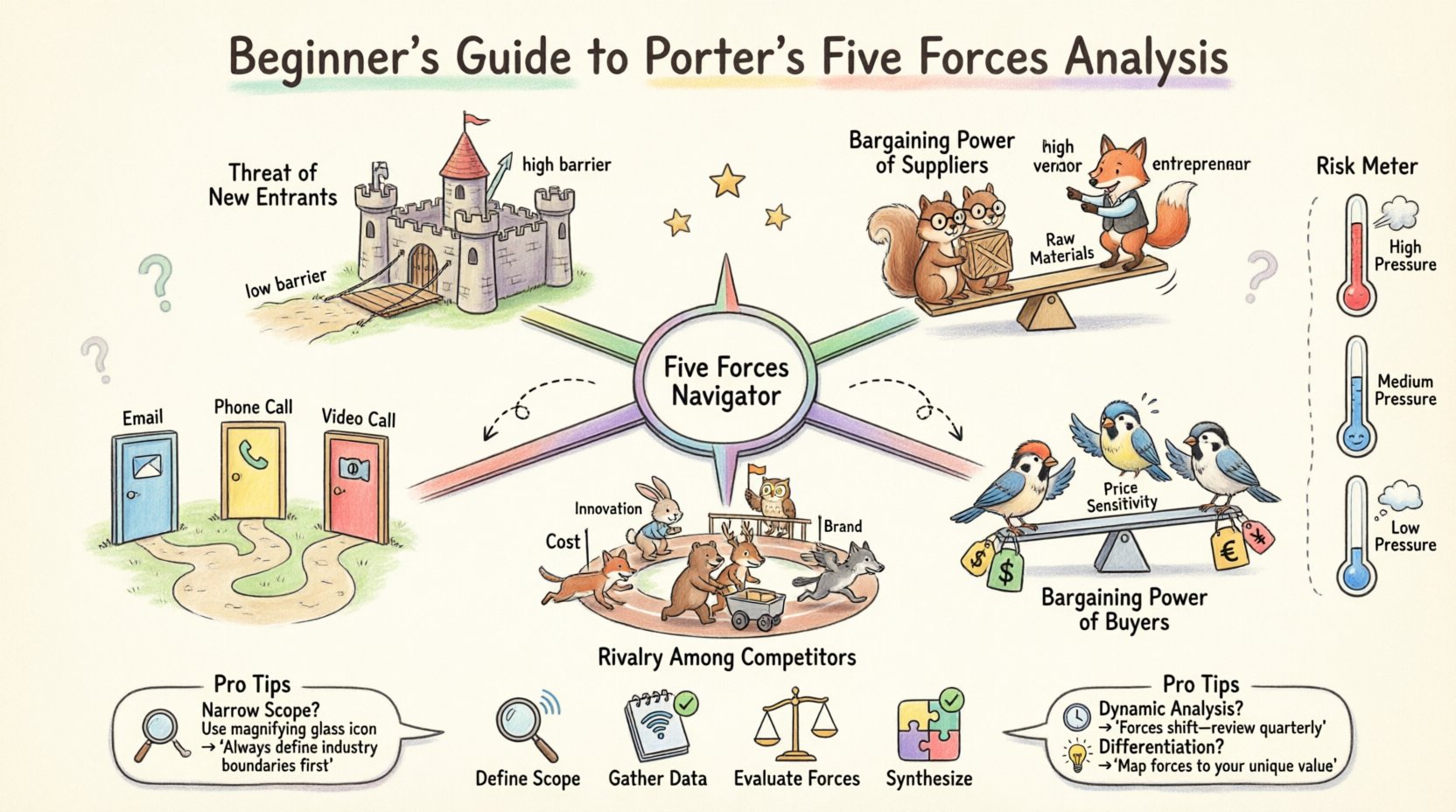
📊 What is Porter’s Five Forces?
Developed by Michael Porter in 1979, this framework analyzes the competitive intensity and attractiveness of a market. It moves beyond just looking at direct competitors. Instead, it examines the underlying structural forces that determine the profit potential of an industry. The core premise is that these five forces collectively determine the intensity of competition and the profitability of the market.
When applied to a new idea, the analysis shifts from retrospective to prospective. You are predicting the future state of the industry based on current trends. This forward-looking approach helps in stress-testing your business model against external pressures.
The five forces are:
- Threat of New Entrants: How easy is it for others to start competing?
- Bargaining Power of Suppliers: How much control do vendors have over your costs?
- Bargaining Power of Buyers: How much leverage do customers have over your pricing?
- Threat of Substitute Products: Are there alternative solutions to your offering?
- Rivalry Among Existing Competitors: How intense is the fight for market share?
🔍 The Five Forces Breakdown
To apply this effectively, you must understand the mechanics of each force. Below is a structured overview of what each force entails and the questions you should ask during your research.
| Force | Key Question | High Risk Indicator |
|---|---|---|
| Threat of New Entrants | What barriers exist to entry? | Low capital requirements, no patents |
| Bargaining Power of Suppliers | How many sources do you have? | Single source, specialized materials |
| Bargaining Power of Buyers | How price-sensitive are customers? | High switching costs, commoditized product |
| Threat of Substitutes | Can customers solve the problem differently? | Multiple alternatives, low differentiation |
| Rivalry Among Competitors | How aggressive are current players? | Price wars, high fixed costs |
🛠️ Step-by-Step Application Guide
Applying the framework requires a systematic approach. Follow these steps to conduct a thorough analysis for your specific idea.
1. Define the Industry Scope
Clarity is essential. A broad scope makes the analysis useless. Narrow down the specific market segment you are targeting. If you are building a project management tool, are you targeting small agencies or enterprise software departments? The forces differ significantly between these segments.
- Identify the specific problem you are solving.
- Define the geographic boundaries.
- Specify the customer demographic.
2. Gather Industry Data
Analysis is only as good as the data supporting it. You need to collect information regarding market size, growth rates, and competitor behavior. Reliable sources include industry reports, government statistics, and trade associations. You can also analyze public financial statements of existing competitors.
- Use public databases for market size estimates.
- Review competitor websites for feature sets and pricing.
- Read customer reviews to understand pain points.
3. Evaluate Each Force
Dedicate time to each of the five forces individually. Do not rush this stage. For each force, determine if the pressure is High, Medium, or Low. Provide a brief rationale for your rating based on the data collected.
- High Pressure: A significant threat to margins or growth.
- Medium Pressure: A manageable challenge that requires attention.
- Low Pressure: A favorable condition for your business model.
4. Synthesize the Findings
Once all five forces are rated, look for patterns. High pressure across all forces suggests a difficult market. You may need to pivot or find a niche. Low pressure across the board suggests a lucrative opportunity, but it might also attract immediate competition.
- Identify the single most critical force.
- Determine which forces you can influence.
- Assess the overall attractiveness of the market.
🧐 Deep Dive: Analyzing Each Force
Understanding the theoretical definition is one thing. Applying it to a real scenario is another. Here is a detailed look at how to analyze each force in the context of a new idea.
1. Threat of New Entrants
This force measures how easily new competitors can enter your market. If barriers are low, incumbents face constant threats. Barriers often include capital requirements, regulatory hurdles, and economies of scale.
Questions to ask:
- Does your idea require significant upfront investment?
- Are there patents or intellectual property protecting your concept?
- Do you need specialized skills that are hard to find?
- Are there regulatory licenses required to operate?
If the answer to most of these is “no,” the threat is high. To mitigate this, you might focus on building brand loyalty or creating high switching costs for your users.
2. Bargaining Power of Suppliers
Suppliers can drive up prices or reduce the quality of your inputs. If you have few options, they hold the power. This is critical if your costs are a large portion of your revenue.
Questions to ask:
- How many suppliers are available for your core components?
- Is the supply specialized or commoditized?
- Can you easily switch to a different supplier?
- Does the supplier pose a threat of forward integration?
In a software context, this might refer to cloud hosting providers or API services. In a physical product, it refers to raw materials. Diversifying your supply chain reduces this risk.
3. Bargaining Power of Buyers
Customers can drive down prices by demanding better quality or service. If they have many options, their power is high. This force is often the most significant for consumer-facing businesses.
Questions to ask:
- How concentrated are the customers?
- How large is the average order value?
- Are products commoditized or differentiated?
- What are the switching costs for the customer?
If customers can easily compare prices and switch providers, you must focus on differentiation. Building a unique value proposition reduces buyer power.
4. Threat of Substitute Products
Substitutes are not direct competitors but alternative ways to solve the same problem. They cap the price you can charge. If a substitute is cheaper or more convenient, your business suffers.
Questions to ask:
- What do customers do now to solve this problem?
- Is the price-performance ratio of the substitute better?
- Are there technological shifts changing the landscape?
- How essential is your solution compared to alternatives?
For example, a video conferencing tool competes not just with Zoom, but with email, phone calls, and in-person meetings. Understanding these substitutes helps you position your product effectively.
5. Rivalry Among Existing Competitors
This is the most visible force. It involves the intensity of competition among current players. High rivalry leads to price wars, advertising battles, and innovation races.
Questions to ask:
- How many competitors are there?
- Is the industry growing or stagnant?
- Are there high fixed costs?
- Is there product differentiation?
In a growing market, rivalry is often lower because there is room for everyone. In a stagnant market, competition is fierce as players fight for market share. You should look for niches where competitors are weak or absent.
📉 Interpreting the Results
After completing the analysis, you will have a matrix of risks. Here is how to interpret the output and decide on your next steps.
Scenario A: High Pressure Across the Board
If most forces are rated high, the industry may be unattractive. Profitability will be low. Consider pivoting to a different industry or finding a highly specific niche where these pressures are lower. For example, entering a general market might be risky, but entering a specialized sub-segment might be viable.
Scenario B: Mixed Pressure
This is the most common scenario. Some forces are manageable, while others are threatening. Focus your strategy on mitigating the high-pressure forces. If supplier power is high, secure long-term contracts. If buyer power is high, increase product differentiation.
Scenario C: Low Pressure
A low-pressure environment is ideal, but it often attracts competitors quickly. Your strategy should focus on building barriers to entry immediately. Establish a strong brand, secure exclusive partnerships, and capture market share before others arrive.
⚠️ Common Pitfalls to Avoid
Even with a solid framework, errors can occur during the analysis. Be aware of these common mistakes.
- Defining the industry too broadly: Analyzing “the automotive industry” is too vague. Analyzing “electric vehicle charging stations” is actionable.
- Ignoring substitutes: Many founders focus only on direct competitors. Substitutes often kill industries faster than rivals.
- Static analysis: The market changes. This analysis should be revisited annually or when major shifts occur.
- Confirmation bias: Do not look only for data that supports your idea. Be objective about the risks.
- Overlooking complementary products: While not part of the original model, complementary products can drive demand. Consider how your idea fits into a larger ecosystem.
🔄 Integrating with Other Tools
The Five Forces Analysis is powerful, but it works best when combined with other strategic tools. It provides the external context, but you need internal alignment as well.
SWOT Analysis
Use the output of the Five Forces to inform the “Threats” and “Opportunities” sections of a SWOT analysis. This connects external market forces with internal strengths and weaknesses.
Business Model Canvas
Adjust the “Key Partners” and “Value Proposition” blocks of the canvas based on your Five Forces findings. If supplier power is high, you might need to change your cost structure.
🏁 Final Thoughts
Applying Porter’s Five Forces to your idea is an exercise in realism. It forces you to look beyond your enthusiasm and confront the structural realities of the market. While it does not predict the future, it maps the terrain you will be navigating.
By systematically evaluating these five forces, you make informed decisions about resource allocation and strategic positioning. This discipline separates well-researched ventures from speculative bets. Take the time to gather data, remain objective, and use the insights to refine your approach.
Remember that strategy is dynamic. As the market evolves, so should your understanding of these forces. Regular review ensures your plan remains relevant and resilient in the face of change.
Related posts:
 Five Forces Analysis for Startups: The Definitive Overview You Need Before Launching
 How Tech Founders Use Five Forces Analysis to Spot Market Gaps in 2024
 Five Forces Analysis Checklist: A Step-by-Step Guide for First-Time Entrepreneurs
 The Real Cost of Ignoring the Five Forces: Common Mistakes That Kill Startups