


The technology landscape in 2024 presents a unique set of challenges and opportunities. Capital efficiency is paramount, and the speed of innovation has accelerated beyond traditional cycles. For founders navigating this environment, intuition alone is insufficient. Strategic rigor is required to distinguish between a fleeting trend and a sustainable market opportunity.
Porter’s Five Forces remains a cornerstone of strategic analysis, but its application has evolved. It is no longer just about analyzing competitors; it is about understanding the structural profitability of an industry. By dissecting the competitive dynamics, founders can locate white spaces where value can be created without direct confrontation with entrenched players. This guide details how to leverage this framework specifically for technology ventures in the current year.
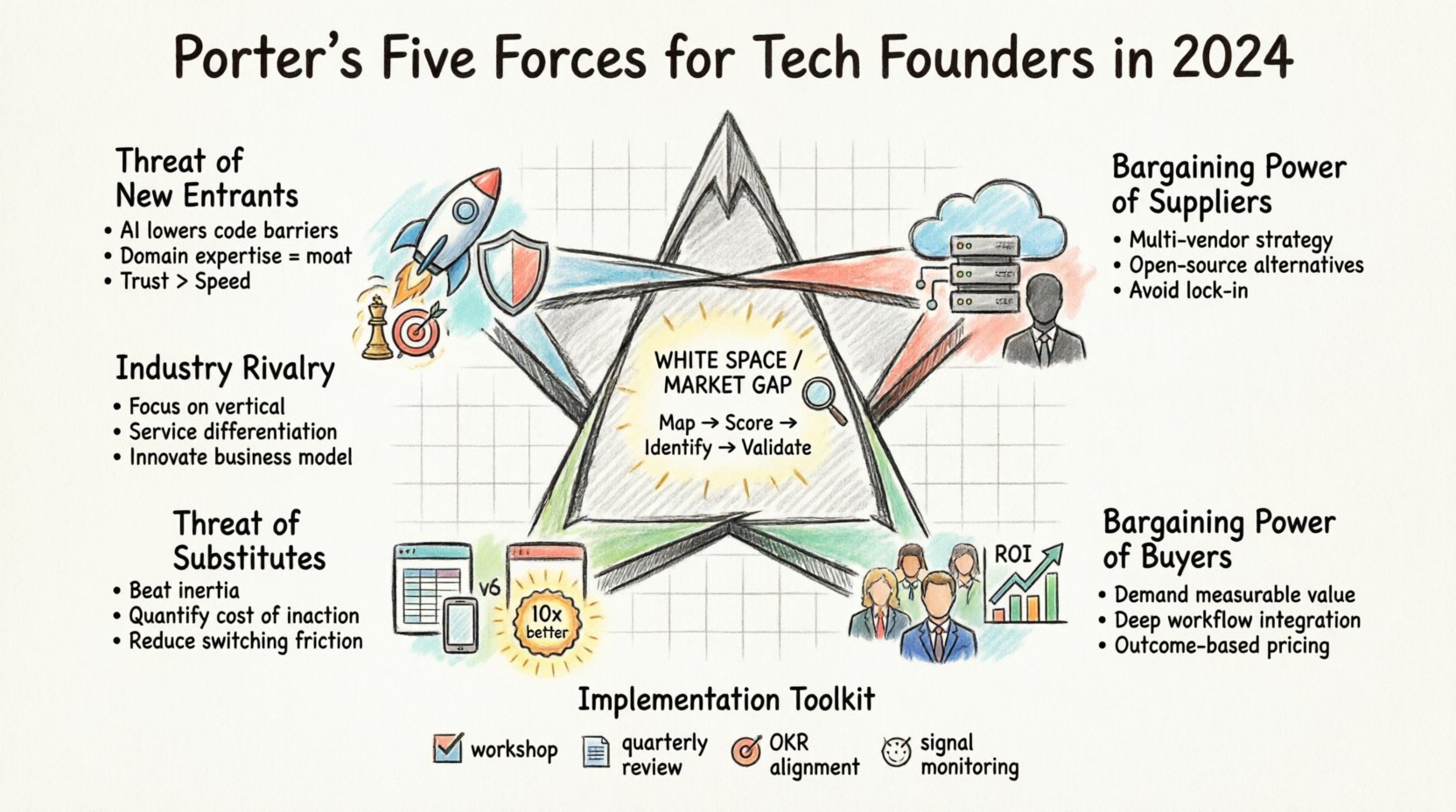
Why Strategic Analysis Matters More Than Ever 🧭
In the past, a strong product could secure market share despite poor strategic positioning. Today, the margin for error is slim. The cost of customer acquisition has risen, and investor scrutiny is heightened. Understanding the structural forces at play allows founders to:
- Validate Market Viability: Determine if the industry structure supports profitability before writing code.
- Identify Asymmetric Opportunities: Find areas where competitors are structurally unable to respond effectively.
- Allocate Resources Wisely: Focus capital on building moats rather than fighting battles that cannot be won.
- Navigate Regulatory Shifts: Anticipate how policy changes might alter the competitive balance.
1. Threat of New Entrants 🏗️
This force assesses how easy it is for new competitors to enter the market. In 2024, the barrier to entry has fluctuated. While AI tools have lowered the cost of software development, the cost of customer trust and distribution has increased.
Key Factors to Evaluate
- Capital Requirements: Does the business model require significant upfront investment in infrastructure or hardware?
- Regulatory Hurdles: Are there compliance standards (e.g., GDPR, HIPAA) that slow down new players?
- Access to Distribution: How difficult is it to reach the target audience without established channels?
- Switching Costs: Once a customer adopts a solution, how hard is it for them to leave?
2024 Context: The AI Effect
The rise of generative AI has democratized technical execution. A small team can now build features that previously required a large engineering department. However, this has increased the threat of new entrants in horizontal tools. Founders must look for niches where specific domain knowledge acts as a barrier. If the only differentiator is code speed, the threat is high. If the differentiator is proprietary data or specialized workflows, the threat is lower.
Strategic Implications
- Build proprietary datasets that improve over time.
- Create complex integrations that add friction to switching.
- Focus on enterprise sales cycles where trust is the primary currency.
2. Bargaining Power of Suppliers 🤝
Suppliers in the tech sector are not just hardware vendors. They include cloud providers, API dependencies, talent pools, and data sources. High supplier power can squeeze margins and limit operational flexibility.
Identifying Critical Suppliers
| Supplier Type | Impact on Business | Strategic Risk |
|---|---|---|
| Cloud Infrastructure | Cost scaling, uptime reliability | Vendor lock-in, price hikes |
| Specialized Talent | Product velocity, innovation quality | Hiring bottlenecks, salary inflation |
| API & Data Providers | Feature functionality, data accuracy | Service disruption, rate limits |
| App Stores / Marketplaces | Customer acquisition channels | Policy changes, commission increases |
Reducing Dependency
Founders must assess their reliance on single points of failure. In 2024, supply chain resilience is a competitive advantage. If your entire stack relies on one AI model provider, a change in their pricing or terms could cripple your unit economics.
- Multivendor Strategies: Avoid exclusive contracts where possible.
- Open Source Alternatives: Evaluate if open-source models can reduce dependency on proprietary APIs.
- Internal Capability Building: Invest in core competencies so you are not dependent on external agencies for critical functions.
3. Bargaining Power of Buyers 👥
Buyer power refers to the pressure customers can exert to drive prices down or demand better quality. In the B2B SaaS space, this power has grown significantly due to economic tightening.
Indicators of High Buyer Power
- Concentration: A few large customers control a significant portion of your revenue.
- Price Sensitivity: Customers are actively negotiating discounts or demanding more features for the same price.
- Transparency: Easy access to pricing information and comparison tools.
- Standardization: Products are perceived as commodities rather than differentiated solutions.
2024 Market Dynamics
Buyers are more educated and skeptical. The era of “growth at all costs” is over. Customers demand measurable ROI before signing contracts. This shift increases the bargaining power of buyers because they can easily walk away if the value proposition is not clear.
Counter-Strategies
- Deep Integration: Embed your solution into their daily workflows so it becomes indispensable.
- Outcome-Based Pricing: Align your pricing with the value delivered rather than seats or usage.
- Community Building: Create a network effect where the product becomes more valuable as more people use it.
4. Threat of Substitutes 🔄
Substitutes are not direct competitors. They are alternative ways to solve the same problem. Often, the biggest threat to a startup is not another startup, but the status quo or a spreadsheet.
Types of Substitutes
- Internal Development: The customer builds the solution in-house using their existing team.
- Manual Workarounds: Continuing to use spreadsheets, email, or pen and paper.
- Competing Categories: A different technology solving the same pain point (e.g., mobile vs desktop, cloud vs on-prem).
- Outsourcing: Hiring a freelancer or agency instead of buying software.
Analyzing the Substitution Threat
Founders often underestimate the power of inertia. If a process works “well enough,” customers will not switch. To overcome this, the new solution must be 10x better in terms of speed, cost, or reliability.
- Quantify the Cost of Inaction: Show customers how much money or time they lose by sticking with the old way.
- Reduce Friction: Make the transition from the substitute to your product seamless.
- Highlight Hidden Costs: Expose the technical debt or maintenance costs of legacy solutions.
5. Industry Rivalry ⚔️
This force measures the intensity of competition among existing firms. High rivalry leads to price wars, heavy advertising spend, and rapid feature releases that can erode profitability.
Factors Increasing Rivalry
- Number of Competitors: A crowded market with many players of similar size.
- Industry Growth: Slow growth forces companies to fight for existing market share.
- Fixed Costs: High overhead requires high volume to break even, leading to aggressive pricing.
- Exit Barriers: High costs to leave the industry keep struggling companies in the fight.
The 2024 Competitive Landscape
The funding environment has shifted from growth to profitability. This has reduced the number of well-capitalized rivals willing to burn cash to gain share. However, consolidation is occurring. Larger players are acquiring smaller ones, which can increase the power of incumbents.
Navigating Rivalry
- Focus on Niche: Do not try to serve everyone. Dominate a specific vertical.
- Differentiate on Service: Software is often commoditized; service and support are differentiators.
- Innovate on Business Model: Try revenue-sharing or usage-based models that competitors have not adopted.
Synthesizing the Analysis: Finding the Gap 🔍
Once the five forces are mapped, the next step is synthesis. The goal is to find a position where the industry forces are favorable or where you can alter them in your favor.
Gap Identification Framework
- Map the Forces: Create a visual representation of each force for your target market.
- Score the Intensity: Rate each force from Low to High impact on profitability.
- Identify Weaknesses: Where are competitors vulnerable? Where are suppliers weak?
- Validate Assumptions: Talk to customers and suppliers to confirm your analysis.
Example Scenario: Enterprise Security Tool
Imagine building a security tool for mid-market companies.
- New Entrants: High threat due to AI tools, but low threat due to trust requirements.
- Suppliers: Moderate threat; reliance on threat intelligence feeds.
- Buyers: High power; CISOs are price-sensitive and demand compliance.
- Substitutes: High threat; many companies rely on manual processes or generic tools.
- Rivalry: Moderate; dominated by large legacy players who are slow to innovate.
The Gap: Focus on the “Trust” and “Speed” aspects. Large players are slow. Manual processes are risky. A solution that combines automated compliance with high-touch support fills the white space.
Implementation Steps for Founders 🛠️
Analysis is useless without action. Here is how to operationalize this framework within your organization.
- Conduct Workshops: Bring together engineering, sales, and product leaders to map the forces collaboratively.
- Set Review Cadence: Market dynamics change. Review the analysis quarterly.
- Link to OKRs: Ensure your Objectives and Key Results reflect the strategic choices made during the analysis.
- Monitor Signals: Watch for changes in supplier pricing, regulatory announcements, or competitor hiring.
Common Pitfalls to Avoid ⚠️
Even experienced founders can misapply this framework. Be wary of these common mistakes.
- Ignoring Disruption: Assuming current competitors will stay relevant. New entrants often change the rules.
- Over-Focusing on Features: Competing on feature parity is a race to the bottom. Compete on value.
- Neglecting the Supply Chain: Focusing only on customers while ignoring the cost and stability of your own infrastructure.
- Static Analysis: Treating the analysis as a one-time event rather than an ongoing process.
The Role of Data in Modern Analysis 📊
In 2024, data availability allows for more precise force analysis. Instead of guessing supplier power, you can analyze contract terms across the industry. Instead of estimating buyer power, you can look at churn rates and net dollar retention.
Data Sources
- Public Filings: Review earnings calls of public competitors.
- Job Postings: Analyze hiring trends to understand where competitors are investing.
- Review Aggregators: Monitor customer sentiment on platforms to gauge buyer satisfaction.
- API Documentation: Study competitor APIs to understand their technical debt and integration capabilities.
Maintaining Strategic Agility 🏃
The Five Forces framework provides a snapshot, but the market is dynamic. Founders must maintain the ability to pivot based on new information.
- Build for Flexibility: Ensure your product architecture can adapt to new market conditions.
- Keep Costs Low: Maintain a lean burn rate to allow for strategic shifts without existential risk.
- Cultivate Relationships: Strong relationships with suppliers and customers can buffer against market shocks.
- Stay Informed: Continuous learning about industry trends is essential.
Final Thoughts on Market Positioning 🌟
Strategic clarity is the foundation of sustainable growth. By rigorously applying the Five Forces framework, tech founders can move beyond gut feelings and make decisions grounded in market reality. The goal is not to fight every battle, but to choose the right battlefield.
In an era where technology moves fast, the most valuable asset is not code, but insight. Understanding the structural forces of your industry allows you to position your venture where it can thrive, regardless of the external noise. This approach minimizes risk and maximizes the potential for long-term value creation.
Take the time to map your landscape. Engage your team in the process. Use data to validate your assumptions. The market gaps are there, waiting for those who look with clear eyes and structured thinking.