


Entering a new market without understanding the competitive landscape is akin to navigating a ship without a compass. For founders and entrepreneurs, strategic clarity is not just an advantage; it is a necessity for survival. This guide provides a comprehensive breakdown of the Five Forces Analysis framework, tailored specifically for startups preparing to launch. By examining the structural forces of an industry, you can identify where the power lies and how to position your venture for sustainable growth 💡.
The Five Forces framework, developed by Michael Porter, remains a cornerstone of strategic planning. While often associated with established corporations, its application for early-stage companies is critical. It shifts the focus from internal capabilities to external market dynamics. This document outlines how to conduct this analysis, interpret the results, and integrate findings into your business model without relying on hype or generic advice.
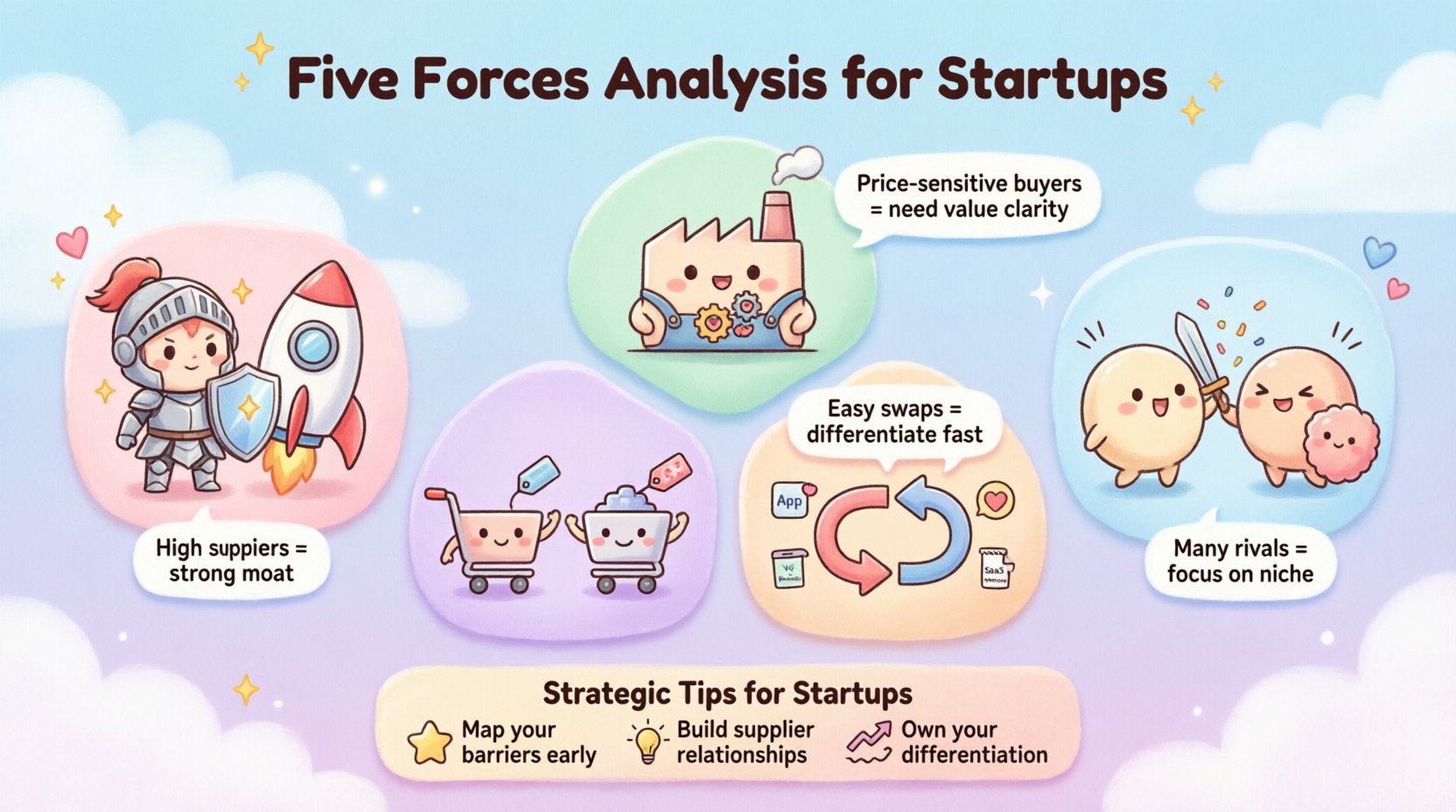
Understanding Porter’s Five Forces Framework 📊
At its core, this model assesses the intensity of competition and the profitability potential of an industry. It looks beyond direct competitors to understand the broader ecosystem. For a startup, knowing the profit potential is vital before committing capital. If the forces are too strong, margins may be too thin to sustain operations.
The framework consists of five distinct elements that determine industry attractiveness:
- Threat of New Entrants: How easy is it for others to join the market?
- Bargaining Power of Suppliers: Can vendors drive up prices?
- Bargaining Power of Buyers: Can customers demand lower prices or better quality?
- Threat of Substitute Products: Are there alternative solutions to your offering?
- Rivalry Among Existing Competitors: How intense is the fight for market share?
When these forces are strong, the industry is generally less profitable. When they are weak, the industry offers higher potential returns. Startups must map these forces before finalizing their go-to-market strategy.
1. Threat of New Entrants 🛡️
This force measures the ease with which new competitors can enter the market and challenge your position. High barriers to entry protect existing players, while low barriers invite competition that can erode margins quickly.
Key Factors to Evaluate
- Capital Requirements: Does launching a competitor require massive investment in machinery, inventory, or technology?
- Regulatory Hurdles: Are there licenses, permits, or compliance standards that are difficult to obtain?
- Access to Distribution Channels: Can new players easily reach customers, or are channels controlled by incumbents?
- Switching Costs: How much effort does it take for a customer to change from your solution to a new one?
- Brand Loyalty: Do customers trust established names over unknown entities?
- Proprietary Technology: Are there patents or trade secrets that block entry?
For a startup, the threat of new entrants is often double-edged. While you are the new entrant, you must assess if others can follow your lead once you prove the concept. If the path to market is open, you must build defensibility early.
2. Bargaining Power of Suppliers 🏭
Suppliers can influence profitability by raising prices or reducing quality. If you rely on a single source for critical components, your leverage is low. Conversely, if there are many vendors, you hold the advantage.
Indicators of High Supplier Power
- Concentration of Suppliers: Is the supply market dominated by a few large players?
- Uniqueness of Supply: Does the supplier offer a specialized product with few substitutes?
- Threat of Forward Integration: Could the supplier decide to compete with you directly?
- Switching Costs: How expensive is it to change suppliers (e.g., retraining staff, changing machinery)?
- Importance of Volume: Does your business represent a significant portion of the supplier’s revenue?
Startups often face high supplier power because they lack volume. To mitigate this, diversify your supply chain. Do not rely on a single vendor for critical inputs. Negotiate long-term contracts early to lock in rates. Consider vertical integration where feasible, though this requires capital.
3. Bargaining Power of Buyers 👥
Buyers exert power by demanding lower prices or higher quality. In industries where buyers are large or purchase in bulk, their leverage is significant. For startups, understanding customer behavior is essential to pricing strategy.
Factors Increasing Buyer Power
- Concentration of Buyers: Are there few customers buying large volumes?
- Standardized Products: Is your product easily compared with competitors?
- Price Sensitivity: Does a small price change significantly impact demand?
- Availability of Information: Can customers easily research costs and alternatives?
- Threat of Backward Integration: Could the buyer decide to produce the product themselves?
To reduce buyer power, focus on differentiation. If your product solves a unique problem or offers superior service, price sensitivity decreases. Building a community around your brand can also create emotional loyalty that withstands price wars. Avoid competing solely on price unless you have a structural cost advantage.
4. Threat of Substitute Products 🔄
Substitutes are not direct competitors but offer a different way to solve the same problem. A coffee shop does not just compete with other coffee shops; it competes with tea, energy drinks, and even home-brewing equipment.
Evaluating Substitution Risks
- Price-Performance Trade-off: Are substitutes cheaper or better value?
- Switching Costs: How difficult is it for users to adopt the alternative?
- Buyer Propensity to Substitute: Are customers open to trying new methods?
- Trends in Technology: Is a new technology emerging that renders your solution obsolete?
Startups often overlook substitutes because they focus on direct competitors. You must ask what customers do today to solve the pain point you address. If they currently use spreadsheets, your software competes with Excel, not just your specific niche tool. Understanding the substitute threat helps define the true market size and the value proposition required to win.
5. Rivalry Among Existing Competitors ⚔️
This force represents the intensity of competition in the industry. High rivalry leads to price wars, advertising battles, and constant innovation, all of which squeeze profitability.
Drivers of Intense Rivalry
- Number of Competitors: Is the market crowded with many similar firms?
- Industry Growth: Is the market growing slowly, forcing firms to fight for share?
- Fixed Costs: Are there high fixed costs that encourage price cutting to fill capacity?
- Product Homogeneity: Are products viewed as commodities?
- Exit Barriers: Is it difficult to leave the industry if it fails?
For startups, entering a market with high rivalry is risky. Unless you have a clear niche or disruptive technology, you may become a commodity. Look for blue ocean strategies where competition is irrelevant. Alternatively, target underserved segments where incumbents are too large to serve efficiently.
Conducting the Analysis: A Step-by-Step Guide 📝
Executing this analysis requires rigorous research and honest self-assessment. Avoid guessing. Use data to inform your strategy.
- Define the Industry Boundaries: Be specific. Is it “electric vehicles” or “luxury electric sedans”? The scope changes the forces.
- Gather Market Data: Look at industry reports, financial statements of public competitors, and customer reviews.
- Interview Stakeholders: Talk to suppliers, potential customers, and former employees of competitors.
- Score the Forces: Rate each force as High, Medium, or Low threat/power.
- Identify Strategic Implications: What does a High threat mean for your pricing? What does Low power mean for your sourcing?
- Update Regularly: Markets change. Revisit this analysis annually or after major shifts.
Comparative Overview of Forces 📋
Use the table below to quickly reference the core question and strategic implication for each force during your planning sessions.
| Force | Core Question | Strategic Implication for Startups |
|---|---|---|
| Threat of New Entrants | How easy is it for others to copy us? | Build barriers early (IP, network effects). |
| Bargaining Power of Suppliers | Can vendors control our costs? | Diversify vendors; negotiate volume commitments. |
| Bargaining Power of Buyers | Can customers dictate terms? | Differentiate product; increase switching costs. |
| Threat of Substitutes | Is there a better way to solve the problem? | Focus on unique value; monitor tech trends. |
| Competitive Rivalry | How fierce is the fight for share? | Fine-tune niche; avoid price wars. |
Common Pitfalls in Strategic Analysis 🚫
Even experienced strategists make mistakes when applying this framework. Avoid these common errors to ensure accuracy.
- Confusing Industry with Competitors: The framework analyzes the industry structure, not just the rival firms. Do not limit your view to direct competitors.
- Static Analysis: Treat the forces as dynamic. A startup disrupts the status quo, changing the forces themselves.
- Ignoring Macro Trends: External factors like regulations or economic shifts impact these forces.
- Overlooking Complementary Products: Sometimes a product that works with yours (like apps for hardware) affects value.
- Confirmation Bias: Do not interpret data to fit your desired outcome. If the market is unattractive, acknowledge it.
Integrating with Other Strategic Models 🔗
The Five Forces framework works best when combined with other tools. It does not operate in isolation.
SWOT Analysis
Use the Five Forces to inform the Opportunities and Threats sections of a SWOT analysis. The internal Strengths and Weaknesses can then be matched against the external forces to determine fit.
PESTLE Analysis
Political, Economic, Social, Technological, Legal, and Environmental factors influence the Five Forces. For example, a new law (Legal) might increase the Threat of New Entrants by adding compliance costs.
Value Chain Analysis
While Five Forces looks outward, Value Chain looks inward. Ensure your internal operations support the strategy required to withstand external pressures. If supplier power is high, invest in logistics to reduce dependency.
Case Application: A Hypothetical SaaS Startup 💻
Consider a startup launching a project management tool for remote teams.
- Threat of New Entrants: Moderate. Software is easy to build, but network effects create barriers.
- Supplier Power: Low. Cloud infrastructure is commoditized and widely available.
- Buyer Power: High. Many tools exist; switching costs are low for users.
- Substitute Threat: High. Spreadsheets, email, and basic chat apps solve parts of the problem.
- Rivalry: High. Established players dominate the market with large budgets.
Strategic Conclusion: The startup cannot compete on features or price. It must compete on niche specialization (e.g., specific industry needs) or superior user experience to overcome buyer power and substitute threats.
Data Gathering Techniques 📈
Reliable data is the foundation of this analysis. Without it, you are guessing.
- Secondary Research: Industry reports, government statistics, and financial filings of public companies.
- Primary Research: Surveys, interviews, and focus groups with potential customers.
- Competitor Monitoring: Track their pricing changes, marketing campaigns, and hiring patterns.
- Supplier Audits: Understand their cost structures and capacity constraints.
Remember that data quality matters more than quantity. A single interview with a key industry insider can outweigh pages of generic market data.
Final Considerations for Founders 🎯
Strategy is not about predicting the future; it is about preparing for multiple possibilities. The Five Forces Analysis provides a structured way to understand the battlefield before you step onto it.
Do not treat this as a one-time exercise. Markets evolve. New technologies emerge. Competitors adapt. Regular review cycles ensure your strategy remains relevant. By rigorously analyzing these five forces, you reduce uncertainty and make informed decisions about resource allocation.
Success in business is often defined by the quality of the questions you ask before you act. This framework equips you to ask the right questions about competition, pricing, and sustainability. Use it to validate your assumptions, challenge your biases, and build a venture that can withstand market pressures.