
From Natural Language to Living Diagrams: Architecting Systems with VPasCode
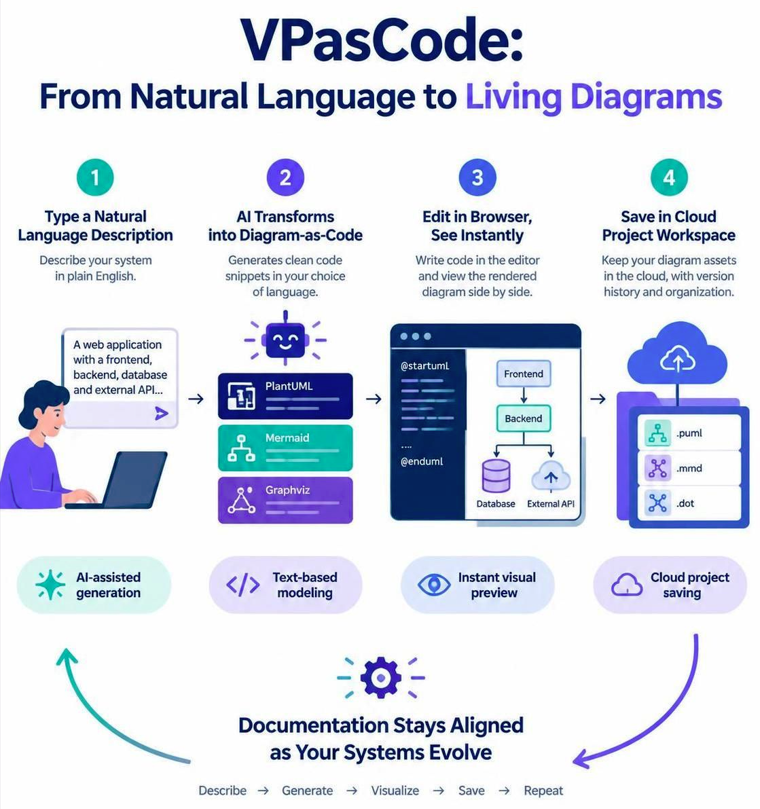
In the modern software development lifecycle, documentation often struggles to keep pace with implementation. Traditional diagramming tools that rely on dragging and dropping shapes frequently become obsolete the moment the architecture changes. Enter Visual Paradigm VPasCode, a revolutionary browser-based platform that fundamentally shifts the paradigm from “drawing” diagrams to “coding” them. This tutorial explores how VPasCode merges the precision of text-based coding with the clarity of visual modeling, supercharged by Generative AI and cloud capabilities.
The Core Philosophy: Diagram-as-Code (DaC)
VPasCode is built upon the concept of Diagram-as-Code (DaC). Instead of manipulating pixels on a canvas, users define their system architecture using text-based languages. This approach transforms documentation into a version-controlled, maintainable asset. The platform supports industry-standard domain-specific languages, including:
- PlantUML: Ideal for detailed software architecture and sequence diagrams.
- Mermaid: A JavaScript-based tool often used for markdown-based documentation.
- Graphviz: Powerful for graph theory and dependency visualization.
By treating diagrams as code, teams can leverage the same benefits they enjoy with their application code: version history, collaborative editing, and automated deployment pipelines.
Step 1: The AI-Driven Workflow
The most distinct feature of VPasCode is its ability to bridge the gap between natural language and technical modeling. This process creates a “living” documentation lifecycle that evolves alongside the system.
- Type a Natural Language Description: The journey begins with plain English. Instead of worrying about syntax or node positioning, the user describes the system concept. For example, one might type: “A web application with a frontend, backend, database, and external API.”
- AI Transforms to Diagram-as-Code: VPasCode’s generative AI engine analyzes the natural language prompt. It instantly translates this description into clean, syntactically correct code snippets using the user’s preferred language (e.g., PlantUML).
- Edit in Browser, See Instantly: The platform operates in a split-screen mode. On the left, the user sees the generated code; on the right, the rendered diagram updates in real-time. This immediate feedback loop allows for rapid iteration.
- Save in Cloud Project Workspace: Once the diagram is complete, assets are saved to a cloud-based workspace. This ensures that all diagram versions, history, and organization are preserved centrally.
Technical Architecture of the Platform
VPasCode is designed as a persistent, project-based workspace rather than a simple file editor. The underlying architecture supports a continuous cycle of documentation:
Describe → Generate → Visualize → Save → Repeat
This architecture ensures that documentation stays aligned as systems evolve. By moving away from static images to dynamic code representations, teams can manage their visual documentation lifecycle with the same rigor as their application code.
Conclusion: A New Era of Modeling
By integrating Generative AI with the robustness of Diagram-as-Code, Visual Paradigm VPasCode addresses the critical pain point of documentation drift. It empowers architects and developers to create complex diagrams quickly using natural language, refine them with precise code, and manage them within a unified cloud environment. Whether you are defining a simple database schema or a complex distributed system, VPasCode provides the tools to make your diagrams truly “living” assets.