
Mastering Diagram-as-Code: AI-Driven VPasCode and Mermaid Architecture
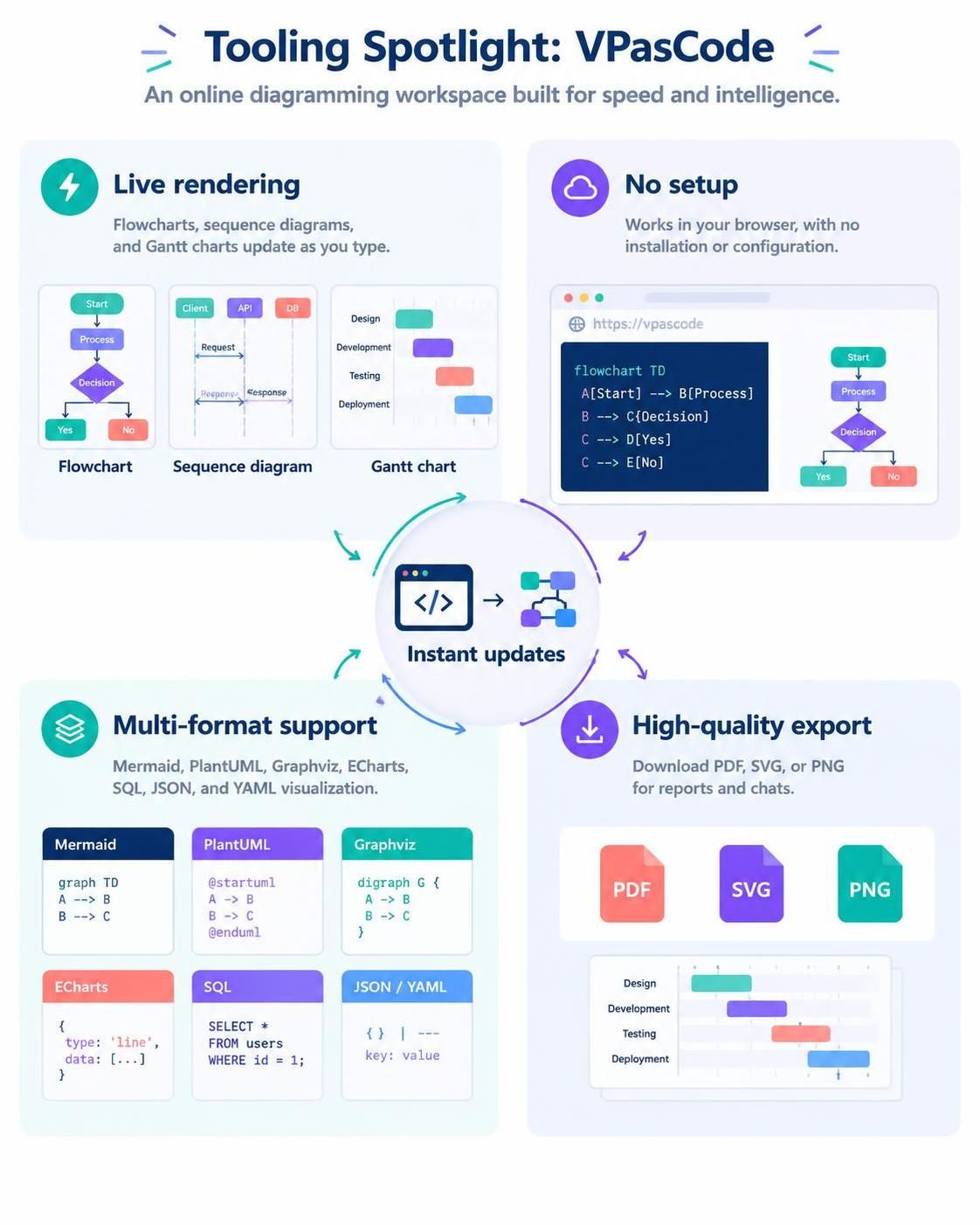
In the rapidly evolving landscape of software development and systems analysis, the gap between abstract logic and visual representation is often bridged by “Diagram-as-Code” tools. These tools allow engineers to write text-based descriptions that are automatically rendered into professional-grade diagrams. This tutorial explores the architecture and capabilities of Visual Paradigm VPasCode, a comprehensive online workspace designed to leverage this methodology for speed, intelligence, and collaboration.
The Paradigm Shift: From Drag-and-Drop to Code-First Modeling
Traditional diagramming tools often rely on a “WYSIWYG” (What You See Is What You Get) approach, where users manually drag shapes onto a canvas. While intuitive for beginners, this method struggles with version control and complex logic management. VPasCode represents a shift toward a code-first paradigm.
At its core, this architecture treats the diagram source code as the “Single Source of Truth.” By writing text definitions, users can generate:
- Flowcharts: Visualizing decision trees and process logic.
- Sequence Diagrams: Mapping the interaction between system components over time.
- Gantt Charts: Planning project timelines and resource allocation.
System Architecture: The Live Rendering Engine
The standout feature of VPasCode is its Live Rendering architecture. Unlike static diagramming tools that require a “Compile” or “Render” button, VPasCode utilizes an event-driven engine that listens for keystrokes.
- Input Parsing: As you type in the left-hand editor pane, the system parses the text stream.
- AST Generation: The parser converts the text into an Abstract Syntax Tree (AST), identifying nodes (shapes) and edges (connectors).
- Real-time Rendering: The visualization engine instantly paints the diagram on the right-hand canvas. This allows for immediate feedback, ensuring that syntax errors or logical gaps are spotted instantly.
This “No Setup Required” cloud-native approach means the heavy lifting of dependency management and rendering libraries is handled server-side, allowing the browser to focus purely on the user interface and interaction.
Multi-Format Support: A Polyglot Modeling Environment
VPasCode distinguishes itself by supporting a wide array of modeling languages, not just Mermaid. This flexibility allows teams to use the same tool for different stakeholders:
1. Mermaid & PlantUML (Process Logic)
These are the industry standards for general system flow. They use human-readable text to define complex relationships between objects.
graph TD
    A[Start] --> B{Is Valid?}
    B -- Yes --> C[Process Data]
    B -- No --> D[Log Error]
    C --> E[End]
2. Graphviz (Dependency Graphs)
While Mermaid is great for flow, Graphviz excels in describing directed graphs with complex mathematical layouts, often used for dependency analysis or network topology.
digraph G {
    A -> B
    B -> C
    C -> A
}
3. ECharts (Data Visualization)
For data scientists and analysts, the integration of ECharts allows for the creation of dynamic, interactive charts directly from JSON configurations. This bridges the gap between database outputs and visual reporting.
{
    type: 'line',
    data: [...]
}
4. SQL & YAML (Data & Config)
The ability to visualize SQL queries and YAML configurations provides a unique insight into data structures. Instead of viewing raw code, developers can see the hierarchy of configuration files or the structure of a database query result set.
SELECT *
FROM users
WHERE id = 1;
Exporting for the Enterprise: High-Quality Delivery
In a professional setting, diagrams must be portable. VPasCode addresses this with a robust export engine that supports:
- SVG (Scalable Vector Graphics): The gold standard for technical documentation, ensuring diagrams look crisp on any screen size or print resolution.
- PNG (Portable Network Graphics): Ideal for quick sharing in chat applications (Slack, Teams) or embedding in web pages.
- PDF (Portable Document Format): Perfect for formal reports, architectural reviews, and documentation.
Integrating AI: The Future of Modeling
The architecture of VPasCode is increasingly intertwined with AI capabilities. By integrating AI generation for Mermaid code, users can describe a process in natural language (e.g., “Create a flowchart for a user login process”) and have the system generate the precise syntax required. This lowers the barrier to entry, allowing non-technical stakeholders to contribute to system modeling.
Conclusion
VPasCode represents the next evolution in system design: an intelligent, browser-based workspace that prioritizes speed and flexibility. By unifying multiple diagramming languages under one roof and offering real-time rendering, it empowers developers and architects to focus on the logic of their systems rather than the mechanics of drawing them.