
Mastering BPMN Choreography: Modeling Independent Participants and Shared Outcomes
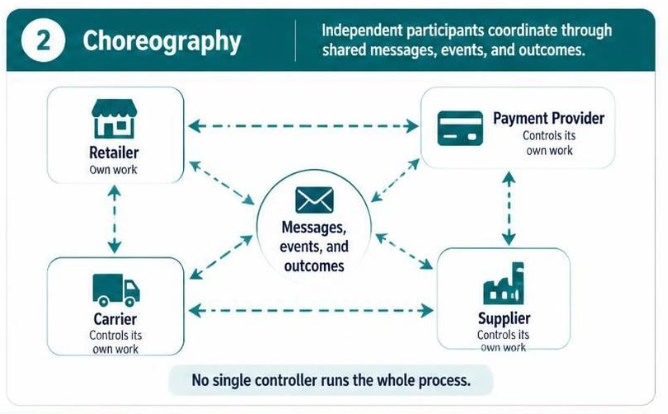
In the complex ecosystem of modern business processes, organizations often operate as autonomous entities. While they collaborate to achieve a shared goal—such as delivering a product to a customer—they do not always hand over control to a single “master” system. This is the core concept of Process Choreography.
This tutorial explores the architectural concept of choreography, where independent participants coordinate through shared expectations, messages, and events, rather than a central controller. We will analyze the specific relationships between a Retailer, Supplier, Carrier, and Payment Provider to understand how to model this decentralized flow using BPMN standards.
What is Process Choreography?
Process choreography is a modeling approach used to describe the interactions between independent participants. Unlike traditional orchestration, where a central “conductor” (or controller) dictates the flow of tasks to every other system, choreography relies on a peer-to-peer interaction model.
In a choreography model:
- Autonomy: Each participant manages its own internal logic and work.
- Shared Expectations: Participants agree on what messages to send, what events to wait for, and what the final outcomes should be.
- No Central Controller: No single participant runs the whole process. The “process” is actually an emergent property of these interactions.
Deconstructing the Choreography Diagram
Let’s walk through the specific components shown in the diagram to understand how they function within a supply chain context.
1. The Independent Participants
The diagram features four distinct entities, each representing a participant that controls its own internal work:
- Retailer: The entity initiating the transaction with the customer. They manage their inventory and sales processes.
- Supplier: The manufacturer or wholesaler. They control their production and shipping schedules.
- Carrier: The logistics provider. They control the physical movement of goods.
- Payment Provider: The financial entity. They control the authorization and settlement of funds.
2. The Central Hub: Messages, Events, and Outcomes
In the center of the diagram is a circle labeled “Messages, events, and outcomes.” This is a critical visualization metaphor. It does not represent a server or a database; rather, it represents the Shared Context.
In BPMN terms, this represents the message pool. The participants do not talk directly to each other in a rigid sequence; they react to the state of the system. For example, when the Supplier ships a package, they emit an event. The Carrier picks up the package. The Retailer sees the “Shipped” event. All parties are reacting to the shared state of the message.
Modeling the Relationships
The dotted arrows connecting the participants to the center and to each other signify the flow of information. In a BPMN Choreography Diagram (using BPMS Choreography shapes), these relationships are formalized using specific constructs.
The Interaction Flow:
- Retailer to Supplier: The retailer sends a purchase order (Message). The supplier receives it as a trigger event.
- Supplier to Carrier: The supplier requests shipping (Message). The carrier accepts and updates the status.
- Carrier to Retailer: The carrier updates the delivery status (Event). The retailer now knows the item is in transit.
- Retailer to Payment Provider: The retailer requests payment. The provider confirms (Outcome).
Why “No Single Controller” Matters
The text at the bottom of the diagram states: “No single controller runs the whole process.” This is the defining characteristic of choreography.
If the Supplier goes offline, the Carrier can still ship the goods. If the Payment Provider is slow, the Retailer can still track the delivery. Because no single system holds the entire workflow state, the architecture is more resilient. If one participant fails, the others can often continue operating or handle the failure locally without crashing the entire business process.
Visualizing the Architecture
When creating this model in tools like Visual Paradigm, you would typically use the Choreography Diagram type. Here is a conceptual breakdown of how the logic is structured in the modeling tool.
Participant: Retailer
  - Internal Task: Process Order
  - Message: Send Order to Supplier
  - Message: Receive Delivery Confirmation
  - Message: Request Payment

Participant: Supplier
  - Internal Task: Fulfill Order
  - Message: Receive Order from Retailer
  - Message: Send Order Acknowledgement
  - Message: Request Shipping from Carrier

Participant: Carrier
  - Internal Task: Transport Goods
  - Message: Receive Shipping Request
  - Message: Send Delivery Status Update

Participant: Payment Provider
  - Internal Task: Validate Transaction
  - Message: Receive Payment Request
  - Message: Send Payment Confirmation

Interaction:
  Retailer --(Order)--> Supplier
  Supplier --(Ack)--> Retailer
  Supplier --(Ship)--> Carrier
  Carrier --(Status)--> Retailer
  Retailer --(Pay)--> Payment Provider
  Payment Provider --(Confirm)--> Retailer
Implementation in BPMN
In strict BPMN 2.0 modeling, this is represented using:
- Choreography Task: A task that is performed by two or more participants.
- Message Flow: The dotted lines indicating the exchange of data.
- Message Event: The circle with an envelope icon, representing the receipt or sending of a message.
By modeling the process this way, you ensure that the diagram accurately reflects the reality of the business: independent systems cooperating to achieve a result.
Conclusion
Process choreography is essential for modeling complex, distributed systems. By understanding that no single participant controls the end-to-end process, architects can design systems that are more flexible, scalable, and robust. The diagram illustrates that the “process” is not a linear path but a network of coordinated interactions driven by shared messages and outcomes.