
Architecting the Private Enterprise AI Solution: A Strategic Framework
In the modern enterprise landscape, the barrier to adopting Artificial Intelligence is no longer a lack of capability, but rather a lack of cohesion. Organizations often face the “integration paradox”: they have powerful AI models but struggle to connect them to their proprietary knowledge without compromising security or requiring a massive team of engineers.
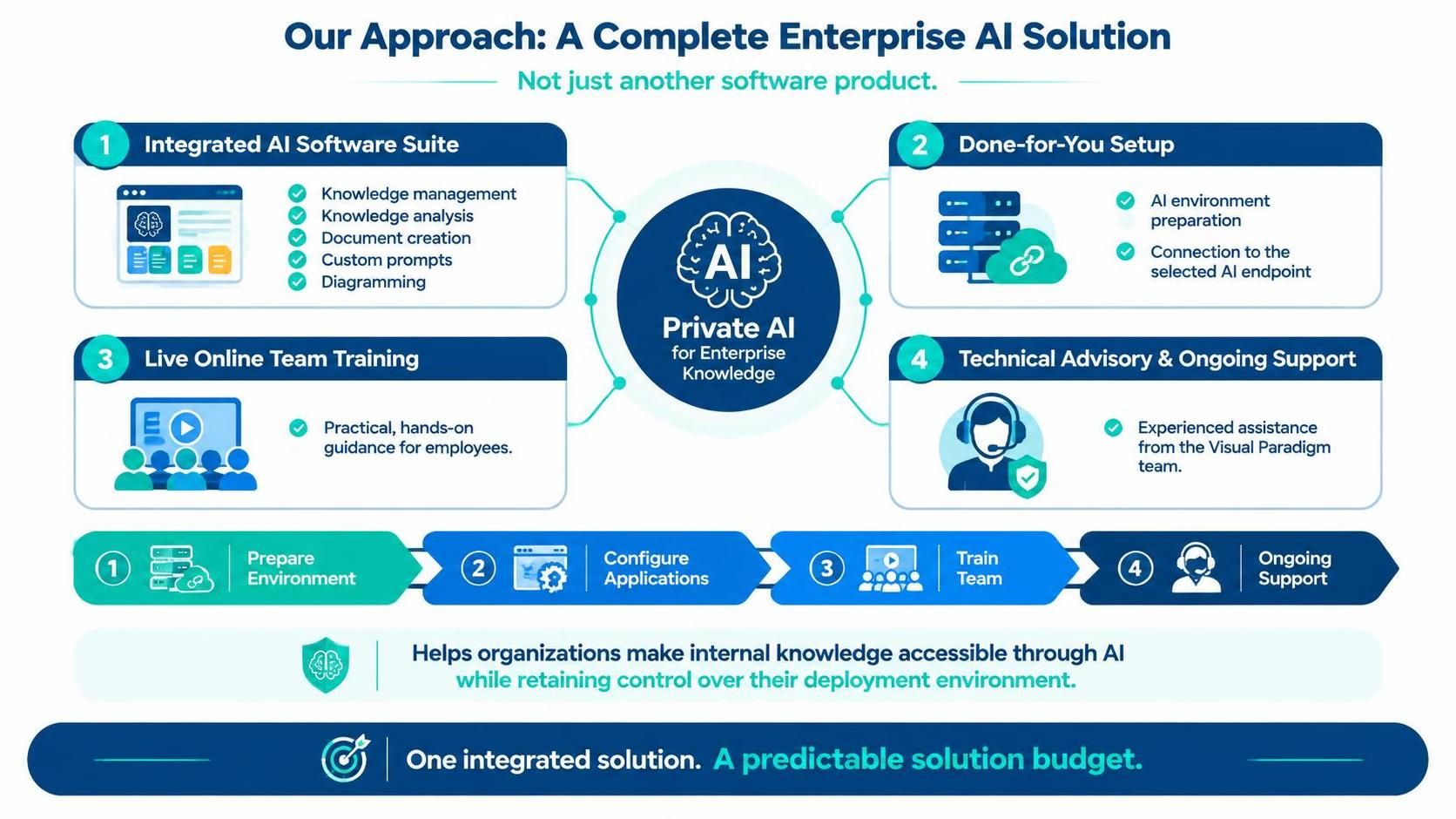
This tutorial explores the strategic architecture of a complete Enterprise AI Solution, specifically focusing on the Private AI for Enterprise Knowledge model. We will deconstruct the four pillars of this ecosystem—Software, Infrastructure, Training, and Support—to understand how they form a unified system rather than disparate tools. By the end of this guide, you will understand how to structure an AI deployment that prioritizes privacy, control, and ease of use.
The Core Philosophy: From “Software Product” to “Integrated Solution”
Traditional software acquisition often leaves the customer to bridge the gaps between the tool, the infrastructure, and the people. The “Private AI” architecture flips this script. It treats the AI environment as a holistic service.
The central goal is to make internal knowledge accessible through AI while maintaining strict control over the deployment environment. This is critical for organizations that cannot rely on public cloud models for sensitive data.
Pillar 1: The Integrated AI Software Suite
The foundation of this architecture is the application layer. Instead of a generic chatbot interface, this suite is designed for the specific workflows of corporate knowledge management.
- Knowledge Management: Structuring unstructured data (documents, PDFs, emails) so the AI can retrieve it contextually.
- AI-Powered Analysis: Moving beyond simple search to allow the system to synthesize information across multiple documents.
- Document Creation & Custom Prompts: Empowering users to generate content using pre-approved, company-specific instructions.
- Diagramming: Integrating visual modeling (like UML or Flowcharts) directly into the AI workflow, allowing for “Visual AI” where the model helps design system architectures.
Pillar 2: Done-for-You Infrastructure & Endpoint Setup
The “Private” aspect of the solution relies heavily on the underlying infrastructure. This is often the most complex part of AI adoption, requiring the selection of endpoints (where the AI runs) and the configuration of security protocols.
In this framework, the provider handles the heavy lifting:
- AI Environment Preparation: Setting up the necessary compute resources, whether on-premise or in a private cloud.
- Endpoint Connection: Establishing the secure handshake between the Visual Paradigm software suite and the selected AI model endpoint. This ensures that data flows securely from the user’s knowledge base to the AI engine and back.
Pillar 3: Live Online Team Training
Technology is useless if the workforce does not know how to leverage it. This architecture includes a dedicated “Human Layer.” The training is not theoretical; it is practical and hands-on.
The objective is to bridge the gap between IT and Business users. Employees are guided on how to use the custom prompts, analyze AI outputs, and utilize the diagramming tools effectively. This ensures that the ROI of the software is realized quickly.
Pillar 4: Technical Advisory & Ongoing Support
Finally, the system is sustained by a feedback loop of support. This involves dedicated technical advisory from the provider’s team. It acts as a safety net, ensuring that any issues with the integration, the model performance, or the infrastructure are resolved by experts, not by the customer’s internal IT staff.
System Workflow: The Implementation Lifecycle
To visualize how these pillars work together, we can look at the implementation lifecycle. This is a linear progression that moves an organization from a concept to a fully operational Private AI environment.
The workflow follows a logical sequence:
- Prepare Environment: Establishing the secure infrastructure.
- Configure Applications: Setting up the software suite and connecting data sources.
- Train Team: Onboarding the workforce.
- Ongoing Support: Continuous maintenance and advisory.
Conclusion
This integrated approach represents a shift in how enterprises view AI adoption. By combining the software, the infrastructure, the training, and the support into a single predictable budget and solution, organizations can bypass the typical friction of AI implementation. The result is a system where the AI is not just a tool, but a fully integrated partner in enterprise knowledge management.