
Architecting Enterprise Systems: The Core Architecture of Visual Paradigm Desktop
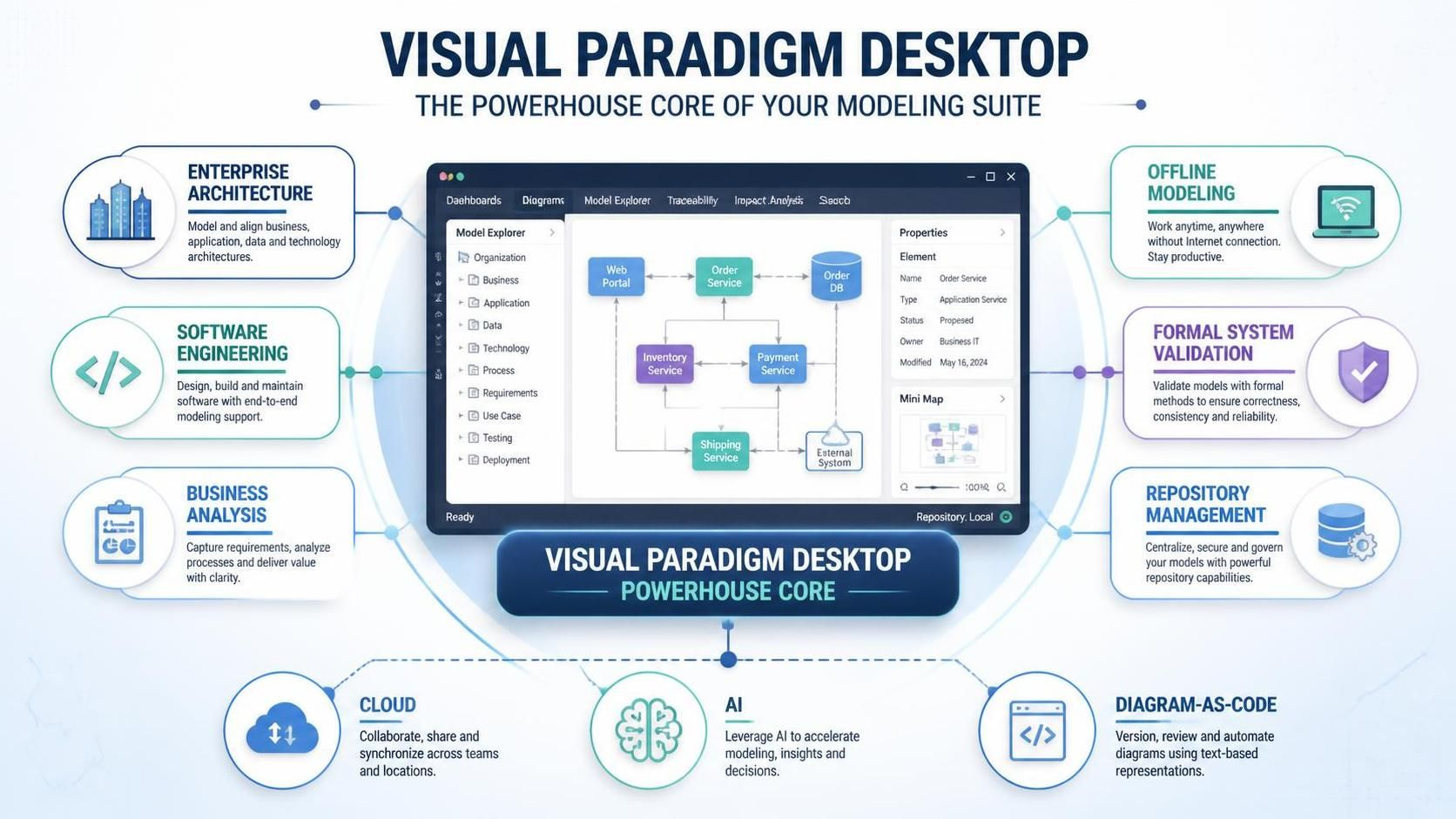
In the rapidly evolving landscape of software development and enterprise architecture, the distinction between “modeling” and “engineering” is often blurred. However, Visual Paradigm Desktop stands out as a comprehensive powerhouse designed to bridge this gap. It is not merely a drawing tool; it is a robust, offline-capable modeling suite that serves as the central nervous system for enterprise architects, software engineers, and business analysts.
This tutorial explores the technical architecture of the Visual Paradigm Desktop environment. We will dissect how it integrates offline modeling with cloud connectivity, formal validation, and AI-driven insights to create a unified ecosystem for system design.
1. The Central Modeling Environment
At the heart of the Visual Paradigm Desktop application lies a sophisticated workspace designed for high-fidelity system representation. As depicted in the central interface of the suite, the environment is divided into three critical operational zones that facilitate the “Model-Driven Development” (MDD) approach.
Model Explorer and Repository Structure
On the left-hand side, the Model Explorer provides a hierarchical tree view of your project. This is where the “Repository” aspect of the software comes alive. It allows users to organize complex systems into logical containers:
- Organization: For defining high-level business contexts.
- Application & Data: For detailed software architecture and database schemas.
- Process & Requirements: For capturing business logic and user stories.
The Canvas: Service-Oriented Architecture
The central canvas in the provided image demonstrates a classic Service-Oriented Architecture (SOA) or Microservices pattern. The diagram illustrates the interaction between various system components:
- Web Portal: The entry point for user interaction.
- Order Service: A stateless service handling transaction requests.
- Order DB: A persistent data store.
- Inventory, Payment, & Shipping Services: Specialized back-office services that the Order Service orchestrates.
2. Offline Modeling: The Power of Autonomy
One of the most critical features of Visual Paradigm Desktop is its capability for Offline Modeling. In many modern “cloud-first” tools, a stable internet connection is a prerequisite for basic functionality. Visual Paradigm Desktop, however, is engineered for resilience.
When working on sensitive enterprise projects or during travel, the “Work anytime, anywhere” capability ensures that the modeling process is not interrupted. The local engine parses syntax, validates relationships, and generates artifacts without relying on external server latency. This is essential for maintaining productivity in environments with strict security policies or limited connectivity.
3. Formal System Validation
Modeling is not just about aesthetics; it is about logic. Visual Paradigm Desktop incorporates a Formal System Validation engine. This feature allows architects to mathematically prove the correctness of their models before a single line of code is written.
This validation ensures:
- Consistency: Preventing conflicting data definitions across different diagrams.
- Reliability: Verifying that state machines and process flows do not contain deadlocks or unreachable states.
- Traceability: Ensuring that every requirement is linked to a design element.
4. Integration: Cloud, AI, and Diagram-as-Code
While the Desktop version is powerful offline, it acts as a synchronization hub for the broader ecosystem. It integrates seamlessly with:
- Cloud Collaboration: Teams can synchronize models across different locations, ensuring that the “Single Source of Truth” remains consistent.
- AI Acceleration: Leveraging Artificial Intelligence to generate models from natural language prompts or to suggest architectural optimizations.
- Diagram-as-Code: For engineers who prefer version control via Git, the platform supports text-based representations (like Mermaid or PlantUML) to automate diagram generation and review.
Conclusion
Visual Paradigm Desktop is more than just a diagramming tool; it is a complete engineering platform. By combining the robustness of offline architecture with the agility of cloud and AI integration, it empowers teams to model complex enterprise systems with precision, ensuring that the transition from design to implementation is seamless and validated.