
AI-Driven PERT Charts: A Human-in-the-Loop Framework for Project Delivery
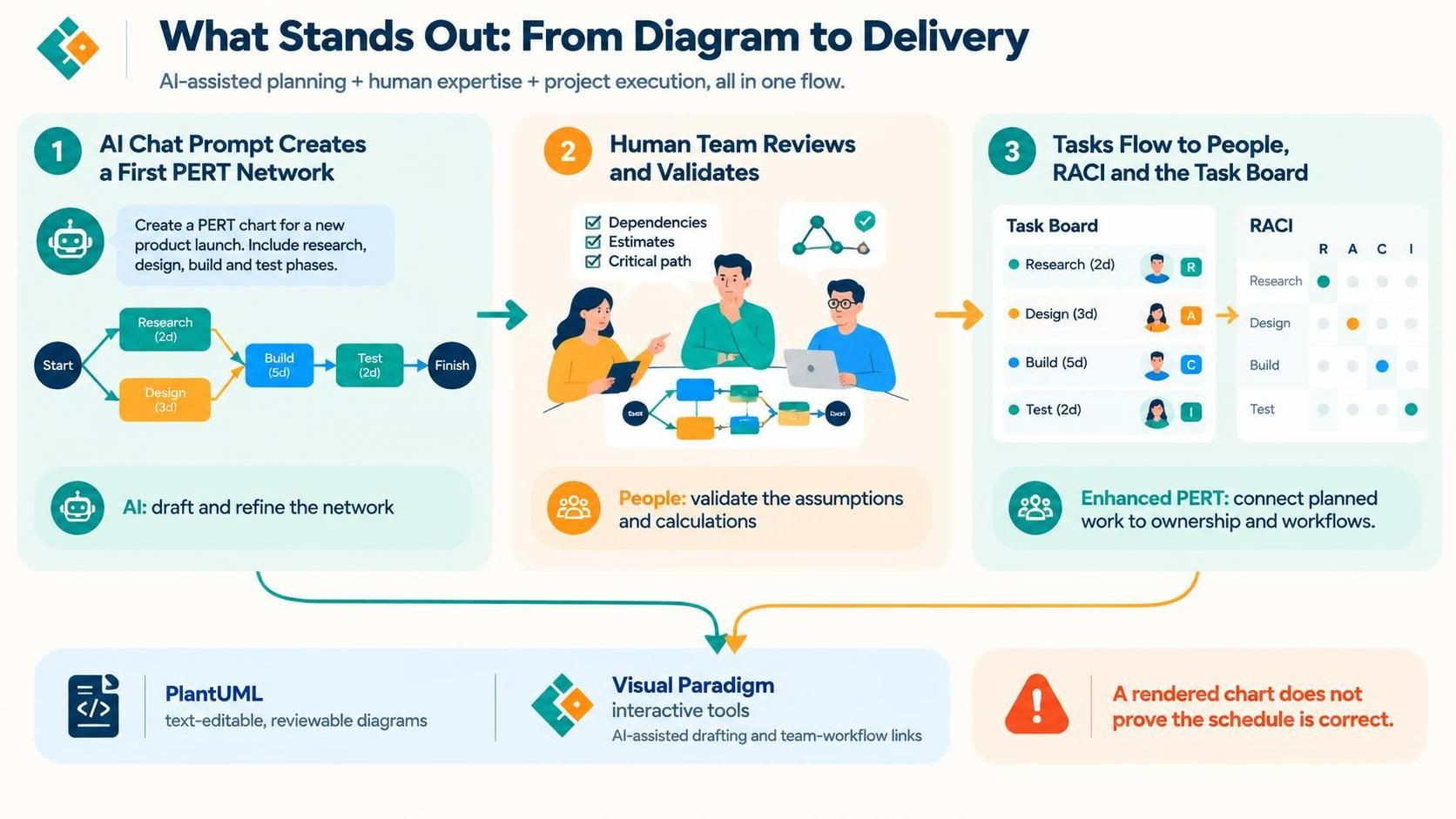
In modern project management, the gap between a theoretical plan and actual execution is often bridged by complex software tools. However, a new paradigm is emerging that combines the speed of Artificial Intelligence with the critical oversight of human expertise. This tutorial explores a hybrid system architecture where AI generates the initial project structure, humans validate the logic, and the final output is directly integrated into team workflows and resource allocation.
The Core Philosophy: AI Drafting, Human Validation
The architecture described here moves beyond simple diagramming. It treats the PERT (Program Evaluation and Review Technique) chart not just as a static image, but as a dynamic dataset that drives project execution. The workflow is a three-stage funnel designed to balance efficiency with accuracy.
Phase 1: The AI-Generated Foundation
The process begins with a conversational interface. Instead of manually dragging and dropping nodes onto a canvas, the project manager or planner initiates the process via a natural language prompt. This approach significantly lowers the barrier to entry for creating complex network diagrams.
- The Input: A high-level request, such as “Create a PERT chart for a new product launch including research, design, build, and test phases.”
- The Logic: The AI engine interprets the text, identifies the logical sequence of events, and assigns initial duration estimates.
- The Output: A draft network diagram (Start → Research/Design → Build → Test → Finish) is rendered instantly.
This phase leverages tools like VPasCode or AI Chartbots to translate intent into structural data. The AI handles the tedious setup of dependencies and initial calculations, allowing the team to start with a “First Draft” rather than a blank slate.
Phase 2: The Human Review Loop
This is the most critical step in the architecture. While AI is excellent at speed and pattern recognition, it lacks the contextual nuance required for high-stakes planning. The system enforces a mandatory review stage before any plan becomes actionable.
During this phase, the Human Team Reviews and Validates three specific pillars:
- Dependencies: Does the logic hold? (e.g., Is “Build” truly dependent on “Design”?)
- Estimates: Are the durations realistic based on current team capacity?
- Critical Path: Which tasks, if delayed, will delay the entire project?
The system is designed to refine the network iteratively. If the AI-generated diagram misses a constraint, the human user can refine the prompt or adjust the nodes, and the system regenerates the logic.
Phase 3: Execution and Integration
Once the plan is validated, it transitions from a “Diagram” to “Delivery.” This is the “Enhanced PERT” capability. The system takes the validated nodes and links them to real-world entities:
- Task Board: Tasks are converted into actionable items with assigned owners.
- RACI Matrix: Responsibilities are clarified. Who is Responsible (doing the work), Accountable (signing off), Consulted, or Informed?
- Workflows: The project plan becomes a living schedule that teams can interact with.
Tooling and Technology Stack
This architecture relies on a specific combination of tooling capabilities to function effectively. The system distinguishes between text-based editing and interactive visual drafting.
Visual Paradigm & VPasCode
The core engine often utilizes Visual Paradigm for its robust project management features. By leveraging VPasCode, the system allows for programmatic generation of diagrams. This is particularly useful for creating complex dependencies that might be tedious to draw manually.
PlantUML vs. Interactive Tools
The architecture supports different output formats depending on the user’s need for reviewability versus interactivity:
- PlantUML: Preferred when the diagram needs to be text-editable and reviewable. It treats the diagram as code, allowing version control and text-based diffing.
- Visual Paradigm Interactive Tools: Preferred when the goal is AI-assisted drafting or linking directly to team workflows. These tools offer a graphical interface that is more intuitive for non-technical stakeholders.
Conclusion
This hybrid system architecture represents the future of project planning. By using AI to handle the “heavy lifting” of diagram creation and then applying human intelligence to validate the strategy, organizations can ensure that their project plans are both efficient to create and reliable to execute. The transition from a simple dependency plan to an assigned, RACI-mapped task board is seamless, ensuring that the project moves from the drawing board to the delivery stage without losing momentum.