
Mastering Multi-Channel Loan Approval Processes with Visual Paradigm BPMN
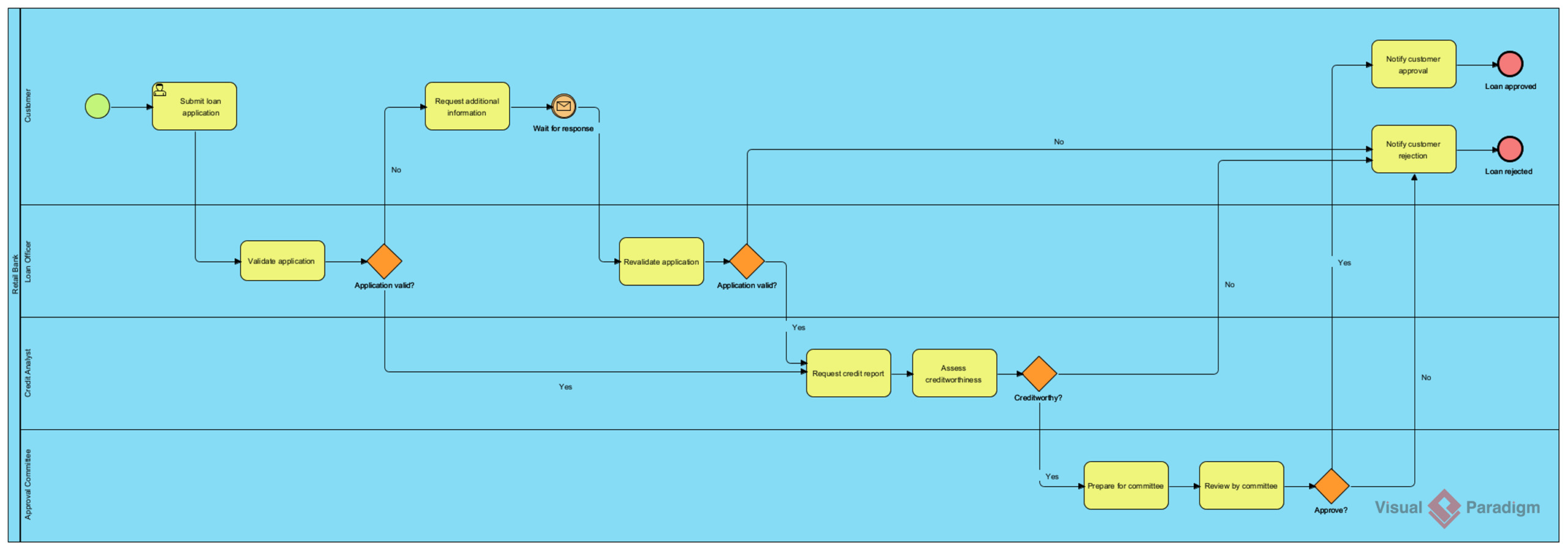
In the modern financial sector, the loan application process is rarely linear. It is a complex ecosystem involving multiple channels (online vs. in-branch), strict regulatory compliance checks, and parallel processing to ensure speed. This tutorial explores the architecture of a Loan Application and Approval Process using Visual Paradigm. We will dissect how to model a hybrid system that handles diverse inputs, manages exceptions, and orchestrates complex decision-making across different organizational departments.
Understanding the Architecture: Multi-Channel Entry Points
The foundation of this process model is its ability to handle Multiple Start Events. In real-world banking, customers do not all enter the system the same way. Visual Paradigm allows you to model these distinct entry points to ensure the process logic remains robust regardless of the source.
- Online Submission: A digital interface where data is pre-validated by the bank’s website before reaching the core system.
- In-Branch Submission: A physical interaction where a loan officer captures data, requiring manual validation.
These distinct starts converge into a unified process flow. This is known as Process Convergence. It ensures that whether a customer applies via a mobile app or walks into a branch, the subsequent validation logic remains consistent. Visual Paradigm simplifies this by allowing you to model these separate paths and merge them seamlessly into a single logical flow using Exclusive Gateways.
Orchestrating Parallel Processing for Efficiency
One of the most significant performance drivers in loan processing is the ability to run checks simultaneously rather than sequentially. In the diagram, once an application is deemed valid, the system splits into Parallel Processing paths.
- Credit Report Retrieval: The system automatically requests a credit report from external bureaus.
- Income Verification: Simultaneously, the loan officer or automated system verifies income documents.
By modeling these as parallel tasks (often using an AND Gateway), the process reduces the total cycle time from days to hours. The diagram demonstrates how Visual Paradigm handles the synchronization of these tasks, ensuring that the next phase of the process does not begin until all parallel tasks are complete.
Navigating Complex Decision Logic
Financial processes are rife with conditional logic. Visual Paradigm’s BPMN capabilities allow for complex decision trees that go beyond simple Yes/No scenarios.
1. The Credit Score Tiering
Instead of a binary approval, the model implements a tiered approach:
- High Credit Score (>750): Triggers a “Fast-track” path, bypassing manual review.
- Medium Credit Score (650-750): Requires standard review.
- Low Credit Score (<650): Triggers manual underwriting or immediate rejection.
2. The Debt-to-Income (DTI) Ratio
Beyond the credit score, the process includes a specific gateway for Debt-to-Income ratio. This acts as a secondary filter. If a customer has a high credit score but a DTI that is too high, the process diverts to a specific resolution path, ensuring that the bank’s risk appetite is strictly adhered to.
Exception Handling and Time-Based Management
A robust process model must account for what happens when things don’t go according to plan. Visual Paradigm excels in modeling Exception Handling and Intermediate Timer Events.
Consider the scenario where the bank requests additional information from the customer. This creates a waiting state. If the customer does not respond within a specific timeframe (e.g., 3 days), the process must not hang indefinitely. The diagram illustrates an Intermediate Timer Event attached to this task. Once the timer expires, the flow automatically diverts to a “Suspend” or “Reject” path, ensuring operational efficiency and preventing backlogs.
Stakeholder Communication via Swimlanes
Clear communication between departments is vital. The model utilizes Swimlanes to visually segregate responsibilities:
- Customer Lane: Contains the initial submission and responses to information requests.
- Loan Officer Lane: Handles validation and manual reviews.
- Credit Analyst Lane: Focuses on creditworthiness assessment.
- Approval Committee Lane: Handles final high-value approvals.
Visual Paradigm allows you to export specific views of these swimlanes, enabling targeted reviews where a Loan Officer only sees tasks relevant to their role, reducing cognitive load and errors.
Business Value and Automation Readiness
Implementing this model in Visual Paradigm offers tangible business benefits:
- Risk Management: By explicitly modeling decision points like credit scores, you prevent bad loans from entering the portfolio.
- Regulatory Compliance: The visual model serves as an audit trail, showing exactly how decisions are made.
- Operational Efficiency: Identifying parallel processing opportunities allows the bank to cut processing times significantly.
- Automation Planning: Visual Paradigm allows you to tag tasks as “Automated” or “Manual,” providing a clear roadmap for IT implementation.
By leveraging the BPMN + AI Ecosystem, teams can generate documentation, RACI matrices, and implementation guides directly from this diagram, bridging the gap between high-level strategy and technical execution.