
Mastering Parallel Gateways in BPMN: A Deep Dive into the Onboarding Process
In the world of Business Process Model and Notation (BPMN), efficiency is not just a buzzword—it is a structural necessity. One of the most powerful tools available to process architects for achieving operational efficiency is the Parallel Gateway. While many organizations struggle with “siloed” workflows where departments wait idly for others to finish, a well-modeled parallel process ensures that critical path activities happen simultaneously.
This tutorial dissects the Onboarding Process to demonstrate how parallel gateways transform a linear, slow sequence into a dynamic, concurrent workflow. We will explore the architecture of this process, the specific roles of the lanes (HR, IT, and Manager), and the logical flow that ensures “Employee Day 1 Ready” status is achieved with maximum speed.
Understanding the Process Architecture
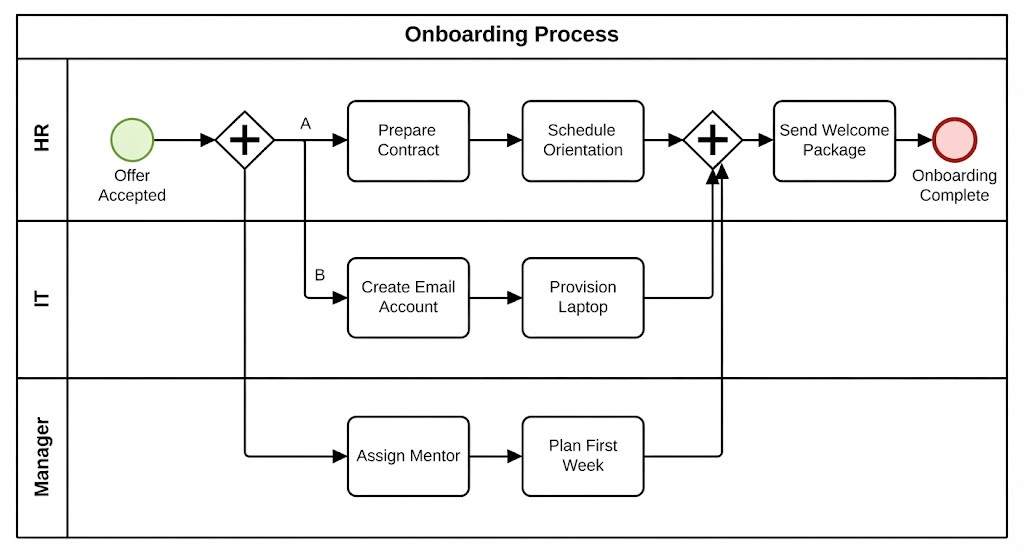
The diagram presents a classic “Swimlane” architecture. In BPMN, swimlanes are used to categorize tasks by the actor responsible for them. In this specific Onboarding Process, we see three distinct actors:
- HR (Human Resources): Responsible for legal compliance and cultural integration.
- IT (Information Technology): Responsible for infrastructure and digital access.
- Manager: Responsible for team integration and role-specific planning.
The core innovation in this model lies in how these lanes interact. Without parallel processing, the process would look like a relay race: HR finishes, then IT starts, then the Manager starts. This creates significant bottlenecks. By utilizing parallel gateways, we convert the relay race into a sprint where all three departments sprint toward the finish line at the same time.
Step-by-Step Flow Analysis
Let’s break down the lifecycle of a new hire from the moment an offer is accepted to their first day.
1. The Trigger: Start Event
The process begins with the Start Event, labeled “Offer Accepted”. This is the green circle on the far left. In BPMN terms, this event signifies that the precondition for the process has been met. The workflow engine (or the human administrator) is now instructed to initiate the onboarding sequence.
2. The Split: Parallel Gateway (AND)
Immediately following the start event is the first diamond shape containing a Plus sign (+). This is the Parallel Gateway. Unlike a Exclusive Gateway (an X), which forces the process to choose one path, the Parallel Gateway forces the process to take all paths simultaneously.
At this specific node, the process flow splits into three concurrent threads:
- Path A (HR): The flow moves to “Prepare Contract” and “Schedule Orientation”.
- Path B (IT): The flow moves to “Create Email Account” and “Provision Laptop”.
- Path C (Manager): The flow moves to “Assign Mentor” and “Plan First Week”.
Analogy: Think of this like a chef preparing a meal. Instead of boiling water, chopping vegetables, and preheating the oven one after another, they do all three tasks at the exact same time to save minutes of cooking time.
3. The Convergence: Joining the Paths
After the individual tasks are completed (Preparation, Provisioning, Planning), the process encounters the second Parallel Gateway. This is the Join point.
For the process to move forward from this point, the BPMN engine waits for all incoming arrows to arrive. If HR is fast but IT is slow, the process pauses at this gateway until the IT tasks (“Create Email Account” and “Provision Laptop”) are finished. This ensures that no work is done out of order.
4. The Final Steps
Once the parallel threads synchronize, the flow proceeds to the final task: “Send Welcome Package”. This is a critical task that likely requires data from all previous steps (e.g., knowing the start date, the manager’s name, and the laptop serial number). Finally, the process reaches the End Event (the red circle), marking the status as “Onboarding Complete” or “Employee Day 1 Ready”.
Why Parallel Gateways Matter
The inclusion of parallel gateways in this diagram is not merely aesthetic; it is a strategic design choice that impacts the company’s bottom line. The primary benefit is the reduction of Lead Time.
If these tasks were sequential, the total time to onboard would be the sum of all task durations. By making them parallel, the total time is determined only by the critical path—the longest single sequence of tasks. In this scenario, if IT takes 2 days and HR takes 1 day, the total time is 2 days, not 3. This agility is essential for modern talent acquisition.
Conclusion
The Onboarding Process diagram serves as a perfect example of how visual modeling can optimize business logic. By clearly defining the “Offer Accepted” trigger and utilizing Parallel Gateways to synchronize the efforts of HR, IT, and Management, the organization ensures a smooth, efficient, and professional first experience for new employees. Whether you are using Visual Paradigm or another modeling tool, mastering these gateway behaviors is the key to creating robust, high-performance business processes.