
Why Is BPMN Important? Mastering the Visual Language of Business Processes
In the modern enterprise, the gap between business strategy and technical execution often leads to inefficiencies, misunderstood requirements, and stalled projects. Business Process Model and Notation (BPMN) acts as the universal translator bridging this divide. It is more than just a drawing tool; it is a standardized graphical notation designed to specify, analyze, and automate business processes.
This tutorial explores why BPMN is critical for organizational success, how it standardizes communication between technical and business teams, and how tools like Visual Paradigm BPMN leverage AI to streamline this complex workflow.
The Power of a Shared Model
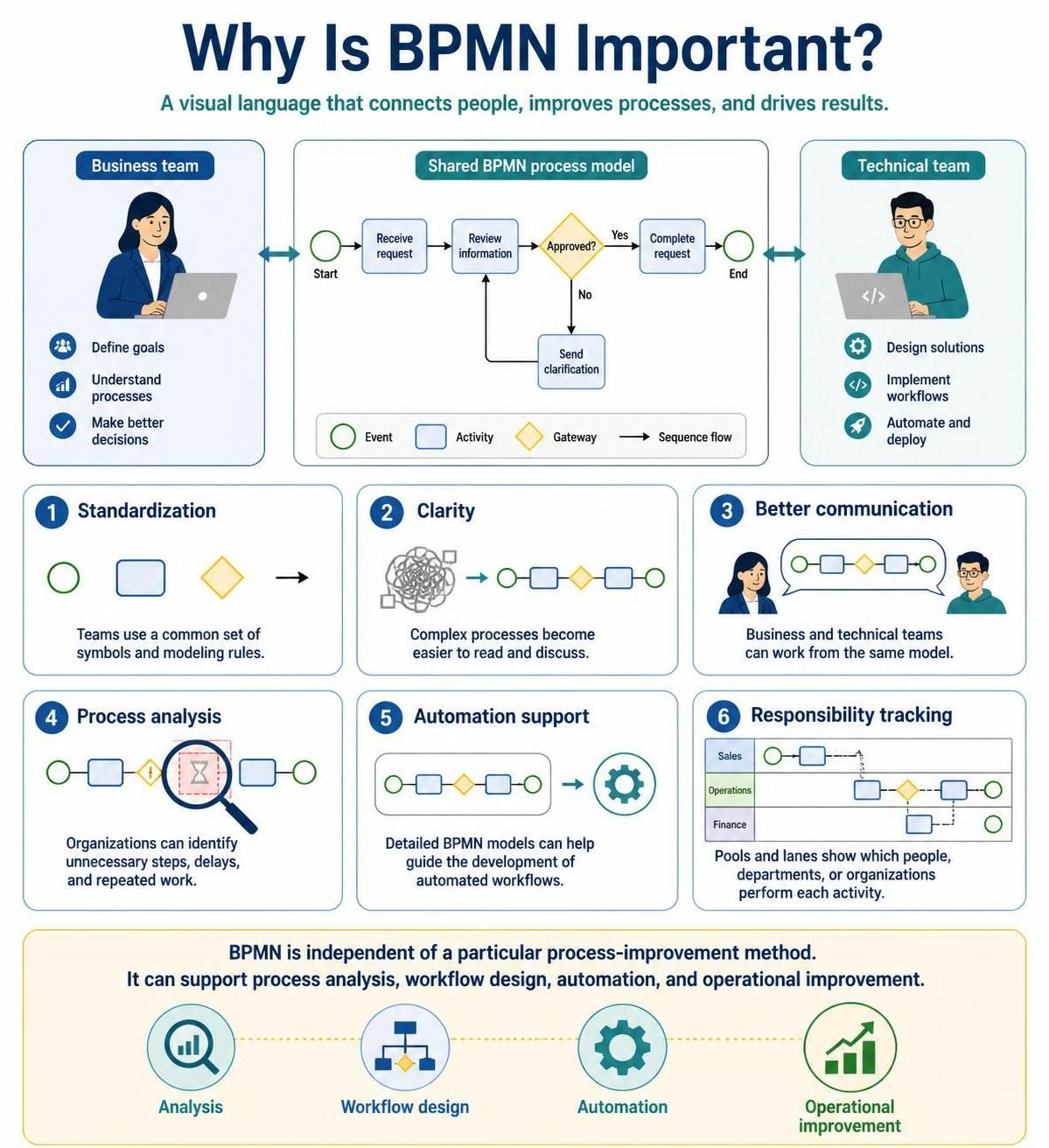
The core value of BPMN lies in its ability to create a “Shared BPMN process model.” As illustrated in the system architecture of modern process management, a single diagram serves two distinct audiences:
- The Business Team: Uses the diagram to define goals, understand the current state of operations, and identify bottlenecks. They rely on the visual flow to make better decisions without needing to read technical code.
- The Technical Team: Uses the same diagram as a blueprint. They can interpret the sequence flows and decision points to design solutions, implement workflows, and automate deployments.
By utilizing a common set of symbols, both teams work from the same source of truth. This eliminates the “telephone game” often found in traditional documentation where requirements get distorted as they pass from stakeholders to developers.
Key Benefits of BPMN Implementation
BPMN offers a structured approach to process management. Here are the primary advantages that drive its adoption:
1. Standardization and Clarity
Before BPMN, every organization had its own way of drawing a flowchart. BPMN introduced a rigorous set of symbols and modeling rules. Whether you are drawing a simple Start Event (a circle) or a Complex Gateway (a diamond with a cross), the rules are consistent. This standardization means that a process model drawn in one department is instantly readable by another, regardless of their industry or expertise.
2. Enhanced Communication
Complex processes often become a “spaghetti diagram” when described in text. BPMN transforms these abstract descriptions into a clear visual narrative. It allows business and technical teams to discuss the logic of the process—such as the “Yes” or “No” paths in a decision gate—using a shared vocabulary.
3. Process Analysis and Optimization
Once a process is modeled, it can be analyzed. Organizations can visually identify unnecessary steps, delays, or repeated work. By simulating the process flow, you can pinpoint exactly where a bottleneck occurs before you ever attempt to fix it.
4. Automation Support
For technical teams, detailed BPMN models are not just documentation; they are executable specifications. A well-constructed BPMN diagram can guide the development of automated workflows. If a process is clearly defined with specific inputs, outputs, and decision logic, it can often be converted directly into executable code or workflow engine scripts.
5. Responsibility Tracking
BPMN utilizes “Pools” and “Lanes” to assign ownership. You can visually see exactly which person, department, or organization performs each activity. This accountability is crucial for performance tracking and ensures that every step in a workflow has an owner.
Methodology Independence
One of the most powerful aspects of BPMN is its flexibility. It is independent of a particular process-improvement method. Whether your organization follows Lean, Six Sigma, or Agile methodologies, BPMN serves as the underlying language. It can support:
- Process Analysis: Understanding how things work today.
- Workflow Design: Planning how things should work tomorrow.
- Automation: Executing the process.
- Operational Improvement: Continuous optimization.
By adopting BPMN, you are not just drawing pictures; you are building a robust architecture for your business logic.