
Building the Bridge: BPMN Architecture for Business-Technical Alignment
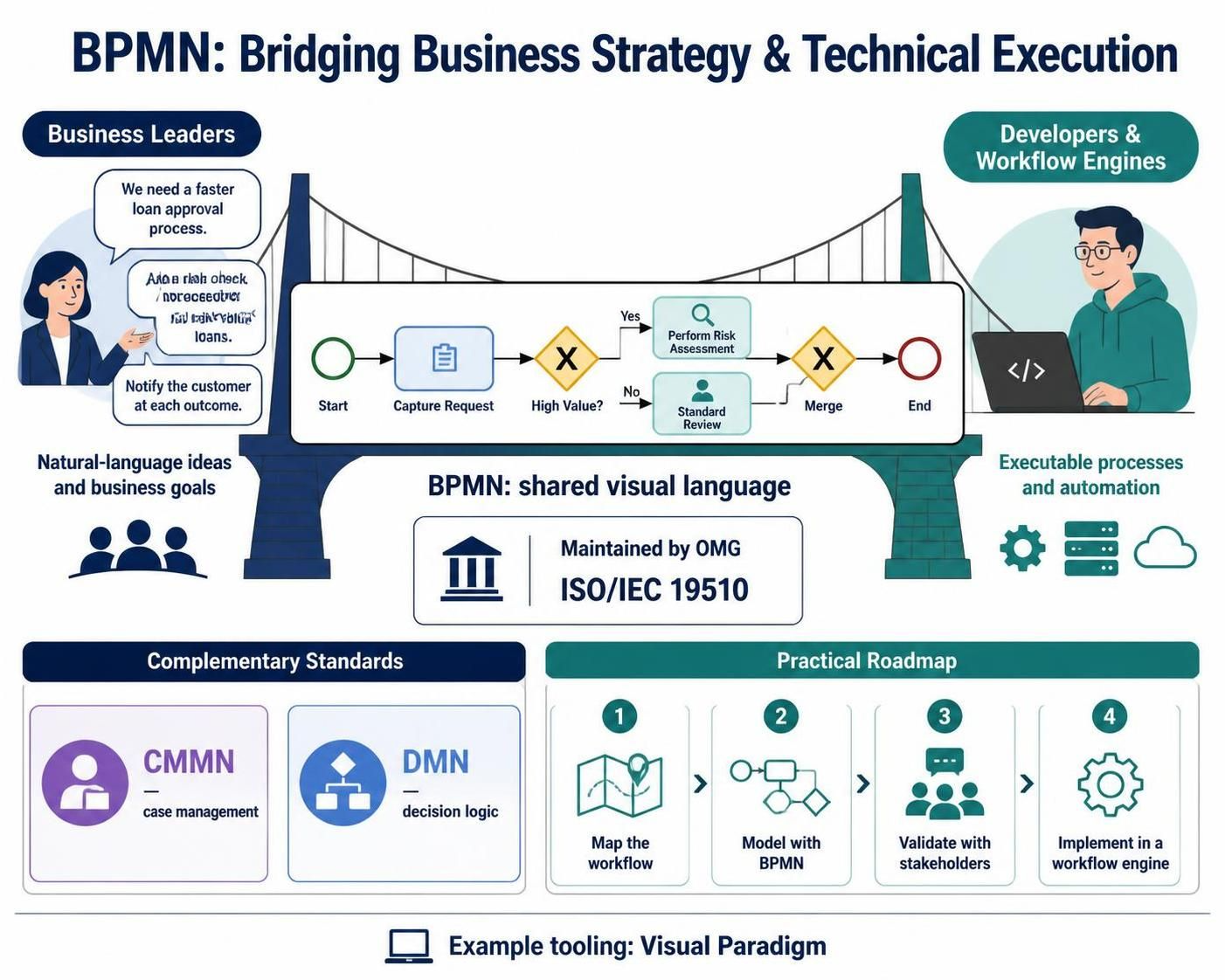
In the modern enterprise, the chasm between business strategy and technical execution is often where projects fail. Business leaders articulate workflows in natural language, while developers require precise, executable logic. Business Process Model and Notation (BPMN) serves as the universal translator between these two distinct worlds.
This tutorial explores the system architecture of BPMN, its role as a shared visual language, and how it integrates with complementary standards like CMMN and DMN to create a robust process management ecosystem.
The BPMN Bridge Architecture
Imagine a bridge connecting two islands: one representing “Business Leaders” with their natural-language goals, and the other representing “Developers & Workflow Engines” with their executable requirements. BPMN is the deck of that bridge.
As the image illustrates, the architecture relies on a standardized foundation maintained by the Object Management Group (OMG) and standardized as ISO/IEC 19510. This standardization ensures that a diagram drawn by a business analyst is semantically identical to the logic interpreted by a workflow engine.
Key Architectural Components
- Left Bank (Strategy): Natural-language ideas (e.g., “We need a faster loan approval process”).
- The Span (BPMN): The shared visual language that converts vague goals into structured steps.
- Right Bank (Execution): Executable processes, automation, and logic implemented on servers or cloud platforms.
Modeling Concepts: From Concept to Code
To effectively bridge the gap, one must understand how to translate the “Start” and “End” of a business narrative into BPMN elements. Let’s break down the example of a “Loan Approval Process” shown in the diagram.
1. The Sequence Flow
Processes are linear but dynamic. We begin with a Start Event (the green circle) and proceed through a Task (the rounded rectangle), such as “Capture Request”.
2. Exclusive Gateways (The “X”)
The diamond shape with an “X” represents an Exclusive Gateway. This is the decision point where the process diverges. The logic is “One or None” paths out of the gateway.
In the diagram, the gateway checks: “High Value?”. Based on the answer, the flow splits:
- Yes Path: Moves to “Perform Risk Assessment”.
- No Path: Moves to “Standard Review”.
3. Merging Paths
After the divergent paths execute their respective tasks, they must converge. Another Exclusive Gateway acts as a Join or Merge, bringing the logic back together before reaching the End Event (the red circle).
Complementary Standards: The Ecosystem
While BPMN is the gold standard for process flow, it is not a “one-size-fits-all” solution. The architecture of enterprise automation often requires pairing BPMN with two other OMG standards:
- DMN (Decision Model and Notation): While BPMN handles the flow (e.g., “Is the value high?”), DMN handles the complex logic behind the decision (e.g., the mathematical formula for calculating “High Value”).
- CMMN (Case Management Model and Notation): BPMN is rigid and defined. CMMN is flexible and driven by the user. It is used for “Case Management” where the process cannot be fully predicted in advance (e.g., legal proceedings or medical diagnosis).
Practical Roadmap for Implementation
Using industry-standard tooling like Visual Paradigm, organizations can follow a four-step roadmap to operationalize these models:
- Map the Workflow: Document the high-level steps informally.
- Model with BPMN: Translate the map into a standardized BPMN diagram.
- Validate with Stakeholders: Use the visual diagram to confirm requirements with business leaders (the “Natural Language” bridge).
- Implement in a Workflow Engine: Deploy the executable model to a server for automation.
Conclusion
By adopting BPMN as a shared visual language, enterprises ensure that the “What” (Business Strategy) and the “How” (Technical Execution) remain perfectly aligned, preventing the costly failures that occur when translation is lost in translation.