
Architecting Live Docs: Visual Paradigm OpenDocs & VP AI Ecosystem
In modern enterprise architecture, the “Documentation Drift” phenomenon is a critical challenge. It occurs when technical specifications—often static images or PDFs—become obsolete the moment the underlying code or system design changes. To solve this, Visual Paradigm has engineered the OpenDocs ecosystem. This tutorial dissects the architecture of this system, specifically focusing on how it transforms static modeling into a dynamic, synchronized knowledge management platform.
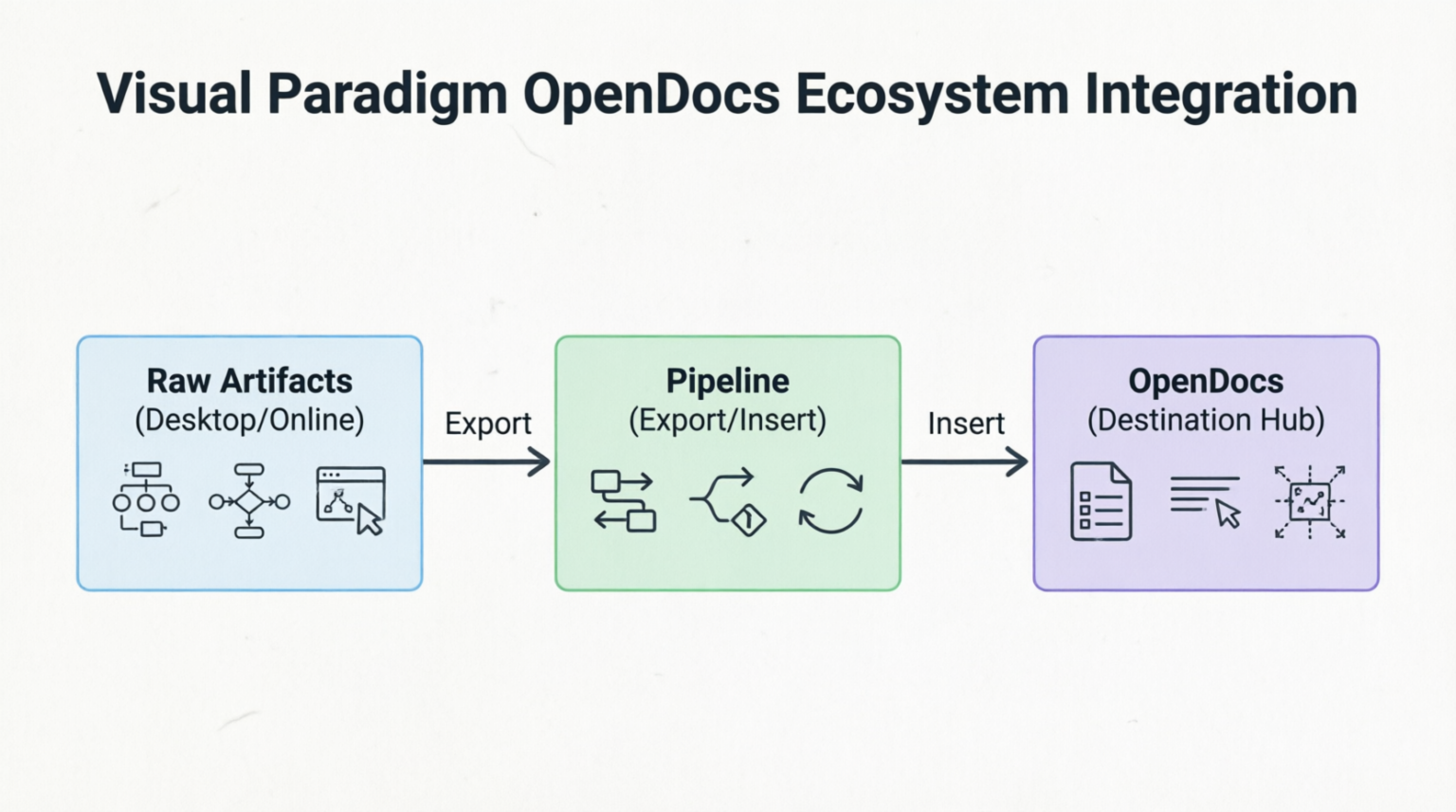
The core of this architecture is a linear assembly line that moves data from creation to consumption. By treating diagrams as “first-class citizens” (live assets) rather than static snapshots, the system ensures that the documentation you read today is mathematically linked to the diagram you designed today.
The Linear Assembly Line Architecture
The OpenDocs ecosystem operates on a strictly defined flow of data. This flow is designed to eliminate manual file handling. Instead of saving a file to a hard drive and attaching it to a document, the system creates a live link. The architecture consists of three distinct stages:
- Raw Artifacts (The Source): Where the modeling happens.
- The Pipeline (The Transit Hub): Where versioning and synchronization occur.
- OpenDocs (The Destination): Where the final documentation is consumed.
Stage 1: Raw Artifacts (Desktop & Online)
The process begins in the modeling environment—Visual Paradigm Desktop or the Web Application. Here, architects create “Raw Artifacts.” These are not just images; they are complex data structures representing UML, BPMN, ERD, or ArchiMate diagrams.
When you create a diagram in the editor, it is treated as a versioned cloud asset. The system does not view this as a “picture” to be exported; it views it as a live object. This distinction is crucial because it allows the diagram to retain its logic, data, and interactivity as it moves through the system.
Stage 2: The OpenDocs Pipeline
The “Pipeline” is the secure, central transit hub that connects the modeling tools to the documentation platform. It functions as the backbone of the synchronization engine. Its responsibilities include:
- Asset Tracking: Monitoring every change made to a model.
- Version Control: Managing the history of artifacts so that documentation can reference specific versions if needed.
- Change Management: Automatically triggering updates in the destination when the source changes.
The Pipeline handles the “Export/Insert” logic. It does not perform a “cut and paste” operation; instead, it establishes a persistent connection. This ensures that the documentation remains synchronized with design changes in real-time.
Stage 3: OpenDocs (Destination Hub)
Finally, the data arrives at OpenDocs, the destination hub. Here, the raw artifacts are integrated into a unified knowledge base. Because the connection is live, the diagrams inside the documentation are interactive. They are not static images; they are live elements that can be zoomed, panned, and inspected.
This hub unifies technical documentation with visual modeling, creating a single source of truth. It eliminates the confusion caused by “documentation drift” because the written specifications and the visual models are mathematically bound together.
Advanced Capabilities: AI and Distribution
While the core architecture handles the movement of data, the ecosystem is enhanced by AI and flexible distribution layers.
AI Chatbots & Generators
The integration includes an AI subsystem that can accelerate the initial documentation phase. Users can interact with the system using natural language prompts. For example, a user might request:
"Create a flowchart for a refund process."
The AI subsystem instantly generates a complex process diagram or structural view directly inside the workspace. This diagram is then treated as a “Raw Artifact,” entering the pipeline and becoming part of the live documentation system.
Distribution Layers
Once the documentation is compiled in the OpenDocs hub, it can be distributed in various formats. The system supports embedding documentation into dynamic interactive formats, such as Visual Paradigm Flipbooks, or sharing it broadly via web-based Bookshelves. This ensures that stakeholders can access the information in the format that suits their needs, whether for internal review or client-facing deliverables.
Conclusion
The Visual Paradigm OpenDocs ecosystem represents a shift from static documentation to dynamic knowledge management. By leveraging a linear assembly line architecture that connects Raw Artifacts through a robust Pipeline to the OpenDocs Hub, organizations can ensure that their documentation is always accurate, up-to-date, and synchronized with their actual system design.