


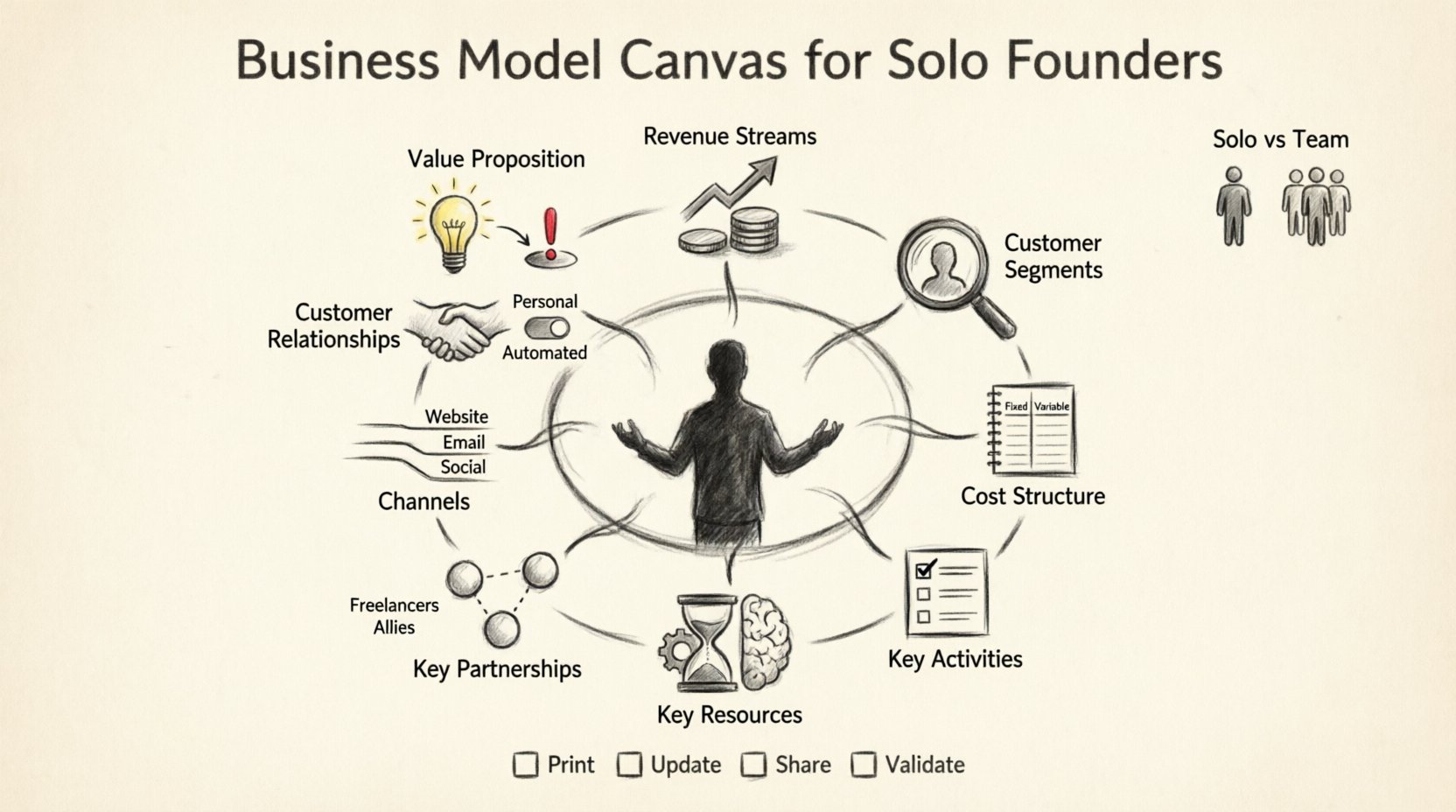
Starting a business alone requires a different kind of clarity than managing a large team. You must wear every hat, from CEO to customer support, without diluting your focus. The Business Model Canvas provides a structured way to visualize this complexity. It breaks down your venture into nine building blocks, allowing you to see connections between strategy, operations, and finance.
For a solo founder, this tool is not just a document; it is a survival guide. It helps you validate assumptions before spending significant resources. Below, we address the most common questions regarding the canvas when you are operating without a staff.
🧩 Why the Canvas Matters for One Person
Many solo founders skip formal planning, assuming agility is enough. While speed is vital, unchecked speed leads to wasted effort. The canvas forces you to confront specific areas of your business model. It prevents you from focusing solely on the product while ignoring the customer or the revenue model.
When you are the only employee, your time is the scarcest resource. The canvas helps you prioritize. It highlights where you need to spend time and where you can automate or outsource. It serves as a single source of truth for your strategy.
❓ Question 1: How Do I Define My Value Proposition Alone?
The Value Proposition is the core reason a customer chooses you. It is the problem you solve. Without a team to brainstorm, you might rely on your own intuition too much.
- Focus on Specificity: Do not try to solve every problem. Identify one pain point you can solve better than anyone else.
- Customer Empathy: Since you are the only one talking to customers, ensure your data is accurate. Conduct interviews rather than guessing.
- Unique Contribution: What do you offer that is different? Is it price, speed, quality, or exclusivity?
A clear value proposition reduces marketing costs. If your message is vague, you will burn cash trying to find the right audience. Write your proposition down in one sentence. If you cannot explain it simply, you do not understand it well enough.
❓ Question 2: Can I Really Identify Customer Segments Without a Team?
Customer Segments define who you serve. A solo founder might be tempted to target “everyone.” This is a mistake. You need to narrow your focus to survive.
- Niche Down: Start with a specific group. It is easier to dominate a small market than compete in a large one.
- Persona Development: Create detailed profiles of your ideal customers. Include demographics, behaviors, and goals.
- Validation: Before building, find people who match your segment. Ask if they have the problem you think they have.
When you are alone, you cannot be everything to everyone. Limit your scope to ensure you can deliver value effectively. This clarity allows you to tailor your channels and relationships specifically for that group.
❓ Question 3: What About Revenue Streams When You Are Solo?
Revenue is the lifeblood of your venture. As a solo founder, you need cash flow to sustain yourself. The canvas helps you map out how money enters your business.
- Subscription vs. One-off: Decide if you will charge once or repeatedly. Subscriptions provide stability.
- Pricing Strategy: Cost-plus pricing is common, but value-based pricing often yields better margins.
- Diversification: Do not rely on a single client or product. Have multiple streams if possible.
Consider how you will collect payments. Automated systems reduce your administrative burden. You need to know exactly how much you need to sell to cover your costs. This calculation dictates your sales targets.
❓ Question 4: Managing Costs Without a Finance Department
Cost Structure is often overlooked by founders focused on growth. You need to know where your money goes. Fixed costs and variable costs must be understood.
- Fixed Costs: These are expenses that remain the same regardless of sales. Rent, software subscriptions, and insurance.
- Variable Costs: These change with production or sales. Payment processing fees, shipping, or ad spend.
- Lean Operations: Minimize fixed costs. Use open-source tools where possible. Do not hire until you have the revenue to support it.
Track every expense. Use spreadsheets or simple accounting methods. Knowing your burn rate helps you plan for lean months. You cannot manage what you do not measure.
❓ Question 5: Key Activities You Must Prioritize
Key Activities are the most important things you must do to make your business work. As a solo founder, you cannot do everything. You must choose wisely.
- Production: Creating the product or service. This is often the biggest time sink.
- Sales and Marketing: Finding customers and closing deals. Essential for survival.
- Support: Helping customers after they buy. This builds retention.
Identify which activities generate the most revenue. Delegate or automate the rest. If you spend 80% of your time on tasks that do not generate income, your business model is inefficient. Focus on high-leverage activities.
❓ Question 6: Key Resources vs. Time Constraints
Key Resources are the assets required to operate. For a team, this might be people and equipment. For a solo founder, it is primarily time and skills.
- Human Capital: Your own skills and knowledge. Identify gaps and learn or hire.
- Physical Capital: Computers, office space, or inventory. Keep this minimal.
- Intellectual Capital: Patents, brands, or customer databases. Build these assets over time.
Time is your most critical resource. You must allocate it based on the Value Proposition. Do not spend time on features customers do not want. Protect your time fiercely. It is the fuel for your engine.
❓ Question 7: Partnerships for the Solopreneur
Key Partnerships are networks of suppliers and partners. You do not have to do everything alone. Partnerships can extend your reach and reduce risk.
- Suppliers: Reliable vendors for your products or services.
- Alliances: Other businesses that complement yours. Cross-promotion can be powerful.
- Outsourcing: Hire freelancers for specialized tasks like design or accounting.
Build relationships early. A strong network can substitute for a large team. Trust is the currency here. Ensure partners align with your values and quality standards.
❓ Question 8: Building Channels Without a Marketing Budget
Channels are how you reach your customers. You need to communicate value and deliver the product.
- Owned Channels: Your website, blog, or email list. You control these completely.
- Partner Channels: Marketplaces or affiliates. They bring traffic but take a cut.
- Social Media: Free platforms can build awareness but require consistent effort.
Choose channels where your customers actually hang out. Do not try to be on every platform. Focus on one or two and master them. Consistency matters more than volume.
❓ Question 9: Customer Relationships in a Vacuum
Customer Relationships define how you interact and retain users. Personal attention is your advantage over large corporations.
- Personal Assistance: Direct communication via email or chat. High touch, high value.
- Community: Build a group around your product. Users support each other.
- Automation: Use emails to nurture leads. Save time while staying in touch.
Retention is cheaper than acquisition. A happy customer will refer others. Focus on the experience. Make it easy for them to get help. If you solve their problems quickly, they will stay.
📊 Comparison Table: Solo vs. Traditional Team
Understanding the difference between operating alone and with a team helps manage expectations.
| Building Block | Solo Founder Context | Traditional Team Context |
|---|---|---|
| Key Activities | Focus on core revenue tasks only. | Division of labor across departments. |
| Key Resources | Time, skills, and personal network. | Employees, capital, and infrastructure. |
| Channels | Direct and organic methods. | Multiple paid and owned channels. |
| Cost Structure | Low fixed costs, high personal risk. | Higher fixed costs, shared risk. |
| Customer Relationships | Direct, personal, and scalable only via automation. | Dedicated support teams and sales reps. |
⚠️ Common Pitfalls to Avoid
Even with a plan, mistakes happen. Be aware of these common traps.
- Perfectionism: Do not wait for the perfect product. Launch early and iterate.
- Ignoring Cash Flow: Revenue does not mean profit. Watch your bank balance.
- Isolation: Talk to other founders. Solitude can lead to blind spots.
- Scope Creep: Stick to your Value Proposition. Do not add features that distract.
🚀 Next Steps for Your Canvas
Now that you have reviewed the questions, it is time to take action. The canvas is a living document. It changes as you learn.
- Print It Out: Physical copies encourage engagement.
- Update Weekly: Review your assumptions and adjust.
- Share It: Show it to mentors or advisors for feedback.
- Validate: Test one block at a time before scaling.
Starting alone is challenging, but it offers freedom. The Business Model Canvas gives you structure without bureaucracy. It keeps you focused on what matters. Use it to navigate uncertainty and build a sustainable venture.
Your journey is unique. Adapt the blocks to fit your reality. Do not follow rigid rules. Flexibility is your strength. With a clear model, you can move forward with confidence.
Related posts:
 B2B vs. B2C: How the Business Model Canvas Shifts for Tech Founders
 The 7 Hidden Levers in Your Business Model Canvas That Kill Startups Early
 Stop Guessing Revenue: A Component Breakdown of the Business Model Canvas for SaaS
 From Idea to IPO: A Comprehensive Walkthrough of the Business Model Canvas for First-Time Entrepreneurs