


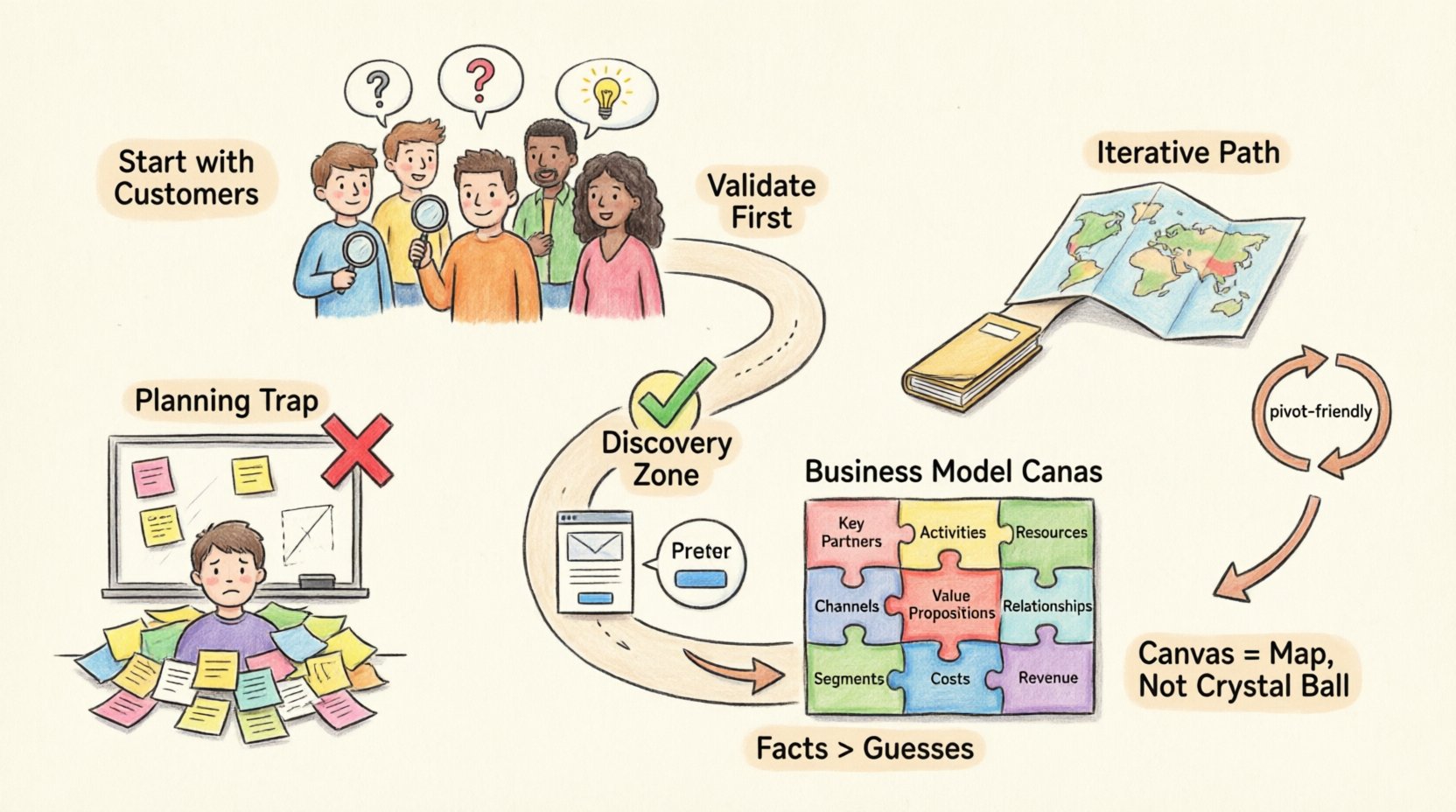
There is a pervasive belief in the startup ecosystem that suggests you must have a perfect plan before you say a single word to a potential buyer. Many founders spend months filling out the nine boxes of the Business Model Canvas (BMC) on whiteboards or in notebooks, convinced that this document is the blueprint for success. They treat the canvas like a crystal ball, expecting it to predict the future. However, this approach often leads to paralysis, wasted resources, and products that solve problems nobody actually has. 💭
The truth is, the Business Model Canvas is a tool for synthesis, not initiation. It is designed to map out a business that already exists or has significant traction. Using it as a primary discovery tool before validating demand is like trying to build a house before you have a foundation. It is a structural error that can sink a venture before it ever moves. This guide explores why customer discovery must precede comprehensive modeling, how to validate assumptions without over-planning, and when the canvas becomes a critical asset rather than a distraction.
What the Business Model Canvas Actually Is 📋
The Business Model Canvas is a strategic management template developed by Alexander Osterwalder. It describes the logic of how an organization creates, delivers, and captures value. It consists of nine building blocks:
- Key Partners: Who helps you do business?
- Key Activities: What must you do to make the business work?
- Key Resources: What assets do you need?
- Value Propositions: What problem are you solving?
- Customer Relationships: How do you interact with users?
- Channels: How do you reach your audience?
- Customer Segments: Who are you serving?
- Cost Structure: What are the major costs?
- Revenue Streams: How do you make money?
When you sit down to fill these out at the very beginning, you are essentially making educated guesses. You are writing down assumptions that have not been tested against reality. This creates a false sense of security. You feel productive because you are writing things down, but you are not gathering data. You are constructing a narrative, not a business strategy.
The Trap of Premature Precision 🛑
One of the biggest risks in early-stage ventures is premature precision. When you commit to a specific revenue model, a specific channel, or a specific customer segment on paper, you create cognitive bias. Your brain will start looking for evidence that supports your written plan and ignoring evidence that contradicts it. This is known as confirmation bias.
Consider the following scenario:
- You write “Enterprise B2B” in the Customer Segments box.
- You start building a sales pitch for CTOs.
- You spend three months developing features for large organizations.
- At the end of three months, you realize CTOs don’t care about your specific feature.
- You have wasted time and money because you assumed the segment before talking to them.
By locking yourself into the canvas early, you limit your agility. Startups need to pivot quickly. If your business model is written in stone, changing direction feels like a failure rather than a strategic adjustment based on new information. The canvas should be a living document that evolves as you learn, not a static contract you sign before you start.
Customer Discovery: The Real First Step 👥
Before you map out how you will make money, you must understand who you are trying to make money from. The process of Customer Discovery is about getting out of the building (or off the screen) and talking to real people. This is where the real data lives, not on a whiteboard.
The goal of the initial phase is not to sell. It is to listen. You want to uncover:
- What pains are keeping them up at night?
- What solutions are they currently using?
- How much do they pay for those solutions?
- What do they hate about the current market options?
- Are they actively seeking a new solution, or just tolerating the status quo?
When you have this information, filling out the Business Model Canvas becomes a process of documentation, not invention. You are recording facts, not hopes. This distinction is critical. If you fill out the canvas based on facts, it becomes a powerful communication tool for investors and partners. If you fill it out based on guesses, it becomes a piece of fiction.
Static Planning vs. Iterative Discovery 🔄
To understand why waiting is better, we must compare the two approaches to business modeling. One treats the plan as a fixed destination. The other treats it as a dynamic map that updates as you travel.
| Feature | Static Planning (Early Canvas) | Iterative Discovery (Post-Validation) |
|---|---|---|
| Primary Goal | Prove you have a plan | Prove people want the solution |
| Data Source | Internal assumptions and intuition | Customer interviews and feedback |
| Flexibility | Low (High emotional investment) | High (View changes as learning) |
| Risk Profile | High (Building the wrong thing) | Low (Building what is needed) |
| Outcome | Confidence in a hypothesis | Confidence in a business model |
The table above highlights that the Static Planning approach often leads to high risk because it relies on internal data which is often flawed. The Iterative Discovery approach relies on external data, which is the only truth that matters in business.
Why Guessing the Revenue Model is Dangerous 💸
One of the most common mistakes founders make is deciding on a revenue model too early. They decide to charge a subscription fee, or a one-time license, or advertising revenue, without knowing if the customer is willing to pay for the value provided. This is a form of premature optimization.
If you have not spoken to customers, you do not know:
- What metric they value (time saved, cost reduced, revenue increased).
- What price point feels fair to them.
- If they prefer a monthly commitment or a pay-as-you-go model.
- If they are willing to pay at all, or if they need a free tier to see value.
By locking in a revenue stream in the canvas before testing, you may build a product that is technically sound but financially unviable. You might spend thousands developing features that customers don’t value enough to pay for. The only way to know is to ask. Try to get pre-orders, letters of intent, or signed contracts before you finalize the revenue box in your planning documents.
The Risk of Assumptions vs. Facts 📝
Every block in the Business Model Canvas represents a hypothesis until proven otherwise. When you fill it out before you have customers, you are treating hypotheses as facts. This is dangerous because it changes your mindset. You stop looking for disconfirming evidence.
For example, let’s look at the Key Partners block. You might assume you need a large logistics company to deliver your product. You might sign a contract with them before you have a single sale. If the product turns out to be digital, or if the market is local, that contract becomes a liability. If you wait until you have sales, you can negotiate the terms based on volume. You have leverage because you have revenue. If you have no revenue, you have no leverage.
This applies to Key Activities as well. You might assume you need a large engineering team. But maybe you can solve the problem with a no-code tool for the first six months. By assuming the activity is necessary, you commit to the cost. By testing the market first, you might discover that the activity can be outsourced or automated later.
When to Finalize the Canvas 🗓️
Does this mean you never use the Business Model Canvas? Absolutely not. It is an excellent tool for alignment and strategy. However, there is a specific time when it becomes most effective. You should finalize the canvas when you have achieved Product-Market Fit.
This typically happens after:
- You have sold to at least 10 to 50 paying customers.
- You have a repeatable sales process.
- You understand the unit economics (Customer Acquisition Cost vs. Lifetime Value).
- You have a clear definition of who your best customers are.
At this stage, the canvas serves to communicate your strategy to potential investors, new hires, or partners. It shows that you understand the business. Before this stage, the canvas is just a collection of guesses. After this stage, it is a record of success and a roadmap for scaling.
Think of it this way: You do not plan a road trip route before you know where you are starting. You figure out your starting point, then you map the route. The Business Model Canvas is the map. You need the starting point (customers) first.
Actionable Steps for Early Validation ✅
So, if you shouldn’t fill out the full canvas, what should you do instead? Here is a practical workflow to validate your business ideas without getting bogged down in planning.
- Write Down Your Hypotheses: Instead of a full canvas, write a one-page list of your biggest risks. What do you think you need to know to make this work?
- Conduct Customer Interviews: Talk to 20 potential users. Do not pitch your solution. Ask about their problems. Listen more than you speak.
- Create a Landing Page: Build a simple page describing the value proposition. Drive traffic to it. Measure how many people click or sign up.
- Run a Concierge Test: Manually deliver the service before building the software. See if people actually want the outcome.
- Seek Pre-Sales: Try to get a commitment to pay. Even if you don’t build it yet, can they agree to buy it when it is ready?
- Document Findings: Update your notes with real data. Now you can fill out the canvas with confidence.
This process is faster and cheaper than building a full product. It minimizes the risk of failure. It ensures that when you do sit down to fill out the Business Model Canvas, you are recording the truth, not the fiction.
The Psychology of the Founder 🧠
It is important to acknowledge why founders feel the need to plan so thoroughly. There is a fear of uncertainty. Filling out a canvas gives a sense of control. It feels like work. Talking to customers feels messy and unpredictable. It requires vulnerability. You might get rejected. You might be told your idea is bad.
But this discomfort is necessary. The market is the only entity that matters. Your feelings about the plan are irrelevant. The market’s reaction is the only metric that counts. Embracing the messiness of customer discovery is a sign of maturity. It shows you are willing to follow the data, even when it contradicts your initial vision.
Summary of Best Practices 📌
To summarize the key takeaways from this discussion:
- Do not start with the canvas: Start with the problem and the customer.
- Validate before you build: Ensure there is demand before you invest in resources.
- Treat the canvas as a living document: Update it as you learn, don’t treat it as a final contract.
- Focus on unit economics: Understand the cost to acquire and the value delivered before scaling.
- Embrace iteration: Changing your model is not failure; it is learning.
By shifting your focus from planning to discovery, you increase your chances of building a sustainable business. You reduce the risk of building something nobody wants. You save time, money, and emotional energy. The Business Model Canvas is a powerful tool, but it is a tool for the middle and end of the journey, not the beginning.
Final Thoughts on Strategic Planning 🤝
Building a business is a journey of continuous learning. The Business Model Canvas is a map you draw as you walk the path, not a map you draw before you leave the house. By prioritizing customer interaction over theoretical planning, you ground your venture in reality. You ensure that every decision you make is backed by evidence.
Resist the urge to perfect the plan. Instead, focus on finding the people who need your solution. Let their needs dictate your strategy. When you finally sit down to formalize the Business Model Canvas, you will find that the boxes are easy to fill. They will be filled with facts, not guesses. And that is the only way to build a business that lasts.
Related posts:
 B2B vs. B2C: How the Business Model Canvas Shifts for Tech Founders
 The 7 Hidden Levers in Your Business Model Canvas That Kill Startups Early
 Stop Guessing Revenue: A Component Breakdown of the Business Model Canvas for SaaS
 From Idea to IPO: A Comprehensive Walkthrough of the Business Model Canvas for First-Time Entrepreneurs