


The landscape of modern entrepreneurship is defined by speed, adaptation, and strategic clarity. Among the many frameworks proposed to navigate this complexity, the Business Model Canvas stands as a persistent fixture. It offers a visual chart to describe a firm’s value proposition, infrastructure, customers, and finances. However, no single tool provides a complete picture of organizational viability. Understanding the specific strengths and limitations of this framework is essential for founders and strategists aiming to build sustainable ventures. This guide examines the mechanics of the canvas, its application in early-stage companies, and the critical blind spots that often lead to failure.
Origins and Context 🏛️
Developed by Alexander Osterwalder and Yves Pigneur, the Business Model Canvas was introduced in 2010 as a refinement of traditional business planning. The traditional approach often required a 40-page document that was static and slow to update. The canvas condensed this into nine building blocks that could be visualized on a single page. This shift prioritized agility over documentation.
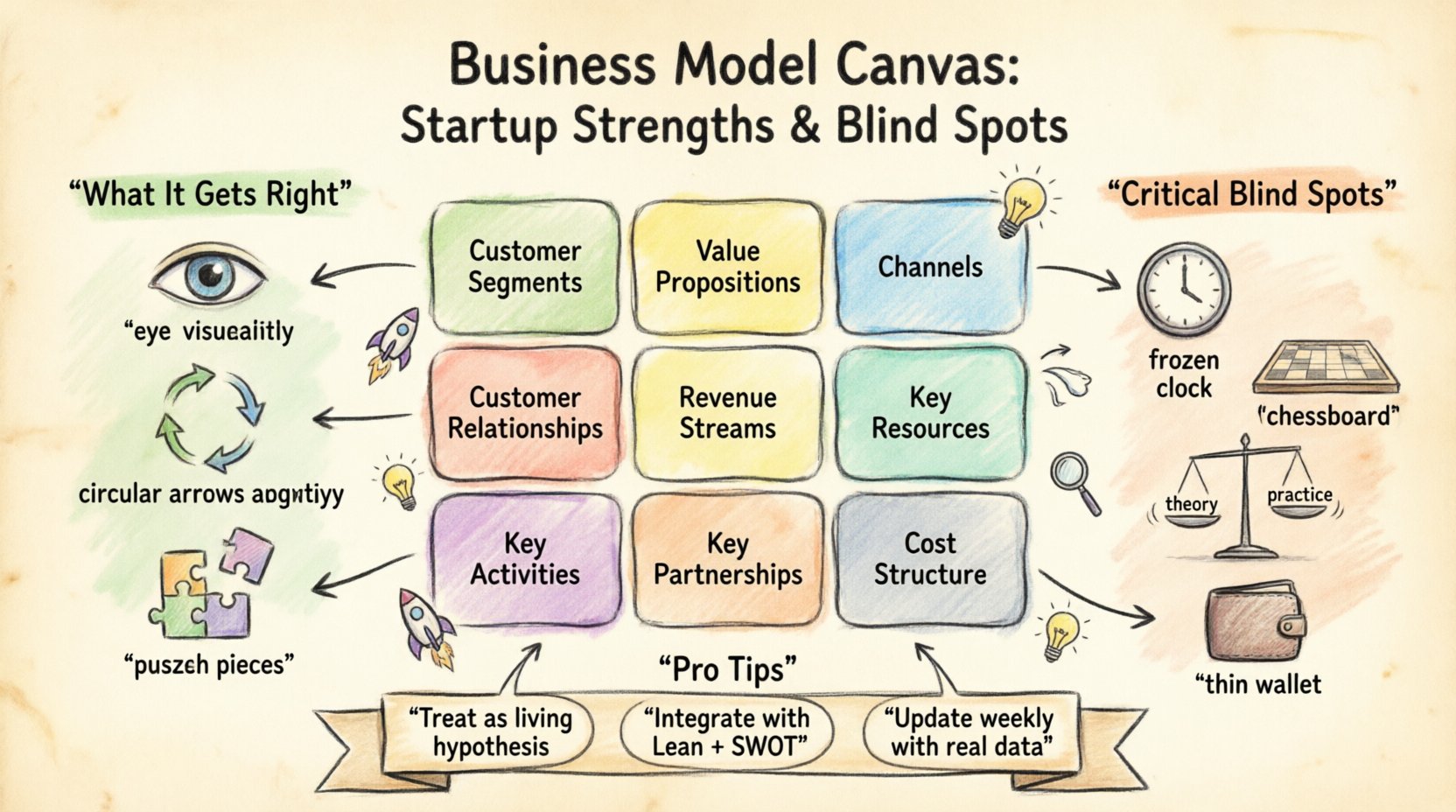
The framework divides the organization into two primary sides: the front stage (market-facing) and the back stage (infrastructure). The front stage includes customer segments, channels, relationships, revenue streams, and value propositions. The back stage covers key activities, key resources, key partners, and cost structures. This separation helps teams understand how internal operations support external value delivery.
While the canvas gained rapid adoption across incubators and accelerators, its simplicity is both its greatest asset and its most significant vulnerability. It invites collaboration but can obscure complexity if used without rigorous interrogation. Founders must treat it as a living hypothesis rather than a finalized contract.
The Nine Building Blocks Explained 🧱
Each component of the canvas requires specific attention. A robust model relies on the alignment between these elements. Below is a detailed breakdown of how each block functions and what to scrutinize during the planning phase.
- Customer Segments: This defines the specific groups of people or organizations the enterprise aims to reach and serve. It is crucial to identify which needs are most critical. A startup often fails because it attempts to serve everyone. Defining a niche allows for targeted resource allocation. Questions to ask include: Who are our most profitable customers? Which segments are we ignoring?
- Value Propositions: This block articulates the bundle of products and services that create value for a specific customer segment. It answers why customers choose one company over another. Is it price? Performance? Design? Convenience? The value proposition must be distinct and defensible. Without a clear differentiator, the model relies on market luck rather than strategic advantage.
- Channels: These describe how a company communicates with and reaches its customer segments to deliver a value proposition. Channels serve as touchpoints for customer experience. They include physical stores, web platforms, or sales teams. The goal is to integrate these channels to provide a seamless user journey. Inefficiencies here often lead to high customer acquisition costs.
- Customer Relationships: This outlines the types of relationships a company establishes with specific customer segments. Relationships can range from personal assistance to automated services. The type of relationship influences customer retention and lifetime value. A startup must decide if it will build loyalty through community or through transactional efficiency.
- Revenue Streams: This represents the cash a company generates from each customer segment. Revenue can arise from asset sales, usage fees, subscription fees, or advertising. It is vital to ensure that revenue models align with customer willingness to pay. A high-value product with a low-cost revenue model is a mismatch that leads to insolvency.
- Key Resources: These are the most important assets required to make a business model work. They can be physical, intellectual, human, or financial. For a tech startup, this might be code and talent. For a logistics firm, it is vehicles and warehouses. Identifying the right resources prevents over-investment in non-critical areas.
- Key Activities: These are the most important things a company must do to make its business model work. They include production, problem-solving, or platform/network management. Activities must directly support the value proposition. If the proposition is speed, activities must focus on rapid iteration and deployment.
- Key Partnerships: This block describes the network of suppliers and partners that make the business model work. Partnerships can optimize economies of scale, reduce risk, or acquire resources. Startups often leverage partnerships to access capabilities they do not possess internally. However, dependency on partners introduces external risk.
- Cost Structure: This describes all costs incurred to operate a business model. It is driven by key resources, key activities, and key partnerships. Costs can be fixed or variable. Understanding the cost structure is critical for pricing and margin analysis. A startup must know its break-even point to survive early cash flow challenges.
Where the Canvas Excels ✅
The framework offers several distinct advantages for early-stage companies. Its primary benefit lies in visualization. By placing all elements on a single page, stakeholders can see the interdependencies between operations and market goals. This fosters better communication across departments. Marketing, engineering, and finance teams often speak different languages. The canvas provides a common vocabulary.
Furthermore, the canvas promotes iteration. Because it is a single page, it is easy to print, annotate, and update. This supports the lean methodology of building, measuring, and learning. Teams can test hypotheses rapidly by modifying specific blocks without rewriting an entire business plan. This agility is crucial in volatile markets where conditions change weekly.
Additionally, the structure forces comprehensive thinking. It discourages founders from focusing solely on the product. Many entrepreneurs become obsessed with features and neglect cost structures or customer acquisition channels. The canvas mandates attention to the financial and operational realities that sustain the product.
Critical Limitations and Blind Spots ⚠️
Despite its utility, the Business Model Canvas is not without significant flaws. It is static by nature, often failing to capture the dynamic nature of market evolution. The following table outlines the specific areas where the framework falls short.
| Limitation | Impact on Startups | Example Scenario |
|---|---|---|
| Lack of Timeline | Creates a false sense of stability. | A team plans for Year 1 revenue but ignores the runway required to get there. |
| No Competitor Analysis | Leads to strategic isolation. | Founders assume demand exists without verifying market saturation or substitutes. |
| Static Snapshot | Misses feedback loops. | Customer feedback is not integrated into the product development cycle visually. |
| Execution Gap | Strategy remains theoretical. | A perfect canvas does not guarantee operational capability or team alignment. |
| Financial Depth | Superficial cash flow management. | Revenue streams are listed but unit economics and burn rate are ignored. |
One major criticism is the lack of emphasis on competitive dynamics. The canvas focuses on the internal logic of the firm. It does not explicitly account for competitor reactions or market barriers. A startup might have a perfect value proposition, but if a competitor has a superior distribution channel, the model may fail.
Another issue is the tendency to treat the canvas as a deliverable rather than a process. Teams often fill out the blocks once and file the document away. This defeats the purpose of the framework. If the canvas is not revisited weekly or monthly, it becomes a historical artifact rather than a strategic tool.
Common Pitfalls in Execution ❌
Even with the right tool, execution often goes wrong. Founders frequently make the mistake of filling in blocks based on assumptions rather than data. This is known as confirmation bias. They define the customer segment they want, not the one that exists. They set revenue targets based on ambition, not validated pricing.
Another common error is overcomplicating the value proposition. The canvas encourages clarity, yet many teams create complex bundles of services. Simplicity is often a competitive advantage. If the customer cannot explain the value in one sentence, the business model is likely too confused.
There is also the risk of resource misalignment. A startup might have a high-cost structure but a low-revenue model. This happens when key resources are prioritized over key activities. For example, investing in luxury office space instead of product development. The canvas highlights this mismatch, but teams often ignore the financial implication of their resource choices.
Integrating with Lean Methodologies 🔄
To mitigate the limitations of the canvas, it should be integrated with other strategic frameworks. The Lean Startup methodology complements the canvas by introducing the concept of the Minimum Viable Product (MVP). While the canvas defines the destination, the Lean approach defines the path to get there through experimentation.
Another integration point is the SWOT analysis (Strengths, Weaknesses, Opportunities, Threats). While the canvas maps the business, SWOT maps the external environment. Using both ensures that internal capabilities match external opportunities. This combination prevents the tunnel vision that often occurs when using a single tool.
Financial modeling should also accompany the canvas. The revenue and cost blocks are high-level summaries. Detailed spreadsheets are necessary to calculate cash burn, gross margins, and customer acquisition costs. The canvas sets the strategy; the spreadsheet validates the math.
Moving Beyond the Static Page 📈
The future of strategic planning lies in dynamic modeling. The static canvas is a starting point. Successful organizations treat the canvas as a dashboard. They update the blocks in real-time as they gather data from the market. This requires a culture of continuous learning and adaptation.
Teams should also consider the temporal dimension. A startup in the ideation phase requires different blocks than a growth-stage company. Early stages focus on value proposition and customer discovery. Later stages focus on key resources, partnerships, and cost efficiency. The canvas must evolve as the company matures.
Finally, human factors cannot be ignored. The canvas maps processes, but it does not map culture. A brilliant business model will fail if the team lacks the discipline to execute. Organizational health and leadership dynamics are the invisible foundations that support the visible blocks.
Final Considerations for Founders 🎯
The Business Model Canvas remains a vital tool for structuring thought. However, it is not a magic solution. It requires rigorous application and honest self-assessment. Founders must be willing to tear up the canvas and start over if the data suggests the current model is flawed. Flexibility is more valuable than perfection.
Use the canvas to facilitate conversation, not to create a document for investors. The value lies in the debate it sparks among the team. If everyone agrees on the canvas without question, the team has likely not thought deeply enough. Challenge the assumptions in every block.
Ultimately, the goal is not to fill the boxes. The goal is to understand the system. By recognizing what the canvas gets right and what it misses, entrepreneurs can build more resilient organizations. The framework is a map, but the terrain is the market. Navigate with care, keep the data close, and remain ready to pivot when the path changes.
Related posts:
 B2B vs. B2C: How the Business Model Canvas Shifts for Tech Founders
 The 7 Hidden Levers in Your Business Model Canvas That Kill Startups Early
 Stop Guessing Revenue: A Component Breakdown of the Business Model Canvas for SaaS
 From Idea to IPO: A Comprehensive Walkthrough of the Business Model Canvas for First-Time Entrepreneurs