


Business environments change faster than ever before. What worked yesterday might not function tomorrow. A static plan is a liability. Leaders must actively challenge their strategic foundations before external forces do. The Business Model Canvas offers a visual structure to map out how an organization creates, delivers, and captures value. However, a filled canvas is not a guarantee of survival. It is a hypothesis that requires validation under pressure.
This guide outlines a rigorous process to stress-test your business model. The goal is not to predict the future with certainty, but to build resilience against the unexpected. We will examine each building block of the canvas through the lens of potential disruption. By the end of this process, you will understand the vulnerabilities in your current setup and identify areas that need reinforcement.
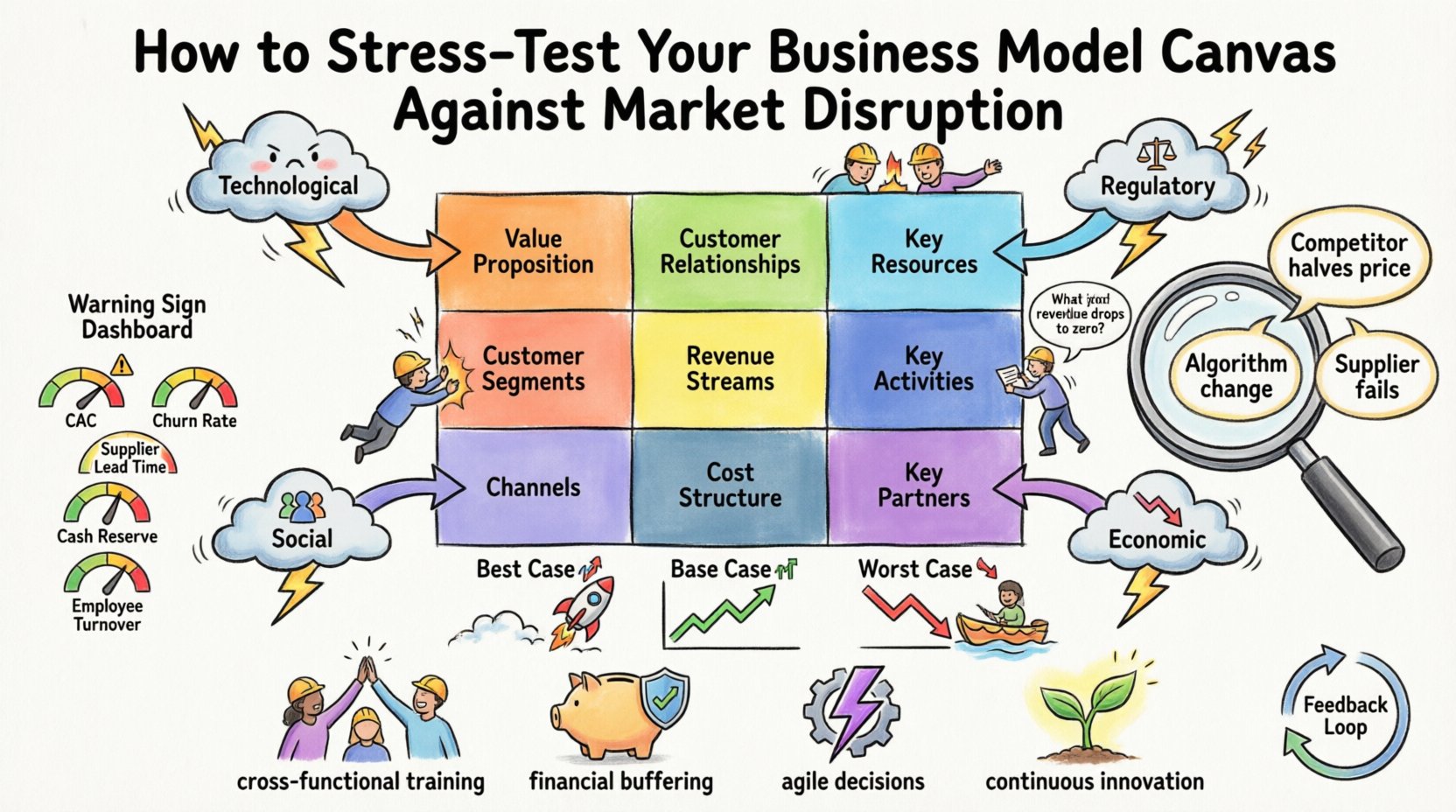
Understanding Market Disruption 🌪️
Disruption is not merely a competitor launching a better product. It is a fundamental shift in how value is delivered or consumed. It can come from technology, regulation, economic shifts, or changing consumer behaviors. To stress-test effectively, you must first categorize the threats you face.
- Technological Disruption: New tools render old processes obsolete. Automation replaces manual labor. AI changes service delivery models.
- Regulatory Disruption: New laws alter compliance costs or ban specific practices entirely.
- Economic Disruption: Inflation, currency fluctuation, or supply chain collapse impacts margins and pricing power.
- Social Disruption: Consumer values shift. Sustainability or ethical sourcing becomes a requirement rather than a differentiator.
When you map these forces against your canvas, you can see where the friction points lie. A rigid supply chain is vulnerable to economic shocks. A high-touch service model is vulnerable to technological automation. Understanding the nature of the threat is the first step in building immunity.
Setting the Baseline 📝
Before applying pressure, you need a clear picture of the current state. You cannot measure the impact of a shock if you do not know your baseline metrics. This step involves auditing the nine building blocks of your Business Model Canvas.
Ensure every block is defined with specific data points. Vague descriptions like “high quality” or “good service” are insufficient for stress-testing. You need quantifiable metrics.
- Value Proposition: What specific pain point does this solve? Is it price, speed, or quality?
- Customer Segments: Who exactly pays? Are they price-sensitive or value-driven?
- Channels: How do customers find and buy from you? Is this channel owned or rented?
- Customer Relationships: Is this automated, personal, or community-based?
- Revenue Streams: How is money made? Subscription, one-time, licensing, or transaction fees?
- Key Resources: What assets are critical? Intellectual property, physical locations, or human capital?
- Key Activities: What must you do daily to operate? Manufacturing, problem-solving, or platform management?
- Key Partners: Who relies on you? Suppliers, alliances, or joint ventures?
- Cost Structure: Where does the money go? Fixed costs, variable costs, or economies of scale?
Once the baseline is set, you can begin the simulation. The objective is to break the model to understand its limits.
The 9-Block Stress-Test Framework 🔍
Each block of the canvas reacts differently to stress. A change in one area often ripples through the others. Below is a detailed breakdown of how to test each section against disruption.
1. Value Proposition 🎯
Ask yourself: If the core benefit of your product disappears, does the business survive?
- Scenario: A competitor offers the same service for half the price.
- Scenario: A new technology makes your product feature redundant.
- Question: Is your value proposition tied to a proprietary technology or a brand perception? Proprietary tech is easier to defend but harder to sustain if innovation stalls. Brand perception is durable but expensive to build.
2. Customer Segments 👥
Over-reliance on a single segment is a critical risk.
- Scenario: The primary demographic shifts their spending habits.
- Scenario: A regulatory change bans your segment from operating in a key region.
- Question: Do you have a secondary segment that can absorb the shock? If 80% of revenue comes from one group, your model is fragile. Diversification reduces volatility.
3. Channels 📢
Channels are the arteries of your business. If they clog, the organization stops.
- Scenario: A major distribution partner drops you.
- Scenario: A platform algorithm change reduces your visibility to zero.
- Question: Do you own your channel or rent it? Renting from a third party (like a social media platform or marketplace) introduces high risk. Owning your channel (email list, physical store) provides stability but requires more upfront investment.
4. Customer Relationships 🤝
How do you retain customers when they have new options?
- Scenario: Customer acquisition costs double due to market saturation.
- Scenario: Service automation lowers quality and increases churn.
- Question: Is your relationship based on loyalty or convenience? Convenience is easy to steal. Loyalty is harder to replicate. Stress-test your retention strategies to see if they hold up under economic pressure.
5. Revenue Streams 💰
Diversity in revenue is a primary defense against disruption.
- Scenario: A specific pricing model becomes unsustainable due to inflation.
- Scenario: A recurring revenue stream collapses because of a subscription fatigue trend.
- Question: Are you dependent on a single transaction type? Combining subscription revenue with transactional revenue creates a buffer. If one stream dries up, the other can sustain operations.
6. Key Resources 🏗️
Resources are the foundation. If the foundation cracks, the structure falls.
- Scenario: A key patent expires.
- Scenario: A critical supplier fails to deliver.
- Question: Are your resources exclusive or commoditized? Exclusive resources offer protection but limit scalability. Commoditized resources offer flexibility but zero defensibility. Ensure you have redundancy in your critical assets.
7. Key Activities ⚙️
Activities are what you actually do. Efficiency matters here.
- Scenario: Labor costs increase significantly.
- Scenario: A new regulation requires a completely new workflow.
- Question: Can your activities be automated or outsourced without losing quality? If your activities are deeply tied to specific human expertise, you face a talent bottleneck. Standardize processes to reduce dependency on individuals.
8. Key Partners 🤲
Partners extend your reach, but they also introduce external risk.
- Scenario: A partner goes bankrupt.
- Scenario: A partner becomes a competitor.
- Question: Do you have backup partners? Relying on a single vendor for critical components is a vulnerability. Map out your supply chain and identify single points of failure.
9. Cost Structure 💸
Cash flow is the lifeblood. Disruption often hits costs first.
- Scenario: Fixed costs remain high while revenue drops.
- Scenario: Variable costs spike due to supply chain issues.
- Question: Can you convert fixed costs to variable costs? High fixed costs create a break-even point that is hard to hit during downturns. Flexible cost structures allow you to scale down quickly when revenue declines.
Scenario Planning Techniques 🎲
Once you have tested individual blocks, you must test the system as a whole. Scenario planning helps you visualize different futures. Do not rely on a single forecast. Prepare for at least three distinct outcomes.
The Best Case 🚀
In this scenario, market conditions are ideal. Demand surges, costs remain stable, and competitors are slow to react.
- Focus: Scalability.
- Question: Can your infrastructure handle a 10x increase in demand? If your answer is no, you have a growth bottleneck.
The Base Case 📈
Conditions remain relatively stable with moderate growth. This is the most likely outcome.
- Focus: Efficiency.
- Question: How can you optimize margins without sacrificing quality? This is where you refine operations.
The Worst Case 📉
Market conditions deteriorate. Revenue drops, costs rise, and competitors undercut prices.
- Focus: Survival.
- Question: How long can you operate with zero revenue? Calculate your burn rate and runway. Identify which activities can be cut immediately.
This exercise reveals your safety margins. If your worst-case scenario leads to bankruptcy within three months, your model is too fragile.
Identifying Early Warning Signs 🚨
Stress-testing is not a one-time event. It requires continuous monitoring. You must establish a dashboard of leading indicators that signal trouble before it becomes a crisis.
| Indicator | Normal Range | Warning Sign |
|---|---|---|
| Customer Acquisition Cost (CAC) | Stable or declining | Sharp increase month-over-month |
| Churn Rate | Low single digits | Sudden spike in cancellations |
| Supplier Lead Time | Consistent | Delays exceeding 20% |
| Cash Reserve | 6+ months | Drops below 3 months |
| Employee Turnover | Industry average | Key talent leaving voluntarily |
When these indicators shift, it is time to re-run your stress tests. The market does not wait for your quarterly review. Agility is a competitive advantage.
Adapting Without Losing Identity 🔄
There is a fine line between adaptation and losing your core identity. When you stress-test, you might find that your original model is broken. Pivoting is necessary, but it must be strategic.
- Pivot the Value Proposition: Keep the technology, change the problem you solve.
- Pivot the Segment: Keep the product, find a new customer base.
- Pivot the Channel: Keep the offer, change how you reach people.
Do not abandon your strengths. If your strength is customer service, do not pivot to a fully automated model just because it is cheaper. You will lose the advantage that made you successful in the first place.
Building Resilience into Operations 🏗️
Resilience is not just about surviving a shock; it is about positioning yourself to thrive after the shock passes. This requires a cultural shift within the organization.
Cross-Functional Training 👥
Ensure that employees understand how different parts of the business connect. If the sales team understands the supply chain, they can manage customer expectations better during disruptions. Knowledge silos create fragility.
Financial Buffering 💵
Build cash reserves during good times. Do not distribute all profits as dividends. Retained earnings provide the fuel needed to navigate turbulent periods. A lean cost structure is better than a high-margin structure that collapses under pressure.
Agile Decision Making ⚡
Reduce the layers of approval required to make changes. If a disruption hits, you need to act fast. Bureaucracy kills adaptability. Empower local teams to make decisions based on real-time data.
Continuous Innovation 🌱
Do not wait for a crisis to innovate. Dedicate a portion of resources to exploring new models. This keeps the organization flexible and ready to pivot. Innovation is not just about new products; it is about new ways of working.
The Feedback Loop 🔄
Stress-testing is a cycle, not a destination. The market evolves, and so must your model. Implement a quarterly review process where you revisit your canvas and your scenarios.
- Review the Data: Are your assumptions still valid?
- Update the Scenarios: Have new threats emerged?
- Adjust the Plan: What changes need to be made to the budget or strategy?
This process ensures that your business model remains a living document. It prevents the stagnation that leads to obsolescence. By treating your canvas as a hypothesis rather than a blueprint, you maintain the flexibility required for long-term success.
Final Considerations for Leaders 🧠
The goal of this exercise is not to induce fear. It is to cultivate confidence through preparation. When you know your weak points, you can fortify them. When you understand your dependencies, you can reduce them.
Disruption is inevitable. It is a constant feature of the business landscape. The difference between companies that fail and companies that endure is not luck. It is the rigorous application of stress-testing methodologies. You build a model that bends but does not break.
Start today. Gather your team. Map your current state. Apply the pressure. The future belongs to those who are ready for it.
Related posts:
 B2B vs. B2C: How the Business Model Canvas Shifts for Tech Founders
 The 7 Hidden Levers in Your Business Model Canvas That Kill Startups Early
 Stop Guessing Revenue: A Component Breakdown of the Business Model Canvas for SaaS
 From Idea to IPO: A Comprehensive Walkthrough of the Business Model Canvas for First-Time Entrepreneurs