


Securing Series A funding is often treated as a milestone where the primary focus shifts to top-line growth numbers. While revenue is a critical indicator of market fit, investors at this stage look deeper. They examine the engine driving that growth. The Business Model Canvas (BMC) serves as a strategic map to visualize this engine. It moves beyond simple financial projections to reveal operational leverage, scalability, and sustainability.
This guide explores how to utilize the Business Model Canvas not merely as a planning document, but as a communication tool that aligns with the rigorous due diligence processes of venture capital firms. By refining each block of the canvas, founders can demonstrate a comprehensive understanding of their business mechanics.
Why Revenue Alone Is Insufficient for Series A 💰
Seed funding validates a hypothesis. Series A funding validates a repeatable business model. Investors at the Series A stage are evaluating the transition from a startup to a scalable company. They ask specific questions that a revenue number alone cannot answer:
- Unit Economics: Is the cost to acquire a customer lower than the lifetime value? Does this hold true at scale?
- Operational Efficiency: How do key activities change as volume increases? Are there bottlenecks?
- Defensibility: What moats exist in the value proposition or partnerships that protect market share?
- Cost Structure: Is the cost base variable or fixed? Can it flex with demand?
The Business Model Canvas addresses these structural elements directly. It forces the founder to articulate how value is created, delivered, and captured. This articulation builds confidence during investor meetings.
Deep Dive: Value Propositions & Customer Segments 🎯
Two of the most critical blocks in the canvas for Series A investors are Value Propositions and Customer Segments. These define the core identity of the company.
1. Value Propositions 🛡️
At the Seed stage, the value proposition is often a solution to a painful problem. By Series A, the value proposition must be defensible. Investors scrutinize the following aspects within this block:
- Differentiation: Is the solution unique, or is it a commodity? Series A investors need to know there is a competitive moat.
- Stickiness: Does the product create switching costs? High switching costs imply higher retention rates.
- Problem Fit: Is the problem being solved critical enough to justify the price point?
When presenting the canvas, do not just list features. Explain the economic value of the feature. For example, instead of saying “We offer analytics,” state “Our analytics reduce operational overhead by 20%, directly impacting net margin.” This links the value proposition to financial outcomes.
2. Customer Segments 👥
Investors want to see that the customer acquisition strategy is precise. The Customer Segments block should reflect a clear understanding of the target market.
- Market Segmentation: Are you targeting the entire market, or a specific niche? Series A often requires focus on a specific segment before expansion.
- Customer Clarity: Can you describe the buyer persona beyond demographics? Include psychographics and behavioral triggers.
- Retention vs. Acquisition: Is the segment composed of users who stay, or users who churn quickly? Investors prefer recurring revenue streams over one-off sales.
Using the canvas here helps map the Customer Relationship block. If the segment requires high-touch sales, the cost structure must reflect that. If it is product-led growth, the channel block must reflect automation.
Revenue Streams, Channels & Relationships 🔄
These three blocks form the delivery and monetization pipeline. Series A investors scrutinize the predictability and scalability of this pipeline.
Revenue Streams 💵
Revenue models are more complex than just “selling a product.” The canvas should detail:
- Pricing Models: Subscription, licensing, freemium, or transaction-based? Each carries different risks and cash flow implications.
- Revenue Mix: Reliance on one-time sales vs. recurring revenue. Investors heavily favor recurring revenue for valuation multiples.
- Upsell Potential: Is there room to increase revenue per user without significant cost increases?
Ensure the revenue stream block aligns with the cost structure. If revenue is highly variable, the cost structure should ideally be too to protect margins.
Channels 📢
Channels are the touchpoints through which the value proposition reaches the customer. For Series A, the focus is on efficiency and scalability.
- Acquisition Channels: Paid ads, organic search, partnerships, direct sales. Which channel has the lowest Customer Acquisition Cost (CAC)?
- Delivery Channels: How is the product delivered? Digital, physical, or hybrid? Digital scales infinitely; physical scales with logistics.
- Channel Integration: Do the channels work together? For instance, does social media drive traffic to a sales funnel that converts efficiently?
Investors want to see that the channel strategy is not random. It should be a calculated approach based on where the customers actually are.
Customer Relationships 🤝
This block defines how the company interacts with each segment. It impacts retention and lifetime value.
- Automation vs. Personalization: Can the relationship be automated to save costs, or does it require human intervention?
- Support Models: Community-driven, dedicated account management, or self-service?
- Feedback Loops: How does customer feedback inform product development? This indicates agility.
Key Activities, Partners & Cost Structure 🏗️
The final three blocks cover the operational backbone. This is often where the most detailed due diligence occurs.
Key Activities ⚙️
These are the most important things the company must do to make its business model work. For Series A, investors look for operational leverage.
- Product Development: Is R&D efficient? How fast can features be built and deployed?
- Sales & Marketing: Is the sales process repeatable? Is the marketing message consistent?
- Platform Maintenance: If the business relies on a platform, how is uptime and security managed?
Highlighting activities that are automated or outsourced can signal efficiency. Investors prefer founders who focus on high-value activities while minimizing operational drag.
Key Partnerships 🤝
Partnerships can accelerate growth and reduce risk. This block should explain the ecosystem.
- Suppliers: Are there supply chain risks? Is the company dependent on a single vendor?
- Strategic Alliances: Do you have partnerships that provide distribution or credibility?
- Outsourcing: Which non-core functions are outsourced to optimize cash flow?
A robust partnership strategy can de-risk the business model. For example, a strategic partnership with a major cloud provider might guarantee infrastructure stability at scale.
Cost Structure 📉
This block details all costs incurred to operate the business. It is critical for understanding cash burn and path to profitability.
- Fixed vs. Variable Costs: High fixed costs require high volume to break even. High variable costs scale linearly with revenue.
- Salaries & Headcount: Is the team lean? Are roles optimized for growth?
- Technology Costs: Infrastructure costs relative to revenue.
Investors analyze the cost structure to determine if the company can achieve economies of scale. If costs rise faster than revenue, the model is unsustainable.
Seed vs. Series A: The Canvas Shift 📊
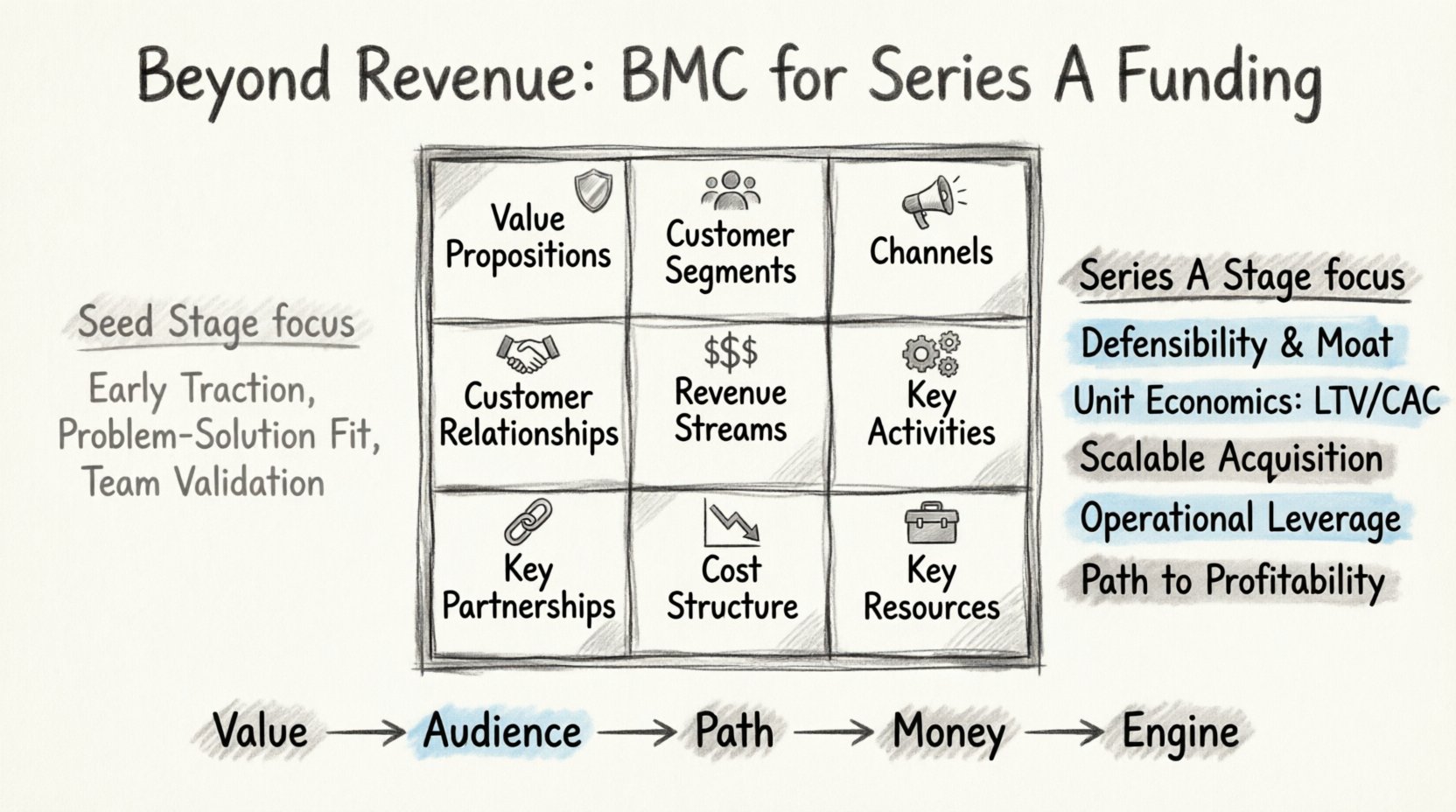
The Business Model Canvas is not static. It evolves as the company matures. The table below outlines the shift in focus between Seed and Series A stages.
| BMC Block | Seed Stage Focus | Series A Stage Focus |
|---|---|---|
| Value Proposition | Problem-Solution Fit | Defensibility & Moat |
| Customer Segments | Early Adopters | Scalable Market Segments |
| Channels | Manual Testing | Optimized & Automated Acquisition |
| Revenue Streams | Validation of Willingness to Pay | Unit Economics & LTV/CAC |
| Key Activities | Product Development | Scaling Operations & Sales |
| Cost Structure | Minimal Burn | Efficiency & Path to Profitability |
When preparing for Series A, review your canvas against the right column. If you are still focused on manual testing in channels, you are not ready for Series A funding.
Aligning the Canvas with Due Diligence 🔍
Due diligence is the process investors use to verify claims. The Business Model Canvas acts as a summary of these claims. Aligning the canvas with due diligence documentation reduces friction.
- Financial Models: The Revenue Streams and Cost Structure blocks must match the financial projections exactly.
- Legal Documents: Key Partnerships should align with signed contracts or NDAs.
- Product Roadmap: Key Activities should reflect the development timeline investors see.
Consistency is key. If the canvas says the model is product-led, but the financials show heavy reliance on a large sales team, investors will question the operational reality.
Common Pitfalls in BMC Usage ⚠️
Even experienced founders make mistakes when using this framework for fundraising.
- Vagueness: Writing “Marketing” as a Key Activity is too broad. Specify “Paid Search Optimization” or “Content Marketing.” Specificity signals competence.
- Ignoring Risk: The canvas often highlights strengths. Series A requires acknowledging risks in the Cost Structure or Partnerships blocks to show realism.
- Disconnecting Blocks: A high-value proposition means nothing if the Channels cannot reach the customers. Ensure logical flow between blocks.
- Static Document: The canvas should be updated quarterly. Stale data suggests a lack of strategic oversight.
Narrative Consistency & Storytelling 📖
A canvas is a visual aid, but the narrative is what closes the deal. The story told by the canvas must match the verbal pitch.
When presenting the canvas, guide the investor through the logic:
- Start with Value: Explain the problem and the solution (Value Prop).
- Define the Audience: Show who needs this (Customer Segments).
- Show the Path: Explain how they get it (Channels).
- Explain the Money: Detail the monetization and costs (Revenue & Cost Structure).
- Prove the Engine: Outline the operations and partners (Activities & Partners).
This flow mirrors the logical progression of an investment thesis. It demonstrates that the founder understands the business as a system, not just a collection of ideas.
Final Considerations for Founders 🏁
Using the Business Model Canvas to secure Series A funding is about more than filling in boxes. It is about proving that the business is a machine designed for growth. It requires a deep understanding of how each component interacts with the others.
Founders who treat the canvas as a living strategic document find themselves better prepared for the scrutiny of institutional investors. They can answer questions about scalability, efficiency, and risk with precision.
Focus on the alignment between your operational reality and your financial aspirations. Ensure that the story told by the canvas is consistent with the data in your financial models. This alignment builds the quiet confidence that investors look for in a Series A lead.
By rigorously applying this framework, you move beyond the conversation of potential revenue and into the conversation of sustainable value creation. This shift is often the difference between a rejection and a term sheet.
Related posts:
 B2B vs. B2C: How the Business Model Canvas Shifts for Tech Founders
 The 7 Hidden Levers in Your Business Model Canvas That Kill Startups Early
 Stop Guessing Revenue: A Component Breakdown of the Business Model Canvas for SaaS
 From Idea to IPO: A Comprehensive Walkthrough of the Business Model Canvas for First-Time Entrepreneurs