


Building a startup often feels like a race against time. Founders frequently jump straight into writing code, assuming that functionality equals value. This approach often leads to wasted resources and products that solve problems no one actually has. The “No-Code” approach to strategy flips this script. It prioritizes the structural integrity of the business before a single line of software is written. By using a visual, iterative framework, you can validate your business model with precision and confidence.
This guide explores how to construct a resilient Business Model Canvas (BMC) specifically tailored for Minimum Viable Products (MVPs). We will move beyond simple definitions and dive into the strategic mechanics of each block, ensuring your foundation is solid before you build. This is about clarity, validation, and speed.
🧩 Why Strategy Comes Before Code 💻
In the early stages of a venture, ambiguity is the enemy. Developers build what they are told; they do not validate why it is being built. When you start with code, you risk building a solution for a non-existent problem. A robust Business Model Canvas allows you to map out the logic of your business without the constraints of technical implementation.
Here is why this approach is critical for MVPs:
- Cost Efficiency: Changing a diagram is free. Refactoring code is expensive.
- Speed of Iteration: You can test hypotheses in hours, not weeks.
- Stakeholder Alignment: Visual models are easier for investors and partners to understand than technical specifications.
- Risk Reduction: Identifying flaws in the business logic prevents technical debt later.
🛠 Defining the “No-Code” Methodology 🧩
When we speak of “No-Code” in this context, we are not referring to a specific software tool or platform. Instead, we are referring to a mindset of rapid prototyping and visual thinking. It means using collaborative spaces to draft, test, and refine your business logic before committing to engineering resources.
This methodology relies on the following principles:
- Visual First: Complex relationships are easier to see when drawn than when described in text.
- Modular Thinking: Treat each block of the canvas as a distinct component that can be swapped out.
- Empathy-Driven: Start with the customer, not the feature list.
- Fail Fast: The goal is to find the truth about your market quickly, not to build a perfect product immediately.
🏗 The Nine Building Blocks of Your MVP 🏗️
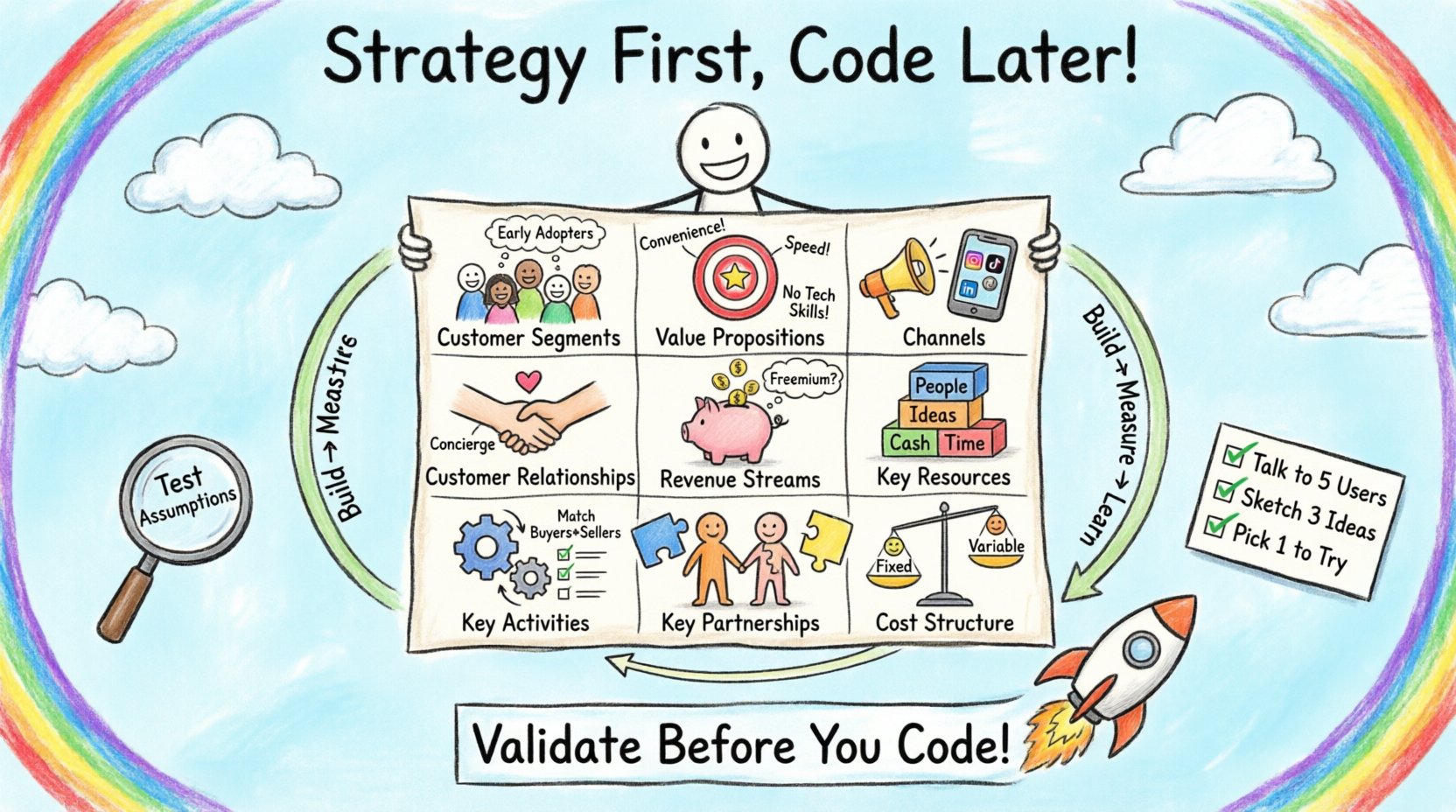
The Business Model Canvas consists of nine essential building blocks. For an MVP, each block requires specific scrutiny. You do not need to fill every box perfectly, but you must understand the connections between them. Below is a deep dive into each section.
1. Customer Segments 👥
Who are you creating value for? In an MVP context, you cannot target “everyone.” You must define a specific niche.
- Mass Market: Selling to everyone (rare for early MVPs).
- Niche Market: Serving a specific, well-defined group.
- Segmented: Distinguishing between different groups with different needs.
- Multi-sided Platforms: Two or more interdependent customer groups.
Strategic Note: For your MVP, identify the “Early Adopters.” These are the people most likely to tolerate bugs and imperfect features in exchange for solving a critical pain point.
2. Value Propositions 🎯
What value do you deliver? Why should customers choose you over the competition? This is the core of your MVP.
- Novelty: Is this something new?
- Performance: Does it work better than alternatives?
- Customization: Can it be tailored to the user?
- Design: Is the experience superior?
- Price: Is it more affordable?
- Convenience: Is it easier to use?
- Risk Reduction: Does it lower the risk for the buyer?
Strategic Note: Do not list features here. List benefits. Instead of “Cloud Storage,” write “Access your files from anywhere without worrying about hardware failure.”
3. Channels 📢
How do you reach your customer segments? This involves communication, distribution, and sales.
- Owned Channels: Your website, blog, or email list.
- Partner Channels: Distributors or affiliates.
- Phases: Awareness, Evaluation, Purchase, Delivery, After Sales.
Strategic Note: For an MVP, choose channels that offer the fastest feedback loop. Social media might be faster than a sales team for initial validation.
4. Customer Relationships 🤝
What type of relationship does each segment expect? This defines how you acquire, retain, and grow customers.
- Personal Assistance: Human interaction.
- Self-Service: Automated tools.
- Automated Services: Algorithms and AI.
- Communities: User groups and forums.
- Co-creation: Building with the user.
Strategic Note: Early MVPs often rely on “Concierge” relationships where the founder manually handles tasks to learn the process, even if the final product will be automated.
5. Revenue Streams 💰
For what value are customers truly willing to pay?
- Asset Sale: Selling ownership of a physical good.
- Usage Fee: Charging based on usage.
- Subscription Fees: Recurring payments for access.
- Lending/Renting/Leasing: Temporary access rights.
- Brokerage Fees: Facilitating a transaction.
Strategic Note: Be careful with pricing models. A free-to-start model might generate traffic but fail to validate willingness to pay. Consider a freemium or trial model to test conversion.
6. Key Resources 🧱
What physical, intellectual, human, or financial assets are required to make the model work?
- Physical: Buildings, vehicles, machines.
- Intellectual: Brands, patents, copyrights, data.
- Human: The team, skills, expertise.
- Financial: Cash, lines of credit.
Strategic Note: Identify the “Key” resources. You do not need to own everything. Can you leverage existing platforms or partnerships instead of building your own infrastructure?
7. Key Activities ⚙️
What strategic activities do your value propositions require?
- Production: Designing, making, and delivering a product.
- Problem Solving: Creating new solutions for individual customer problems.
- Platform/Network: Maintaining and improving the platform.
Strategic Note: Focus on the activities that directly create value. If you are building a marketplace, the activity is “Matching Buyers and Sellers,” not just coding the website.
8. Key Partnerships 🤝
Who are your key suppliers and partners?
- Strategic Alliances: Non-competitors cooperating.
- Coopetition: Strategic partnerships between competitors.
- Joint Ventures: To develop new businesses.
- Buyer-Supplier Relationships: To ensure reliable supplies.
Strategic Note: Outsourcing non-core activities allows you to focus your limited resources on the value proposition. Use partnerships to reduce risk and acquisition costs.
9. Cost Structure 💸
What are the most important costs inherent in the business model?
- Cost-Driven: Minimizing costs wherever possible.
- Value-Driven: Focusing on value creation even at higher costs.
Strategic Note: Distinguish between fixed and variable costs. MVPs should aim for high variable costs initially to avoid heavy overhead until revenue is proven.
🔄 Integrating Validation Loops 🔄
A canvas is not a static document. It is a living hypothesis map. The “No-Code” approach emphasizes the speed at which you can move through the Build-Measure-Learn feedback loop.
Here is how to integrate validation into your planning process:
- Assumption Mapping: Identify the riskiest assumptions in each block.
- Experiments: Design small tests to validate those assumptions.
- Data Collection: Gather evidence from the real world, not internal opinions.
- Pivot or Persevere: Update the canvas based on what the data says.
This cycle ensures that your business model evolves based on reality, not speculation.
📊 BMC Block vs. MVP Validation Metric
| Canvas Block | Key Question | Validation Metric |
|---|---|---|
| Customer Segments | Who is actually using it? | Active User Demographics |
| Value Proposition | Does it solve the problem? | Task Completion Rate / NPS |
| Channels | Where do they come from? | Traffic Source & CAC |
| Revenue Streams | Will they pay? | Conversion Rate / ARPU |
| Key Activities | Is it feasible? | Operational Lead Time |
⚠️ Common Pitfalls in Visual Planning ⚠️
Even with a structured approach, founders often stumble. Awareness of these pitfalls can save months of work.
- Confusing Features with Value: Listing features instead of benefits in the Value Proposition block.
- Ignoring Unit Economics: Focusing on growth without understanding the cost to acquire a customer.
- Over-Engineering the Model: Trying to plan for 5 years when you need to survive 6 months.
- Sticking to the Plan: Failing to update the canvas when data contradicts the initial hypothesis.
- Lack of Consensus: Having different versions of the canvas for different team members.
To avoid these, treat the canvas as a single source of truth. Everyone in the organization should be looking at the same visual map.
📈 From Canvas to Code: The Transition 📈
Once the canvas is validated, the transition to development becomes much smoother. The canvas serves as the blueprint for the architecture.
Consider the following steps:
- Scope Definition: Use the “Key Activities” block to define the MVP feature set strictly.
- Resource Allocation: Use the “Key Resources” block to hire the right talent for the specific tech stack needed.
- API Design: Map the “Channels” and “Customer Relationships” to the necessary API endpoints and integrations.
- Cost Modeling: Use the “Cost Structure” block to estimate cloud hosting and maintenance costs.
This alignment ensures that the engineering effort directly supports the validated business strategy.
✅ Checklist for Launch ✅
Before you commit to a full build cycle, run this checklist against your canvas.
- ☐ Have I defined a specific Customer Segment?
- ☐ Is the Value Proposition clear and distinct?
- ☐ Do I know exactly how customers will find me (Channels)?
- ☐ Have I tested the willingness to pay (Revenue)?
- ☐ Are the Key Activities achievable with current resources?
- ☐ Have I identified the risks in the Cost Structure?
- ☐ Is there a mechanism to gather feedback post-launch?
🏃 Maintaining Agility 🏃
The “No-Code” approach is not about staying static. It is about the ability to pivot quickly. As market conditions change, your canvas should change with it. Regular reviews of the Business Model Canvas should be a standing agenda item in your weekly strategy meetings.
By keeping the focus on the model rather than the code, you build a business that is adaptable. You create an organization that responds to market signals rather than internal roadmaps. This is the essence of building a robust MVP foundation.
Remember, the goal is not to build a perfect canvas immediately. The goal is to build a canvas that helps you learn. Every iteration brings you closer to a sustainable business model. Stay focused on the value, validate the assumptions, and let the structure guide the build.
Related posts:
 B2B vs. B2C: How the Business Model Canvas Shifts for Tech Founders
 The 7 Hidden Levers in Your Business Model Canvas That Kill Startups Early
 Stop Guessing Revenue: A Component Breakdown of the Business Model Canvas for SaaS
 From Idea to IPO: A Comprehensive Walkthrough of the Business Model Canvas for First-Time Entrepreneurs