


The Business Model Canvas (BMC) has long served as the blueprint for entrepreneurs and strategists worldwide. Created by Alexander Osterwalder, this one-page framework visualizes the logic of how a company creates, delivers, and captures value. Traditionally, the BMC was a static tool, often treated as a snapshot of a company’s current state. However, the rapid integration of artificial intelligence into organizational structures is transforming this static diagram into a dynamic, living system. We are witnessing a shift where algorithms do not just support business models; they redefine the core components themselves.
This guide explores the future outlook of the Business Model Canvas in an AI-driven economy. We will examine how each building block of the canvas is evolving, moving from human-centric assumptions to data-centric realities. The goal is to understand the mechanics of this transformation without the noise of hype.
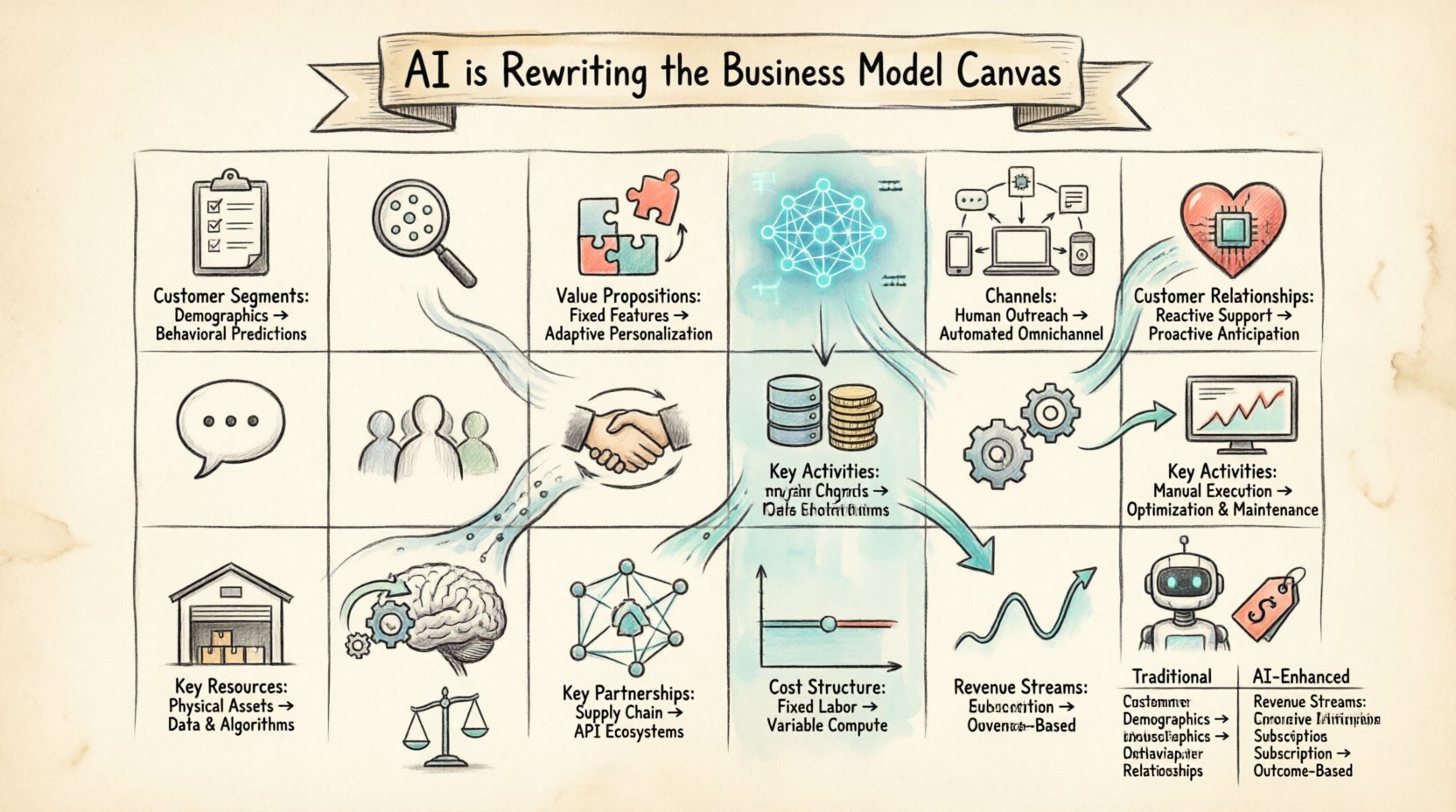
1. Customer Segments: From Demographics to Behavioral Predictions 🎯
Traditionally, defining customer segments relied on broad demographic data: age, location, income level, and industry. This approach often resulted in generalized marketing strategies that missed nuance. AI changes this by enabling hyper-granular segmentation based on real-time behavior.
- Dynamic Clustering: Machine learning algorithms can cluster customers based on thousands of data points, not just a few. Segments become fluid rather than fixed.
- Predictive Needs: AI models analyze past interactions to predict what a customer needs before they express it. This shifts the segment definition from “who they are” to “what they will do next”.
- Micro-Segments: The concept of a “segment” is dissolving into individual personas. Mass personalization allows businesses to treat every user as a unique segment.
For example, instead of targeting “Small Business Owners in Tech,” an AI-enhanced model might target “Developers who use specific open-source tools and have recently increased their cloud spending.” This precision reduces waste and increases conversion rates.
2. Value Propositions: Dynamic and Adaptive Offerings 💎
The Value Proposition block describes the bundle of products and services that create value for a specific customer segment. In the past, this was a static list of features. Now, AI allows value propositions to adapt in real-time.
- Personalized Pricing: Algorithms can adjust pricing based on demand, user willingness to pay, and market conditions instantly.
- Feature Customization: Software products can now auto-configure interfaces and features based on how a user interacts with the system. The value proposition changes per user session.
- Predictive Outcomes: Value is no longer just about the tool provided; it is about the outcome predicted. Selling “time saved” or “risk reduced” becomes a quantifiable metric.
This adaptability means the Value Proposition is no longer a statement on a slide deck. It is a continuous negotiation between the algorithm and the user, optimizing for maximum utility.
3. Channels: Automated and Omnichannel Integration 📡
Channels describe how a company communicates with and reaches its customer segments. AI has revolutionized this by automating touchpoints and ensuring consistency across platforms.
- Intelligent Routing: AI directs customer inquiries to the most appropriate channel (chat, email, phone) based on the complexity of the issue and the customer’s preference.
- Content Optimization: Algorithms test variations of content across different channels to determine the highest performing format for each segment.
- Frictionless Entry: Biometric authentication and predictive search reduce the steps required for a user to engage with the product.
The channel is no longer a separate department. It is an integrated network where data flows seamlessly from marketing to sales to support, guided by predictive logic.
4. Customer Relationships: From Service to Anticipation 🤝
Customer relationships define the types of connections a company establishes with specific customer segments. AI shifts this from reactive support to proactive partnership.
- 24/7 AI Agents: Conversational agents handle routine queries, allowing human teams to focus on complex, high-value interactions.
- Churn Prediction: Models identify users at risk of leaving before they actually cancel, triggering automated retention workflows.
- Contextual Awareness: AI remembers past interactions across all channels, ensuring the customer feels understood without repetition.
The relationship becomes less about a contract and more about a continuous feedback loop. The system learns from every interaction to improve future engagement.
5. Key Resources: Data and Algorithms as Assets 🏦
Key resources are the assets required to make a business model work. In the AI era, physical assets are often secondary to digital assets.
- Data Repositories: Clean, structured, and accessible data is the most critical resource. Without data, the model cannot function.
- Computational Power: Access to processing power for training and inference is a major strategic asset.
- Talent: Data scientists and engineers become core resources, replacing traditional operational roles in many functions.
Businesses must now treat their data infrastructure with the same rigor as their supply chain. Data quality directly impacts the accuracy of the business model.
6. Key Activities: Optimization and Maintenance ⚙️
Key activities are the most important things a company must do to make its business model work. AI introduces new activities that were previously non-existent.
- Model Training: Continuous training of algorithms to ensure accuracy and relevance.
- Data Governance: Ensuring data privacy, security, and compliance with regulations.
- Automation Management: Monitoring automated systems to prevent errors or drift.
The focus shifts from manual execution to system oversight. The human role becomes that of a supervisor and optimizer rather than an executor.
7. Key Partnerships: Ecosystems and APIs 🤝
Key partners are the network of suppliers and partners that make the business model work. AI encourages deeper integration and ecosystem dependency.
- Data Sharing: Partnerships often involve sharing data to enhance mutual predictive capabilities.
- API Integration: Connecting with third-party services to extend functionality without building it in-house.
- Cloud Providers: Reliance on large infrastructure providers for compute and storage.
Partnerships are no longer just about supply chains. They are about data synergies and technical interoperability.
8. Cost Structure: Efficiency and Compute Costs 💰
The cost structure describes all costs incurred to operate a business model. AI alters this structure significantly.
- Variable Costs: Costs often shift from fixed (labor) to variable (compute usage, API calls).
- R&D Investment: Significant investment is required to develop and maintain proprietary models.
- Scalability: Marginal costs for serving additional customers decrease dramatically as automation takes over.
Businesses must carefully model the cost of inference versus the revenue generated. Over-engineering models can lead to financial inefficiency.
9. Revenue Streams: Usage-Based and Outcome-Based 💵
Revenue streams represent the cash a company generates from each customer segment. AI enables entirely new monetization models.
- Pay-Per-Outcome: Charging based on the result delivered rather than the time spent.
- Dynamic Subscription: Pricing tiers that adjust automatically based on usage intensity.
- Data Monetization: Anonymized insights derived from usage can be sold to third parties.
The shift is from selling access to selling performance. This aligns the business incentives directly with customer success.
Comparative Analysis: Traditional vs. AI-Enhanced Canvas
To visualize these shifts, consider the following comparison table.
| Component | Traditional Approach | AI-Enhanced Approach |
|---|---|---|
| Customer Segments | Static demographics | Dynamic behavioral clusters |
| Value Proposition | Fixed feature set | Adaptive personalization |
| Channels | Human-led outreach | Automated omnichannel |
| Relationships | Reactive support | Proactive engagement |
| Key Resources | Physical assets & staff | Data & compute power |
| Cost Structure | High fixed labor costs | Variable compute costs |
| Revenue | Subscription or one-time | Usage or outcome-based |
Ethical Considerations and Risks ⚖️
While the potential for efficiency is immense, integrating AI into the business model introduces specific risks that must be managed.
Data Privacy and Consent
- Collecting granular data requires strict adherence to privacy regulations.
- Transparency about how data is used is essential to maintain trust.
Algorithmic Bias
- Models trained on historical data may perpetuate existing biases.
- Regular auditing of decision-making processes is necessary.
Job Displacement
- Automation may reduce the need for certain roles.
- Strategic planning must include workforce reskilling initiatives.
Future Scenarios: The Autonomous Business Model 🤖
Looking further ahead, we can envision a future where the Business Model Canvas operates autonomously. In this scenario, AI agents manage the entire lifecycle of the business.
- Self-Optimizing Models: The system continuously tests and adjusts pricing, features, and channels without human intervention.
- Market Sensing: AI monitors global trends and adjusts the business model in real-time to capitalize on opportunities.
- Automated Compliance: Systems ensure all activities meet legal and ethical standards automatically.
This level of autonomy does not mean humans are irrelevant. It means human strategy shifts from execution to governance. Leaders define the boundaries and ethical constraints, while AI handles the optimization within those boundaries.
Implementation Steps for Integration 📋
For organizations looking to update their business model canvas with AI, a structured approach is recommended.
- Audit Current Data: Assess the quality and availability of data across the organization.
- Identify High-Impact Areas: Pinpoint which blocks of the canvas offer the greatest ROI for AI integration.
- Start Small: Pilot AI features in one channel or segment before scaling.
- Build Infrastructure: Ensure the technical backbone can support real-time data processing.
- Train Teams: Upskill employees to work alongside AI systems effectively.
- Monitor and Iterate: Continuously measure performance and refine the model.
Strategic Implications for Leadership 👔
Leaders must rethink their role in the AI-driven future. The traditional command-and-control model is less effective when decisions are data-driven and rapid.
- Decentralized Decision Making: Empower AI systems to make operational decisions within set parameters.
- Long-term Vision: Focus on ethical guidelines and long-term sustainability rather than short-term gains.
- Adaptability: Cultivate a culture that embraces change and continuous learning.
The Business Model Canvas is not obsolete; it is evolving. The nine blocks remain, but the content within them is shifting from static assumptions to dynamic data flows. Companies that fail to adapt risk becoming static relics in a fluid market.
Final Thoughts on the AI Evolution 🚀
The integration of artificial intelligence into business strategy is not a temporary trend. It is a fundamental shift in how value is created and captured. The Business Model Canvas provides a necessary framework for navigating this change, offering a structured way to assess the impact of technology on core operations.
By understanding the specific changes in each block—from Customer Segments to Revenue Streams—organizations can plan a transition that is both strategic and practical. The future belongs to those who can balance the efficiency of algorithms with the nuance of human insight.
As you review your own business model, consider where AI can introduce flexibility. Where are the inefficiencies? Where is the data? How can you turn those assets into a competitive advantage? The tools are available. The framework is clear. The next step is execution.
Related posts:
 B2B vs. B2C: How the Business Model Canvas Shifts for Tech Founders
 The 7 Hidden Levers in Your Business Model Canvas That Kill Startups Early
 Stop Guessing Revenue: A Component Breakdown of the Business Model Canvas for SaaS
 From Idea to IPO: A Comprehensive Walkthrough of the Business Model Canvas for First-Time Entrepreneurs