


Building a startup is less about having a brilliant idea and more about constructing a viable system that delivers value sustainably. The Business Model Canvas (BMC) has become the standard framework for visualizing this system. It forces clarity across nine building blocks, from value propositions to cost structures. However, many founders treat the canvas as a static document rather than a dynamic hypothesis map. When used incorrectly, the canvas can create a false sense of security, masking fundamental weaknesses in the strategy.
Early-stage companies face unique pressures. Resources are scarce, time is limited, and the market is unforgiving. A single strategic error can derail months of work. This guide identifies the five most common fatal flaws found in early-stage BMC strategies. By understanding these pitfalls, founders can build a more resilient foundation for growth.
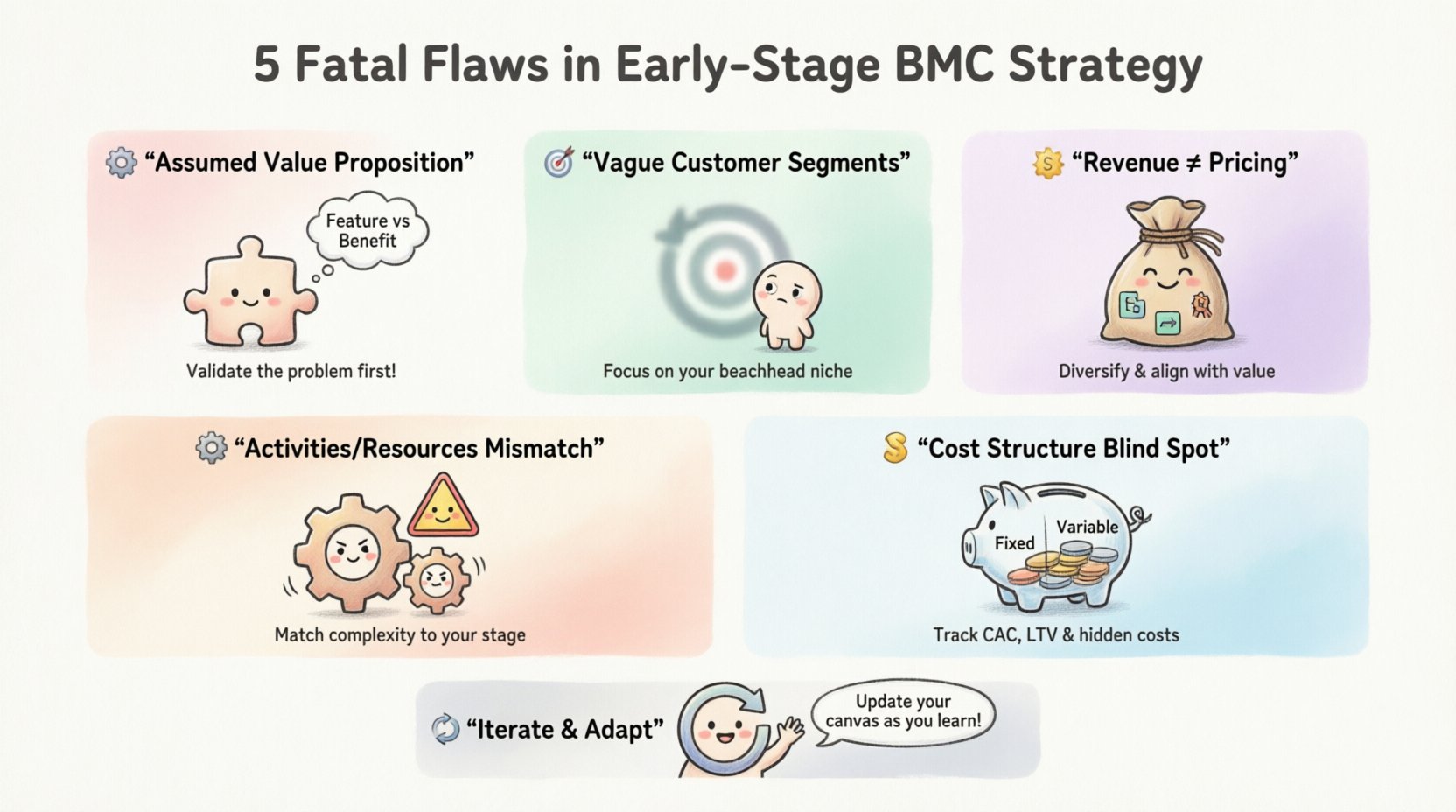
1. The Assumed Value Proposition Trap 🧩
The core of any business is the value it delivers. Yet, this is where the first major flaw often appears. Founders frequently define their value proposition based on what they *want* to build, rather than what the market actually needs. This is known as the “feature-first” fallacy.
When a team focuses on the mechanics of their solution before validating the problem, the resulting canvas is hollow. The Value Proposition block becomes a list of features instead of a statement of benefits. This disconnect leads to products that solve non-existent problems or solve them in a way that is too costly for the customer.
Why This Fails
- Lack of Market Fit: You build a product nobody wants to pay for.
- Resource Misallocation: Engineering and design time is spent on features that do not drive adoption.
- Weak Messaging: Marketing efforts become confused when the core benefit is unclear.
The Correction Strategy
To fix this, shift the focus from the solution to the problem. Ask: “What job is the customer hiring us to do?” Validate the pain point before finalizing the solution. Ensure the value proposition block in your canvas explicitly states the outcome for the customer, not just the technical capability of the product.
Example of a Flawed Statement: “We provide a cloud-based inventory management system with AI integration.”
Example of a Strong Statement: “We reduce stock-out incidents by 40% for small retailers through real-time predictive tracking.”
2. Vague Customer Segments 🎯
The second fatal flaw is the “everyone is my customer” mindset. In the Customer Segments block of the canvas, many early-stage strategies list demographics that are too broad. If you say your customer is “everyone,” you are likely saying your customer is “no one.”
Broad segmentation leads to diluted marketing spend and a product that tries to appeal to too many different needs simultaneously. A generic approach prevents deep empathy with the specific users you are trying to serve.
The Consequences of Broad Segmentation
- Ineffective Acquisition: You cannot target ads efficiently when the audience is undefined.
- Product Bloat: You attempt to build features for multiple segments that do not align.
- Low Retention: Without a specific niche, users do not feel the product was designed for them.
Defining the Right Segments
Focus on a niche first. Early-stage businesses should aim for a “beachhead market.” This is a specific group of people who have the most acute pain and the willingness to pay for a solution. Once you dominate this small segment, you can expand.
Use the following criteria to define your segment:
- Specific Demographics: Age, location, industry, or role.
- Behavioral Triggers: Actions they take that indicate a need (e.g., switching software, hiring a consultant).
- Accessibility: Can you actually reach them through existing channels?
When filling out the canvas, be ruthless. If a segment does not fit the core value proposition, exclude it. It is better to own a small market than to lose in a large one.
3. Confusing Revenue with Pricing 💰
The Revenue Streams block is often treated as a simple pricing menu. This is a critical error. Revenue Streams describe *how* value is captured, not just the price tag. Many founders assume that if they have a product, revenue will automatically follow. This overlooks the mechanics of monetization.
A common mistake is relying on a single revenue model that is fragile. For example, depending entirely on one-time sales without recurring revenue creates a perpetual need for new customer acquisition. Another error is choosing a pricing model that does not align with the customer’s perceived value.
Common Revenue Flaws
- Price Without Value: Charging a premium without delivering premium utility.
- Hidden Costs: Customers feel nickel-and-dimed, leading to churn.
- Unscalable Models: Revenue that requires direct labor per unit does not scale well.
Structuring Revenue Correctly
Consider the relationship between the customer and the business. Does the value increase as the customer uses the product more? If yes, a usage-based model might work. Is the value a one-time purchase? Then a transaction model is appropriate.
Do not limit yourself to a single stream. Diversify within the canvas to show robustness:
- Subscription: Recurring income for stability.
- Transactional: One-off fees for specific needs.
- Licensing: Fees for using your technology or IP.
- Advertising: Monetizing attention or data (if applicable).
Ensure the pricing strategy aligns with the Cost Structure. If your costs are high, your pricing must reflect that without deterring the target segment.
4. Key Activities and Resources Mismatch ⚙️
The Key Activities and Key Resources blocks define the engine of the business. The fourth fatal flaw is promising more than the current organization can deliver. Founders often list high-level activities like “24/7 customer support” or “global logistics” without assessing if they have the resources to execute them.
This creates a gap between the strategy and the operations. If the canvas claims the activity is crucial, but the resources are missing, the business cannot function. This is often called “over-engineering the front end” while ignoring the back-end capacity.
Identifying the Mismatch
Review your Key Activities. Are they essential for the value proposition? If an activity does not directly support the value delivered to the customer, consider removing it to save costs. Conversely, ensure the Key Resources (people, technology, capital) are listed accurately.
Common Pitfalls:
- Outsourcing Critical Functions: Relying on third parties for core competencies without a backup plan.
- Underestimating Tech Debt: Building custom solutions when off-the-shelf tools exist.
- Ignoring Human Capital: Focusing on software and forgetting the team needed to run it.
Aligning Operations with Strategy
Match the complexity of your activities to your stage. Early-stage companies should prioritize agility over perfection. Focus on activities that provide immediate feedback from the market. Do not build a massive infrastructure before validating the demand. Keep the Key Resources lean. Use partnerships to fill gaps rather than building everything in-house.
5. The Cost Structure Blind Spot 💸
The final fatal flaw is a lack of visibility into costs. Many founders focus so heavily on revenue that they neglect the Cost Structure block. This block details all costs incurred to operate the business model. Ignoring this leads to a classic startup killer: burning cash without a clear path to profitability.
A common error is treating all costs as variable. In reality, startups often have high fixed costs (salaries, office rent, software subscriptions) that do not change with sales volume. If revenue dips, these fixed costs remain, creating a cash crunch.
The Cost Breakdown Mistakes
- Ignoring Customer Acquisition Cost (CAC): Failing to account for the cost of finding a customer.
- Blind to Churn: Not factoring in the cost of losing customers and replacing them.
- Hidden Operational Costs: Legal fees, taxes, and administrative overhead are often overlooked.
Building a Healthy Cost Model
Separate fixed and variable costs clearly in your strategy. This allows you to model different scenarios. What happens if revenue is 50% of projections? Can you survive? This is the basis of financial resilience.
Strategies to manage costs:
- Fixed Cost Reduction: Can you work remotely to save on rent? Can you use contractors instead of full-time staff?
- Variable Cost Optimization: Negotiate with suppliers. Automate manual processes.
- Unit Economics: Ensure the lifetime value (LTV) of a customer is significantly higher than the CAC.
Strategic Comparison: Good vs. Bad BMC Practices 📊
To summarize the differences between a flawed strategy and a robust one, review the following matrix. This table highlights the specific shifts required in each block.
| Canvas Block | ❌ The Fatal Flaw | ✅ The Strategic Correction |
|---|---|---|
| Value Proposition | Feature-focused; “We do X” | Benefit-focused; “We solve Y for you” |
| Customer Segments | Everyone; Broad demographics | Niche; Specific behavioral triggers |
| Revenue Streams | Single model; Price confusion | Diversified; Aligned with value |
| Key Activities | Over-engineered; Unreachable | Essential; Aligned with resources |
| Cost Structure | Ignored; Hidden fixed costs | Transparent; LTV > CAC focus |
Iterating on the Canvas 🔄
The Business Model Canvas is not a one-time exercise. It is a living document that must evolve as you learn. The flaws listed above often become apparent only after you begin talking to customers and testing your assumptions. When you receive negative feedback, update the canvas immediately. Do not cling to the initial plan.
Regularly schedule reviews where you challenge every block. Ask:
- Has the value proposition changed based on feedback?
- Are we still targeting the right segment?
- Do our costs match our revenue reality?
- Are our key activities efficient?
By treating the canvas as a hypothesis rather than a contract, you reduce the risk of failure. The goal is not to predict the future perfectly, but to remain agile enough to adapt when the market changes.
Final Considerations for Founders 🚀
Building a successful business requires discipline and honesty. The five fatal flaws identified in this guide represent the most common points of failure for early-stage ventures. Avoiding them requires a shift in mindset from “building a product” to “building a system that delivers value.”
Focus on clarity in your segments. Be specific about the value you provide. Ensure your revenue model is sustainable. Align your activities with your resources. And keep a tight rein on your costs. These steps form the bedrock of a resilient strategy.
When you fill out your canvas, do not fill it to make yourself feel good. Fill it to understand the truth of your business. Use it to identify gaps and risks. If you can navigate these five areas with precision, you significantly increase the odds of long-term success.
Remember, a good strategy is one that works when things go wrong. By anticipating these flaws, you prepare your business to withstand the pressures of the early market. Keep the canvas visible, keep the data honest, and keep iterating.
Related posts:
 B2B vs. B2C: How the Business Model Canvas Shifts for Tech Founders
 The 7 Hidden Levers in Your Business Model Canvas That Kill Startups Early
 Stop Guessing Revenue: A Component Breakdown of the Business Model Canvas for SaaS
 From Idea to IPO: A Comprehensive Walkthrough of the Business Model Canvas for First-Time Entrepreneurs