


Launching a new venture involves more than just a great idea. It requires a validated framework that connects what you offer with what the market actually needs. The Business Model Canvas (BMC) serves as this strategic foundation, but one specific block often causes the most friction: the Value Proposition.
Many founders build products based on assumptions rather than evidence. When the Value Proposition is flawed, the entire business model becomes fragile. This guide provides a deep dive into troubleshooting your BMC, specifically focusing on diagnosing and correcting weak value propositions. By addressing these issues early, you reduce the risk of costly pivots later.
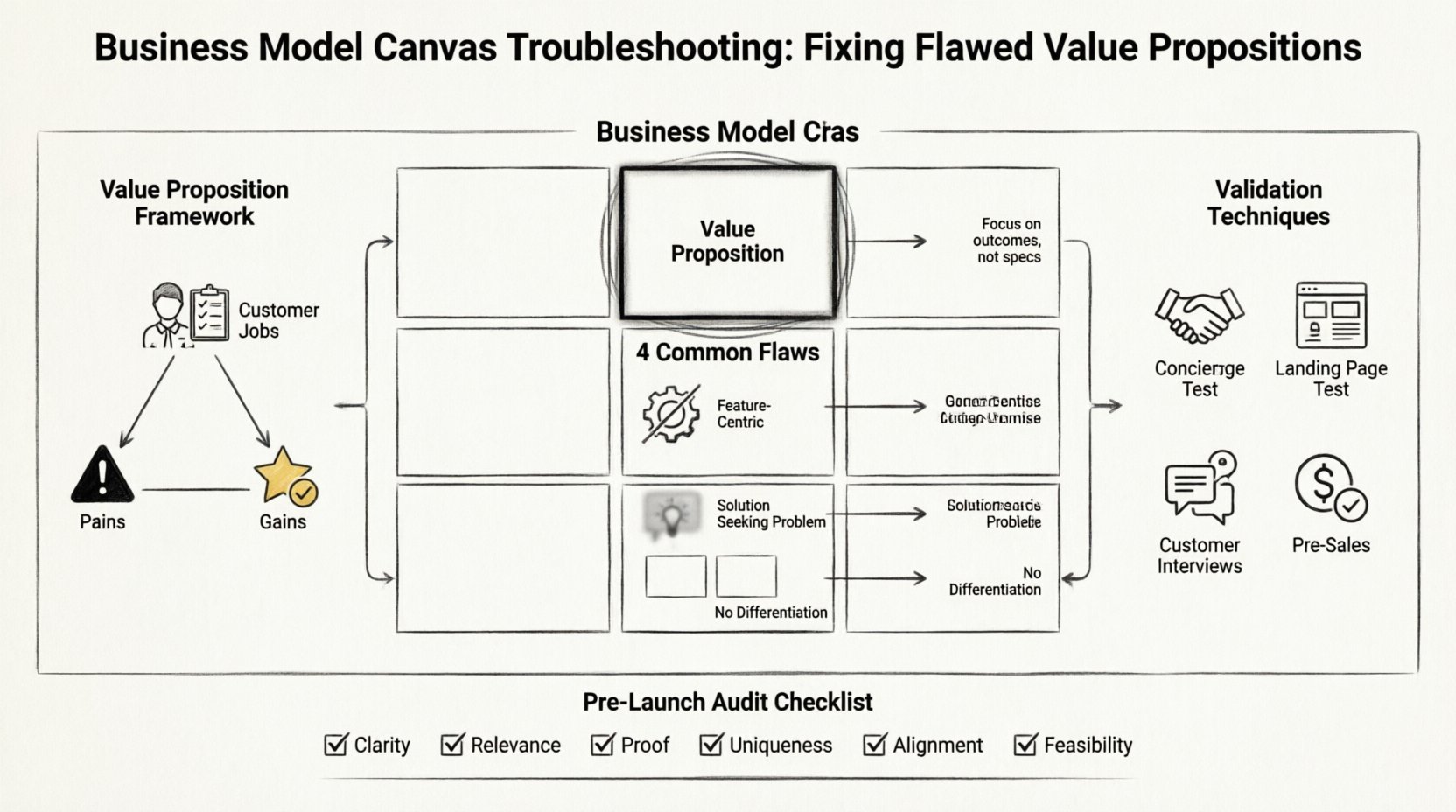
🔍 Understanding the Value Proposition Block
The Value Proposition is the heart of the Business Model Canvas. It describes the bundle of products and services that create value for a specific customer segment. It is not merely a tagline or a marketing slogan. It is the core reason why a customer chooses you over a competitor.
A robust Value Proposition must address three critical areas:
- Customer Jobs: What is the customer trying to accomplish in their personal or professional life?
- Pains: What obstacles, risks, or negative emotions are they experiencing while trying to achieve those jobs?
- Gains: What outcomes, benefits, or positive experiences are they seeking?
If your Value Proposition does not explicitly map to these three areas, it is likely too generic to drive traction. A strong proposition solves a painful problem or creates a significant benefit in a way that is distinct from existing alternatives.
⚠️ Diagnosing Common Flaws in Your Value Proposition
Before you can fix a flaw, you must identify it. During the troubleshooting phase, review your current Value Proposition block against the following common failure modes. These patterns often appear in early-stage drafts and can lead to low conversion rates.
1. The Feature-Centric Approach
Startups often describe what their product does rather than what it does for the user. Listing technical specifications or features confuses the buyer. They do not care about the engine size; they care about the speed and safety of the ride.
- Weak: “We offer a cloud-based CRM with 256-bit encryption.”
- Strong: “Securely manage client relationships without worrying about data breaches.”
2. The Generic Promise
Claims like “high quality,” “best in class,” or “affordable” are meaningless without context. Every competitor makes these claims. To troubleshoot this, ask: “Why should I believe you?” If the answer is not specific evidence, the proposition is weak.
3. The Solution Looking for a Problem
Often, teams fall in love with a technology and then try to find a use case. If you cannot clearly articulate the pain point you are solving, the Value Proposition is disconnected from market reality. This is the most dangerous flaw because it leads to building something nobody wants.
4. Lack of Differentiation
If a customer can swap your solution for a competitor’s without losing any value, your proposition is not sticky. You must define your Unfair Advantage. This could be proprietary data, exclusive partnerships, or a unique distribution channel.
📊 Troubleshooting Checklist: Flaw vs. Correction
Use the table below to audit your current Value Proposition. Identify the symptom, understand the root cause, and apply the recommended correction strategy.
| Symptom | Root Cause | Correction Strategy |
|---|---|---|
| Low Conversion Rates | Vague benefits or missing urgency | Focus on specific outcomes and time-sensitive gains. |
| High Churn Early On | Overpromising or underdelivering on core needs | Re-align with actual customer Jobs-to-be-Done. |
| Confused Feedback | Technical jargon in customer-facing language | Simplify language to match customer vocabulary. |
| Price Sensitivity | Perceived value is lower than cost | Highlight unique value drivers, not just cost savings. |
| Competitor Copycats | No clear differentiation | Identify proprietary assets or niche focus. |
🤝 Aligning Value with Customer Segments
A Value Proposition cannot exist in a vacuum. It must align perfectly with the Customer Segments block. If you target multiple segments, you may need different Value Propositions for each. A common error is assuming one message fits all.
The Jobs-to-be-Done Framework
Apply the Jobs-to-be-Done theory to your troubleshooting process. Customers “hire” products to get a job done. They are not buying a drill; they are buying a hole. They are not buying a subscription; they are buying peace of mind.
When troubleshooting, map your Value Proposition to specific functional, social, and emotional jobs.
- Functional Jobs: Efficiency, cost reduction, speed.
- Social Jobs: Status, approval, group belonging.
- Emotional Jobs: Feeling safe, confident, or relaxed.
If your Value Proposition only addresses functional jobs but your customer segment is driven by emotional needs, you will face resistance. For example, a luxury travel service might focus on “fast booking” (functional), but the customer segment might value “exclusivity and status” (emotional/social). Fixing this mismatch is crucial.
🧪 Validation Techniques Without Budget
You do not need expensive software or large teams to validate your Value Proposition. Before investing in full-scale development, use these lean methods to test your hypotheses.
1. The Concierge Test
Manually perform the service your product promises to automate. Offer this to a small group of potential customers. If they are willing to pay or commit time to a manual process, they will likely pay for the automated version. If they hesitate, your Value Proposition may not be strong enough.
2. Landing Page Smoke Tests
Create a simple document describing your offer. Use a basic web form to collect interest. Do not build the product yet. Drive targeted traffic to the page. Measure the click-through rate and sign-up rate. If the Value Proposition is compelling, users will engage. If not, they will bounce.
3. Customer Interviews
Conduct structured interviews. Do not ask “Would you buy this?” This leads to biased answers. Instead, ask about their current behavior. “How do you currently solve this problem?” “What do you hate about your current solution?” “How much does this problem cost you in time or money?” Listen for emotional language and specific pain points.
4. Pre-Sales and Deposits
Ask for a deposit or a letter of intent. Nothing validates a Value Proposition like money. If potential customers are willing to put funds on the line before you have built the full solution, you have found product-market fit.
🔄 Iterating the Business Model Canvas
Once you identify a flaw, you must update the Canvas. This is not a failure; it is the core of the lean methodology. The Business Model Canvas is a living document that evolves as you learn.
Step 1: Isolate the Variable
Identify exactly which part of the Value Proposition is failing. Is it the specific benefit? Is it the pricing model? Is it the channel of communication? Do not change everything at once.
Step 2: Hypothesize a Change
Formulate a new Value Proposition statement based on your findings. Ensure it directly addresses the pain points uncovered during validation.
Step 3: Test the New Hypothesis
Apply the validation techniques mentioned above to the new statement. Gather data. Compare it against the previous iteration.
Step 4: Update the Canvas
Physically rewrite the Value Proposition block on your Canvas. Update related blocks if necessary. For example, if you change your Value Proposition to focus on speed, your Key Resources might need to change to prioritize logistics partners.
🛡️ Specific Scenarios and Fixes
Below are common scenarios found during BMC troubleshooting and the specific fixes applied to them.
Scenario A: The “Me-Too” Product
Situation: You are offering a service similar to existing market leaders.
Fix: Narrow your focus. Instead of “for everyone,” choose a specific niche. Instead of “all features,” choose one core feature and do it 10x better. Specialization creates clarity.
Scenario B: The “Too Complex” Solution
Situation: Customers understand the features but find the value hard to grasp.
Fix: Simplify the narrative. Use analogies. Reduce the number of steps required to see the value. The Value Proposition must be understandable in under 30 seconds.
Scenario C: The “High Cost” Barrier
Situation: Customers acknowledge the value but reject the price.
Fix: Shift the value narrative. Emphasize the cost of inaction. Show the ROI. Alternatively, adjust the business model to offer tiered pricing or a freemium entry point.
📋 Pre-Launch Audit Checklist
Before you move to the “Launch” phase, run this final audit. Ensure your Value Proposition is robust enough to withstand market scrutiny.
- Clarity: Can a stranger understand your offer in one sentence?
- Relevance: Does it address a pain point that customers are actively trying to solve?
- Proof: Do you have evidence (testimonials, data, trials) to support your claims?
- Uniqueness: Can you articulate why you are different from the closest competitor?
- Alignment: Does the Value Proposition match the Customer Segments block?
- Feasibility: Can your Key Resources and Partners actually deliver this promise?
🚀 Moving Forward with Confidence
Fixing a flawed Value Proposition is an investment in your company’s longevity. It is better to spend weeks refining this block than months building a product that no one buys. The Business Model Canvas is a tool for thinking, not just a document for filing.
By rigorously troubleshooting your value proposition, you ensure that every resource you deploy moves you toward a sustainable business. Treat this process as a continuous loop of learning and adjustment. The market changes, and your proposition must evolve with it.
Remember, the goal is not perfection on the first try. The goal is a clear, validated promise that connects your solution to a real human need. When that connection is strong, the rest of the business model naturally falls into place.
Related posts:
 B2B vs. B2C: How the Business Model Canvas Shifts for Tech Founders
 The 7 Hidden Levers in Your Business Model Canvas That Kill Startups Early
 Stop Guessing Revenue: A Component Breakdown of the Business Model Canvas for SaaS
 From Idea to IPO: A Comprehensive Walkthrough of the Business Model Canvas for First-Time Entrepreneurs