


Building a business without validation is like navigating a ship without a compass. You might move, but you are not moving toward a destination. The Business Model Canvas (BMC) is a strategic management template used for developing new or documenting existing business models. However, a canvas filled with assumptions is just a wish list. The true value lies in the rigorous testing of those assumptions.
This guide outlines a structured 48-hour sprint designed to validate your Business Model Canvas. The goal is not perfection. The goal is evidence. By the end of this process, you will have moved from guesswork to data-backed decisions. This approach saves capital, reduces risk, and clarifies the path forward.
Understanding the Validation Imperative 🧪
Most startups fail because they build something nobody wants. They fall in love with the solution rather than the problem. Validating your BMC shifts the focus from building to learning. It forces you to confront reality early.
During this 48-hour window, you are not building the product. You are building the knowledge base required to build the product. You are testing the core hypotheses that drive the business. If these hypotheses fail, the business model fails. If they succeed, you have a foundation for growth.
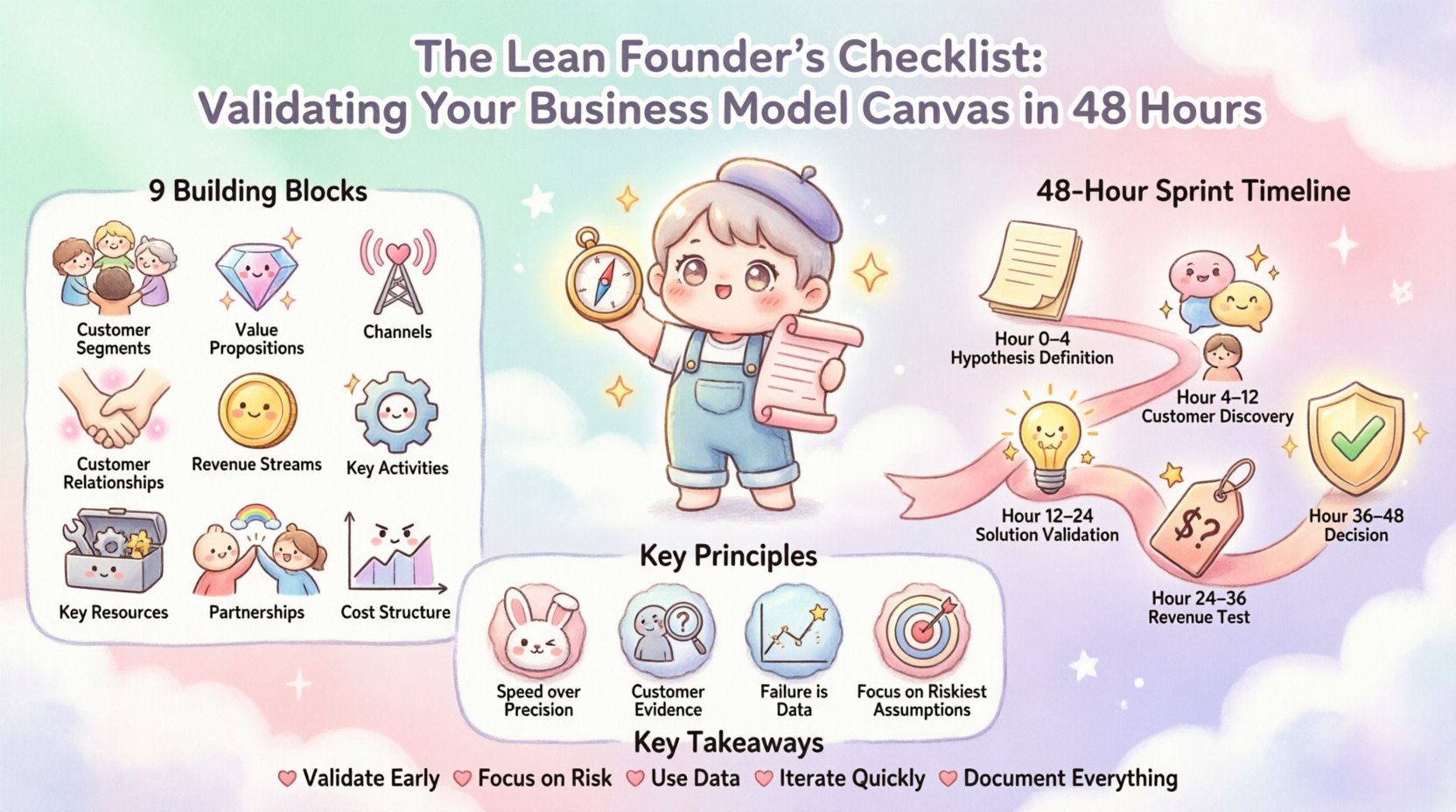
Key principles for this sprint:
- Speed over precision: A fast, imperfect test is better than a slow, perfect analysis.
- Customer evidence: Opinions are cheap. Commitments and money are valuable.
- Failure is data: A failed hypothesis is not a waste. It is a pivot point.
- Focus on the riskiest assumptions: Do not validate everything at once. Target the critical path.
Deconstructing the Nine Building Blocks 🔍
The BMC consists of nine strategic levers. Each lever represents a hypothesis about how your business creates, delivers, and captures value. To validate the canvas, you must stress-test each section.
1. Customer Segments 👥
Who are you creating value for? Which needs are you satisfying? Which customers will pay for your product?
- Validation Question: Do these people actively seek a solution for this problem?
- Method: Direct interviews with individuals who fit the profile.
2. Value Propositions 💎
What value do you deliver? Which problem are you solving? What bundle of products and services are you offering?
- Validation Question: Is this problem painful enough that they will switch solutions to solve it?
- Method: Problem-first interviews. Do not mention your solution yet.
3. Channels 📡
Through which customer segments do you want to reach and communicate with? Which channels work best? Which are most cost-effective?
- Validation Question: Where do these customers currently look for information or products?
- Method: Observing customer behavior in existing marketplaces or forums.
4. Customer Relationships 🤝
What type of relationship does each customer segment expect? Personal assistance? Automated services? Community-driven?
- Validation Question: How do they prefer to interact with a brand?
- Method: Surveying existing communities or analyzing competitor reviews.
5. Revenue Streams 💰
For what value are customers really willing to pay? Do they currently pay? How are they currently paying? How would they prefer to pay?
- Validation Question: Would they pay today if the solution existed?
- Method: Landing page tests, pre-orders, or Letters of Intent (LOI).
6. Key Resources 🏗️
What key resources do your value propositions require? Physical, intellectual, human, or financial assets?
- Validation Question: Can you access these resources within your budget?
- Method: Feasibility checks with potential partners or suppliers.
7. Key Activities ⚙️
What key activities do your value propositions require? Production, problem-solving, platform management?
- Validation Question: Are these activities scalable?
- Method: Process mapping and cost estimation.
8. Key Partnerships 🤝
Who are your key suppliers and partners? Which key resources are we acquiring from partners? Which key activities do partners perform?
- Validation Question: Are partners motivated to work with you?
- Method: Cold outreach and partnership feasibility calls.
9. Cost Structure 📉
What are the most important costs inherent in your business model? Which key resources/activities are most expensive?
- Validation Question: Is the cost of acquisition lower than the lifetime value?
- Method: Financial modeling based on market rates.
The 48-Hour Validation Sprint Schedule 📅
Time is your most scarce resource. The following schedule allocates specific blocks of time to specific validation tasks. Adherence to this timeline is crucial.
| Time Block | Focus Area | Primary Action | Success Metric |
|---|---|---|---|
| Hour 0-4 | Hypothesis Definition | Map assumptions to the 9 blocks | 10 clear assumptions documented |
| Hour 4-12 | Customer Discovery | Conduct 10 problem interviews | 5 interviews completed, pain points verified |
| Hour 12-24 | Solution Validation | Present concept, gauge interest | 30% express strong interest |
| Hour 24-36 | Revenue & Cost Test | Pricing experiments, cost estimates | Willingness to pay confirmed |
| Hour 36-48 | Synthesis & Decision | Review data, determine pivot or proceed | Go/No-Go decision made |
Phase 1: Hypothesis Definition (Hours 0-4) 📝
Before you speak to anyone, you must know what you are looking for. Write down your initial Business Model Canvas. Then, convert every block into a falsifiable hypothesis.
A hypothesis is a statement that can be proven true or false. It should follow the format: “We believe that [customer segment] has a [problem] that can be solved by [solution] and will pay [price].”
Actionable Steps:
- Draw the canvas on paper or a digital whiteboard.
- Identify the riskiest block. This is usually the Value Proposition or Revenue Stream.
- List the top 5 assumptions per block.
- Prioritize assumptions based on risk. High risk = High priority.
Example Hypothesis:
- Assumption: Freelancers need a tool to automate tax estimates.
- Test: Ask 10 freelancers if they currently estimate taxes manually and if they spend more than 1 hour a month doing it.
Phase 2: Customer Discovery (Hours 4-12) 🗣️
This is the most critical phase. You are going out to talk to potential customers. The goal is to uncover the problem, not to sell the solution.
Interview Guidelines:
- Keep it open-ended: Ask “How do you currently handle X?” instead of “Do you like X?”
- Listen for emotion: Frustration indicates a real problem.
- Watch for workarounds: If they are using a spreadsheet to solve a complex problem, that is a sign of demand.
- Don’t lead: Avoid suggesting features or benefits.
Target Audience:
- Aim for 10 to 15 interviews in this block.
- Do not interview friends or family. They are biased.
- Recruit from industry forums, social media groups, or professional networks.
Key Questions to Ask:
- Walk me through how you currently solve this.
- How much time does this take you?
- How much money does this problem cost you?
- What tools are you using right now?
- What is the most annoying part of this process?
Phase 3: Solution Validation (Hours 12-24) 🎯
Now that you understand the problem, you introduce your concept. This does not mean you have built the product. It means you have a description, a mockup, or a prototype.
The Smoke Test:
Create a landing page that describes the value proposition. Include a call to action, such as “Join Waitlist” or “Reserve Early Access.” Do not ask for credit card details yet. Ask for an email address.
Conversion Metrics:
- Click-Through Rate (CTR): Are people clicking from your ads or links?
- Sign-up Rate: Are people willing to give their contact info?
- Engagement: Are they reading the content deeply?
Interpretation:
- If conversion is below 10%, your value proposition is unclear or unappealing.
- If conversion is above 20%, you have strong interest.
- Follow up with every sign-up. Ask them why they signed up.
Phase 4: Revenue & Cost Validation (Hours 24-36) 💳
Interest is not revenue. You need to know if the economics work. This phase tests the financial viability of the model.
Willingness to Pay:
Ask directly. “If this product existed today, would you buy it for $X?”
- If they say yes, ask for a deposit. A deposit proves intent.
- If they hesitate, ask what price point would make it a no-brainer.
Cost Estimation:
Calculate the Cost of Customer Acquisition (CAC) and Lifetime Value (LTV).
- CAC: How much marketing spend do you need to get one paying customer?
- LTV: How much will that customer pay over time?
- Rule: LTV must be greater than CAC (ideally 3:1).
Unit Economics:
Determine the variable costs per unit. Include hosting, payment processing, support, and content creation.
- Ensure margins are healthy enough to sustain growth.
- Identify fixed costs that will scale with the business.
Phase 5: Synthesis & Decision (Hours 36-48) 🧠
You now have data. The final step is to interpret it and decide on the next move. This is the moment of truth.
Review the Data:
- Compare your hypotheses against the evidence collected.
- Identify which blocks of the BMC are validated and which are disproven.
- Look for patterns in the customer interviews.
Decision Matrix:
| Result | Action | Example |
|---|---|---|
| All Hypotheses Validated | Proceed to Development | Build MVP, allocate budget. |
| Value Prop Valid, Channels Weak | Pivot Channels | Change marketing strategy. |
| Problem Not Real | Pivot or Kill | Find a new problem to solve. |
| Pricing Too Low | Adjust Pricing Model | Test higher price points. |
Documentation:
Write a summary report. Include the original hypotheses, the data collected, the insights gained, and the final decision. This document serves as a baseline for future iterations.
Common Pitfalls to Avoid ⚠️
Even with a structured plan, founders often stumble. Here are common mistakes to watch out for during the sprint.
1. Falling in Love with the Solution
When you are the founder, you see the potential in your idea. You must detach your ego from the outcome. Treat the business model as a scientific experiment.
2. Asking Leading Questions
Don’t ask “Would you buy this?” because people want to be polite. Ask “What do you do now?” and “How much does that cost you?”
3. Ignoring Negative Feedback
It is easy to focus on the people who liked the idea. Pay more attention to the people who said no. They are telling you what is wrong.
4. Overestimating Time
You will find it harder to find interviewees than expected. Schedule buffer time. Do not let a lack of data stop the clock.
5. Skipping the Cost Analysis
A great idea with bad economics is a hobby, not a business. Ensure the unit economics work before scaling.
Final Thoughts on Sustainable Validation 🔁
Validation is not a one-time event. It is a continuous cycle. The 48-hour sprint is a starting point. As you build the product, you will validate further. As you scale, you will validate again.
The Business Model Canvas is a living document. It should change as you learn. The value of this process is not just in the checklist, but in the mindset shift. You are no longer guessing. You are testing.
Keep the canvas updated. Keep the data fresh. Keep the feedback loop tight. This is how sustainable businesses are built.
Key Takeaways 📌
- Validate early: Do not build until you know people want it.
- Focus on risk: Test the most dangerous assumptions first.
- Use data: Decisions should be based on evidence, not intuition.
- Iterate quickly: If the data says no, change course immediately.
- Document everything: Learning is valuable only if it is recorded.
By following this structured approach, you increase your chances of building a business that solves real problems for real people. The 48-hour sprint is a catalyst for clarity. Use it wisely.
Related posts:
 B2B vs. B2C: How the Business Model Canvas Shifts for Tech Founders
 The 7 Hidden Levers in Your Business Model Canvas That Kill Startups Early
 Stop Guessing Revenue: A Component Breakdown of the Business Model Canvas for SaaS
 From Idea to IPO: A Comprehensive Walkthrough of the Business Model Canvas for First-Time Entrepreneurs