


Building a technology company requires more than just a functional product. It demands a clear understanding of how value is created, delivered, and captured. For founders, the Business Model Canvas (BMC) serves as a foundational blueprint. However, the shift between Business-to-Business (B2B) and Business-to-Consumer (B2C) models represents a fundamental change in strategy, operations, and customer dynamics.
Tech founders often struggle with this distinction. A product that succeeds in a consumer app may fail in an enterprise environment due to differences in decision-making processes, pricing structures, and support requirements. This guide breaks down how each of the nine building blocks of the Business Model Canvas shifts when moving from B2C to B2B. We will explore the nuances of customer segments, value propositions, channels, and revenue streams without relying on buzzwords or generic advice.
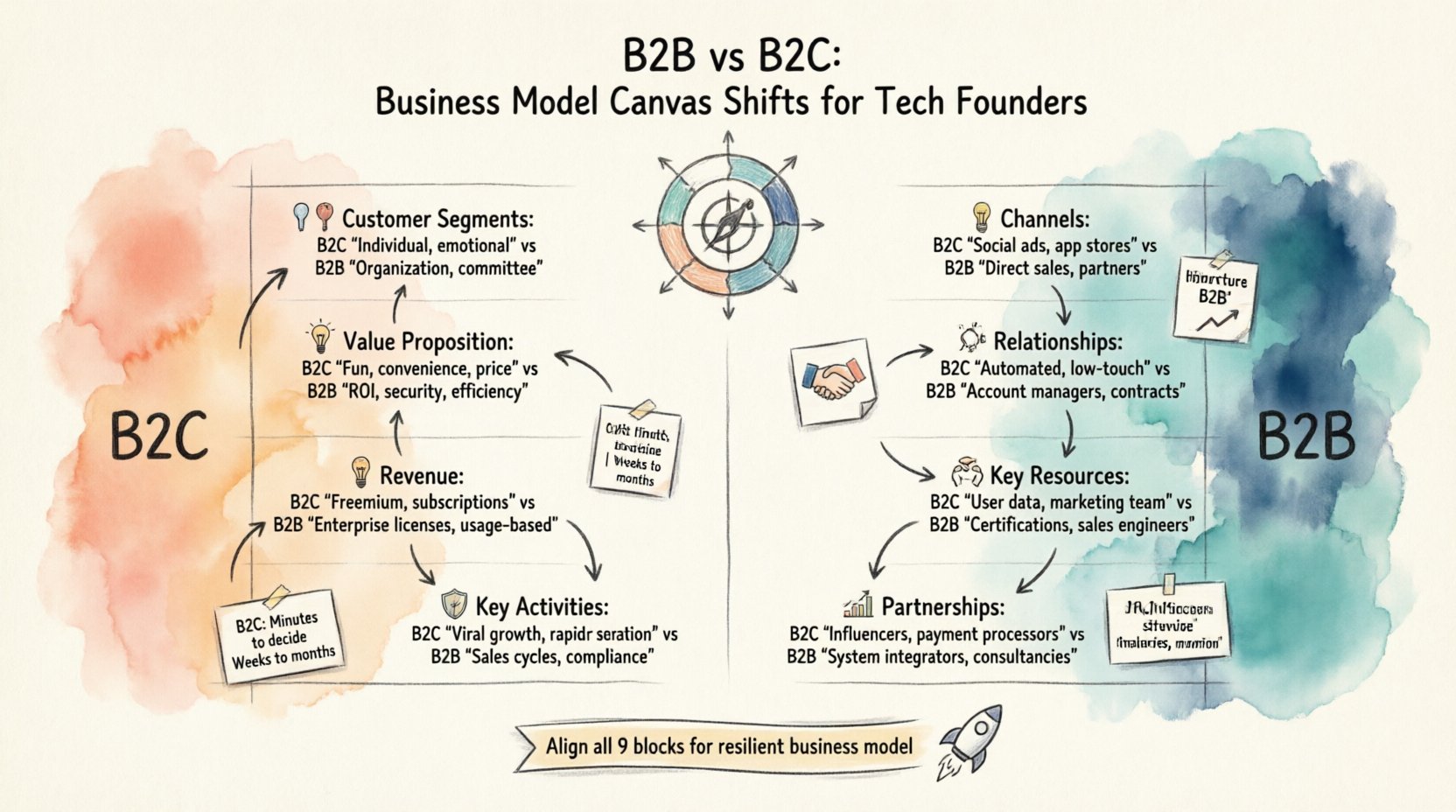
Understanding the Framework 🧩
The Business Model Canvas is a strategic management template used for developing new or documenting existing business models. It consists of four main areas: customers, infrastructure, offerings, and financial viability. Each block contains specific building blocks that define the mechanics of the business.
When a tech founder pivots from a B2C focus to B2B, or vice versa, the underlying assumptions change. What works for a mass market of individual users does not translate to a niche of organizational buyers. The following sections analyze these shifts in detail.
1. Customer Segments 👥
The Customer Segments block defines the different groups of people or organizations an enterprise aims to reach and serve. The nature of the buyer dictates the entire downstream strategy.
B2C Customer Segments
- Mass Market: The goal is to serve a wide audience. Examples include social media apps or e-commerce platforms.
- Niche Market: Focused on a specific group with distinct needs, such as fitness trackers for runners.
- Individual Decision Makers: The person using the product is usually the person paying for it. Decisions are often emotional or convenience-driven.
B2B Customer Segments
- Organizations: Buyers are companies, government bodies, or institutions. The size of the organization dictates the sales cycle length.
- Key Decision Makers: The user is rarely the payer. A committee often approves the purchase. This includes CTOs, CFOs, and procurement officers.
- Integration Requirements: The buyer needs to know how the tool fits into their existing tech stack.
Shift Insight: In B2C, you market to the individual. In B2B, you market to the organization and its specific pain points. The persona changes from “Sarah, the consumer” to “The IT Department at Acme Corp”.
2. Value Propositions 🎁
The Value Proposition describes the bundle of products and services that create value for a specific Customer Segment. It solves a problem or satisfies a need.
B2C Value Propositions
- Emotional Benefit: How does it make the user feel? (e.g., connected, entertained, secure).
- Price Sensitivity: Consumers often look for the best deal or a free tier.
- Speed to Value: The user expects immediate gratification. Onboarding must be frictionless.
- Feature Richness: Features should be intuitive without training.
B2B Value Propositions
- ROI Focus: The value is calculated in terms of efficiency gains, cost reduction, or revenue increase.
- Reliability & Security: Downtime is unacceptable. Data privacy is non-negotiable.
- Scalability: The solution must grow with the organization.
- Support & Service: High-touch support is often part of the value, not an add-on.
Shift Insight: B2C sells a dream or a lifestyle. B2B sells a solution to a business risk or an operational inefficiency. The language shifts from “fun” to “efficient”.
3. Channels 📢
Channels are how a company communicates with and reaches its Customer Segments to deliver a Value Proposition. This includes both customer touchpoints and distribution.
B2C Channels
- Digital Marketing: Social media ads, search engine marketing, and influencer partnerships.
- App Stores: Direct download from iOS or Android stores.
- Viral Loops: Referral programs where users invite other users.
- Direct-to-Consumer: Selling directly via a website without intermediaries.
B2B Channels
- Direct Sales: A team of account executives manages relationships with high-value clients.
- Partner Networks: Resellers, system integrators, and implementation partners.
- Content Marketing: Whitepapers, case studies, and webinars that demonstrate expertise.
- Trade Shows: Physical or virtual industry events for networking and lead generation.
Shift Insight: B2C relies on scale and automation. B2B relies on relationships and trust-building. One requires a megaphone; the other requires a handshake.
4. Customer Relationships 🤝
This block describes the types of relationships a company establishes with specific Customer Segments. It is crucial for customer acquisition, retention, and growth.
B2C Relationships
- Automated: Chatbots, email newsletters, and self-service portals.
- Personal Assistance: Available support lines for troubleshooting.
- Community: Building a user base where members interact with each other.
- Low Touch: Minimal interaction required to maintain the subscription.
B2B Relationships
- Personal Account Management: Dedicated managers ensure client satisfaction.
- Co-Creation: Working closely with clients to customize the product.
- Contractual: Agreements define service levels and uptime guarantees.
- Long-Term: Retention is prioritized over new acquisition due to high acquisition costs.
Shift Insight: In B2C, you fight churn with engagement. In B2B, you fight churn with service quality and contract renewal.
5. Revenue Streams 💰
Revenue Streams represent the cash a company generates from each Customer Segment. This block is often the most visible difference between models.
B2C Revenue Models
- Subscription: Monthly or annual fees (SaaS).
- Transaction Fees: A percentage of each sale processed.
- Freemium: Basic features are free; premium features cost money.
- Advertising: Revenue comes from third-party advertisers targeting users.
B2B Revenue Models
- Enterprise Licensing: Annual contracts based on user count or volume.
- Usage-Based: Billing based on API calls, storage, or compute time.
- Professional Services: Charging for implementation, training, and consulting.
- Support Packages: Tiered levels of technical support sold separately.
Shift Insight: B2C pricing is often transparent and immediate. B2B pricing is often negotiated and invoiced with net-30 or net-60 terms.
6. Key Resources 🛠️
Key Resources are the most important assets required to make a business model work. They enable the creation of value and the operation of the business.
B2C Resources
- Intellectual Property: Algorithms, code, and brand design.
- Human Resources: Marketing teams, customer support staff, and developers.
- Physical Infrastructure: Servers and data centers (often cloud-based).
- User Data: Understanding user behavior to improve the product.
B2B Resources
- Specialized Talent: Sales engineers, solutions architects, and account managers.
- Security Certifications: SOC 2, ISO 27001, and compliance documentation.
- API Documentation: Comprehensive guides for integration.
- Reputation: Trust is a resource that takes years to build.
Shift Insight: B2C resources focus on scaling user acquisition. B2B resources focus on scalability of delivery and trust verification.
7. Key Activities 🚀
Key Activities are the most important things a company must do to make its business model work. These vary significantly based on the model type.
B2C Activities
- Marketing & Advertising: Heavy investment in customer acquisition.
- Product Development: Rapid iteration based on user feedback.
- Platform Management: Ensuring uptime and performance for millions of users.
- Community Management: Engaging users on social platforms.
B2B Activities
- Sales & Negotiation: Managing complex deal cycles.
- Customer Success: Ensuring clients achieve their goals with the product.
- Integration Services: Helping clients connect the product to their systems.
- Compliance Management: Keeping up with regulatory changes.
Shift Insight: B2C activities are volume-driven. B2B activities are relationship-driven.
8. Key Partnerships 🤝
Key Partners are the network of suppliers and partners that make the business model work. They help optimize operations, reduce risk, or acquire resources.
B2C Partnerships
- App Stores: Apple App Store, Google Play Store.
- Payment Processors: Handling credit card transactions.
- Influencers: Promoting the brand to their followers.
- Cloud Providers: AWS, Azure, or Google Cloud for hosting.
B2B Partnerships
- System Integrators: Firms that implement the software for clients.
- Channel Resellers: Companies that sell the software as part of a larger package.
- Technology Alliances: Partnerships with other tech firms for API interoperability.
- Consultancies: Firms that recommend the solution to enterprises.
Shift Insight: B2C partnerships are transactional. B2B partnerships are often strategic alliances.
9. Cost Structure 💸
The Cost Structure describes all costs incurred to operate a business model. It is driven by the Key Activities, Resources, and Partnerships.
B2C Cost Structure
- Customer Acquisition Cost (CAC): High spending on ads and marketing.
- Server Costs: Scaling infrastructure for peak traffic.
- Customer Support: High volume, low cost per interaction.
- Payment Processing Fees: Costs associated with handling transactions.
B2B Cost Structure
- Sales Salaries: High commissions and salaries for account executives.
- Implementation Costs: Time spent onboarding and configuring for clients.
- Compliance & Security: Audits and security certifications.
- Account Management: Dedicated teams for key accounts.
Shift Insight: B2C costs are front-loaded in marketing. B2B costs are spread across the sales cycle and support.
Side-by-Side Comparison 📊
To visualize the differences, consider the following table summarizing the shifts across the Business Model Canvas.
| Building Block | B2C Focus | B2B Focus |
|---|---|---|
| Customer | Individual, emotional buyer | Organization, rational buyer |
| Decision Cycle | Minutes to Days | Weeks to Months |
| Value Prop | Convenience, Fun, Price | Efficiency, Security, ROI |
| Channel | Online Ads, App Stores | Direct Sales, Partners |
| Revenue | Volume, Low Ticket | Contracts, High Ticket |
| Support | Self-Service, Automation | Dedicated, High-Touch |
Strategic Implications for Tech Founders 🚀
Understanding these shifts is critical for resource allocation. Founders often fail because they apply B2C tactics to B2B problems or vice versa. Here are three critical implications.
1. Sales Cycle Length
In B2C, you expect immediate conversion. In B2B, you must budget for a long sales cycle. This affects cash flow management significantly. You need enough runway to sustain operations while waiting for contracts to sign.
2. Pricing Strategy
B2C pricing is often fixed and visible. B2B pricing is often hidden and negotiable. Founders must be prepared to discount for volume or strategic partnerships. Transparency is less valued than value.
3. Product Roadmap
B2C products evolve based on trends and user feedback. B2B products evolve based on client requirements and market regulations. The roadmap must accommodate enterprise-grade features like single sign-on (SSO) and audit logs.
Common Pitfalls to Avoid ⚠️
Even experienced founders stumble when crossing the boundary between these models. Identifying these pitfalls early can save significant time and capital.
- Assuming Product-Market Fit is Universal: A product that fits a consumer market may not fit an enterprise environment due to security or integration needs.
- Underestimating Support Costs: B2B customers expect more support than B2C customers. This can erode margins if not priced correctly.
- Ignoring Compliance: Enterprise buyers require compliance with standards like GDPR, HIPAA, or SOC 2. Consumer buyers rarely care about these specifics.
- Over-Engineering: B2C users want simplicity. B2B users want control. Trying to satisfy both with one interface often results in a product that satisfies neither.
Final Thoughts on Model Selection 🏁
Choosing between B2B and B2B is not just a marketing decision; it is a fundamental operational choice. It dictates how you hire, how you build, and how you survive. The Business Model Canvas provides the structure to map these decisions clearly.
For tech founders, the path forward involves honest assessment of your resources and your market. Do not force a B2C strategy into a B2B box, or expect B2B pricing to work in a consumer app. The canvas shifts. The strategy must shift with it.
Success comes from aligning the nine blocks. When the value proposition matches the customer segment, and the channels match the buying behavior, the business model becomes resilient. This alignment is the difference between a feature and a company.
Related posts:
 The 7 Hidden Levers in Your Business Model Canvas That Kill Startups Early
 Stop Guessing Revenue: A Component Breakdown of the Business Model Canvas for SaaS
 From Idea to IPO: A Comprehensive Walkthrough of the Business Model Canvas for First-Time Entrepreneurs
 The Lean Founder’s Checklist: Validating Your Business Model Canvas in 48 Hours