Building software that works is a significant achievement. Building software that grows without breaking is a true engineering feat. For junior developers, the transition from writing individual functions to designing entire systems marks a pivotal moment in professional growth. This journey requires a shift in mindset, moving from solving immediate problems to anticipating future challenges.
This guide focuses on Object-Oriented Analysis and Design (OOAD) principles specifically tailored for creating scalable architectures. We will explore the foundational concepts that allow systems to handle increased load, complexity, and change over time. By understanding these core mechanics, you can construct robust solutions that stand the test of time without relying on specific tools or frameworks.
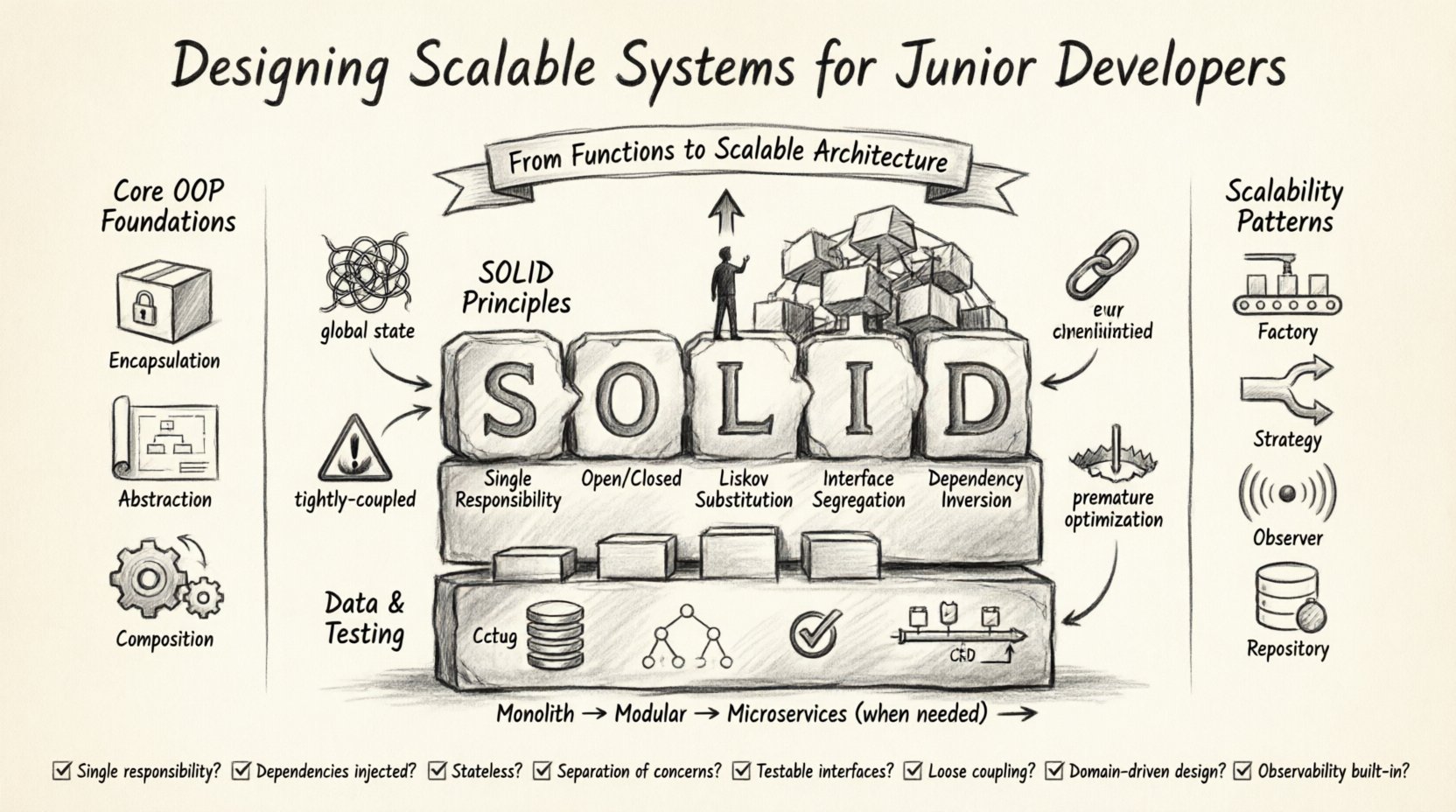
📐 Understanding Scalability in Object-Oriented Contexts
Scalability is often misunderstood as simply making things faster. In reality, it is the ability of a system to handle a growing amount of work by adding resources. In the context of Object-Oriented Analysis and Design, scalability is about structure. It is about how your classes interact, how data flows, and how components can be replicated or modified without causing systemic failure.
When designing for scale, you must consider three primary dimensions:
- Vertical Scaling: Increasing the capacity of a single component. This is often limited by hardware constraints.
- Horizontal Scaling: Adding more instances of a component. This requires stateless design and effective distribution of work.
- Elasticity: The system’s ability to automatically adjust resources based on demand.
For a junior developer, focusing on horizontal scalability is crucial because it reduces the risk of single points of failure. However, achieving this requires a solid foundation in OOAD. Without clear boundaries between objects, adding more instances becomes a nightmare of synchronization and data inconsistency.
🏗️ Core Object-Oriented Principles for Structure
Before diving into complex patterns, one must master the basics of object-oriented design. These principles ensure that your codebase remains manageable as it grows. A scalable system is not just about speed; it is about maintainability and extensibility.
1. Encapsulation and Data Hiding
Encapsulation protects the internal state of an object. By restricting direct access to some of an object’s components, you prevent external code from interfering with its internal workings. This is vital for scalability because it allows you to change the internal implementation of a class without breaking the rest of the system. If every class exposes its data, any change requires a global update, which is impossible at scale.
2. Abstraction
Abstraction allows you to define what an object does without defining how it does it. This decouples the consumer of the object from the implementation details. When designing scalable systems, you want to define interfaces that represent capabilities rather than specific actions. This flexibility allows you to swap out implementations (e.g., changing a database storage mechanism) without altering the higher-level logic.
3. Inheritance and Polymorphism
These mechanisms allow for code reuse and dynamic behavior. However, they must be used judiciously. Deep inheritance hierarchies can become brittle and difficult to maintain. A scalable design often favors composition over inheritance. By composing smaller, specialized objects, you gain flexibility. Polymorphism ensures that different objects can be treated uniformly, allowing you to swap components dynamically during runtime.
⚖️ The SOLID Principles: A Framework for Stability
The SOLID principles are a set of five design guidelines intended to make software designs more understandable, flexible, and maintainable. Adhering to these rules is essential when building systems that need to scale.
- S – Single Responsibility Principle (SRP): A class should have only one reason to change. If a class handles both database connections and business logic, a change in the database driver might break the business logic. Splitting these concerns isolates risk.
- O – Open/Closed Principle (OCP): Software entities should be open for extension but closed for modification. You should be able to add new features without rewriting existing code. This is achieved through interfaces and abstract classes.
- L – Liskov Substitution Principle (LSP): Objects of a superclass should be replaceable with objects of its subclasses without breaking the application. This ensures that inheritance hierarchies are safe and predictable.
- I – Interface Segregation Principle (ISP): Clients should not be forced to depend on methods they do not use. Large, monolithic interfaces are hard to implement and maintain. Small, specific interfaces are easier to adapt to changing requirements.
- D – Dependency Inversion Principle (DIP): High-level modules should not depend on low-level modules. Both should depend on abstractions. This reduces coupling and makes testing easier, which is critical for large systems.
Why SOLID Matters for Scalability
When a system grows, the number of interactions between components increases exponentially. SOLID principles act as a governance mechanism. They ensure that changes in one part of the system do not cascade destructively through others. For example, Dependency Inversion allows you to mock components during testing, ensuring that new features do not introduce regressions in old code.
🧩 Architectural Patterns for Growth
Patterns provide proven solutions to common problems. While they should not be applied blindly, understanding them helps in structuring a system for scale. Here are key patterns relevant to scalable architecture.
1. The Factory Pattern
Factories handle object creation. In a scalable system, you often need to create complex objects based on configuration or runtime data. A factory encapsulates this logic, allowing you to swap out how objects are created without changing the code that uses them. This is useful when scaling specific components that require different initialization logic.
2. The Strategy Pattern
This pattern defines a family of algorithms, encapsulates each one, and makes them interchangeable. It allows the algorithm to vary independently from the clients that use it. For scalability, this is useful when you need to switch between different processing methods based on load. For instance, one strategy could handle simple requests, while another handles heavy computation.
3. The Observer Pattern
Observer defines a one-to-many dependency between objects. When one object changes state, all its dependents are notified and updated automatically. This is fundamental for event-driven architectures, which are essential for handling high-throughput systems. Instead of direct polling, components react to events, reducing latency and resource usage.
4. The Repository Pattern
Repositories abstract the data access layer. They provide an interface to retrieve and save data without exposing the underlying database or storage technology. This abstraction allows you to scale the storage layer independently from the business logic. If you need to move from a file system to a distributed database, you only update the repository implementation.
| Pattern | Primary Use Case | Impact on Scalability |
|---|---|---|
| Factory | Complex object creation | Centralizes initialization logic, reducing duplication |
| Strategy | Algorithm interchangeability | Allows dynamic switching of processing methods |
| Observer | Event notification | Enables decoupled, asynchronous processing |
| Repository | Data access abstraction | Decouples business logic from storage mechanics |
🗄️ Data Management and Storage Strategies
Data is often the bottleneck in scalable systems. How you model your data directly impacts performance. Object-Oriented Analysis must extend to how objects persist.
1. Normalization vs. Denormalization
Normalization organizes data to reduce redundancy. It is excellent for data integrity. However, in high-scale systems, joining multiple tables can become a performance killer. Denormalization introduces redundancy to speed up read operations. A scalable design often strikes a balance. Critical, frequently accessed data might be denormalized, while reference data remains normalized.
2. Indexing and Query Optimization
Even with perfect object design, poor data access will kill performance. Understanding how data is indexed is crucial. You should design your objects with the queries in mind. If a specific attribute is used for filtering often, ensure the underlying storage supports efficient indexing on that attribute.
3. Caching Strategies
Caching stores copies of data in faster storage to reduce access time. In OOAD, you can design specific “Cache” objects that manage this logic. The system should know when data is stale and when to refresh it. Implementing a cache invalidation strategy is more important than the caching mechanism itself. Without it, stale data can lead to logical errors.
🧪 Testing and Maintenance in Scalable Systems
As systems grow, the cost of regression increases. Testing is not just a phase; it is a design principle. A scalable system must be testable. If you cannot test a component in isolation, it is likely too tightly coupled.
1. Unit Testing
Unit tests verify the behavior of individual classes. They should run fast and be deterministic. Relying on unit tests gives you the confidence to refactor code, which is necessary when scaling. If you fear changing a class, you will not scale it.
2. Integration Testing
Integration tests verify how different components work together. In a scalable architecture, components often communicate over a network. Testing these interactions ensures that the system behaves correctly under load. Mocking external dependencies allows you to simulate high traffic without needing the actual infrastructure.
3. Continuous Integration
Automating the build and test process ensures that new code does not break existing functionality. This feedback loop is essential for maintaining code quality as the team grows. It prevents technical debt from accumulating.
🚫 Common Pitfalls to Avoid
Even experienced developers make mistakes when designing for scale. Recognizing these patterns early can save significant time and resources.
- Global State: Using global variables creates hidden dependencies. Different parts of the system may change the state unexpectedly, leading to race conditions.
- Tight Coupling: When classes know too much about each other’s internal details, changing one breaks the other. Use interfaces to define relationships.
- Premature Optimization: Do not optimize for scale before you have a problem. Focus on writing clean, maintainable code first. Optimize only when metrics indicate a bottleneck.
- Hardcoding: Avoid putting configuration values directly in the code. Use configuration management to allow the system to adapt to different environments.
- Ignoring Concurrency: If multiple users access the system simultaneously, ensure your objects handle concurrent access safely. Use locks or immutable objects where appropriate.
📋 A Scalability Checklist for Developers
Before deploying a new feature or module, run through this checklist to ensure it aligns with scalability principles.
- ✅ Does the class have a single responsibility?
- ✅ Are dependencies injected rather than created internally?
- ✅ Can this component be replaced without affecting others?
- ✅ Is the data access layer abstracted from the business logic?
- ✅ Are there unit tests for all public methods?
- ✅ Is the component stateless, allowing horizontal replication?
- ✅ Are error handling and logging consistent across the module?
- ✅ Have you considered how this component behaves under high load?
🔄 Evolution of Architecture
Designing for scale is not a one-time task. It is an ongoing process. As user demand grows, your architecture must evolve. This evolution is often incremental. You might start with a monolithic structure and move towards microservices as complexity increases. However, do not split services prematurely. A well-structured monolith is often better than a poorly designed distributed system.
The key is to keep the boundaries clear. Define modules based on business domains rather than technical layers. This domain-driven approach ensures that the system aligns with business needs, making it easier to scale specific parts of the business without affecting others.
🛠️ Final Thoughts on Building Robust Systems
Designing scalable systems is a discipline that blends art and engineering. It requires a deep understanding of how objects interact, how data flows, and how resources are consumed. For junior developers, the path forward is not about memorizing patterns but understanding the underlying principles.
Focus on writing clean code. Prioritize readability and maintainability over cleverness. When you design with the future in mind, you build systems that can grow with your users. Remember that scalability is not just about handling more traffic; it is about handling more complexity with ease. By applying Object-Oriented Analysis and Design rigorously, you lay the groundwork for systems that are resilient, efficient, and ready for the future.