In the landscape of software development, the gap between what a business needs and what a system delivers is often where projects fail. This disconnect is rarely about technology; it is about translation. Converting vague business desires into precise technical structures is the art of Object-Oriented Analysis and Design (OOAD). This guide explores the rigorous process of mapping domain concepts to object models, ensuring the final system mirrors the reality it is intended to support. We will move beyond theory and examine the mechanics of building a robust foundation for software architecture.
Understanding Business Requirements 📋
Before a single object can be instantiated, the input must be scrutinized. Business requirements are often narrative, fragmented, and occasionally contradictory. They describe what the system should do, not how it should do it. These requirements come from stakeholders, users, and market analysis. They exist in natural language, filled with domain-specific jargon that developers must decode.
To translate these effectively, one must distinguish between functional and non-functional requirements. Functional requirements define behaviors, such as “The system must calculate tax based on location.” Non-functional requirements define constraints, such as “The system must respond within two seconds.” Both influence the object model, but in different ways.
- Functional Requirements: These drive the methods and behaviors of your objects.
- Non-Functional Requirements: These often dictate performance characteristics, security protocols, and architectural patterns.
- Domain Vocabulary: The specific terms used by the business (e.g., “Invoice,” “Client,” “Order”) are the primary candidates for classes in your model.
Ignoring the nuance in these requirements leads to a model that works technically but fails practically. A requirement like “Manage users” is too vague. Does it mean creating accounts? Resetting passwords? Assigning roles? Each of these actions requires different objects and relationships. Deep analysis is required to decompose these high-level statements into actionable components.
The Core of Object-Oriented Analysis 🏗️
Object-Oriented Analysis (OOA) is the phase where the problem space is understood before the solution space is designed. It focuses on identifying the key concepts within the domain. Unlike procedural analysis, which focuses on functions and data flow, OOA focuses on entities and their interactions. This shift in perspective is critical for systems that need to evolve over time.
When analyzing a domain, the goal is to create a conceptual model that remains stable even as technology changes. Technology stacks change, but the business logic of an insurance company or a logistics firm remains relatively constant. The object model should reflect this stability.
Key principles guide this phase:
- Cohesion: Objects should have a single, well-defined responsibility.
- Coupling: Dependencies between objects should be minimized to allow independent modification.
- Abstraction: Complex details should be hidden behind clean interfaces.
By adhering to these principles, the resulting model becomes a blueprint that is easier to maintain and extend. It serves as a common language between technical teams and business stakeholders, bridging the communication gap.
Step-by-Step Translation Process 🔄
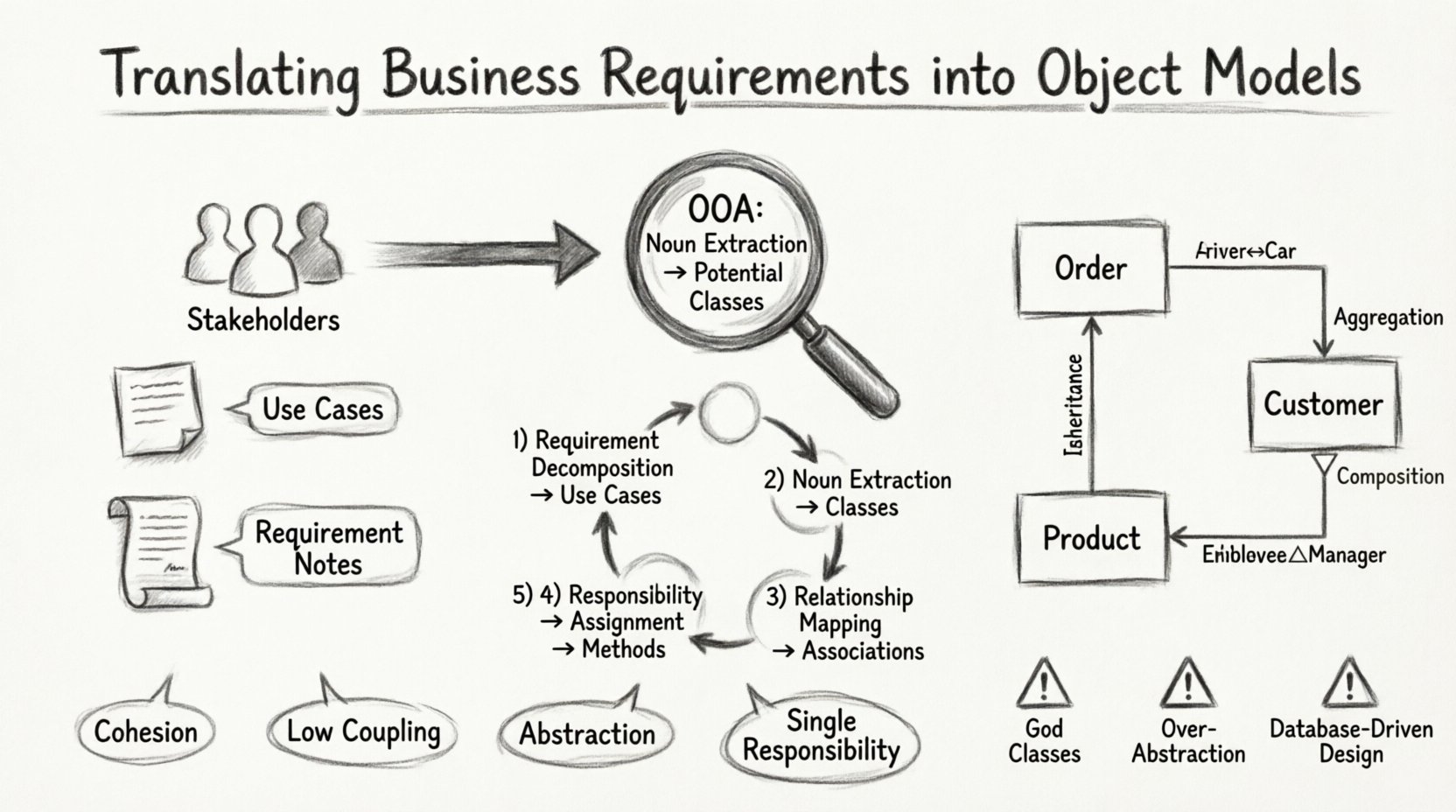
Translating requirements is not a linear path but an iterative cycle. It involves reading, extracting, modeling, and validating. Below is a structured approach to this workflow.
| Step | Activity | Output Artifact |
|---|---|---|
| 1 | Requirement Decomposition | List of Use Cases |
| 2 | Noun Extraction | Potential Classes |
| 3 | Relationship Mapping | Association Lines |
| 4 | Responsibility Assignment | Method Signatures |
| 5 | Validation | Refined Domain Model |
1. Requirement Decomposition
Start by breaking down the high-level requirements into specific scenarios. Use cases are an excellent tool for this. A use case describes a sequence of interactions between an actor (user or system) and the system itself to achieve a goal. For example, “Place Order” is a use case. “Cancel Order” is another. Each use case reveals different aspects of the domain.
2. Noun Extraction
Read the use case descriptions and highlight nouns. These nouns often represent the entities involved in the scenario. If the text says, “The customer selects a product from the catalog,” the nouns are Customer, Product, and Catalog. These become the seeds of your class diagram. However, not every noun is a class. Articles like “the” and prepositions like “from” must be ignored.
3. Relationship Mapping
Once you have potential classes, determine how they interact. Do they depend on each other? Does one own the other? This step defines the structural skeleton. Relationships can be associations, aggregations, or compositions. Understanding the nature of these links is vital for data integrity.
4. Responsibility Assignment
What does each object do? This involves defining methods. If a class is named “Order,” it might have a method called calculateTotal() or updateStatus(). This is where the logic moves from the requirements into the model.
5. Validation
Review the model against the original requirements. Does every requirement have a supporting structure in the model? If a requirement mentions “Discounts,” is there a mechanism in the model to handle them? If not, the model is incomplete.
Identifying Classes and Objects 👥
The heart of the object model is the class. A class is a blueprint for creating objects. It encapsulates data (attributes) and behavior (methods). Identifying the correct classes is a skill that balances granularity with utility.
When deciding if a concept warrants its own class, ask the following questions:
- Does it have a unique identity? A “Color” might not need its own class if it is just a string, but a “ProductColorVariant” might.
- Does it have complex behavior? If a concept requires logic beyond simple data storage, it likely needs a class.
- Does it represent a core domain concept? Core business entities should always be modeled explicitly.
There is a risk of over-engineering. Creating a class for every single noun leads to a fragmented system that is hard to navigate. Conversely, under-engineering leads to “God Objects” that do too much. The goal is a balanced model where each object has a clear purpose.
Value Objects vs. Entities
Distinguishing between Entities and Value Objects is crucial for advanced modeling.
- Entities: Objects defined by their identity. Two objects are the same if their IDs match, regardless of their data. Examples include User accounts or Orders.
- Value Objects: Objects defined by their attributes. Two objects are the same if all their attributes match. Examples include Money, Address, or Date ranges.
Using Value Objects correctly can simplify logic. Instead of storing multiple fields for an address, you encapsulate them in an Address object. This reduces coupling and improves clarity.
Defining Relationships and Associations 🔗
Objects rarely exist in isolation. They exist in a network of relationships. These relationships define how objects collaborate. Misunderstanding relationships is the most common cause of flawed object models.
There are several types of relationships to consider:
- Association: A general structural link. For example, a Teacher teaches Students. This is a many-to-many relationship.
- Aggregation: A “has-a” relationship where the child can exist independently of the parent. For example, a Department has Employees, but Employees can exist without that specific Department.
- Composition: A stronger “has-a” relationship where the child cannot exist without the parent. For example, a House has Rooms. If the House is destroyed, the Rooms cease to exist.
- Inheritance: An “is-a” relationship. A subclass inherits properties from a superclass. Use this sparingly to avoid deep hierarchies that are hard to maintain.
| Relationship Type | Lifetime Dependency | Example |
|---|---|---|
| Association | Independent | Driver ↔ Car |
| Aggregation | Independent | Library ↔ Books |
| Composition | Dependent | Order ↔ OrderItems |
| Inheritance | Dependent | Employee ↔ Manager |
Choosing the right relationship impacts how data is stored and retrieved. Composition implies ownership and lifecycle management. Aggregation implies loose coupling. Associations imply navigation paths. The model must reflect the business reality of these connections.
Attributes, Methods, and Responsibilities ⚙️
Once the structure is defined, the internal details of the objects must be fleshed out. This involves defining what data they hold and what actions they can perform.
Attributes
Attributes are the properties of an object. They should be specific and typed. Avoid storing raw data that requires transformation before use. For instance, store a Date object rather than a string like “01/01/2023”. This allows the system to perform date arithmetic naturally.
Consider privacy and visibility. Some attributes are internal and should not be accessed directly by other objects. Encapsulation protects the integrity of the object. If an attribute must change, it should go through a method that validates the change.
Methods and Responsibilities
Methods are the behaviors. A fundamental rule in Object-Oriented Design is the Single Responsibility Principle. A method should do one thing well. If a method is too long or complex, it likely needs to be split.
Responsibility-driven design is a technique where you assign responsibilities to classes. If a class is responsible for calculating tax, it should have access to the necessary data and the logic to perform the calculation. It should not ask another class to do the calculation for it without a clear interface.
- Information Experts: Give responsibility to the class that has the information.
- Low Coupling: Minimize dependencies between classes.
- High Cohesion: Keep related responsibilities in the same class.
Common Pitfalls to Avoid 🚫
Even experienced architects make mistakes during the modeling phase. Being aware of common traps can save significant time during implementation.
- Transaction Script Pattern in OOAD: Treating the system as a set of procedures rather than interacting objects. This leads to procedural code wrapped in classes.
- Over-Abstraction: Creating generic interfaces that are too broad. This makes the system hard to use because the specific details are hidden too deeply.
- Ignoring Edge Cases: Modeling the happy path but ignoring errors. The model should account for invalid states, such as a negative balance or an expired coupon.
- Database-Driven Design: Designing objects solely based on database tables. The object model should reflect the business domain, not the storage schema. The two can be decoupled.
- God Classes: Classes that know too much and do too much. These become bottlenecks in the system.
Validation and Refinement ✅
Modeling is not a one-time event. It requires continuous refinement as understanding deepens. Validation ensures the model aligns with the requirements.
Techniques for validation include:
- Walkthroughs: Reviewing the model with domain experts. Can they follow the flow of logic?
- Scenario Testing: Running hypothetical scenarios through the model. Does the model support this workflow?
- Code Generation: Using the model to generate skeleton code. Does the code look logical?
Feedback loops are essential. If developers find the model difficult to implement, the abstraction might be too high. If stakeholders find it hard to understand, it might be too technical. The model is a communication tool first and a technical blueprint second.
Final Thoughts on Alignment 🤝
The process of translating business requirements into object models is the foundation of sustainable software. It requires patience, deep analysis, and a commitment to clarity. When the model aligns with the business domain, the code becomes a reflection of the business itself.
Success in this area is measured by maintainability and adaptability. A well-structured object model allows the system to grow with the business. It reduces the cost of change and minimizes the risk of introducing defects. By focusing on the core concepts of the domain and respecting the boundaries of responsibility, architects can build systems that stand the test of time.
Remember that the goal is not just to write code, but to solve problems. The object model is the map that guides the journey from a vague idea to a functioning system. Treat it with the care it deserves, and the resulting software will be robust, clear, and effective.