In the landscape of Object-Oriented Analysis and Design, the creation of objects often dictates the maintainability and flexibility of the entire system. When objects grow in complexity, relying on standard constructors becomes a bottleneck. The Builder Pattern offers a structured approach to managing this complexity, separating the construction of a complex object from its representation. This guide explores the mechanics, benefits, and practical application of this creational design pattern without relying on specific software products or frameworks.
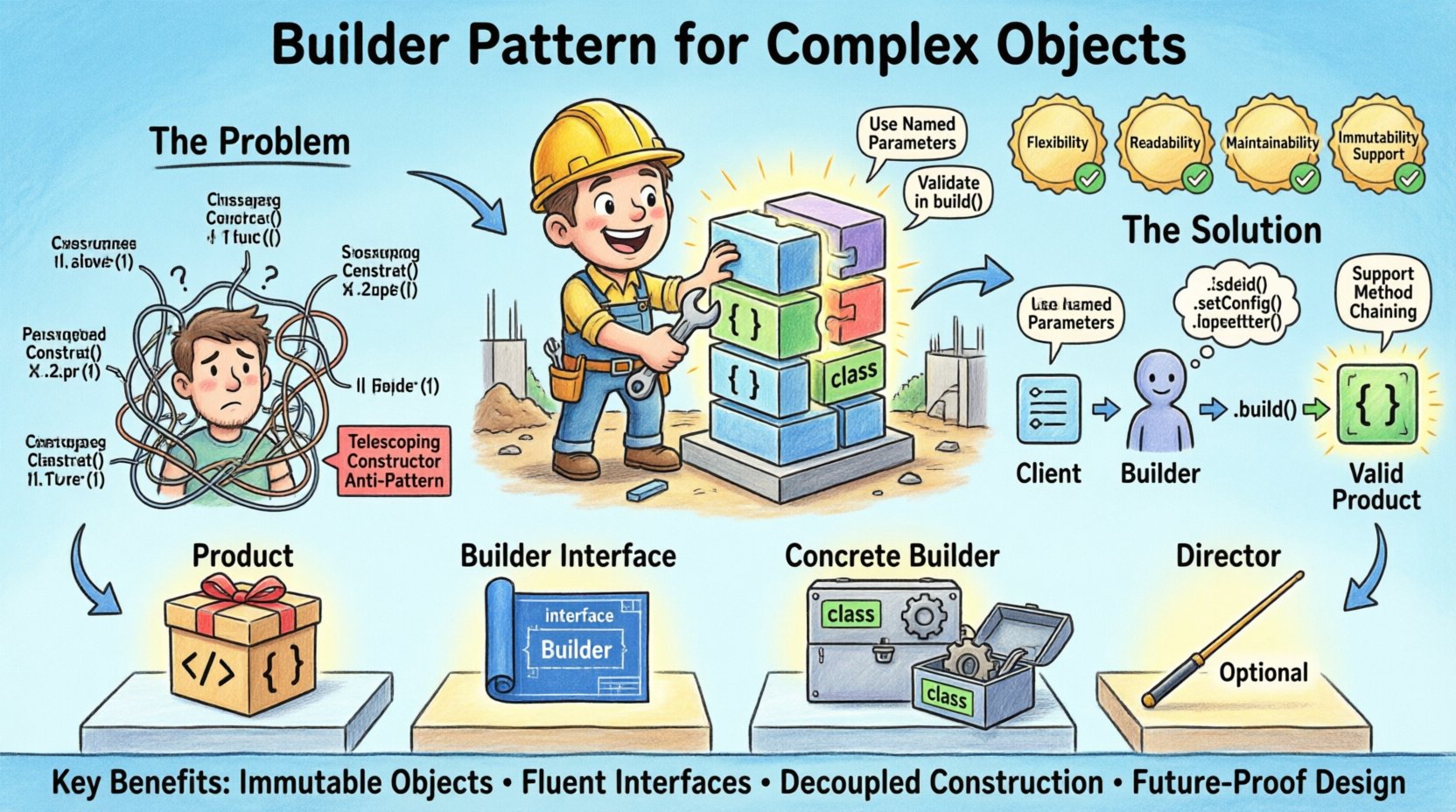
🧩 Understanding the Problem with Complex Construction
Every software system begins with the creation of its fundamental building blocks. In early stages, objects are simple. However, as requirements evolve, objects accumulate attributes, configuration settings, and dependencies. This growth leads to a specific design smell known as the telescoping constructor anti-pattern.
When a class requires many parameters, developers often face a dilemma. They can provide a single constructor with many arguments, but this becomes unreadable and error-prone. Alternatively, they might create multiple overloaded constructors for every combination of parameters. This approach leads to a combinatorial explosion of constructors.
- Readability Issues: A method call with ten arguments is difficult to parse visually.
- Maintainability Burden: Adding a new attribute requires updating every constructor signature.
- Flexibility Limitations: Optional parameters are hard to handle without creating numerous overloaded methods.
Consider a scenario where an object requires a configuration object, a set of optional listeners, a unique identifier, and several boolean flags. Passing these directly in a constructor forces the caller to remember the exact order of arguments. This tight coupling makes the code fragile and difficult to extend.
🔨 Defining the Builder Pattern
The Builder Pattern is a creational design pattern that solves the problem of constructing complex objects step by step. Instead of using a single constructor with a long argument list, the pattern encapsulates the construction logic in a separate builder object. This allows the client to construct the object by calling specific methods on the builder.
The core philosophy is separation of concerns. The object being created (the Product) does not need to know how it is being built. The Builder handles the logic, ensuring that the final object is in a valid state before it is returned.
Key characteristics of this pattern include:
- Encapsulation: The construction logic is hidden inside the builder class.
- Immutability: It is often used to create immutable objects, ensuring thread safety.
- Fluency: Method chaining can be implemented to improve readability.
- Decoupling: The client code is decoupled from the internal structure of the product.
📐 Core Components of the Pattern
To implement this pattern effectively, four primary components are typically involved. Understanding these roles is essential for designing a robust system.
1. The Product
This is the complex object being constructed. It contains the data and logic that the application needs to function. In many implementations, the Product class has a private constructor to prevent instantiation without the Builder, ensuring that only valid objects are created.
2. The Builder (Abstract)
This is an interface or abstract class that defines the methods required to build the Product. It declares the steps necessary to construct the object. By defining a common interface, different concrete builders can be created to produce different types of products or configurations.
3. Concrete Builders
These classes implement the Builder interface. They hold the reference to the Product and maintain the state of the construction process. Each Concrete Builder knows how to set specific attributes of the Product. They also typically contain a method to retrieve the final Product instance.
4. The Director (Optional)
The Director class constructs the complex object by using the Builder interface. It defines the order in which the construction steps occur. While not always necessary, the Director is useful when the construction process is fixed and reused across different parts of the application. It allows the client to avoid knowing the specific details of the construction algorithm.
🚀 Step-by-Step Implementation Logic
Implementing the Builder Pattern involves a specific sequence of steps. This process ensures that the object is created safely and correctly.
- Define the Product: Create the class that represents the final object. Ensure its constructor is private or protected to control instantiation.
- Create the Builder Interface: Define the methods that will set the properties of the Product. These methods should return the Builder itself to support method chaining.
- Implement Concrete Builder: Create a class that implements the interface. Inside, maintain a reference to the Product. Implement the setter methods to update the Product’s state.
- Add a Build Method: Implement a method in the Builder that returns the final Product instance. This is where validation can occur to ensure the object is in a valid state.
- Utilize the Builder: In the client code, instantiate the Builder, call the setter methods with desired values, and finally call the build method.
This flow allows developers to specify only the parameters that are relevant to the current context. Optional parameters can simply be omitted, leaving default values in place.
⚖️ Comparison of Construction Strategies
Choosing the right construction strategy is critical for system architecture. The table below compares the Builder Pattern against other common approaches.
| Strategy | Flexibility | Readability | Maintainability | Immutability Support |
|---|---|---|---|---|
| Telescoping Constructors | Low | Low | Low | Difficult |
| Setter Methods | High | Medium | Medium | Difficult |
| JavaBeans Pattern | High | Low | Medium | Difficult |
| Builder Pattern | High | High | High | Excellent |
The Builder Pattern consistently ranks high in flexibility and maintainability. While Setter Methods offer high flexibility, they often lead to objects in an invalid state during the construction phase. The Builder Pattern allows validation at the moment of construction, ensuring the object is always usable immediately after creation.
🛠️ Best Practices for Object Construction
Adopting the Builder Pattern requires adherence to specific design principles to maximize its effectiveness. These practices ensure that the code remains clean and robust.
- Use Named Parameters: When calling builder methods, use descriptive names. This improves code clarity significantly compared to positional arguments.
- Validate State: Perform validation in the build method. This ensures that required fields are not null and that constraints are met before the object is exposed.
- Support Method Chaining: Return the builder instance from setter methods. This allows for fluent interfaces that are easier to read and write.
- Encapsulate Defaults: If certain attributes have default values, handle them in the builder rather than the product class. This keeps the product class simple.
- Keep Builders Specific: If different types of products are needed, create specific concrete builders. Do not try to build every possible variation in a single generic builder.
🔄 Variations and Extensions
The Builder Pattern is versatile and can be adapted to various scenarios. Understanding these variations helps in applying the pattern correctly.
Immutable Objects
One of the strongest use cases for the Builder Pattern is creating immutable objects. By making the Product class immutable, you ensure that its state cannot change after construction. This is vital for thread-safe applications and functional programming paradigms.
Fluent Interfaces
Fluent interfaces are a direct result of using the Builder Pattern with method chaining. They provide a domain-specific language within the code, making the intent of the construction very clear. This is particularly useful in configuration scenarios or query building.
Abstract Factories
In some cases, the Builder Pattern is combined with the Abstract Factory Pattern. This allows for the creation of families of related objects. The Builder ensures the construction of a single complex object, while the Factory ensures that the product fits within a specific family of compatible objects.
🚫 Common Mistakes to Avoid
Even with a solid understanding of the pattern, developers often introduce inefficiencies. Avoiding these pitfalls is crucial for long-term success.
- Over-Engineering: Do not use the Builder Pattern for simple objects. If an object has only a few parameters, a standard constructor is more efficient and readable.
- Excessive Creators: Creating too many concrete builders can lead to a fragmented codebase. Consolidate builders where the construction logic is similar.
- Ignoring Validation: If the builder allows construction of invalid objects, it defeats the purpose of the pattern. Always validate constraints in the build method.
- Revealing Internal State: Do not expose the internal state of the product during construction. The builder should manage this state privately.
🧠 Theoretical Implications in OOAD
In the context of Object-Oriented Analysis and Design, the Builder Pattern influences how we think about object lifecycles. It shifts the focus from immediate instantiation to a staged construction process. This aligns with the Single Responsibility Principle, as the Builder class has the sole responsibility of constructing the Product.
Furthermore, it supports the Open/Closed Principle. If the construction logic changes, you can modify the Builder without changing the Product class. This reduces the risk of introducing bugs into the core logic of the application.
📊 Performance Considerations
Performance is often a concern when introducing design patterns. The Builder Pattern does add a layer of indirection, as an additional object (the Builder) is created. However, this overhead is typically negligible compared to the benefits of code clarity and safety.
- Memory Usage: The Builder instance exists only during the construction phase. Once the Product is created, the Builder can be garbage collected.
- CPU Overhead: Method calls in a fluent interface are optimized by modern runtimes. The performance difference is rarely a bottleneck in typical application logic.
- Optimization: For high-frequency creation scenarios, ensure that the Builder is not holding onto unnecessary references that prevent memory reclamation.
🔮 Future-Proofing Your Architecture
Using the Builder Pattern prepares your architecture for future changes. As requirements evolve, new attributes may be added to objects. With a standard constructor, adding a new attribute requires changing the signature of the constructor, which breaks existing code. With a Builder, you simply add a new method to the Builder interface.
This extensibility is vital in large-scale systems where backward compatibility is required. Clients can continue to use existing builder methods while newer code utilizes the new methods. This gradual migration path reduces technical debt.
🏁 Summary of Application
The Builder Pattern is a fundamental tool in the arsenal of any software architect dealing with complex object creation. It addresses the limitations of constructors and setters by providing a clean, readable, and safe mechanism for instantiation. By following the guidelines outlined in this guide, developers can create systems that are easier to understand, extend, and maintain.
When faced with a class that has many parameters, optional configurations, or requires strict validation, the Builder Pattern should be the default choice. It transforms a chaotic set of arguments into a structured, logical flow of construction steps. This clarity translates directly to code that is easier to review and less prone to errors.
Adopting this pattern requires discipline, but the return on investment is significant. It promotes immutability, supports fluent interfaces, and decouples construction logic from business logic. As you continue to design object-oriented systems, keep this pattern in mind as a standard solution for complexity.