In the landscape of object-oriented analysis and design, complexity is the primary enemy of maintainability. As systems grow, the number of interactions between components increases exponentially. Developers often find themselves navigating a web of dependencies, calling numerous methods across multiple classes just to perform a single high-level task. This friction slows down development, increases the risk of bugs, and makes the codebase difficult for new team members to understand. The Facade Pattern offers a structured solution to this problem by providing a simplified interface to a complex subsystem.
Understanding the Core Concept 🧠
The Facade Pattern is a structural design pattern that provides a unified interface to a set of interfaces in a subsystem. It defines a higher-level interface that makes the subsystem easier to use. The pattern does not add new functionality to the system; rather, it hides the complexity of the underlying implementation behind a single, cleaner interface.
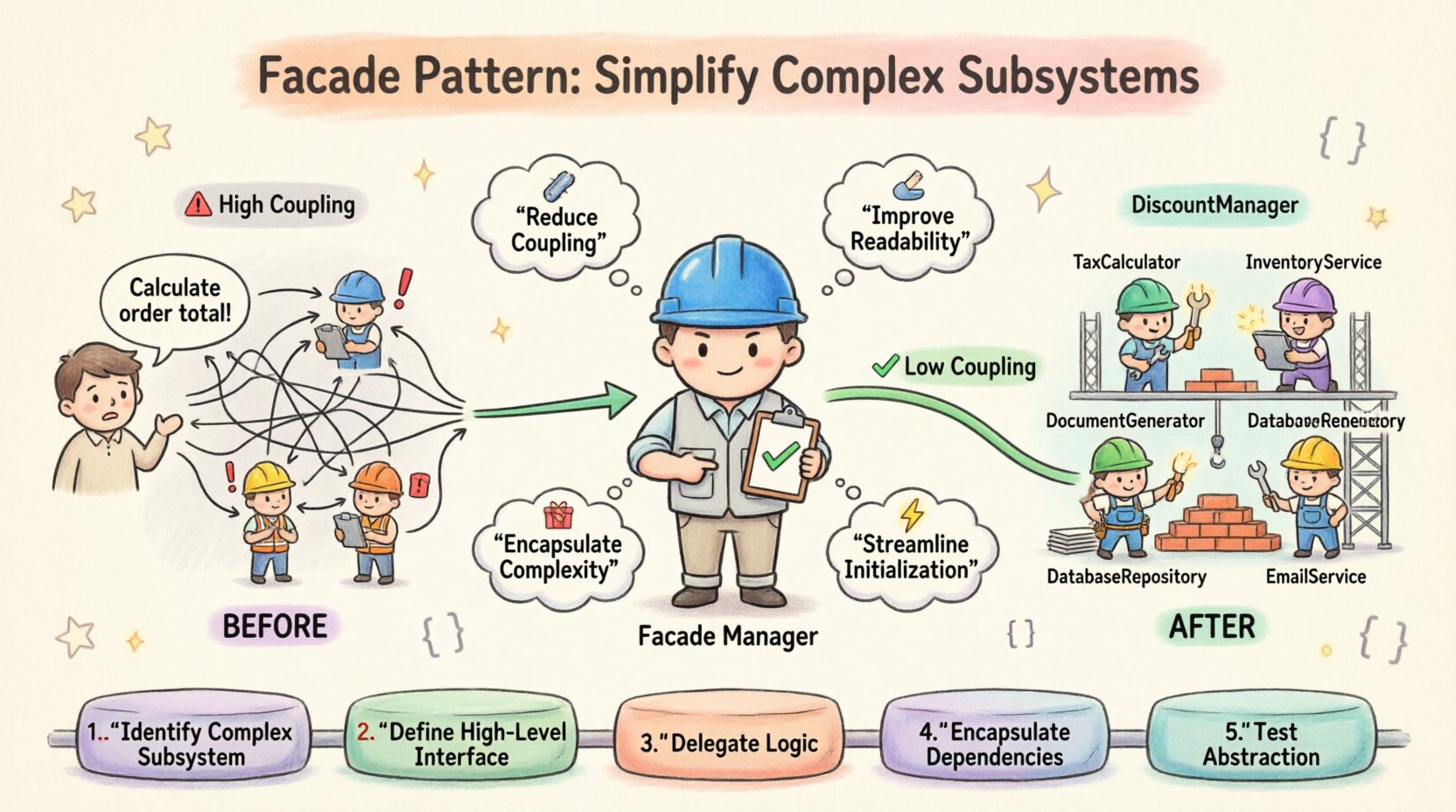
Think of a facade as a manager for a construction site. Instead of asking the electrician, the plumber, and the carpenter to coordinate directly with the homeowner, the homeowner speaks to the manager. The manager handles the coordination and complexity, presenting a simple workflow to the client.
Key Objectives
- Reduce Coupling: The client depends only on the facade, not the underlying classes.
- Improve Readability: Code becomes more understandable with fewer lines.
- Encapsulate Complexity: Details of the subsystem are hidden from the client.
- Streamline Initialization: Complex setup logic is consolidated in one place.
When Complexity Becomes a Problem 📉
Before implementing a solution, it is vital to recognize the symptoms of a subsystem that is too complex. In object-oriented design, these symptoms often appear as:
- Deep Nesting: Methods requiring long chains of calls to initialize or execute logic.
- High Dependency Count: A single client class importing or instantiating dozens of other classes.
- Violation of Open/Closed Principle: Adding new features requires changes in multiple low-level classes.
- Duplicated Logic: The same complex sequence of steps is repeated across different parts of the codebase.
When these issues arise, the system becomes rigid. Refactoring becomes risky because changing one low-level component might break the client logic that relies on it. The Facade Pattern acts as a buffer, absorbing the changes within the subsystem without affecting the clients.
Architecture of the Facade Pattern 🏛️
To understand how to implement this pattern effectively, we must look at the participants involved. The structure is straightforward, consisting of three main roles.
1. The Client
The client is the code that invokes operations on the subsystem. In a standard design without a facade, the client interacts directly with multiple subsystem classes. With the Facade Pattern, the client interacts solely with the facade object. This decoupling means the client does not need to know about the internal workings of the subsystem.
2. The Facade
The facade class holds references to the subsystem classes. It delegates client requests to the appropriate subsystem objects. The facade coordinates the calls, ensuring they happen in the correct order and that necessary data is passed between subsystem components.
3. The Subsystem Classes
These are the classes that perform the actual work. They contain the complex logic, the detailed algorithms, and the specific data manipulations. They are unaware of the facade’s existence; they simply respond to method calls.
Visualizing the Interaction 📊
The following table illustrates the difference between direct interaction and facade-mediated interaction.
| Aspect | Without Facade | With Facade Pattern |
|---|---|---|
| Client Knowledge | Must know about Class A, B, C, and D. | Only knows about FacadeClass. |
| Coupling | High coupling to subsystem internals. | Low coupling to subsystem internals. |
| Code Length | Long, verbose initialization sequences. | Short, concise method calls. |
| Maintenance | Changes in subsystem break client code. | Changes in subsystem isolated from client. |
| Readability | Logic is spread across many files. | Logic is centralized in the facade. |
Step-by-Step Implementation Guide 🛠️
Implementing a facade requires a shift in perspective from “how do I do this task” to “what is the task”. Here is a systematic approach to integrating the pattern into your architecture.
Step 1: Identify the Complex Subsystem
Analyze your codebase to find areas where a single action triggers a cascade of operations. Look for methods that span multiple lines of code and require knowledge of several different classes. This is your candidate for the subsystem.
Step 2: Define the High-Level Interface
Create a new class that will serve as the facade. This class should expose methods that represent the high-level tasks the client needs to perform. Avoid exposing low-level details here. For example, instead of exposing a method to save a log entry, expose a method to “Process Transaction”.
Step 3: Delegate Logic
Inside the facade methods, instantiate or access the necessary subsystem classes. Call their methods in the correct sequence. Handle any data transformation required between the subsystem components.
Step 4: Encapsulate Dependencies
Ensure that the facade holds the references to the subsystem classes. Ideally, these should be injected or created within the facade so the client never instantiates the subsystem directly.
Step 5: Test the Abstraction
Verify that the client can perform the task using only the facade interface. Ensure that internal changes to the subsystem do not require changes to the client code.
A Concrete Scenario: Billing System 💰
To illustrate the pattern without referencing specific software, consider a billing system. A single invoice generation request involves multiple steps:
- Calculating taxes based on location.
- Applying discounts from a loyalty program.
- Checking inventory availability.
- Generating a PDF document.
- Storing the record in the database.
- Sending a notification email.
Without a facade, the client code would need to instantiate a TaxCalculator, a DiscountManager, an InventoryService, a DocumentGenerator, a DatabaseRepository, and an EmailService. It would need to handle the order of operations carefully. If the inventory check fails, the tax calculation might have already occurred, requiring complex rollback logic.
With a Facade, the client calls generateInvoice(orderData). The facade orchestrates the entire flow. It handles the dependencies and the sequence. If the inventory check fails, the facade manages the error state and notifies the client, keeping the client code clean.
Pros and Cons of the Facade Pattern ⚖️
Every design pattern comes with trade-offs. It is important to weigh the benefits against the potential drawbacks before applying it.
Advantages
- Simplified Interface: Clients interact with a single object instead of a distributed set of classes.
- Flexibility: You can change the subsystem implementation without affecting the client.
- Reduced Dependencies: The client depends on fewer classes, lowering the risk of circular dependencies.
- Encapsulation: Complex logic is hidden behind a simple API.
Disadvantages
- Overhead: Adding an extra layer of indirection can introduce slight performance overhead.
- God Facade: If not managed well, the facade class can become too large and complex, violating the Single Responsibility Principle.
- Debugging Complexity: Tracing execution flow requires jumping from the client to the facade, and then to the subsystem.
- Limitation of Functionality: If the client needs to use a feature not exposed by the facade, they must access the subsystem directly, potentially breaking the pattern’s intent.
Common Pitfalls to Avoid ⚠️
While the Facade Pattern is powerful, it is often misused. Below are common mistakes that lead to architectural debt.
1. Creating a “God Facade”
Do not put every possible method of the subsystem into the facade. If the facade class grows to hundreds of methods, it becomes a maintenance nightmare. The facade should only expose the high-level tasks that the client actually needs.
2. Exposing Internal Classes
The facade should not return instances of the subsystem classes to the client. This defeats the purpose of encapsulation. The client should never hold a reference to the TaxCalculator or the EmailService directly.
3. Ignoring Performance Needs
In high-frequency trading systems or real-time processing pipelines, the abstraction layer might add latency. Profile your system before adding a facade if performance is critical.
4. Using It for Everything
Not every class needs a facade. If a subsystem is simple and has only a few interactions, adding a facade adds unnecessary complexity. Use the pattern when complexity justifies the abstraction.
Testing Strategies 🧪
Testing a facade requires a different approach than testing a utility class. Since the facade delegates logic, you are essentially testing the orchestration.
- Unit Tests: Mock the subsystem classes. Verify that the facade calls the correct methods in the correct order with the correct parameters.
- Integration Tests: Run the facade against the real subsystem. Verify that the high-level task completes successfully and returns the expected result.
- Contract Tests: Ensure the facade interface remains stable. If the subsystem changes, the facade interface should ideally remain the same.
Related Patterns and Distinctions 🔗
It is easy to confuse the Facade Pattern with other structural patterns. Understanding the distinctions helps in choosing the right tool.
Facade vs. Adapter
An Adapter changes the interface of a class to match what the client expects. A Facade provides a simpler interface to a complex system. An Adapter focuses on compatibility; a Facade focuses on simplicity.
Facade vs. Mediator
Both patterns manage interactions. A Mediator allows objects to communicate without knowing about each other. A Facade provides a simplified interface to a client. A Mediator is often used for many-to-many relationships, while a Facade is typically client-to-subsystem.
Facade vs. Proxy
A Proxy controls access to an object. A Facade provides a simplified view. While a Proxy might look like a Facade, its primary purpose is to control instantiation or access, not to simplify a complex subsystem.
Refactoring Existing Code 🔄
If you have legacy code with tangled dependencies, introducing a facade can be a gradual process.
- Identify Entry Points: Find the classes that instantiate the subsystem.
- Create the Facade: Build the facade class in parallel to the existing code.
- Delegate: Have the new facade call the existing logic.
- Switch: Update the entry points to use the facade instead of the direct classes.
- Refactor: Once the facade is stable, refactor the subsystem internals to be cleaner, knowing the facade shields the clients.
Conclusion 🎯
The Facade Pattern is a fundamental tool in the object-oriented design toolkit. It addresses the real-world issue of system complexity by providing a clean boundary between the client and the subsystem. By reducing coupling and encapsulating logic, it makes software more maintainable and easier to understand.
However, like any architectural decision, it requires judgment. Do not use it to hide unnecessary complexity, and do not let it grow into a monolithic class. When applied correctly, it creates a stable foundation for your application, allowing the subsystem to evolve without breaking the clients that rely on it. The goal is not to eliminate complexity, but to manage it effectively.