Building robust, scalable software systems requires more than just writing functional code. It demands a structured approach that balances flexibility with consistency. In the domain of Object-Oriented Analysis and Design, few patterns offer the architectural stability required for framework creation like the Template Method Pattern. This behavioral design pattern provides a skeleton for algorithms, allowing subclasses to redefine specific steps without altering the overall structure. By leveraging this pattern, developers can create extensible frameworks that enforce a specific workflow while inviting customization where it matters most. This guide explores the mechanics, benefits, and practical application of this pattern in architectural design.
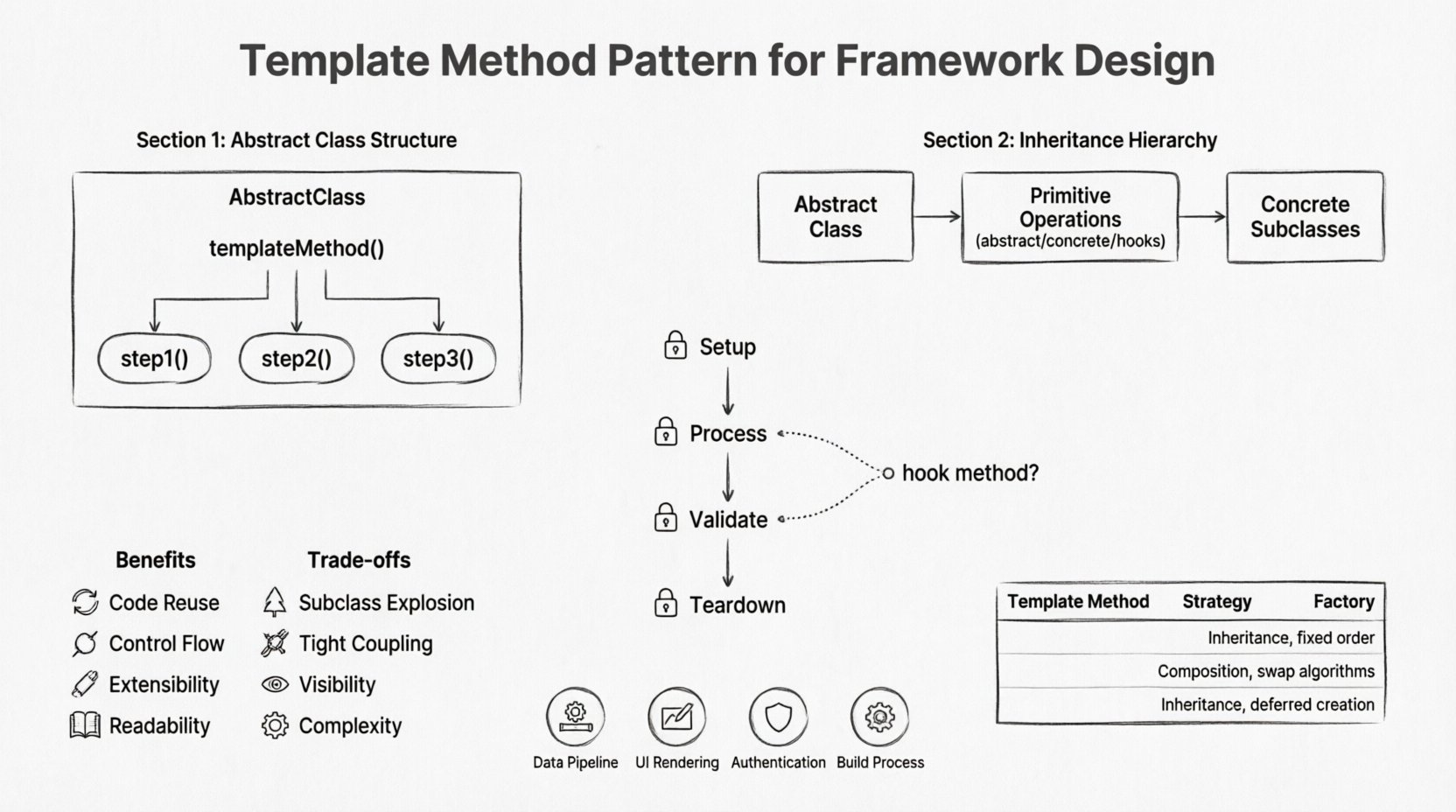
Understanding the Pattern 🧩
The Template Method Pattern defines the skeleton of an algorithm in an operation, deferring some steps to subclasses. It lets subclasses redefine certain steps of an algorithm without changing the algorithm’s structure. This separation is crucial when designing frameworks because it establishes a contract between the framework and the user of the framework.
Imagine a process that involves several distinct phases: setup, processing, validation, and teardown. The order of these phases must remain consistent to ensure system integrity. However, the specific logic within the ‘processing’ phase might vary depending on the data type or business requirement. The Template Method Pattern addresses this by keeping the control flow in a base class while allowing derived classes to inject specific behaviors.
Control Flow: The invariant steps are defined in the abstract class.
Custom Logic: The variant steps are left as abstract methods or hooks.
Consistency: The overall process remains stable across all implementations.
This approach reduces code duplication significantly. Without this pattern, every subclass would need to implement the entire algorithm, leading to repetitive code and potential inconsistencies. By centralizing the common logic, maintenance becomes simpler and the risk of errors decreases.
Core Components 🔒
To implement this pattern effectively, one must understand the specific roles played by different elements within the class hierarchy. The structure relies heavily on abstraction and inheritance.
1. The Abstract Class
This class contains the template method. It defines the sequence of operations that constitute the algorithm. It calls primitive operations, which may be abstract or concrete, at specific points in the sequence. The template method itself is typically final to prevent subclasses from altering the algorithm’s flow.
2. Primitive Operations
These are the individual steps within the algorithm. They can be:
Abstract: No implementation provided; subclasses must override them.
Concrete: A default implementation is provided in the base class.
Hook Methods: Optional methods that subclasses can override to add logic.
3. Concrete Subclasses
These classes inherit from the abstract class and provide the specific implementations for the primitive operations. They do not touch the template method. Their responsibility is solely to define how the specific steps behave.
Applying to Framework Architecture 🏛️
Frameworks often require an inversion of control where the framework calls the user’s code, rather than the user calling the framework. The Template Method Pattern is the backbone of this inversion. It allows the framework to dictate the lifecycle of an object while giving the developer hooks to inject business logic.
Consider a data processing pipeline. The framework handles the opening of resources, the execution of the pipeline steps, and the closing of resources. The developer only needs to define the transformation logic for the data. This separation ensures that resource management is handled consistently, regardless of how the data is processed.
Component | Responsibility | Example |
|---|---|---|
Template Method | Defines the algorithm skeleton |
|
Primitive Op | Defines specific steps |
|
Hook Method | Allows optional customization |
|
This structure supports the Dependency Inversion Principle. High-level modules (the framework) do not depend on low-level modules (the user logic); both depend on abstractions. This decoupling makes the system more modular and easier to test.
The Role of Hook Methods 🪝
Hook methods are a specific type of primitive operation that provides an empty implementation in the base class. They allow subclasses to override these methods if they need to perform actions, but they do not need to do so if the default behavior is sufficient. This adds flexibility without forcing the subclass to implement logic it doesn’t need.
Optional Execution: If a subclass overrides the hook, the framework executes it. If not, it skips or does nothing.
Extensibility: Developers can add side effects, logging, or validation without modifying the core algorithm.
Notification: Frameworks often use hooks to notify developers when a specific event occurs, such as before or after a transaction.
Using hooks prevents the need for multiple subclasses that only differ by a small detail. Instead, a single subclass hierarchy can handle various scenarios through optional overrides. This keeps the class hierarchy flatter and more manageable.
Benefits and Trade-offs ⚖️
Like any design pattern, the Template Method Pattern has strengths and weaknesses. Understanding these is essential for making informed architectural decisions.
Benefits
Code Reuse: Common logic is written once in the base class, reducing duplication.
Control Flow: The framework maintains control over the order of operations, ensuring consistency.
Extensibility: New variants can be added by creating new subclasses without changing existing code.
Readability: The algorithm structure is visible in the template method, providing a clear roadmap.
Trade-offs
Subclass Explosion: Creating many subclasses can lead to a deep and wide hierarchy, which might be hard to navigate.
Tight Coupling: Subclasses are coupled to the base class implementation. Changes in the template method affect all subclasses.
Visibility: In some languages, the template method must be public or protected, exposing implementation details.
Complexity: For simple tasks, the pattern might introduce unnecessary complexity compared to a straightforward function.
When deciding whether to use this pattern, evaluate the complexity of the algorithm. If the process is stable but the steps vary, it is a strong candidate. If the logic changes frequently or the steps are unrelated, other patterns might be more suitable.
Implementation Strategy 🛠️
Implementing this pattern requires a disciplined approach to ensure it adds value rather than complexity. Follow these steps to integrate it into your design.
Identify the Invariant: Determine which steps of the algorithm are identical across all scenarios. These form the core of the template method.
Identify the Variant: Pinpoint the steps that change based on the specific use case. These should be primitive operations.
Create the Abstract Class: Define the template method and the abstract primitive operations.
Implement Concrete Classes: Create subclasses that implement the primitive operations. Ensure they do not override the template method.
Add Hooks: Where optional behavior is needed, add empty hook methods to the base class.
Test Extensibility: Verify that new subclasses can be added without modifying the base class.
During implementation, maintain a clear distinction between the what (the algorithm) and the how (the specific steps). This separation ensures that the framework remains robust even as requirements evolve.
Common Pitfalls ⚠️
Even experienced developers can fall into traps when applying this pattern. Being aware of these common issues helps in avoiding them.
Overusing Abstraction: Do not abstract every method. Only abstract where there is a clear need for variation. Too much abstraction leads to confusion.
Hidden Dependencies: Subclasses might rely on the state of the base class. Ensure that state management is clear and thread-safe if necessary.
Breaking the Contract: Subclasses should not call the template method directly. Doing so can bypass the intended flow.
Ignoring Error Handling: Ensure that error handling is consistent across the hierarchy. A failure in one step should not leave the system in an inconsistent state.
Regular code reviews can help identify these pitfalls early. Focus on the coupling between the base class and subclasses. If changes in one require changes in the other, the design might be too tightly coupled.
Comparison with Other Patterns 🔄
While the Template Method Pattern is powerful, it is not always the best choice. Comparing it with similar patterns clarifies when to use it.
Pattern | Focus | Relationship | Best Used When |
|---|---|---|---|
Template Method | Algorithm structure | Inheritance | Steps vary, order is fixed |
Strategy Pattern | Algorithm selection | Composition | Algorithms are interchangeable |
Factory Method | Object creation | Inheritance | Deferred instantiation |
The Strategy Pattern is often confused with Template Method. The key difference lies in how the variation is achieved. Template Method uses inheritance to vary steps within a single algorithm. Strategy uses composition to swap entire algorithms. If you need to change the whole process, use Strategy. If you need to change specific steps within a process, use Template Method.
Best Practices for Maintainability 📋
To ensure the pattern remains useful over time, adhere to these guidelines.
Clear Naming: Name the template method to reflect the overall process (e.g.,
processOrder). Name primitive operations to reflect the specific step (e.g.,validateOrder).Minimal Abstraction: Keep the base class focused. If it becomes too large, consider splitting responsibilities into multiple base classes.
Documentation: Document the expected sequence of calls. Subclasses must know the order in which they are invoked.
Versioning: Be careful when modifying the template method. Changing the order of calls can break existing subclasses. Use deprecation warnings if changes are necessary.
Interface Segregation: Ensure subclasses do not implement methods they do not need. Use abstract classes or interfaces to define the contract clearly.
Maintainability is about longevity. A well-designed framework should survive changes in requirements without requiring a complete rewrite. The Template Method Pattern supports this by isolating changes to specific methods.
Scenarios and Use Cases 🎯
This pattern shines in specific architectural contexts where consistency and extensibility are paramount.
Data Processing Pipelines
When processing data through multiple stages (ingest, transform, store), the framework manages the flow. The user defines the transformation logic. This ensures that logging, error handling, and resource cleanup happen consistently.
UI Rendering Flows
User interfaces often follow a standard lifecycle: initialize, render, handle events, dispose. The framework manages this lifecycle, while the component defines the specific rendering logic. This ensures a consistent user experience across different widgets.
Authentication Sequences
Authentication often involves checking credentials, validating tokens, and logging sessions. The framework handles the sequence, while the user defines how credentials are checked (e.g., database, LDAP, API).
Build Processes
Software builds involve compiling, testing, and packaging. The build system manages the order. The user defines the specific compilation flags or testing scripts.
In all these cases, the common thread is a fixed sequence of operations with variable content. The Template Method Pattern provides the structure to manage this complexity.
Final Thoughts on Architecture 🏁
The Template Method Pattern is a foundational tool for anyone designing object-oriented frameworks. It provides a balance between control and flexibility that is essential for large-scale systems. By defining the algorithm skeleton in a base class and allowing subclasses to fill in the details, developers can create systems that are both stable and adaptable.
Success with this pattern depends on careful design. Identify the invariant steps clearly. Define the variant steps precisely. Use hooks judiciously to avoid unnecessary complexity. When applied correctly, it leads to cleaner code, easier maintenance, and more robust frameworks.
Remember that design patterns are tools, not rules. Use them where they fit the problem. If the algorithm changes too often, consider a different approach. If the steps are too simple, a function might suffice. But for complex, structured workflows, this pattern remains a reliable choice for professional software engineering.