In the landscape of object-oriented analysis and design, the way objects are instantiated plays a critical role in the maintainability and scalability of a system. When application logic becomes tightly coupled with concrete class implementations, changes ripple through the codebase, increasing technical debt and reducing agility. The Factory Pattern offers a structured approach to managing object creation, allowing systems to remain flexible without hard-coding dependencies.
This guide explores the mechanics of the Factory Pattern, its variations, and how to apply it effectively to achieve decoupled, robust architectures. We will examine the theoretical foundations, practical implementation steps, and the trade-offs involved in adopting this design strategy.
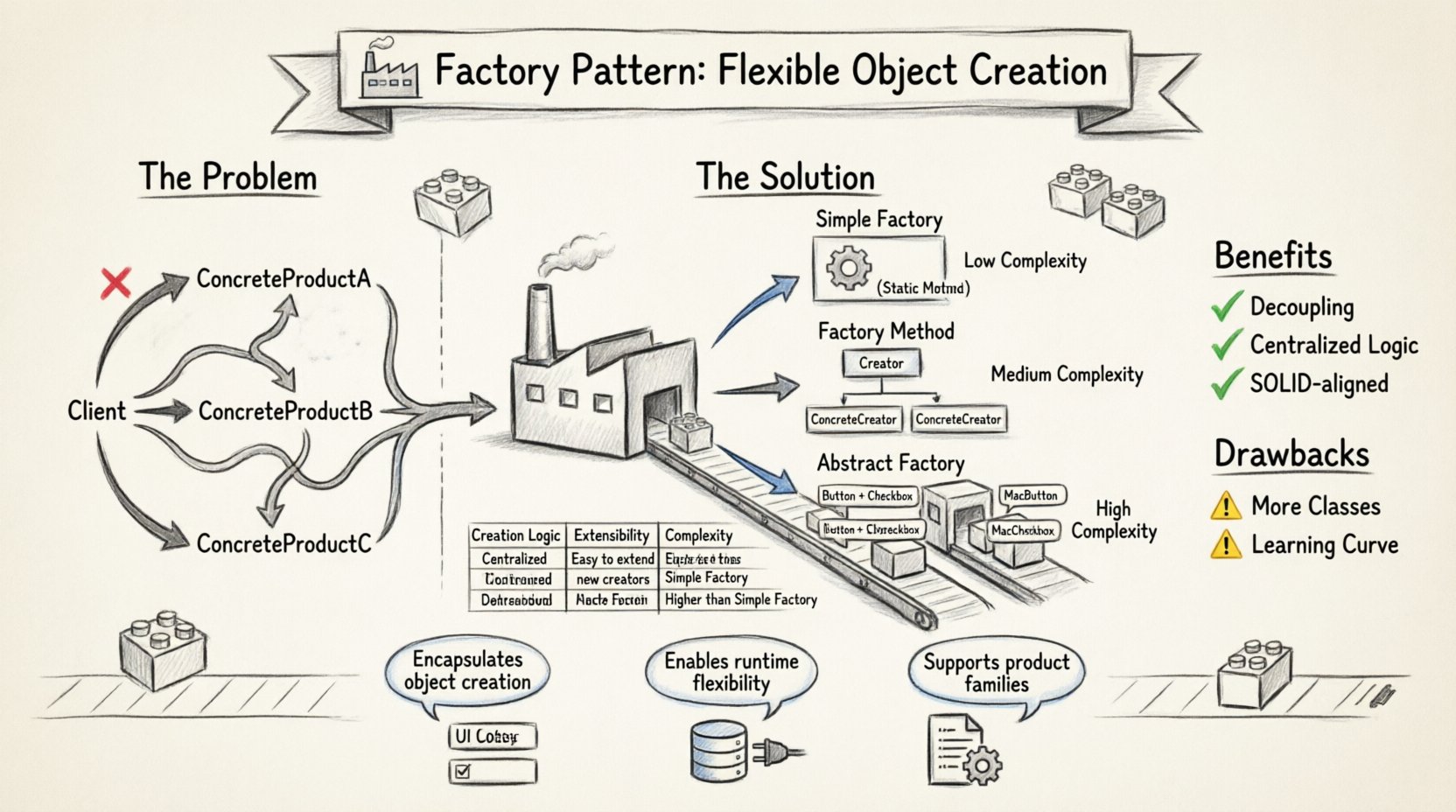
🔍 Understanding the Problem: Tight Coupling
Consider a scenario where a client class needs to instantiate a specific type of service to perform a task. A naive implementation often looks like this:
- The client calls a constructor directly.
- The client knows the exact class name.
- Changing the implementation requires modifying the client code.
This direct dependency creates a rigid structure. If the requirement shifts to use a different implementation, every part of the system that references the original class must be updated. This violates the Open/Closed Principle, which suggests that software entities should be open for extension but closed for modification.
🏭 What is the Factory Pattern?
The Factory Pattern is a creational design pattern that provides an interface for creating objects in a superclass, but allows subclasses to alter the type of objects that will be created. Instead of instantiating objects directly using the new operator, the logic is delegated to a factory method or a factory object.
Key characteristics include:
- Abstraction: The client interacts with an interface or abstract class, not a concrete implementation.
- Encapsulation: Creation logic is hidden within the factory.
- Flexibility: New product types can be added without changing client code.
🛠️ Variations of the Factory Pattern
While the core concept remains consistent, the implementation varies based on the complexity of the system. There are three primary variations used in object-oriented design.
1. Simple Factory (Static Factory)
This is not strictly a pattern in the GoF (Gang of Four) sense but a design idiom. A single class contains a factory method that returns instances of different classes based on input parameters.
- Use Case: Simple systems where the number of product types is small and known.
- Mechanism: A static method accepts a type identifier and returns the appropriate object.
- Limitation: The factory class itself must be modified to add new product types, violating the Open/Closed Principle.
2. Factory Method Pattern
This pattern defines an interface for creating an object, but lets subclasses decide which class to instantiate. The creation logic is deferred to subclasses.
- Use Case: When a class cannot anticipate the class of objects it must create.
- Mechanism: A base class defines a method for creation. Concrete subclasses override this method to return specific product instances.
- Benefit: Adheres strictly to the Open/Closed Principle regarding product creation.
3. Abstract Factory Pattern
This pattern provides an interface for creating families of related or dependent objects without specifying their concrete sub-classes.
- Use Case: Systems that need to work with multiple families of products (e.g., UI buttons for different operating systems).
- Mechanism: An abstract factory declares methods for creating each type of product in the family. Concrete factories implement these methods.
- Benefit: Ensures consistency between related products.
📝 Implementation Workflow
Implementing a Factory Pattern requires a systematic approach to ensure the design remains clean and maintainable. Follow these steps to structure your solution.
Step 1: Define the Product Interface
Start by defining a contract that all concrete products must adhere to. This interface defines the methods available to the client, regardless of the underlying implementation.
- Identify the common behaviors required.
- Create an abstract class or interface.
- Ensure all future product implementations extend this contract.
Step 2: Create Concrete Product Classes
Develop the specific classes that implement the product interface. These classes contain the actual business logic.
- Implement the methods defined in the interface.
- Keep them independent of the factory logic.
- Ensure they do not know about the factory that creates them.
Step 3: Define the Factory Interface
Create a factory interface that declares methods for creating the products. This acts as the contract for the creation process.
- Define methods corresponding to each product type.
- Keep the factory focused solely on instantiation.
Step 4: Implement Concrete Factories
Build concrete factory classes that implement the factory interface. Inside these classes, instantiate the specific concrete products.
- Map the factory to the specific product family.
- Return new instances of the concrete products.
- Avoid complex logic; focus on object construction.
Step 5: Integrate with the Client
Update the client code to depend on the factory interface rather than concrete classes. The client requests objects from the factory.
- Inject the factory into the client or retrieve it from a registry.
- Use the returned objects through the product interface.
- Remove direct instantiation logic from the client.
📊 Comparison of Factory Variations
Choosing the right variation depends on the specific requirements of the project. The table below outlines the differences.
| Feature | Simple Factory | Factory Method | Abstract Factory |
|---|---|---|---|
| Creation Logic | Single class method | Subclass method | Interface of families |
| Extensibility | Low (Modify factory) | High (Add subclass) | High (Add concrete factory) |
| Complexity | Low | Medium | High |
| Product Families | Single type focus | Single type focus | Multiple related types |
| Open/Closed | Violated | Adhered | Adhered |
✅ Benefits of Using the Factory Pattern
Adopting this pattern introduces significant structural advantages to an application.
- Decoupling: Client code is decoupled from concrete classes. The system is less fragile when implementations change.
- Centralized Logic: All instantiation logic resides in one place, making it easier to debug and modify.
- Single Responsibility: Factories handle creation, while product classes handle behavior. This separation of concerns improves code organization.
- Configuration Management: Factories can easily integrate with configuration files to determine which product to instantiate at runtime.
- Security: You can restrict the client from accessing constructors directly, controlling how objects are created.
⚠️ Drawbacks and Considerations
While powerful, the pattern is not a silver bullet. It introduces complexity that must be weighed against the benefits.
- Increased Complexity: Introducing factories adds layers of indirection. Simple applications may become over-engineered.
- Code Volume: More classes are required (interfaces, concrete products, factories, concrete factories), increasing the total line count.
- Readability: Understanding the flow of object creation requires tracing through multiple classes, which can be confusing for new developers.
- Testing Overhead: Unit tests may need to mock the factory or specific factory implementations to isolate behavior.
🚀 Best Practices for Implementation
To ensure the Factory Pattern adds value rather than noise, adhere to these guidelines.
- Keep it Simple: Start with a Simple Factory. Only move to Factory Method or Abstract Factory if the complexity demands it.
- Use Dependency Injection: Inject the factory into the client rather than having the client create the factory instance. This facilitates testing and swapping implementations.
- Naming Conventions: Use clear names for factory classes (e.g.,
PaymentFactory) and products (e.g.,CreditCardPayment) to maintain clarity. - Avoid Side Effects: Factory methods should ideally only create objects. Avoid heavy business logic within the factory itself.
- Handle Errors Gracefully: If a factory cannot create a requested product, define a clear error handling strategy, such as throwing a specific exception.
🧩 Integration with SOLID Principles
The Factory Pattern aligns closely with several SOLID principles, which guide object-oriented design.
Dependency Inversion Principle (DIP)
High-level modules should not depend on low-level modules. Both should depend on abstractions. The Factory Pattern enforces this by having clients depend on the product interface and the factory interface, not concrete classes.
Open/Closed Principle (OCP)
Entities should be open for extension but closed for modification. By using the Factory Method or Abstract Factory, you can add new product types by adding new classes without modifying existing client code.
Single Responsibility Principle (SRP)
A class should have only one reason to change. The Factory Pattern separates the responsibility of knowing how to create objects from the responsibility of using those objects.
⚠️ Common Pitfalls to Avoid
Even experienced developers can misapply this pattern. Watch out for these common mistakes.
- Over-Engineering: Using Abstract Factories for simple applications where a direct constructor call suffices. This adds unnecessary boilerplate.
- Hidden Dependencies: If the factory instantiates objects that have complex dependencies, those dependencies must be managed correctly within the factory.
- Spaghetti Logic: If the factory class becomes too large with multiple conditions, it violates SRP. Split the logic into smaller factory classes.
- Ignoring Performance: In high-performance scenarios, the overhead of factory calls might be negligible, but creating expensive objects inside a factory without pooling can impact memory usage.
🔄 Managing Lifecycle with Factories
Factory patterns are often used to manage the lifecycle of objects, not just their creation. A factory can determine if an object should be created anew or retrieved from a cache.
- Singleton Management: A factory can ensure only one instance of a resource exists.
- Pooling: For expensive resources, the factory can return an instance from a pool instead of creating a new one.
- State Management: The factory can initialize objects with specific states based on configuration data.
🧪 Testing Strategies
Testing code that relies on factories requires specific approaches to ensure reliability.
- Mocking the Factory: In client tests, mock the factory to return fake or stub objects. This isolates the client logic from the creation logic.
- Testing the Factory: Test the factory independently to ensure it returns the correct concrete types based on input parameters.
- Integration Tests: Verify that the concrete factory creates objects that behave correctly according to the product interface.
🌐 Real-World Scenarios
Understanding where this pattern applies helps in recognizing opportunities for refactoring.
UI Frameworks
GUI toolkits often use factory patterns to create widgets. A factory can generate buttons, text fields, or menus specific to the operating system (Windows, macOS, Linux) without the application code knowing the platform details.
Database Connectivity
Applications connecting to databases use factories to create connection objects. A factory can select the appropriate driver (SQL Server, Oracle, MySQL) based on configuration, keeping the application logic database-agnostic.
Logging Systems
A logging framework might use a factory to instantiate different handlers (Console, File, Network). The application requests a logger, and the factory provides the correct handler based on the environment.
🔮 Future-Proofing Architecture
Designing with extensibility in mind is crucial for long-term maintenance. The Factory Pattern supports evolution by allowing the system to grow.
- Plugin Systems: Factories can load plugins dynamically at runtime.
- Feature Flags: Factories can switch implementations based on feature toggles.
- A/B Testing: Different factory variants can be used to serve different user experiences without code changes.
🛑 When Not to Use the Factory Pattern
There are scenarios where this pattern adds unnecessary friction.
- Fixed Dependencies: If the application always needs the exact same class, a factory is redundant.
- Simple Scripts: Small scripts or one-off programs do not require the overhead of multiple interfaces and classes.
- Performance Critical Paths: If object creation is the bottleneck, the indirection of a factory might add latency that cannot be justified.
📈 Measuring Success
How do you know the implementation is working well? Look for these indicators.
- Reduced Merge Conflicts: Since client code does not reference concrete classes, changes to products rarely cause conflicts in client files.
- Fewer Code Changes: Adding a new product type requires fewer lines of code changes across the codebase.
- Improved Testability: Mocking becomes easier, leading to higher code coverage and confidence in refactoring.
- Clearer Architecture: The separation of concerns makes the codebase easier to navigate for new team members.
🎯 Summary of Key Takeaways
- The Factory Pattern encapsulates object creation logic to reduce coupling.
- Three main variations exist: Simple, Factory Method, and Abstract Factory.
- Choose the variation based on the complexity and extensibility needs.
- Align the pattern with SOLID principles for robust design.
- Avoid over-engineering simple systems with complex factory structures.
- Proper testing strategies are essential to validate factory behavior.
By implementing the Factory Pattern correctly, developers build systems that are adaptable to change. The initial investment in structure pays dividends when requirements evolve. This approach fosters a codebase that is easier to maintain, extend, and understand over time.