Software development is an iterative process. As systems grow, so does the complexity of the underlying code. In Object-Oriented Analysis and Design, maintaining a clean structure is paramount. A code smell is not a bug that crashes the system; it is a surface-level indication of a deeper problem in the design. These indicators suggest that the underlying structure may be deviating from best practices, potentially leading to technical debt. Understanding how to spot these signals and apply targeted fixes is essential for long-term maintainability.
This guide explores the nature of object-oriented code smells. It details common patterns, their impact on the system, and practical strategies for refactoring. The goal is to improve the health of the codebase without disrupting functionality.
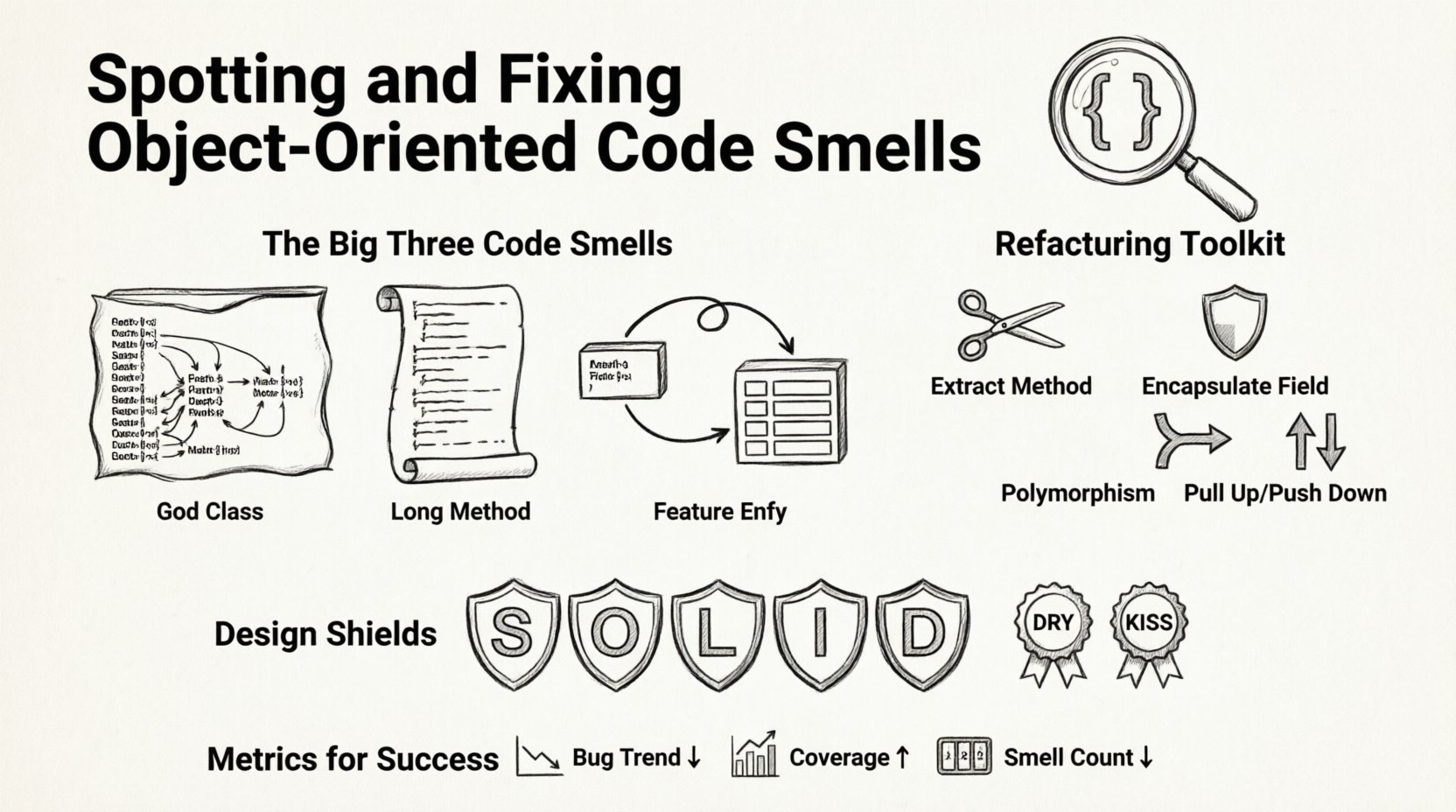
Why Code Smells Matter 💸
Ignoring code smells often feels like saving time in the short term. However, this approach compounds over time. A system riddled with smells becomes fragile. Changes that should take minutes can evolve into days of work. The cost of maintenance rises exponentially as the code becomes less intuitive.
There are several reasons to prioritize code quality:
- Readability: Clean code is easier for new team members to understand.
- Testability: Well-structured objects are simpler to isolate and test.
- Extensibility: A robust design allows for new features with minimal side effects.
- Performance: While not always direct, inefficient designs often lead to unnecessary object creation and processing.
When developers recognize a smell, they are identifying a specific opportunity to improve the architecture. This proactive approach prevents the accumulation of technical debt.
Catalog of Common OOP Smells 📋
There are numerous code smells identified in the literature. While specific names may vary, the underlying issues remain consistent. The following table summarizes the most frequent offenders found in object-oriented systems.
| Code Smell | Primary Symptom | Severity |
|---|---|---|
| God Class | One class does too many things. | High |
| Long Method | A single function is too large. | Medium |
| Feature Envy | A method uses another object’s data excessively. | Medium |
| Divergent Change | One class changes for many different reasons. | High |
| Shotgun Surgery | One change requires edits in many classes. | High |
| Data Class | A class only holds data without behavior. | Low |
| Parallel Inheritance Hierarchies | Two class hierarchies must be updated together. | Medium |
| Lazy Class | A class does little of value. | Low |
Identifying these patterns early allows teams to address issues before they become critical bottlenecks. Let us examine the most critical smells in detail.
Deep Dive: The Big Three 🧐
While many smells exist, three categories frequently cause the most significant friction in object-oriented projects. These are the God Class, the Long Method, and Feature Envy.
1. The God Class ☠️
A God Class is a module that knows about or controls almost everything in the system. It typically handles data processing, business logic, and user interface concerns all in one place. This violates the Single Responsibility Principle.
Symptoms:
- The class file is excessively long.
- It has hundreds of methods and fields.
- Other classes depend heavily on this single entity.
- It is difficult to test because of its dependencies.
The Fix:
Refactoring a God Class requires a surgical approach. Do not delete the class immediately. Instead, extract distinct responsibilities into new classes.
- Extract Classes: Group related methods and fields into separate classes.
- Delegate: Move the logic from the God Class to the new classes.
- Update References: Ensure other parts of the system call the new classes instead of the God Class.
2. The Long Method 📜
A Long Method is a function that is too complex to understand in one glance. It often contains multiple distinct steps that should be separate entities. This reduces readability and makes unit testing difficult.
Symptoms:
- The method exceeds a certain line count threshold.
- It performs multiple logical operations.
- It requires deep indentation levels.
- It is hard to change one part without affecting others.
The Fix:
The primary strategy is Extract Method. Break the large function into smaller, named functions.
- Identify Steps: Find logical blocks within the method.
- Extract: Move each block into its own method.
- Name Clearly: Give the new methods names that describe their behavior.
- Remove Duplication: If a block is copied elsewhere, create a shared method.
This makes the original method a high-level summary of the process, improving clarity.
3. Feature Envy 😒
Feature Envy occurs when a method in one class spends most of its time accessing data from another class. It suggests that the method might belong to the class it is visiting.
Symptoms:
- A method reads multiple attributes of another object.
- It performs calculations using that data.
- The logic is buried in a class that does not own the data.
The Fix:
Move the method to the class that owns the data. This is often called Move Method.
- Analyze Usage: Check which class provides the data the method needs.
- Move Logic: Transfer the method to that class.
- Update Callers: Change the calling code to invoke the method on the new owner.
If the method needs data from both classes, consider creating a wrapper or a composite object to hold that state.
Refactoring Techniques 🛠️
Fixing code smells requires specific refactoring techniques. These are small changes to the code structure that preserve behavior while improving design. Below are essential strategies.
Extract Method
This is the most common technique. It involves taking a block of code within a method and moving it to a new method. The original method then calls the new one. This reduces complexity.
Encapsulate Field
Public fields are a source of coupling. Making fields private and providing public accessors allows for validation and future changes without breaking callers. This protects the internal state of the object.
Replace Conditional with Polymorphism
Switch statements and large if-else blocks often indicate a smell. If a method behaves differently based on the type of an object, use polymorphism. Create a subclass for each behavior and override the method. This removes the conditional logic.
Pull Up Method
If two subclasses share the same code, that code likely belongs in the parent class. Move the method up the inheritance hierarchy. This reduces duplication.
Push Down Method
Conversely, if a method is only used by one subclass, move it down to that specific class. This keeps the parent class clean and focused on commonalities.
Design Principles as Shields 🛡️
Refactoring fixes the symptoms, but design principles prevent new smells. Adhering to established principles creates a robust foundation.
SOLID Principles
- Single Responsibility: A class should have only one reason to change.
- Open/Closed: Software entities should be open for extension but closed for modification.
- Liskov Substitution: Subtypes must be substitutable for their base types.
- Interface Segregation: Clients should not be forced to depend on interfaces they do not use.
- Dependency Inversion: Depend on abstractions, not on concretions.
DRY Principle
Do Not Repeat Yourself. If you see the same code in two places, extract it into a shared method or class. Duplication is the root of many code smells, including Shotgun Surgery.
KISS Principle
Keep It Simple, Stupid. Complex designs are harder to maintain. Choose the simplest solution that meets the requirements. Over-engineering often introduces new smells.
Automated Detection ⚙️
While manual inspection is valuable, automated tools can help identify smells at scale. Static analysis tools scan the source code without executing it. They look for patterns that match known smell definitions.
Metrics often used for detection include:
- Cyclomatic Complexity: Measures the number of linearly independent paths through a program’s source code.
- Coupling: The degree of interdependence between software modules.
- Cohesion: The degree to which elements inside a module belong together.
- Depth of Inheritance Tree: The maximum number of levels in a class hierarchy.
Integrating these tools into the build pipeline ensures that quality standards are met continuously. Alerts can be configured to warn developers when a smell is introduced.
Creating a Culture of Quality 🌱
Technical quality is not just the responsibility of one person. It requires a team culture that values maintainability. Code reviews are a critical mechanism for this.
Peer Reviews
During code reviews, team members look for design issues, not just syntax errors. They ask questions about intent and future changes. This collaborative process helps spread knowledge about good design.
Continuous Refactoring
Refactoring should be a habit, not a phase. Developers should clean up code as they work on features. This prevents the backlog of technical debt from becoming unmanageable.
Documentation
Clear documentation helps explain *why* a design decision was made. This prevents future developers from reverting good changes or introducing new smells due to misunderstanding.
Metrics for Success 📊
How do you know if your refactoring efforts are working? Track specific metrics over time.
- Bug Rate: A reduction in bugs indicates better design.
- Lead Time: Faster implementation of features suggests improved flexibility.
- Code Coverage: Higher test coverage often correlates with better modularity.
- Smell Count: A decreasing trend in static analysis warnings.
Regularly reviewing these metrics helps maintain focus on long-term health. It shifts the conversation from “will it work now?” to “will it work for years?”.
Conclusion
Object-oriented code smells are warning signs. They indicate that the design is straining under the weight of complexity. By identifying these patterns and applying targeted refactoring techniques, teams can restore order. The process requires discipline and a commitment to quality. However, the payoff is a system that is easier to understand, test, and extend. Prioritizing code health is an investment in the future of the software.