In the landscape of software architecture, two foundational principles stand out for their ability to streamline development and maintainability: the DRY principle and the KISS principle. These guidelines are not merely suggestions; they form the bedrock of robust Object-Oriented Analysis and Design (OOD). When applied correctly, they reduce technical debt, minimize errors, and ensure that code remains understandable as systems grow.
Developers often face the challenge of balancing abstraction with simplicity. Too much abstraction leads to complexity that obscures intent. Too little leads to repetition that makes updates painful. Understanding the interplay between these rules is essential for creating sustainable software systems. This guide explores the mechanics, applications, and trade-offs of these critical design patterns.
🚫🔄 The DRY Principle Explained
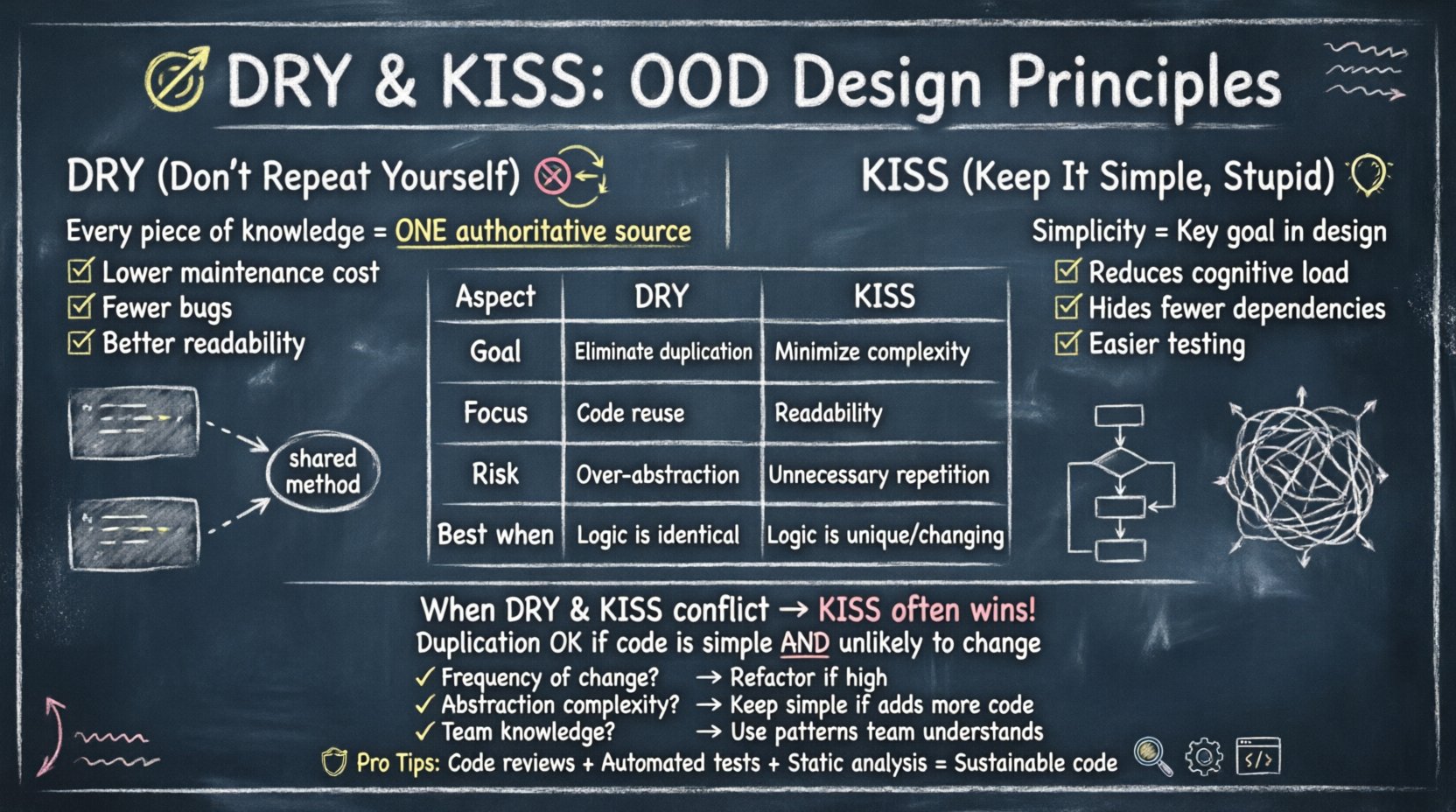
The acronym DRY stands for “Don’t Repeat Yourself.” This principle was introduced to address the inefficiency of code duplication. The core tenet is simple: every piece of knowledge must have a single, unambiguous, authoritative representation within a system. When logic exists in multiple places, any change requires updates across all instances. This increases the risk of inconsistency and bugs.
Why Duplication Hurts
- Increased Maintenance Cost: Changing a business rule requires finding every instance of that rule. If missed, the system behaves inconsistently.
- Higher Bug Probability: The more code written, the higher the surface area for defects. Duplicate code multiplies this surface area.
- Reduced Readability: Developers scanning the codebase see the same logic repeated, which distracts from the unique business logic.
Identifying Violations
Violations of DRY often manifest in specific ways. Recognizing these patterns helps in refactoring:
- Copy-Paste Programming: Taking a block of code and pasting it into another class with minor adjustments.
- Similar Logic: Two methods performing the same calculation but with different variable names or control structures.
- Configuration Redundancy: Hardcoding values in multiple files instead of using a central configuration source.
Refactoring Techniques
To adhere to this principle, developers employ several strategies:
- Extract Method: Move common logic into a single method that other methods call.
- Use Inheritance: Place shared behavior in a parent class so child classes inherit it.
- Apply Design Patterns: Utilize patterns like Strategy or Template Method to encapsulate varying logic while keeping the structure consistent.
🧩 The KISS Principle Explained
KISS stands for “Keep It Simple, Stupid.” Originating from the US Navy, this principle emphasizes that simplicity should be a key goal in design. Complex systems are harder to understand, harder to test, and harder to modify. The goal is not to write less code, but to write code that is easier to comprehend.
The Cost of Complexity
Complexity creates a barrier to entry for new team members and increases the time required for debugging. When a system is overly complex:
- Cognitive Load: Developers must hold more state and logic in their working memory to understand a specific function.
- Hidden Dependencies: Complex interactions often hide side effects, making changes risky.
- Testing Difficulty: Complex logic requires more edge cases to cover in unit tests.
Simplicity vs. Functionality
Applying KISS does not mean sacrificing features. It means achieving the required functionality with the least amount of necessary complexity. This often involves:
- Minimal Interfaces: Design interfaces that expose only what is needed.
- Direct Composition: Prefer composition over deep inheritance hierarchies.
- Explicit over Implicit: Make data flow and logic paths obvious rather than relying on magic or hidden behaviors.
📊 Comparing DRY and KISS
While both principles aim for better software, they can sometimes pull in opposite directions. Over-abstracting to satisfy DRY can violate KISS. Here is a structured comparison to clarify their roles.
| Aspect | DRY Principle | KISS Principle |
|---|---|---|
| Primary Goal | Eliminate duplication | Minimize complexity |
| Focus | Code structure and reuse | Readability and understandability |
| Risk of Misuse | Over-abstraction | Repetition and redundancy |
| Best Context | When logic is identical | When logic is unique or changing |
| Impact on Team | Faster implementation of features | Easier onboarding and debugging |
🏗️ Practical Application in OOD
Implementing these rules requires deliberate thought during the design phase. Object-Oriented Design provides specific tools to enforce these constraints.
1. Inheritance vs. Composition
Inheritance is a powerful tool for DRY. It allows a subclass to reuse code from a superclass. However, it is not always the right choice for KISS. Deep inheritance trees can become difficult to navigate. Composition is often a simpler alternative.
- Scenario: A
Vehicleclass needs engine logic. - Inheritance Approach:
CarextendsVehicle. If the engine logic changes, the whole hierarchy might need review. - Composition Approach:
Carcontains anEngineobject. Logic is encapsulated withinEngine. Changes to the engine do not affect the car’s structure.
2. Interface Design
Interfaces define contracts. A good interface adheres to KISS by not exposing unnecessary methods. If a method is not needed by the caller, it should not be in the interface. This prevents the caller from relying on implementation details.
- Small Interfaces: Prefer several small, focused interfaces over one large, monolithic one.
- Implementation Hiding: Use abstract classes or interfaces to hide the concrete implementation.
3. Naming Conventions
Names are a form of documentation. Clear naming reduces the need for comments, supporting KISS. It also helps identify duplication, supporting DRY.
- Descriptive Names: Use names that describe the intent, not the implementation.
- Consistency: Use the same naming style across the entire codebase to reduce cognitive friction.
⚠️ Common Violations and Risks
Even experienced developers can fall into traps. Recognizing these pitfalls is crucial for maintaining code quality.
Premature Abstraction
This occurs when developers create abstractions before they see the need for them. They anticipate future requirements and build complex structures to accommodate them. This violates KISS because the system is more complex than necessary for the current problem.
- Symptom: Generic classes with many optional parameters that are rarely used.
- Solution: Follow YAGNI (You Ain’t Gonna Need It). Build only what is required now.
Golden Hammer Syndrome
This happens when a developer tries to force every problem to fit a specific pattern they know well. For example, using inheritance for every type of relationship just because it is available.
- Symptom: A massive class hierarchy where relationships are unclear.
- Solution: Evaluate the specific relationship. Use interfaces or composition if inheritance is not a natural fit.
Over-Engineering
Adding features or structures that add no immediate value but are intended to “future-proof” the code. This increases complexity and reduces agility.
- Symptom: Extensive configuration options for scenarios that do not exist.
- Solution: Focus on the current user requirements. Refactor when the need arises.
🛡️ Strategies for Implementation
To successfully integrate these rules into a workflow, teams can adopt specific practices.
Code Reviews
Peer reviews are essential for catching violations. Reviewers should look for:
- Repeated blocks of code across different files.
- Functions that are too long or complex.
- Variables that have unclear purposes.
Automated Testing
Tests act as a safety net. When refactoring to remove duplication, tests ensure behavior remains consistent. A robust test suite allows developers to refactor with confidence.
Static Analysis Tools
Automated tools can scan codebases for duplication and complexity metrics. They flag methods that exceed cyclomatic complexity thresholds or detect duplicate code blocks.
- Duplication Detection: Identifies similar code segments automatically.
- Complexity Metrics: Highlights functions that are too hard to maintain.
📈 Maintenance and Long-Term Value
The true value of DRY and KISS is realized over time. Short-term gains might come from writing code quickly, even if it is duplicated. However, long-term maintenance costs favor these principles.
Reduced Onboarding Time
New developers spend less time deciphering convoluted logic. Simple, non-repetitive code is easier to learn. This accelerates the time to productivity for the team.
Adaptability
Business requirements change. If the code is simple and has no duplication, adapting to new requirements is faster. Developers do not need to hunt down every instance of a rule to change it.
System Stability
Complex systems are fragile. Simple systems are resilient. By keeping things simple and removing redundancy, the system becomes less prone to breaking when changes are introduced.
🔄 The Balance Between Principles
There are times when DRY and KISS conflict. A common example is when a feature requires a slight variation of existing logic. To satisfy DRY, one might create a generic method with many flags. To satisfy KISS, one might write two separate methods.
In this scenario, KISS often takes precedence. A duplicated method is easier to understand and modify than a complex generic method. If the duplication grows, then refactoring to a shared method becomes necessary. The rule of thumb is: duplication is acceptable if the code is simple and the duplication is unlikely to change.
Decision Matrix
When deciding whether to refactor, consider:
- Frequency of Change: If the code changes often, remove duplication.
- Complexity of Abstraction: If the abstraction adds more lines of code than it saves, keep it simple.
- Team Knowledge: If the team understands the pattern, DRY is safer. If not, KISS is safer.
🔧 Conclusion
Adhering to the DRY and KISS principles is a continuous practice rather than a one-time fix. It requires discipline to resist the temptation of quick fixes and the urge to over-engineer solutions. By prioritizing simplicity and eliminating redundancy, developers build systems that are robust, understandable, and maintainable. These rules are not rigid laws but guidelines that, when applied with judgment, lead to higher quality software architecture.
Focus on writing code that is easy to read and easy to change. Let the structure of the code reflect the clarity of the problem being solved. This approach ensures that the software remains a valuable asset rather than a burden as it evolves over time.