In the landscape of software architecture, few concepts carry as much weight as module cohesion. When building complex systems, the goal is not merely to make code that functions, but to create structures that endure change, facilitate maintenance, and support clear communication among developers. This guide explores the principles of maximizing cohesion within your modules, providing a deep dive into how to structure your codebase for longevity and clarity.
📐 Defining Module Cohesion
Cohesion refers to the degree to which the elements inside a module belong together. It measures how closely related and focused the responsibilities of a single module are. In the context of Object-Oriented Analysis and Design (OOAD), a module is typically a class, a component, or a package.
High cohesion implies that a module performs a well-defined task with minimal dependency on external logic. It suggests that every method and variable within that module contributes directly to a single purpose. Conversely, low cohesion occurs when a module handles unrelated tasks, often leading to confusion and fragility.
Consider the following aspects when evaluating cohesion:
- Responsibility: Does the module have one clear reason to exist?
- Interdependence: Are the methods inside the module tightly integrated?
- Scope: Does the module expose only what is necessary?
🔗 The Relationship Between Cohesion and Coupling
Understanding cohesion requires a look at its counterpart: coupling. Coupling describes the level of interdependence between software modules. While cohesion focuses on the internal unity of a module, coupling focuses on the external connections.
There is a general rule of thumb in design: aim for high cohesion and low coupling. However, achieving this is an exercise in balance rather than a rigid law.
- High Cohesion: Reduces the impact of changes. If a module changes, the effect is contained.
- Low Coupling: Reduces the risk of breaking other parts of the system when a change is made.
When you maximize cohesion, you often inadvertently reduce coupling. A module that does one thing well does not need to know about the internals of many other modules to function correctly. It interacts through well-defined interfaces.
🪜 The Spectrum of Cohesion Types
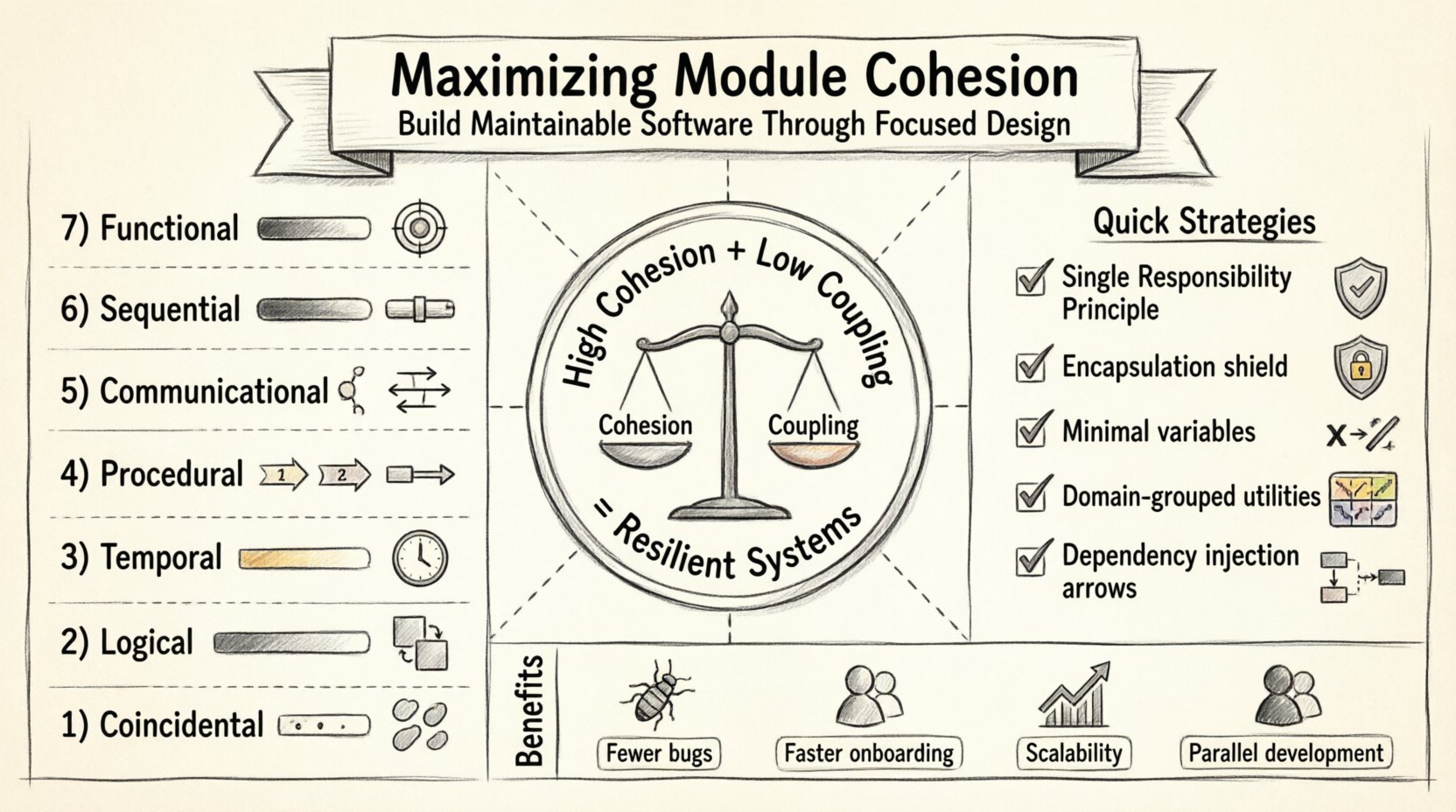
Not all cohesion is created equal. Theoretical models categorize cohesion into a spectrum ranging from the weakest forms to the strongest. Understanding these categories helps in diagnosing design issues.
1. Coincidental Cohesion (Lowest)
This is the weakest form of cohesion. It occurs when elements are grouped together simply because they happen to be in the same place, without any logical relationship.
- Example: A utility class that contains a method to calculate a tax rate, another to format a date, and a third to validate an email address.
- Issue: These functions are unrelated. Changing the tax logic should not affect the date formatter.
2. Logical Cohesion
Elements are grouped because they perform similar actions or handle the same type of data, but they are not functionally related.
- Example: A
ReportGeneratorclass that can generate PDF reports, HTML reports, and CSV reports based on a flag. - Issue: The logic for generating PDFs is distinct from CSV logic. Mixing them increases complexity.
3. Temporal Cohesion
Elements are grouped because they are executed at the same time or during the same phase of a process.
- Example: A class that initializes resources, loads configuration, and connects to a database at startup.
- Issue: While these happen together, they are distinct lifecycle phases. Initialization failures in one area should not break the configuration loading.
4. Procedural Cohesion
Elements are grouped because they are executed in a specific sequence to complete a task.
- Example: A method that reads a file, parses the content, and saves it to a database.
- Issue: The steps are sequential, but the logic might be too complex for one class if the file format changes.
5. Communicational Cohesion
Elements are grouped because they operate on the same set of data.
- Example: A class that manages all operations related to a
Userobject, such as fetching, updating, and deleting. - Issue: This is generally acceptable, but care must be taken that it doesn’t become a “God Object” handling too many user-related scenarios.
6. Sequential Cohesion
The output of one function is the input of the next, and they must be executed in order.
- Example: A pipeline where data is fetched, transformed, and then validated.
- Issue: This is stronger than procedural cohesion because the data flow is explicit.
7. Functional Cohesion (Highest)
All elements within the module contribute to a single, well-defined function. This is the ideal state.
- Example: A class dedicated solely to calculating interest rates based on principal and time.
- Benefit: Highly reusable, easy to test, and simple to understand.
📊 Comparing Cohesion Levels
| Type | Strength | Reliability | Maintainability |
|---|---|---|---|
| Coincidental | Low | Low | Poor |
| Logical | Low | Medium | Fair |
| Temporal | Medium | Medium | Good |
| Procedural | Medium | Medium-High | Good |
| Communicational | High | High | Very Good |
| Functional | Maximum | Maximum | Excellent |
🛠 Strategies for Maximizing Cohesion
Achieving high cohesion is not a one-time task but a continuous practice during development and refactoring. Several strategies can help you align your modules with high cohesion principles.
1. Adhere to the Single Responsibility Principle (SRP)
The SRP states that a class should have only one reason to change. This is the cornerstone of high cohesion.
- Action: Review every class. Ask: “If I change this requirement, does this class need to change?”
- Action: If the answer is yes for multiple distinct requirements, split the class.
2. Encapsulate Implementation Details
Keep the internal workings of a module hidden. This forces the module to define a clear interface, which naturally filters out unrelated data.
- Private Fields: Only expose data that is necessary for the module’s function.
- Public Methods: Define methods that represent actions, not data accessors (getters/setters) unless necessary for data transfer objects.
3. Limit the Number of Instance Variables
Every instance variable should be essential to the primary responsibility of the module. If a variable is only used by one method, it might indicate that the logic belongs elsewhere or the variable is unnecessary.
4. Refactor Utility Classes
Utility classes are notorious for logical and coincidental cohesion. Avoid dumping unrelated helper functions into a single static container.
- Group by Domain: Instead of a
MathUtils, haveGeometryMathandStatisticsMath. - Move to Entities: If a function operates on a specific entity, move it into that entity as a method.
5. Use Dependency Injection
Injecting dependencies allows a module to receive the objects it needs without creating them internally. This decouples the module from concrete implementations.
- Benefit: The module focuses on its logic, not on locating resources.
- Benefit: It becomes easier to swap out implementations during testing.
🧪 The Impact on Testing
High cohesion has a profound effect on how software is tested. Modules with high cohesion are inherently easier to verify.
- Isolation: You can test a cohesive module in isolation without mocking complex external systems.
- Clarity: Test cases clearly map to the specific behavior of the module.
- Stability: Tests are less likely to break when unrelated features are added to the system.
When a module is highly cohesive, a failure in a test points directly to a defect within that module. In low-cohesion systems, a test failure might obscure the root cause because the module is entangled with many other concerns.
🚧 Common Pitfalls to Avoid
Even with the best intentions, design can drift toward low cohesion over time. Be vigilant against these common patterns.
The God Object
This is a class that knows too much or does too much. It often ends up managing data from multiple subsystems.
- Sign: The class has hundreds of methods and thousands of lines of code.
- Fix: Break it down into smaller, specialized classes.
Over-Abstraction
Creating interfaces or base classes that are too generic can lead to confusion. If a class implements an interface that forces it to have methods it doesn’t use, cohesion suffers.
- Fix: Ensure interfaces are specific to the client’s needs (Interface Segregation Principle).
Global State
Using global variables or static state to share data between modules creates hidden dependencies.
- Fix: Pass state explicitly through method parameters or constructor injection.
🔍 Measuring Cohesion
While there are formal metrics for cohesion, practical experience often guides design better than numbers alone. However, understanding the metrics helps in benchmarking.
- LCOM (Lack of Cohesion in Methods): Measures how many methods share data with each other. A high LCOM indicates low cohesion.
- McCabe Complexity: While primarily for cyclomatic complexity, high complexity often correlates with low cohesion.
Use these tools to flag potential issues, but rely on code reviews and readability to make final decisions.
🔄 Refactoring for Cohesion
Refactoring is the process of improving the internal structure of code without changing its external behavior. Here is a step-by-step approach to improving cohesion.
- Identify the Module: Select a class that feels bloated or confusing.
- Analyze Responsibilities: List all the methods and data fields.
- Categorize: Group methods by the specific task they perform.
- Extract: Create new classes for distinct groups.
- Move Data: Move instance variables to the new classes where they belong.
- Update References: Ensure other modules interact with the new classes correctly.
- Test: Run the full test suite to ensure behavior is preserved.
📈 Benefits of High Cohesion
Investing time in maximizing cohesion yields tangible returns throughout the software lifecycle.
- Reduced Bug Density: Defects are easier to locate when code is compartmentalized.
- Faster Onboarding: New developers understand the system faster when modules have clear, singular purposes.
- Scalability: Adding new features is easier when you can plug into existing, well-defined modules.
- Parallel Development: Teams can work on different modules with less risk of merge conflicts.
🎯 Conclusion
Maximizing cohesion within your modules is a fundamental practice for building sustainable software systems. It transforms code from a collection of instructions into a structured, maintainable architecture. By focusing on functional cohesion, avoiding common anti-patterns, and continuously refactoring, you ensure your codebase remains robust against change.
Remember that cohesion is not just about code structure; it is about communication. Clear modules communicate their intent clearly to the developer reading them. Prioritize clarity and purpose in every design decision you make. This disciplined approach leads to software that stands the test of time.