Software systems evolve. Requirements change, features expand, and bug reports accumulate. In this landscape, the quality of the underlying code structure determines whether a project thrives or stagnates. Object-Oriented Analysis and Design (OOAD) provides the framework for building robust systems, but applying its concepts correctly requires discipline. This is where the SOLID principles come into play. These five design rules serve as a guide for writing code that is easier to understand, flexible, and maintainable over time. 🧩
Many developers understand the basics of classes and objects but struggle with the architectural decisions that lead to brittle software. The goal here is not to write code that looks perfect on day one, but to create a foundation that withstands the test of time. We will explore each principle in depth, examining the theory, practical application, and the impact on the development lifecycle. By the end of this guide, you will have a clear roadmap for refactoring existing codebases or designing new ones with stability in mind. 🚀
📚 What are SOLID Principles?
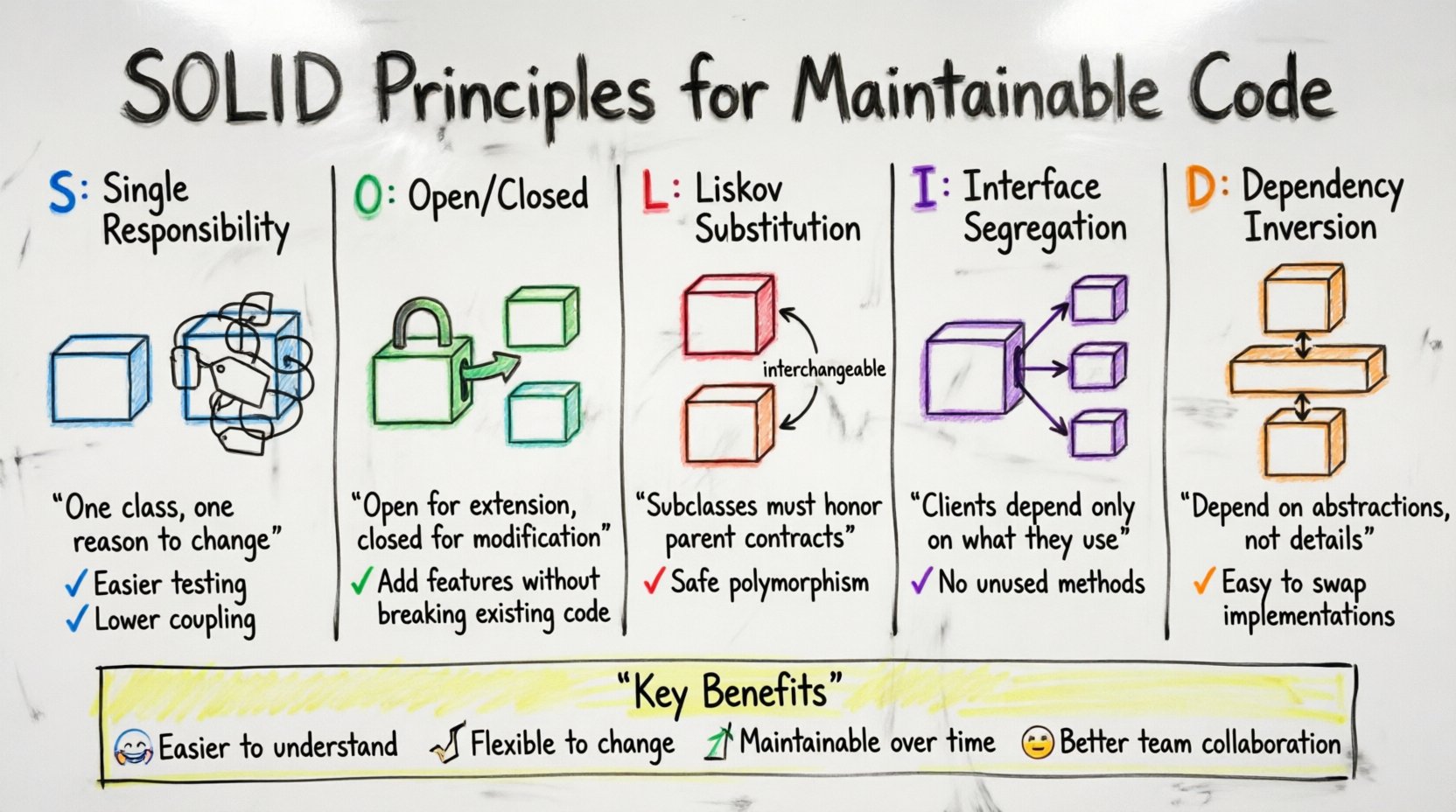
SOLID is an acronym representing five design principles intended to make software designs more understandable, flexible, and maintainable. It was introduced by Robert C. Martin, though the core concepts have roots in earlier object-oriented literature. These principles are not rigid laws but rather guidelines that help developers navigate complex design decisions. When applied correctly, they reduce coupling and increase cohesion within a system.
Think of SOLID as a checklist for architectural health. If a module violates these rules, it often becomes a source of technical debt. The principles address common pitfalls such as:
- Classes that do too much work
- Code that breaks when new features are added
- Dependencies that are too tightly coupled to specific implementations
- Interfaces that force clients to depend on methods they do not need
Adopting these practices requires a shift in mindset. It is about thinking about relationships between components rather than just individual behaviors. Below is a breakdown of what each letter represents:
- S: Single Responsibility Principle
- O: Open/Closed Principle
- L: Liskov Substitution Principle
- I: Interface Segregation Principle
- D: Dependency Inversion Principle
🎯 S: Single Responsibility Principle
The Single Responsibility Principle (SRP) states that a class should have one, and only one, reason to change. This does not mean a class should have only one method. It means a class should encapsulate a single functionality or concern. When a class takes on multiple responsibilities, it becomes fragile. A change in one area of business logic might inadvertently break another area because they share the same code structure. 🧱
Why SRP Matters
Consider a class responsible for processing orders. If this same class also handles saving data to a database and sending email notifications, it violates SRP. Why? Because the reasons to change are different. You might change the email format without touching the database logic. If they are coupled, you risk breaking data persistence while updating the notification system.
Benefits of adhering to SRP include:
- Reduced Complexity: Smaller classes are easier to read and understand.
- Easier Testing: You can test specific behaviors in isolation without mocking unrelated functionality.
- Lower Coupling: Changes in one module do not ripple through unrelated modules.
Refactoring for SRP
To refactor a class violating SRP, identify the distinct responsibilities. Extract each responsibility into its own class. For example, separate the logic for calculating tax from the logic for persisting the order. This separation allows you to modify the tax calculation algorithm without worrying about the database layer. It also allows you to swap the persistence mechanism (e.g., from a file system to a cloud storage) without altering the core business logic. 🔧
🔓 O: Open/Closed Principle
The Open/Closed Principle (OCP) states that software entities should be open for extension but closed for modification. This seems contradictory at first glance. How can something be open yet closed? The meaning is that you should be able to add new functionality without changing the existing source code. You achieve this through abstraction and polymorphism. 🧬
The Cost of Modification
When you modify existing code to add a feature, you introduce the risk of introducing regressions. You are touching code that has likely been tested and trusted. Every line you change is a potential source of new bugs. OCP encourages you to write code where new behaviors are added by creating new classes or modules that implement existing interfaces or inherit from existing base classes.
Implementing OCP
Use abstract classes or interfaces to define the contract. Then, create concrete implementations for specific scenarios. If you need to support a new payment method, do not add an if statement to the existing payment processor. Instead, create a new payment processor class that implements the payment interface. The main system code interacts with the interface, remaining unaware of the specific implementation details. This keeps the core logic closed to modification.
Key strategies for OCP:
- Use polymorphism to defer behavior to subclasses.
- Inject dependencies rather than instantiating them directly.
- Utilize design patterns like Strategy or Factory to manage variations in behavior.
🔄 L: Liskov Substitution Principle
The Liskov Substitution Principle (LSP) is often considered the most abstract of the group. It states that objects of a superclass should be replaceable with objects of its subclasses without breaking the application. In simpler terms, if a program uses a base class, it should be able to use any subclass of that base class without knowing the difference. This ensures that inheritance is used correctly and does not violate expectations. ⚖️
Violating LSP
A common violation occurs when a subclass overrides a method and changes the preconditions or postconditions. For example, if a parent class has a method that guarantees a return value is never null, a subclass should not return null. If a subclass does so, any code relying on the parent class contract will crash when it receives the subclass object. This breaks the trust established by the type system.
Ensuring Substitutability
To maintain LSP, subclasses must uphold the contract of the parent class. This includes:
- Maintaining invariants defined in the parent class.
- Not throwing new exceptions that were not declared in the parent.
- Ensuring that side effects are consistent with the parent class behavior.
If a subclass cannot fulfill the contract of the parent, it should not inherit from that parent. Instead, it might share a common base class or rely on composition. Composition is often a safer alternative to inheritance when the “is-a” relationship is weak or problematic. 🛡️
🔌 I: Interface Segregation Principle
The Interface Segregation Principle (ISP) states that no client should be forced to depend on methods it does not use. Instead of one large, monolithic interface, it is better to have multiple smaller, specific interfaces. This prevents classes from implementing methods they do not need. When a class implements an interface, it is promising to support all methods in that interface. ISP ensures this promise is meaningful and not burdensome. 🧩
The Problem with Fat Interfaces
Imagine a Worker interface with methods for work(), eat(), and sleep(). If you create a Robot class that implements Worker, it must implement eat() and sleep(). This makes no sense for a robot. If you force the robot to implement these methods, you create empty or dummy implementations that clutter the codebase. This is a violation of ISP.
Designing Client-Specific Interfaces
To fix this, split the Worker interface into smaller interfaces. Create a Workable interface for the work method and a Eatable interface for the eating method. The robot implements only Workable, while a human employee might implement both. This keeps the contracts clean and relevant to the implementer. Clients only depend on what they actually use.
Benefits of ISP:
- Cleaner Code: Interfaces are focused and easy to document.
- Flexibility: Classes can implement only the behaviors they require.
- Reduced Dependencies: Changes to one interface do not affect clients of another interface.
🔗 D: Dependency Inversion Principle
The Dependency Inversion Principle (DIP) states that high-level modules should not depend on low-level modules. Both should depend on abstractions. Furthermore, abstractions should not depend on details; details should depend on abstractions. This decouples the system, allowing high-level business logic to remain stable regardless of changes in low-level implementation details like database access or external API calls. 🏗️
Breaking the Hierarchy
Traditionally, high-level modules (business logic) call low-level modules (utility classes, database drivers). This creates a hard dependency. If you switch from a SQL database to a NoSQL database, the high-level module must change. DIP inverts this relationship. The high-level module depends on an interface (abstraction). The low-level module implements that interface. The high-level module never knows which specific implementation is being used.
Practical Application
To apply DIP, define an interface that represents the service the high-level module needs. For example, a StorageService interface. The high-level module injects an implementation of StorageService via a constructor or setter. The actual implementation (e.g., FileStorage or CloudStorage) is wired up at the application boundary. This makes the system testable because you can inject a mock implementation during unit testing. It also makes the system adaptable to infrastructure changes without rewriting business logic. 🔌
📊 Comparing SOLID vs. Non-SOLID Structures
Understanding the difference between code that follows SOLID principles and code that does not can clarify their value. The following table highlights key differences in structure and maintainability.
| Aspect | Non-SOLID Structure | SOLID Structure |
|---|---|---|
| Modifiability | Requires changing existing code to add features. | Adds new classes without touching existing code. |
| Coupling | High coupling between classes and implementations. | Low coupling through abstraction and interfaces. |
| Testing | Difficult to isolate components for testing. | Components are isolated and easy to mock. |
| Complexity | Classes often contain multiple responsibilities. | Classes are focused and have single responsibilities. |
| Scalability | Harder to scale as logic becomes entangled. | Easy to scale by adding new modules. |
🛠️ Practical Refactoring Strategies
Refactoring an existing codebase to adhere to SOLID principles can be daunting. It is rarely possible to rewrite everything at once. A gradual approach is often more effective. Here is a strategy for introducing these principles incrementally:
- Start with SRP: Identify classes that are too large or have multiple reasons to change. Extract methods or classes to isolate responsibilities.
- Introduce Interfaces: Wherever you see concrete dependencies, look for opportunities to introduce interfaces. This sets the stage for DIP and OCP.
- Inject Dependencies: Move object creation out of the class logic. Use constructors or dependency injection containers to provide dependencies.
- Review Subclasses: Check your inheritance hierarchy. Ensure subclasses truly adhere to the contract of their parents (LSP).
- Split Interfaces: If a class implements an interface with many unused methods, consider breaking the interface into smaller parts (ISP).
Remember that refactoring is not about perfection. It is about improving the code incrementally. You can refactor one module at a time as you add new features to it. This is known as the Boy Scout Rule: leave the code cleaner than you found it. 🔍
⚠️ Common Pitfalls to Avoid
While SOLID principles are powerful, misapplying them can lead to over-engineering. It is important to understand the context in which these principles apply.
Over-Abstraction
Creating an interface for every single class is not necessary. If a class is simple and unlikely to change, adding an interface just to satisfy a principle adds unnecessary complexity. Use common sense. Only introduce abstraction where there is a need for variation or multiple implementations. 🧐
Inheritance Abuse
Inheritance is a powerful tool, but it should not be used for code reuse alone. If you find yourself inheriting just to get a method, consider composition instead. Deep inheritance hierarchies can make it hard to understand the flow of data and logic. Keep hierarchies shallow and meaningful.
Ignoring the Business Context
Not every project requires strict adherence to all five principles. For a quick prototype or a script that will be used once, the overhead of SOLID might outweigh the benefits. Evaluate the lifecycle and stability requirements of your project before investing time in extensive refactoring. ⚖️
🌟 Long-term Benefits
Investing time in SOLID principles pays off significantly as the project grows. The initial development might feel slower because you are designing abstractions and interfaces. However, as the codebase expands, the speed of development increases. You can add features faster because you are not afraid to touch existing code. The fear of breaking things diminishes when the architecture is robust.
- Onboarding: New developers can understand the system faster because the structure is logical and consistent.
- Debugging: Issues are easier to isolate because components are decoupled.
- Refactoring: Moving code or changing logic becomes a safe operation.
- Collaboration: Teams can work on different modules with less risk of conflicts.
The journey toward maintainable code is continuous. It requires vigilance and a commitment to quality. By internalizing these principles, you build systems that are not just functional today, but viable for years to come. The code you write today is the legacy you leave for the team tomorrow. Make it count. 🌱
📝 Summary of Implementation
To recap, implementing SOLID principles involves a deliberate shift in how you design classes and their interactions. Focus on single responsibilities to reduce complexity. Design for extension rather than modification to protect existing code. Ensure subclasses behave like their parents to maintain trust. Segregate interfaces to prevent unnecessary dependencies. And invert dependencies to decouple high-level logic from low-level details.
These principles form a cohesive framework for Object-Oriented Analysis and Design. They are not isolated rules but interconnected concepts that reinforce each other. When applied together, they create a resilient architecture capable of adapting to change. Start small, be consistent, and let the structure guide your development process. 🏗️